Your body is regulating its internal conditions all day long without conscious effort. If the room gets hotter, you sweat. If you sprint up stairs, your breathing rate rises. If you lose water, you feel thirsty. These are not random reactions. They are coordinated responses that help keep internal conditions within ranges that cells need in order to function. Life depends on stability, but that stability is not passive. It is actively maintained.
Homeostasis is the ability of an organism to maintain a relatively stable internal environment even when external conditions change. Humans are not the only organisms that do this. Fish regulate salt and water balance. Plants adjust the opening and closing of stomata to regulate water loss. Mammals regulate temperature, water, and many other conditions. The exact target range may vary among organisms, but the principle is the same: living things survive by keeping critical conditions from drifting too far away from normal.
To study this scientifically, we do more than memorize examples. We ask questions, collect data, and look for evidence. A well-designed investigation can show that when a condition changes, the body responds in a way that moves the system back toward balance. That is what feedback mechanisms do, and it is what you will learn to investigate.
The internal environment of an organism includes factors such as temperature, water balance, heart rate, breathing rate, and levels of dissolved substances in body fluids. Cells work best within limited ranges. If temperature rises too much, enzyme-controlled processes may become disrupted or stop functioning properly. If the body loses too much water, blood volume drops and normal transport becomes more difficult. If internal conditions swing wildly, the organism cannot function efficiently.
Homeostasis is the maintenance of relatively stable internal conditions in an organism.
Feedback mechanism is a process in which a change in a system triggers a response that influences that same system.
Negative feedback reduces the original change and tends to restore balance.
Positive feedback increases the original change and pushes a process forward until a specific outcome is reached.
"Relatively stable" does not mean perfectly constant. Your heart rate is not identical every minute, and body temperature can change slightly during the day. Homeostasis means conditions stay within a healthy range. Think of it like a car staying near the speed limit while going uphill or downhill. The speed may shift a little, but a control system keeps it from drifting too far.
Many homeostatic responses happen automatically. You do not decide to dilate blood vessels near the skin on a hot day, and you do not consciously regulate most changes in breathing during exercise. These adjustments are part of the organism's structure and function, shaped to support survival, growth, and normal activity.
[Figure 1] A feedback mechanism usually includes several parts working together: a change in conditions called a stimulus, a receptor that detects the change, a control center that processes information, and an effector that produces a response. The response then affects the original condition.
In negative feedback, the response opposes the change. If body temperature rises, the body activates cooling responses such as sweating and increased blood flow near the skin. If body temperature falls, the body may trigger shivering and reduced blood flow near the skin. In both cases, the response moves the condition back toward its normal range.
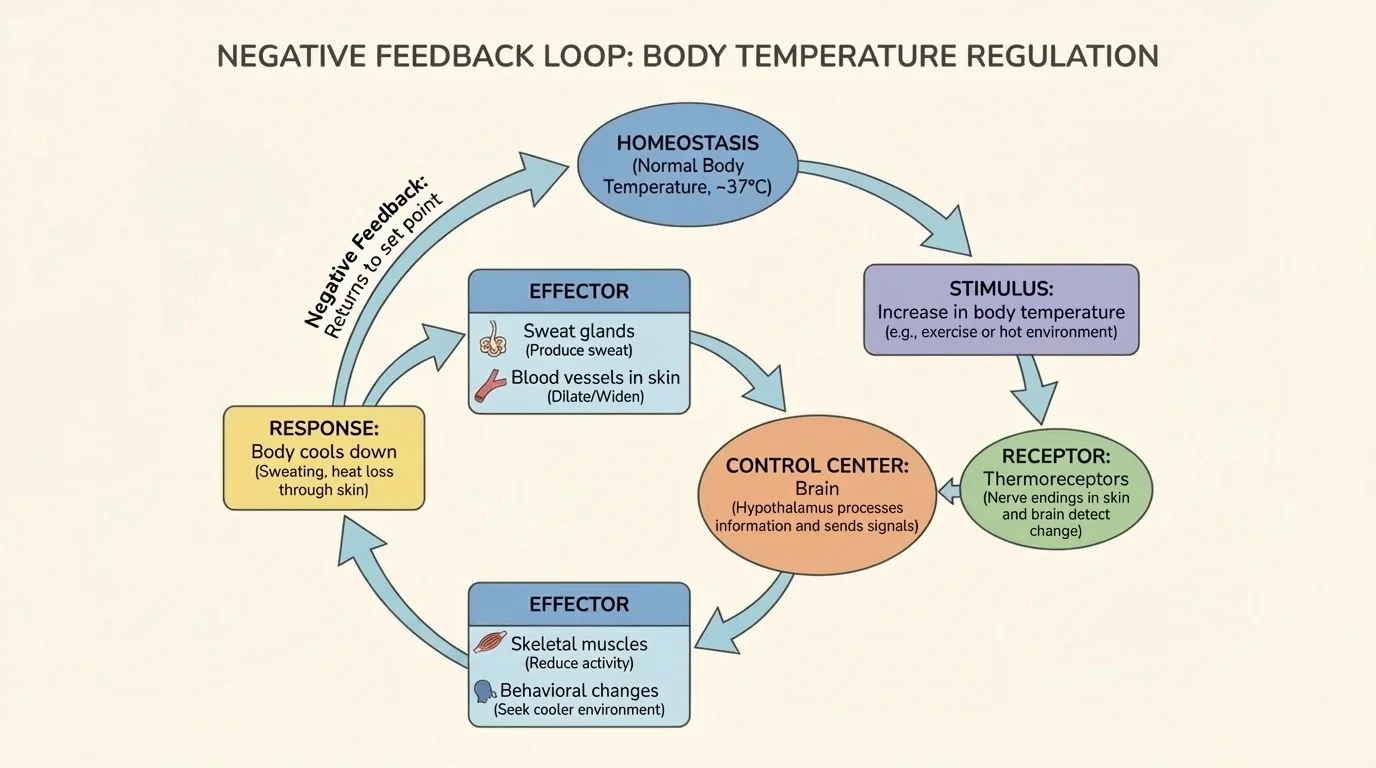
Negative feedback is the main type of feedback involved in maintaining homeostasis because it stabilizes internal conditions. It acts like a correction system. A thermostat is a familiar analogy: if the temperature drops below the set point, the heater turns on; if it rises above the set point, the heater turns off. Biological systems are more complex than machines, but the general logic is similar.
Positive feedback is different. Instead of reversing a change, it amplifies it. This kind of feedback is useful when the body needs to drive a process rapidly toward completion. Examples include labor contractions during childbirth and blood clotting after injury. Positive feedback is not usually used to maintain a steady internal condition over long periods. Instead, it helps complete a specific event.
The difference matters in investigations. If your goal is to provide evidence that feedback mechanisms maintain homeostasis, you will most often investigate negative feedback because homeostasis is about stability. Later, when you compare systems, [Figure 1] still helps because it highlights the basic loop structure found in many regulating systems.
[Figure 2] A strong investigation begins with a question that can be tested with observable data. An organized plan moves from question to hypothesis to procedure to data analysis. For this topic, a good question asks how a measurable body condition changes and then returns toward normal after a disturbance.
Examples of testable questions include: How does heart rate change during exercise and recovery? How does skin temperature respond when a person moves from a cool room to a warm room? How does breathing rate change after physical activity and then return toward resting levels? These questions focus on visible body-level responses, which fits the scope of the topic.
Every investigation needs clearly identified variables. The independent variable is the factor you deliberately change. The dependent variable is what you measure. Controlled variables are conditions kept as constant as possible so they do not confuse the results.
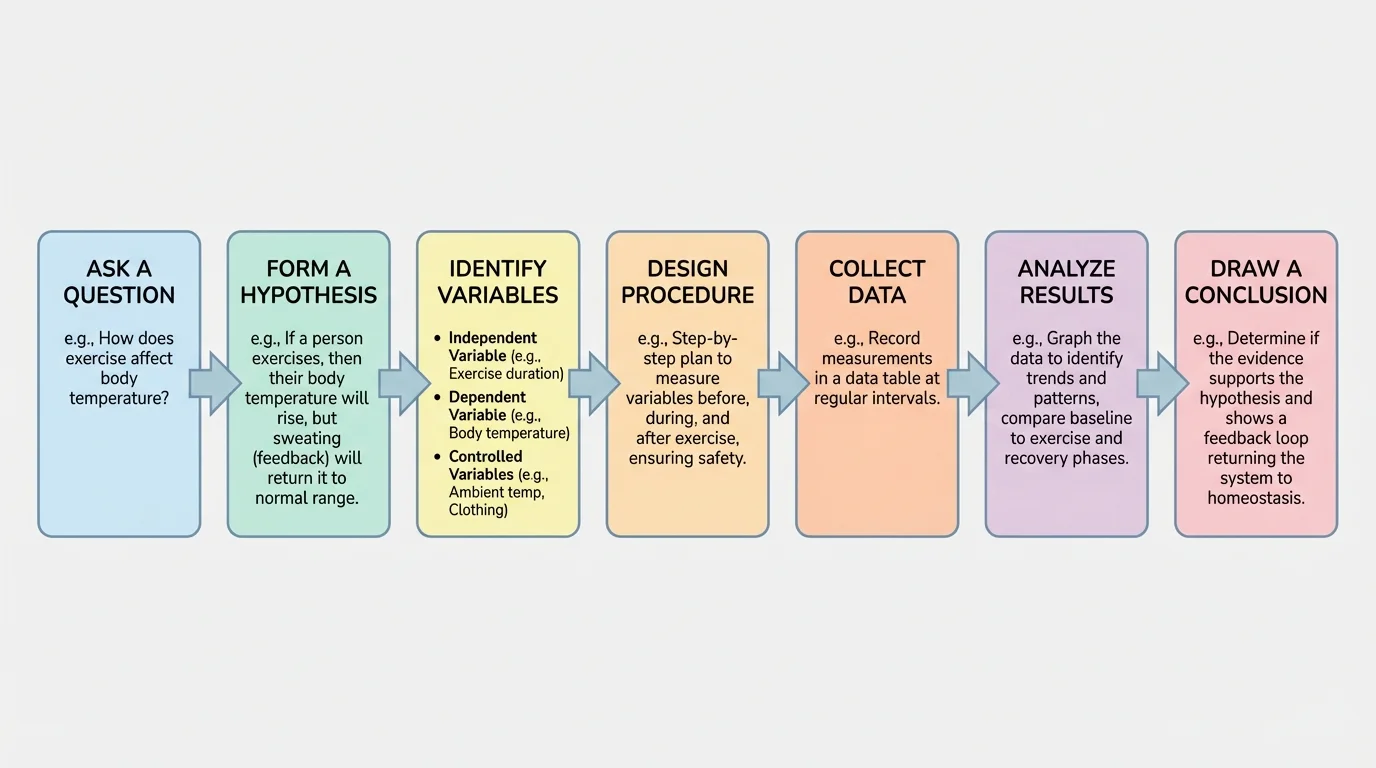
Suppose you investigate heart rate recovery after exercise. The independent variable might be time after exercise or exercise intensity. The dependent variable is heart rate, measured in beats per minute. Controlled variables could include the same participant, same exercise duration, same room conditions, same timing method, and same measurement technique.
Good investigations also include repeated trials and enough data points to reveal a pattern. One pulse reading tells very little. Multiple readings taken before activity, immediately after activity, and during recovery provide stronger evidence. Scientists look for trends, not isolated numbers.
Safety and ethics matter. Do not design investigations that push anyone beyond safe physical limits. Students with medical conditions should not be pressured to participate in exercise-based procedures. Informed consent, teacher supervision, and noninvasive measurements are essential. A scientifically useful investigation is also a responsible one.
When scientists test a claim, they do not simply look for any change. They ask whether the evidence connects a specific cause to a measured effect while controlling other factors. That same logic applies here.
A hypothesis should be specific and based on biological reasoning. For example: If a student performs moderate exercise for two minutes, then heart rate will increase and then gradually decrease toward the resting level during recovery, because negative feedback helps the body restore balance after increased activity. This predicts both the disturbance and the return toward normal.
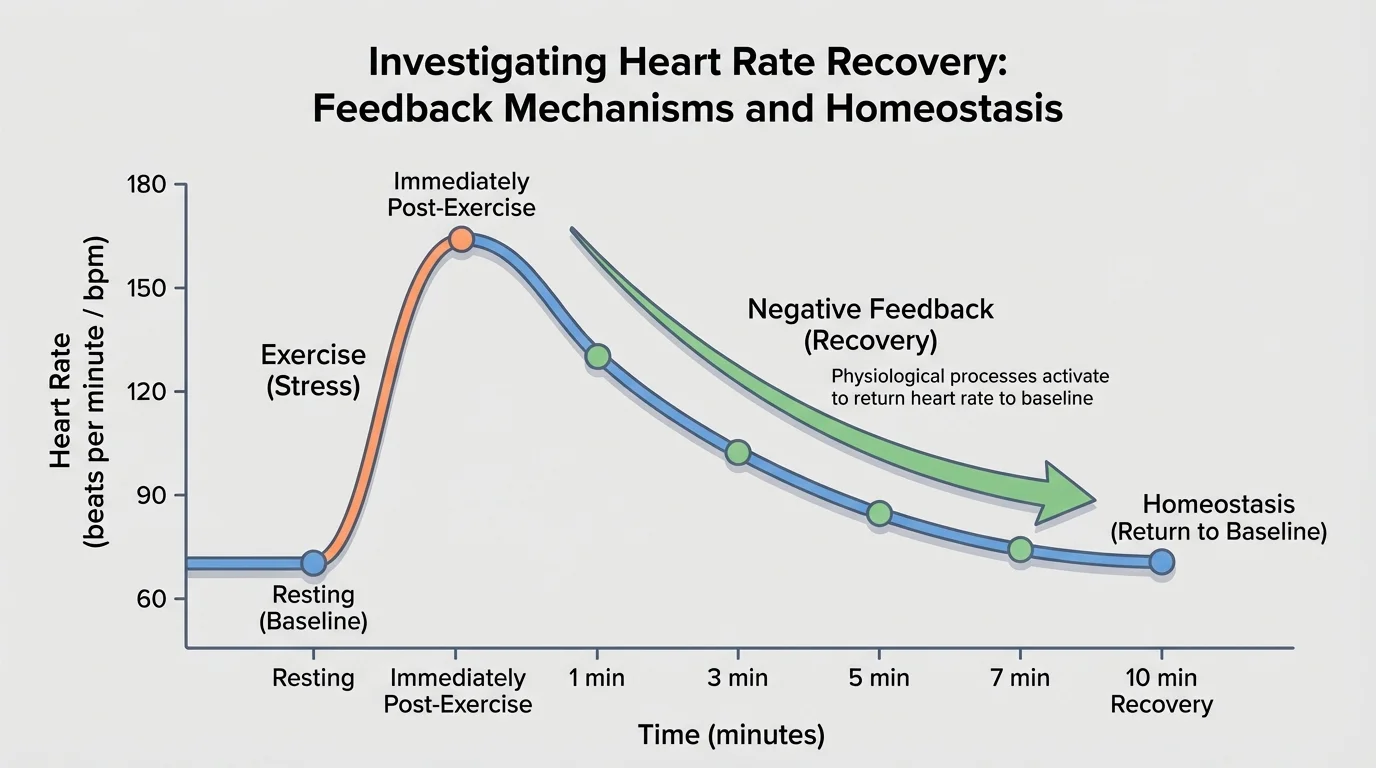
One of the clearest ways to study homeostasis is to measure pulse before and after exercise. The changing pattern over time, as [Figure 3] shows, provides evidence that the body responds to disturbance and then moves back toward a stable condition. This does not mean the heart rate instantly returns to its exact starting value. It means recovery trends toward normal.
In this investigation, students can measure resting heart rate, complete a short period of moderate exercise such as stepping in place, and then record heart rate at regular intervals during recovery. Because the body needs more oxygen during activity, heart rate rises. After exercise ends, negative feedback mechanisms help reduce heart rate toward resting levels.
Model investigation: heart rate recovery
Step 1: Ask the question and state the hypothesis
Question: How does moderate exercise affect heart rate, and how does heart rate change during recovery?
Hypothesis: If exercise increases the body's demand for oxygen, then heart rate will rise during activity and gradually return toward resting rate afterward.
Step 2: Identify variables
Independent variable: time relative to exercise.
Dependent variable: heart rate in beats per minute.
Controlled variables: same exercise duration, same participant posture during recovery, same room conditions, same measuring method.
Step 3: Collect data
Example data from one participant: resting heart rate = \(72\) beats per minute, immediately after exercise = \(132\), after \(1\) minute = \(110\), after \(2\) minutes = \(96\), after \(3\) minutes = \(84\).
Step 4: Calculate change
The increase from rest to immediately after exercise is \(132 - 72 = 60\) beats per minute.
The decrease from immediately after exercise to \(3\) minutes later is \(132 - 84 = 48\) beats per minute.
Step 5: Interpret the pattern
The heart rate rises when the body is stressed by exercise and then falls toward the resting level during recovery. That downward trend is evidence of a stabilizing feedback response.
This example does not prove every part of the control system directly, but it provides measurable evidence that the organism responds in a way that helps restore internal balance.
If you graph the data, the pattern is easier to see: a sharp rise followed by a gradual decline. A recovery graph does not need to return fully to resting value within a few minutes to support the idea of homeostasis. What matters is the direction of change and the consistent movement back toward baseline.
To improve reliability, collect data from several participants or repeat the trial on different days. Then calculate class averages. For example, if three resting heart rates are \(70\), \(74\), and \(76\), the mean resting heart rate is \(\dfrac{70 + 74 + 76}{3} = \dfrac{220}{3} \approx 73.3\) beats per minute. Averages reduce the effect of unusual single readings.
This kind of investigation is also relevant to athletics. Fitness coaches often monitor how quickly heart rate recovers after exercise because faster recovery can indicate efficient regulation. The same logic is used in sports science to study how the body responds to stress and returns toward balance.
[Figure 4] Another useful investigation examines how the body responds when environmental conditions change. A careful setup helps isolate the effect of moving between cooler and warmer surroundings. Skin temperature can be measured with a safe digital thermometer or infrared thermometer, depending on available equipment.
In a simple version, a student rests in one room for several minutes, has skin temperature measured at the same body location, then moves to a room with a different temperature and is measured again at regular intervals. The body does not just passively match the environment. It activates responses such as changing blood flow near the skin and sweating or conserving heat, depending on the direction of change.
To keep the investigation fair, use the same measurement site each time, such as the forehead or forearm. Keep clothing similar, measure after equal waiting times, and avoid adding exercise during the test. These controls make it more likely that temperature changes are due to room conditions rather than unrelated factors.
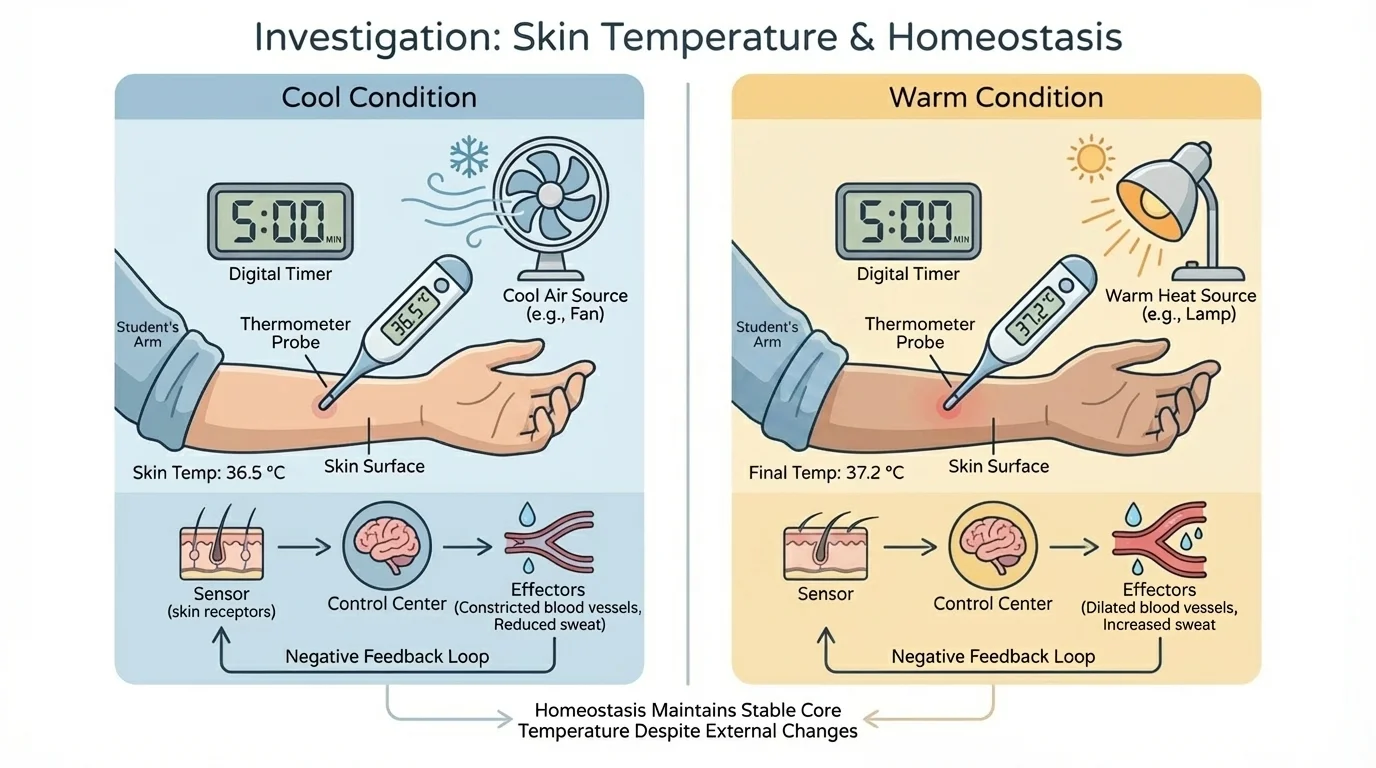
Data may show that skin temperature changes after entering a different environment and then stabilizes as the body adjusts. This investigation is less direct than measuring core body temperature, but it still provides evidence that the body responds to external change in ways connected to temperature regulation.
Model investigation: skin temperature response
Step 1: Form the question
How does skin temperature change when a person moves from a cool environment to a warm environment?
Step 2: Predict the response
If environmental temperature increases, then skin temperature may rise at first and then level off as the body activates heat-loss responses.
Step 3: Record sample data
Example readings at one skin site: cool room = \(31.2 ^\circ\textrm{C}\), after \(2\) minutes in warm room = \(32.0 ^\circ\textrm{C}\), after \(4\) minutes = \(32.5 ^\circ\textrm{C}\), after \(6\) minutes = \(32.4 ^\circ\textrm{C}\).
Step 4: Analyze the change
The initial increase is \(32.5 - 31.2 = 1.3 ^\circ\textrm{C}\). The slight leveling from \(32.5\) to \(32.4 ^\circ\textrm{C}\) suggests the response is not simply continuing upward without limit.
The evidence supports the idea that the body responds dynamically rather than remaining unchanged when surroundings shift.
Thermoregulation has obvious real-world importance. Workers in hot factories, athletes in outdoor competitions, and people experiencing heat waves all rely on feedback systems that help maintain safe internal conditions. When these systems are overwhelmed, heat illness can occur.
Collecting measurements is only the start. Science depends on interpreting data carefully. Look for trends across time, compare experimental conditions, and ask whether the pattern matches your hypothesis. In homeostasis investigations, the strongest evidence usually shows three parts: a disturbance, a response, and movement toward recovery.
Tables are often useful for organizing measurements before graphing them.
| Time Point | Heart Rate (beats per minute) | Interpretation |
|---|---|---|
| Resting | \(72\) | Baseline condition |
| Immediately after exercise | \(132\) | Disturbance from baseline |
| \(1\) minute recovery | \(110\) | Return toward baseline begins |
| \(2\) minutes recovery | \(96\) | Further recovery |
| \(3\) minutes recovery | \(84\) | Closer to baseline |
Table 1. Sample heart rate data showing disturbance and recovery during a homeostasis investigation.
When drawing a conclusion, connect the data to the biological claim. A weak conclusion says, "Heart rate changed." A strong conclusion says, "Heart rate increased after exercise and then decreased toward resting level over time, which supports the claim that a negative feedback mechanism helps restore homeostasis after physical activity." Evidence must support the reasoning.
Scientists also consider limitations. Maybe pulse counting was inconsistent. Maybe some participants had just consumed caffeine. Maybe room temperature varied between trials. These do not automatically invalidate results, but they affect confidence. Naming possible errors and suggesting improvements is part of good science.
What counts as evidence? Evidence is not just any observation. It is data that directly relates to the claim being tested. For homeostasis, useful evidence shows that after a measurable internal condition is disturbed, the organism responds in a way that brings the condition back toward a normal range.
You can strengthen conclusions by comparing repeated trials, using averages, and graphing recovery over time. If several students show the same pattern of increase and return toward baseline, the argument becomes stronger. Reproducibility matters because biology includes variation from person to person.
Sometimes data do not match your prediction exactly. That does not mean the investigation failed. It may reveal that the system is more complex, that the disturbance was too weak, or that a control variable was not held constant. Unexpected results are still scientifically useful when analyzed honestly.
Feedback and homeostasis are not just classroom ideas. Doctors monitor body temperature, heart rate, breathing rate, hydration status, and blood pressure because these measurements reveal whether regulatory systems are maintaining safe conditions. A patient whose vital signs drift too far from normal may need urgent treatment.
In environmental biology, scientists study how animals respond to changing temperatures, drought, or salinity. In agriculture, farmers monitor water balance and heat stress in livestock. In sports medicine, trainers examine recovery time after exertion. Each of these applications depends on the same principle you test in a school investigation: stable internal conditions support life, and feedback mechanisms help maintain them.
Elite endurance athletes often recover their heart rate more quickly after exercise than untrained individuals. That faster recovery reflects how efficiently their bodies adjust after a disturbance.
Engineers also borrow ideas from biology. Automatic control systems in technology, such as thermostats, cruise control, and some medical monitoring devices, use feedback logic similar to living systems. The biological version is far more complex, but the shared principle is powerful: detect change, respond, and adjust.
This topic focuses on investigating feedback at the level of the organism and body systems. You are expected to explain how measurable responses such as changes in heart rate, breathing rate, or temperature help maintain internal stability. You are not expected to investigate interactions at the molecular level or explain detailed biochemical pathways.
For example, it is appropriate to say that the body regulates blood glucose through feedback and that glucose level is part of homeostasis. It is not necessary here to explain how specific molecules are produced or the detailed cellular chemistry involved. The emphasis is on planning investigations, collecting evidence, and reasoning from observable data.
That focus is an important scientific skill. Biology is not only about knowing facts; it is also about knowing how to test claims with evidence. When you investigate homeostasis, you are studying life as an active, regulated process rather than a static condition.
