Every second, the Sun releases more energy than human civilization has used in all of history combined. That energy lights your day, drives weather, powers photosynthesis, and makes nearly every food chain on Earth possible. Yet the Sun is not an eternal lamp. It has a beginning, a long stable stage, and a future that will look very different from what we see now.
To understand the Sun scientifically, we do not just memorize facts about it. We build a model: a simplified explanation based on evidence. A scientific model of the Sun connects what is happening deep inside its interior to what happens at Earth's surface, from sunlight warming oceans to solar energy charging a calculator. It also connects the Sun to other stars, because the Sun is one example of a much larger pattern in the universe.
This lesson focuses on two linked ideas. First, the Sun's energy comes from nuclear fusion in its core. Second, the Sun has a life span that follows the evolutionary path of a star with its mass. By combining these ideas, we can explain both why the Sun shines now and how it will change over billions of years.
The Sun is a star, but it feels different from the stars you see at night because it is so much closer to Earth. Its average distance from Earth is about 1 astronomical unit, or about 150 million kilometers. Even at that enormous distance, sunlight reaches Earth in only about 8 minutes. Without the Sun's steady energy input, Earth would be a frozen, dark world.
Solar energy affects daily life in ways that are easy to overlook. Weather systems form because the Sun heats Earth unevenly. Plants capture solar energy and store it in chemical bonds. Solar panels convert part of incoming radiation into electrical energy. Even fossil fuels represent ancient solar energy stored by organisms long ago. Understanding the Sun is therefore not only an astronomy topic; it is also part of understanding Earth systems.
Recall that energy can change form and move from one place to another. The Sun does not send "heat" to Earth in the same way a stove warms a pot by direct contact. Instead, energy leaves the Sun as radiation and travels through space, where there is no material medium like air.
A good model of the Sun must explain three things clearly: where the energy starts, how it moves outward, and how the Sun changes over time. Those ideas are connected because the Sun's long-term stability depends on the balance between gravity pulling inward and energy from the core pushing outward.
[Figure 1] The Sun has layers, and each layer plays a different role. At the center is the core, where temperature and pressure are high enough for fusion to occur. Surrounding the core are regions through which energy moves outward before finally escaping from the visible surface, called the photosphere.
The Sun is made mostly of hydrogen and helium. Gravity pulls this enormous mass inward, compressing the central region. That compression helps create the extreme conditions needed in the core. Even though the surface looks blazing hot to us, the core is much hotter than the surface, and that temperature difference matters because the energy starts in the center and gradually moves outward.
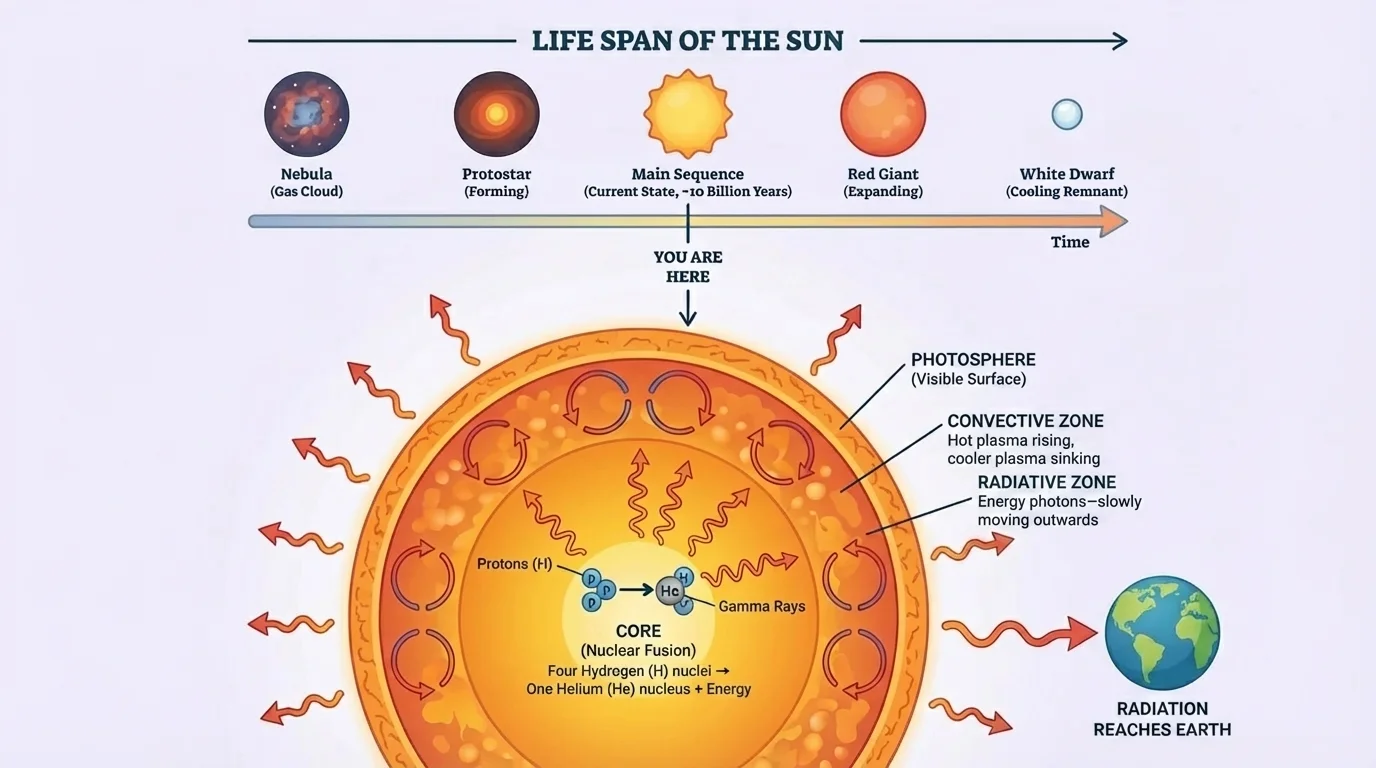
The Sun is not a solid object like Earth. It is a huge sphere of hot plasma, a state of matter in which particles are so energetic that atoms do not remain intact in the same way they do in cool gases. Its diameter is about 109 times Earth's diameter, and its mass is about 333,000 times Earth's mass. These huge values help explain why the Sun's gravity is strong enough to compress its center so intensely.
Star means a massive, glowing sphere of hot plasma held together by gravity and producing energy in its interior. Stellar evolution is the long-term change in a star's structure and appearance over time. Spectrum means the pattern of light separated by wavelength, which can reveal a star's composition, temperature, and motion.
Because the Sun is the nearest star, astronomers can study it in much greater detail than distant stars. At the same time, observations of many other stars help scientists place the Sun into a broader category: a medium-mass, main-sequence star. That classification is important when we model its past and future.
Deep inside the Sun, fusion combines small nuclei into larger ones, releasing energy. At this level, the key idea is simple: in the Sun's core, hydrogen is gradually converted into helium, and some mass is transformed into energy. We do not need the subatomic details to understand the overall process.
The relationship between mass and energy is expressed by Einstein's equation:
\(E = mc^2\)
Here, energy depends on mass and the speed of light. Because the speed of light is very large, even a small amount of mass can correspond to a huge amount of energy. This helps explain how the Sun can shine steadily for billions of years.
Numeric example: why a little mass can mean a lot of energy
Step 1: Use the equation
Take a small mass, such as \( m = 0.001 \textrm{ kg} \). The speed of light is about \( c = 3.0 \times 10^8 \textrm{ m/s} \).
Step 2: Substitute
\( E = 0.001 \times (3.0 \times 10^8)^2 \)
Step 3: Calculate
\( E = 0.001 \times 9.0 \times 10^{16} = 9.0 \times 10^{13} \textrm{ J} \)
A very small mass corresponds to an enormous amount of energy, which is why fusion is such a powerful energy source.
The Sun does not explode because fusion and gravity are in balance for most of its life. Gravity pulls matter inward, while energy produced in the core creates pressure that pushes outward. This balance allows the Sun to remain relatively stable during its long main-sequence stage. When that balance changes, the Sun's structure will change too.
A common misconception is that the Sun is "burning" like wood or gasoline. Chemical burning involves reactions between atoms and releases far less energy than fusion. The Sun's energy source is not ordinary fire. It is fusion in the core, and that difference is essential for understanding the Sun's long life span.
[Figure 2] The energy released in the core does not leap instantly from the Sun to your skin. Instead, it follows a long path, moving from the core through inner solar layers, leaving the photosphere as electromagnetic radiation, and then traveling across space to Earth.
Inside the Sun, energy first moves outward through dense interior regions. In one region, energy is transferred mainly by radiation. In another outer region, hot material rises and cooler material sinks, a process called convection. Eventually, energy reaches the photosphere and escapes into space as light and other forms of electromagnetic radiation.
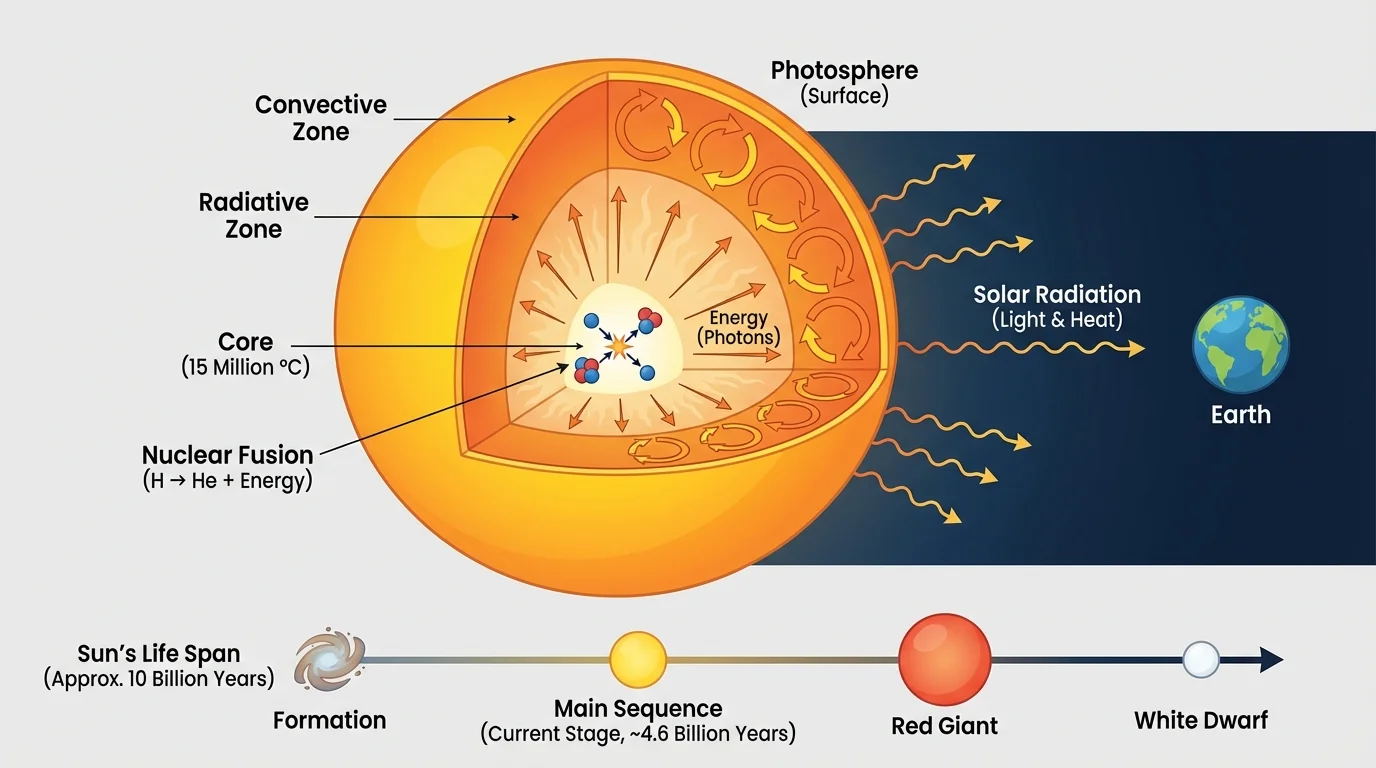
Electromagnetic radiation includes visible light, infrared, ultraviolet, and other wavelengths. Earth receives only a tiny fraction of the total energy the Sun emits, but that tiny fraction is still enough to power climate systems and support life. The visible portion is the sunlight your eyes detect, while infrared contributes strongly to warming.
Because radiation travels at the speed of light, we can estimate the travel time from the Sun to Earth. If the distance is about \(1.5 \times 10^{11} \textrm{ m}\) and the speed of light is \(3.0 \times 10^8 \textrm{ m/s}\), then
\[t = \frac{d}{v} = \frac{1.5 \times 10^{11}}{3.0 \times 10^8} = 5.0 \times 10^2 \textrm{ s}\]
\(5.0 \times 10^2 \textrm{ s}\) is 500 seconds, which is about \(\dfrac{500}{60} \approx 8.3\) minutes. So when you see sunlight, you are seeing the Sun as it was a little over 8 minutes ago.
The sunlight hitting your face has already completed a remarkable journey. After being released from the Sun's surface, it takes only about 8 minutes to cross space to Earth, but the energy may have taken a much longer path through the Sun's interior before escaping.
This outward flow of energy is one reason the Sun remains relevant to technology. Solar panels depend on incoming radiation. Satellite systems must account for solar activity. The energy chain from core to Earth links astrophysics directly to weather, communications, and power generation.
[Figure 3] A model of the Sun's life span tracks a sequence of stages over billions of years. The Sun did not always exist in its current form, and it will not remain a stable main-sequence star forever. Its changes are part of stellar evolution.
The Sun formed from a cloud of gas and dust called a nebula. Gravity pulled material together into a developing object called a protostar. As the protostar contracted, its center became hotter and denser. When conditions in the core became sufficient for sustained fusion, the star entered the main-sequence stage.
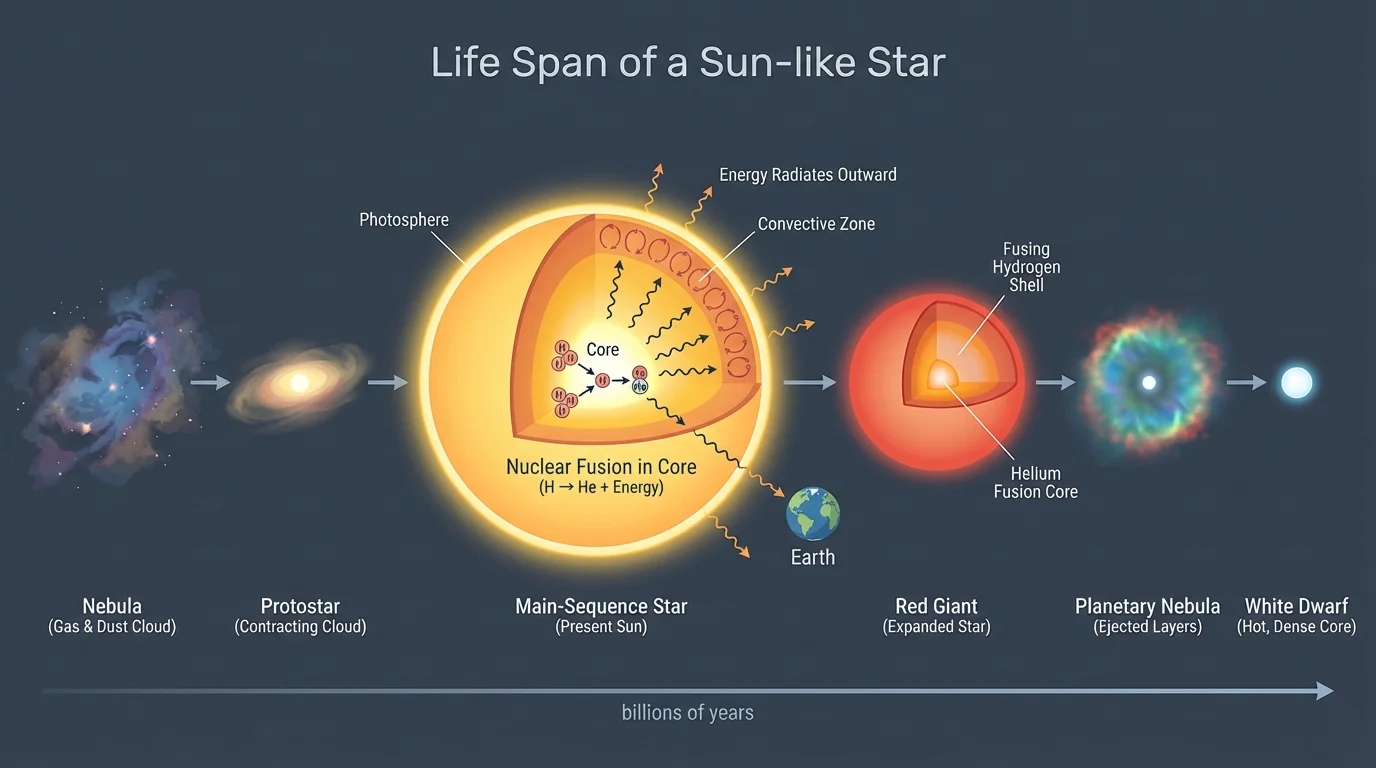
The Sun is currently in the main sequence, the longest and most stable stage of its life. During this stage, hydrogen fusion in the core supplies energy steadily. The Sun is about 4.6 billion years old and is expected to remain in this stage for roughly 10 billion years total, so it is approximately midway through its main-sequence lifetime.
Eventually, the hydrogen in the core will become depleted. The core will contract, and the outer layers will expand. The Sun will become a red giant, much larger than it is now. Its surface will be cooler than it is today, which is why it appears redder, but the star as a whole will be much bigger and more luminous.
Later, the Sun will shed its outer layers, forming a glowing shell of gas called a planetary nebula. The remaining hot core will become a white dwarf, a small, dense stellar remnant that no longer produces energy by core fusion. Over an even longer timescale, that remnant will cool gradually.
Why mass determines a star's future
A star's mass strongly affects its temperature, brightness, lifetime, and final stages. Very massive stars live faster and die more dramatically. The Sun, however, is not massive enough to end as a supernova. Its path leads instead to the red giant stage, planetary nebula, and white dwarf.
The stages are not random events. They follow from changes in the balance among gravity, pressure, temperature, and available fuel. That is why a life-span model of the Sun is more than a timeline; it is a cause-and-effect explanation.
[Figure 4] A scientific model is only useful if it matches evidence. Astronomers cannot watch the Sun live its full billions-of-years life span, but they can study light from many stars and compare stars at different stages. Light is especially powerful evidence because a star's color, brightness, and spectrum reveal important physical information.
A spectrum can show which elements are present in a star. For example, spectral lines reveal strong evidence for hydrogen and helium in stars like the Sun. Spectra also help astronomers estimate temperature, because hotter stars tend to emit more strongly at shorter wavelengths and appear bluer, while cooler stars appear redder.
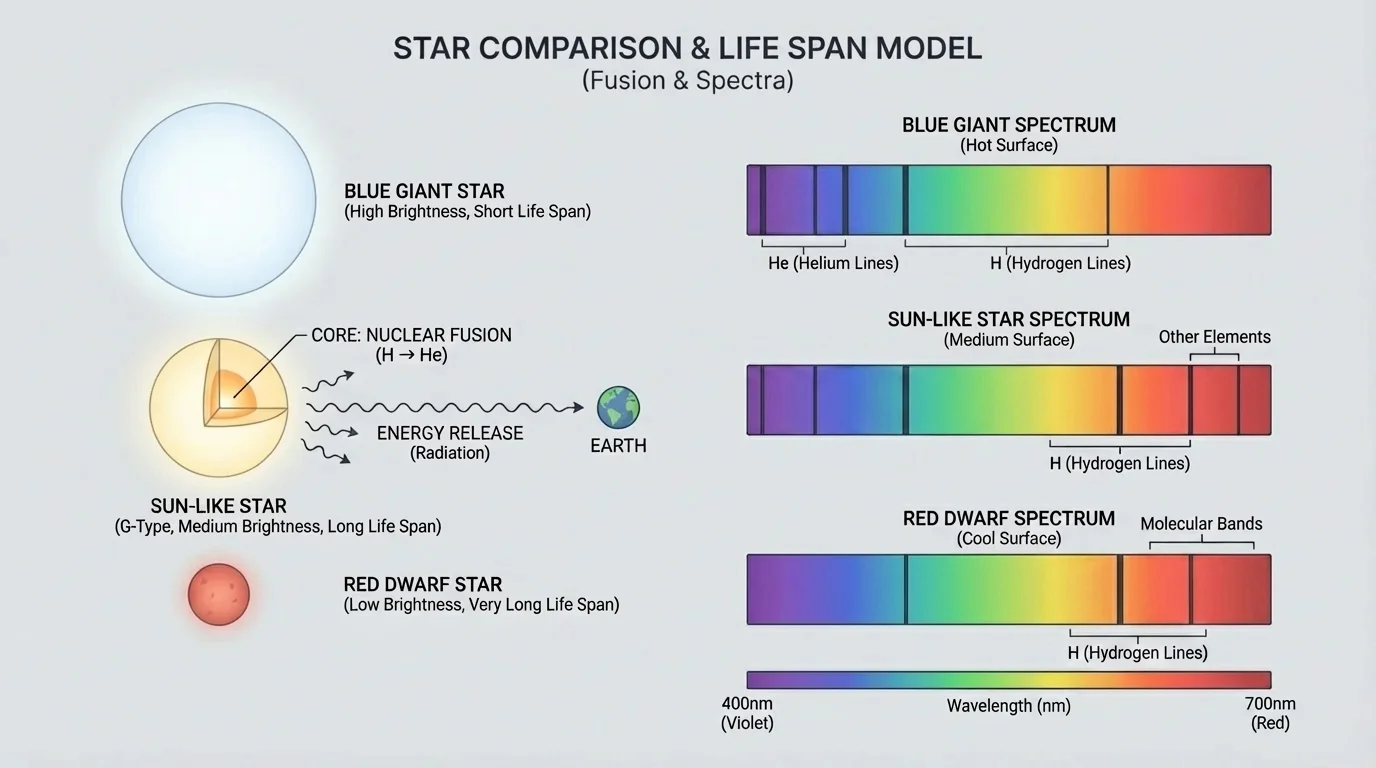
Brightness is another clue. A star's apparent brightness depends partly on distance, but when astronomers account for distance they can compare true luminosities. This helps place stars into categories and life stages. A red giant and a white dwarf can have very different sizes and luminosities even if both are related to the evolution of Sun-like stars.
Star clusters provide especially strong evidence because many stars in a cluster formed at about the same time. If stars of different masses in one cluster are observed in different stages, astronomers can test ideas about how mass influences stellar evolution. By studying many clusters, scientists build confidence in models of how stars change over time.
The same methods are used beyond our Sun. Spectra can also reveal motion through Doppler shifts, and brightness measurements help estimate distance. This means that the model of the Sun is part of a larger astronomy toolkit used to understand stars throughout the galaxy. These comparisons support the idea that the Sun follows the well-established path of a medium-mass star.
| Stage | Main Energy Situation | General Appearance | Evidence Used by Astronomers |
|---|---|---|---|
| Nebula | No sustained core fusion yet | Cloud of gas and dust | Images of star-forming regions, spectra of gas |
| Protostar | Heating during contraction | Young forming star | Infrared observations, surrounding dust |
| Main sequence | Stable hydrogen fusion in core | Relatively steady star | Spectra, luminosity, temperature |
| Red giant | Core conditions changing after main fuel declines | Expanded, cooler surface, brighter | Color, luminosity, stellar size estimates |
| Planetary nebula | Outer layers expelled | Glowing gas shell | Imaging and emission spectra |
| White dwarf | No ongoing core fusion | Small, dense, hot remnant | Spectra, faint luminosity, temperature |
Table 1. Major stages in the evolution of a Sun-like star and the evidence astronomers use to identify them.
Although astronomy often involves enormous scales, a few simple calculations can strengthen the model. We already estimated the sunlight travel time to Earth. Another important idea is that radiation spreads out as it moves away from a source. The intensity decreases with distance according to an inverse-square relationship:
\[I \propto \frac{1}{d^2}\]
This means that if distance from a light source doubles, the received intensity becomes (\(\dfrac{1}{2^2}\) = \(\dfrac{1}{4}\) of the original. If a spacecraft moved from 1 astronomical unit to 2 astronomical units from the Sun, the sunlight intensity would drop to one-fourth of what it was.
Numeric example: fraction of the Sun's main-sequence lifetime completed
Step 1: Identify values
The Sun's age is about \(4.6\) billion years, and its main-sequence lifetime is about \(10\) billion years.
Step 2: Form the ratio
\(\dfrac{4.6}{10} = 0.46\)
Step 3: Convert to percent
\(0.46 \times 100 = 46\%\)
The Sun has completed about 46% of its expected main-sequence lifetime.
These calculations are simple, but they connect numbers to scientific meaning. The Sun is not near the end of its stable life, yet it is not newly formed either. Quantitative reasoning helps make the life-span model more precise.
Knowledge about the Sun matters on Earth right now. Solar panels are designed based on how electromagnetic radiation interacts with materials. Farmers and climate scientists track solar input because sunlight affects temperature, evaporation, and growing seasons. Engineers protect satellites and power systems from solar activity that can disturb electronics and communications.
Studying stellar evolution also matters beyond immediate technology. It tells us how stars create conditions for planetary systems and how the universe changes over time. The elements found in later generations of stars and planets are connected to the life cycles of earlier stars. While the Sun is only one star, understanding it helps scientists interpret the broader history of the cosmos.
"We are made of star-stuff."
— Carl Sagan
This idea is not just poetic. The study of stars links directly to the origin of matter in the universe and to the conditions that make planets and life possible. The Sun's role in our lives is immediate, but its scientific importance reaches far beyond Earth.
One misconception is that the Sun is permanent and unchanging. In reality, all stars evolve. Another is that the Sun's energy comes from ordinary burning. As discussed earlier, fusion is very different from a chemical flame. A third misconception is that the Sun will explode like a massive star in a supernova. The Sun does not have enough mass for that kind of ending.
It is also important not to confuse visible sunlight with all solar radiation. The Sun emits a broad range of wavelengths. Earth's atmosphere blocks some of them and allows others through, which affects life and technology. Finally, remember that models are evidence-based explanations, not guesses. The Sun's future is inferred from strong observations of other stars and from well-tested physical principles.
