The air you breathe is partly the result of ancient life. That is a remarkable idea: organisms too small to see without magnification helped transform the entire planet. Earth did not simply provide a stage on which life appeared. Over billions of years, life and Earth changed each other. To understand this, scientists build arguments from evidence preserved in rocks, fossils, chemical signatures, and patterns in climate history.
When scientists say Earth's systems and life coevolve, they mean that changes in the planet's land, water, air, and climate are linked to changes in living things. The major Earth systems are the geosphere, hydrosphere, atmosphere, and biosphere. [Figure 1] These systems interact constantly, and those interactions can push long-term changes in both Earth and life.
Earth systems are the major parts of the planet that interact: the geosphere (rock and land), hydrosphere (water), atmosphere (air), and biosphere (living things).
Argument from evidence means making a clear claim, supporting it with reliable observations or data, and explaining why the evidence supports the claim.
In Earth science, an argument is not a personal opinion. It is a structured explanation. A strong claim must be backed by evidence such as the ages of rock layers, the presence of certain fossils, chemical traces preserved in rocks, stable isotopes, mineral deposits, or atmospheric gases trapped in ancient materials. Scientists then use reasoning to connect those clues to a larger story about Earth's history.
One useful way to think about this topic is to ask two questions at the same time: How did Earth change life? and How did life change Earth? The best explanations usually answer both. That is why the idea is simultaneous coevolution, not a one-way cause-and-effect chain.
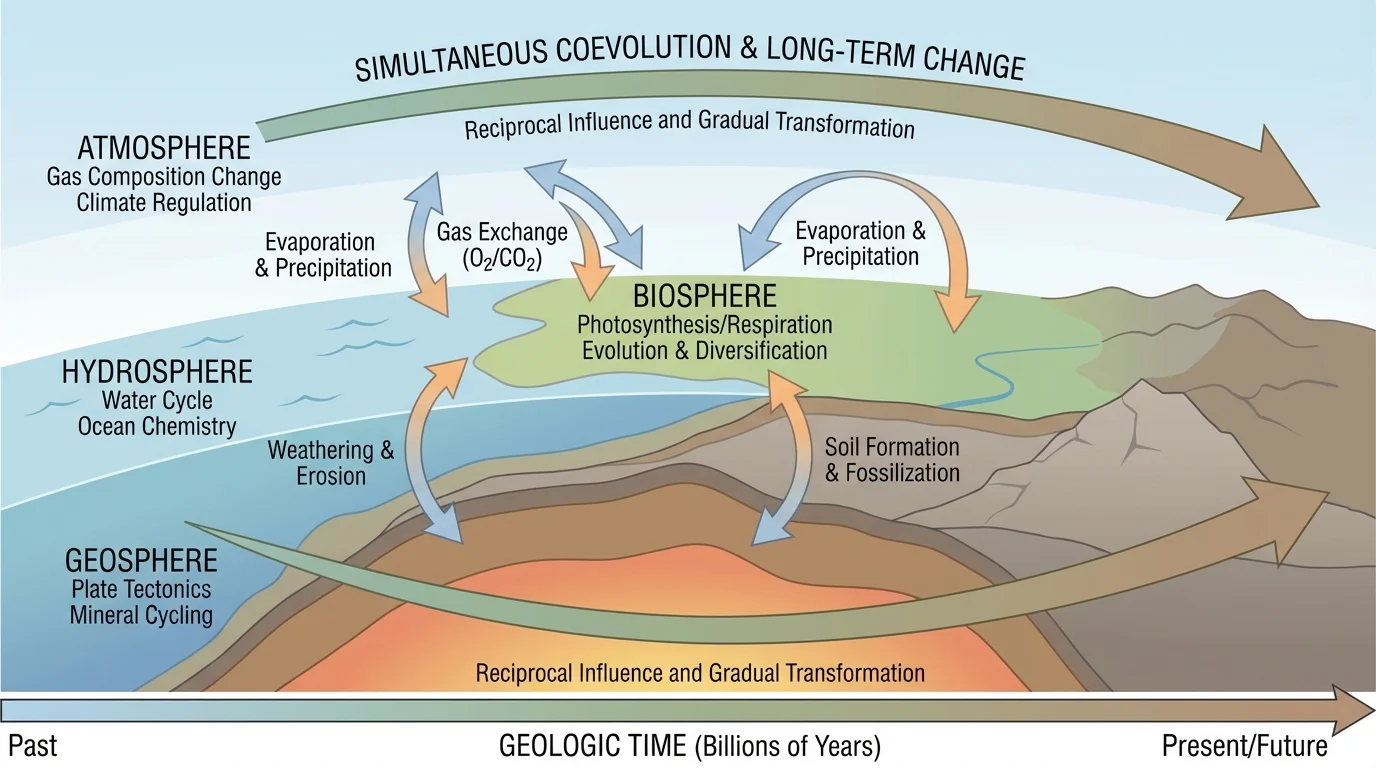
Coevolution on a planetary scale does not mean every organism interacts directly with every Earth system. Instead, it means that over long spans of time, major changes in one part of Earth are linked with major changes in life, and vice versa. For example, a shift in atmospheric composition can alter climate and ocean chemistry, which affects which organisms survive. In turn, widespread photosynthesis can change atmospheric gases.
These changes happen across geologic time, which covers Earth's roughly 4.6-billion-year history. Human lives feel long to us, but geologic processes often unfold over millions of years. That scale matters because coevolution is usually not visible in a single generation. It appears in the long record of layered rocks, mineral changes, and biological transitions.
Evidence for coevolution often comes from matching patterns. If a major environmental change and a major biological change happen at about the same time, scientists ask whether they are connected. They also check whether there is a plausible mechanism. A claim becomes stronger when several independent lines of evidence point in the same direction, a pattern we return to later with [Figure 4].
From earlier Earth science, remember that sunlight drives much of the climate system by transferring energy to the atmosphere, oceans, and land. Changes in atmospheric gases can change how much energy Earth retains, which affects temperature, ice, oceans, and habitats for life.
Because climate depends strongly on energy from the Sun and on the composition of the atmosphere, even gradual atmospheric changes can reshape conditions for life. This is one reason atmospheric history is so important in coevolution: air is not just background. It helps control temperature, weather patterns, and the chemistry of surface environments.
Early Earth was very different from the modern planet. The young atmosphere likely contained gases released by volcanoes, including water vapor, carbon dioxide, and nitrogen, with very little free oxygen. The key point is that Earth's early atmosphere was not suitable for many modern organisms.
As Earth cooled, water condensed and oceans formed. The geosphere and hydrosphere were already interacting through volcanism, weathering, and ocean chemistry. Life emerged in this changing setting, probably first in the oceans. The earliest organisms were simple and microscopic, but simple does not mean unimportant. Microbial life would eventually help alter the planet on a huge scale.
Scientists infer these conditions from ancient rocks, minerals, and isotopic patterns. Some minerals are unstable in the presence of abundant oxygen, so their presence in very old rocks suggests that oxygen levels were low when those rocks formed. This is an example of how chemistry can serve as evidence about Earth's past atmosphere.
Banded iron formations are among the most important clues to ancient atmospheric change. These layered iron-rich rocks formed when dissolved iron in the oceans reacted with oxygen, preserving evidence that oxygen was beginning to accumulate.
At this stage, a strong claim would be: early Earth had little atmospheric oxygen. The supporting evidence includes oxygen-sensitive minerals and the chemistry of ancient sedimentary rocks. The reasoning is that if free oxygen had been common, those minerals and chemical patterns would look different.
[Figure 2] One of the clearest cases of life altering Earth involves photosynthesis. Certain ancient microorganisms, especially cyanobacteria, used sunlight to make food and released oxygen as a byproduct. This is a powerful example of the biosphere changing the atmosphere, illustrated by the sequence from microbial activity to atmospheric change.
A simplified photosynthesis equation is
\[6\mathrm{CO}_2 + 6\mathrm{H}_2\mathrm{O} \rightarrow \mathrm{C}_6\mathrm{H}_{12}\mathrm{O}_6 + 6\mathrm{O}_2\]
This equation shows that carbon dioxide and water can be converted into sugars and oxygen using energy from sunlight. If a microbial population performs this process on a vast scale for millions of years, the oxygen released can build up. For a simple numeric example, if one microbial mat released \(2\) units of oxygen each day and \(500\) similar mats existed, the total would be \(2 \times 500 = 1{,}000\) units per day. Earth's real history is far larger and more complex, but the example shows how small sources can create large long-term effects.
At first, much of the oxygen produced did not stay in the atmosphere. It reacted with materials in the oceans, including dissolved iron. Only after many of these reactions occurred did oxygen begin to rise more noticeably in the air. This transition is called the Great Oxidation Event.
The Great Oxidation Event was a turning point. Oxygen made some environments less hospitable for organisms adapted to oxygen-poor conditions, but it also opened the way for new forms of metabolism and, much later, more complex life. In other words, life changed the atmosphere, and the changed atmosphere then changed which life forms could thrive.
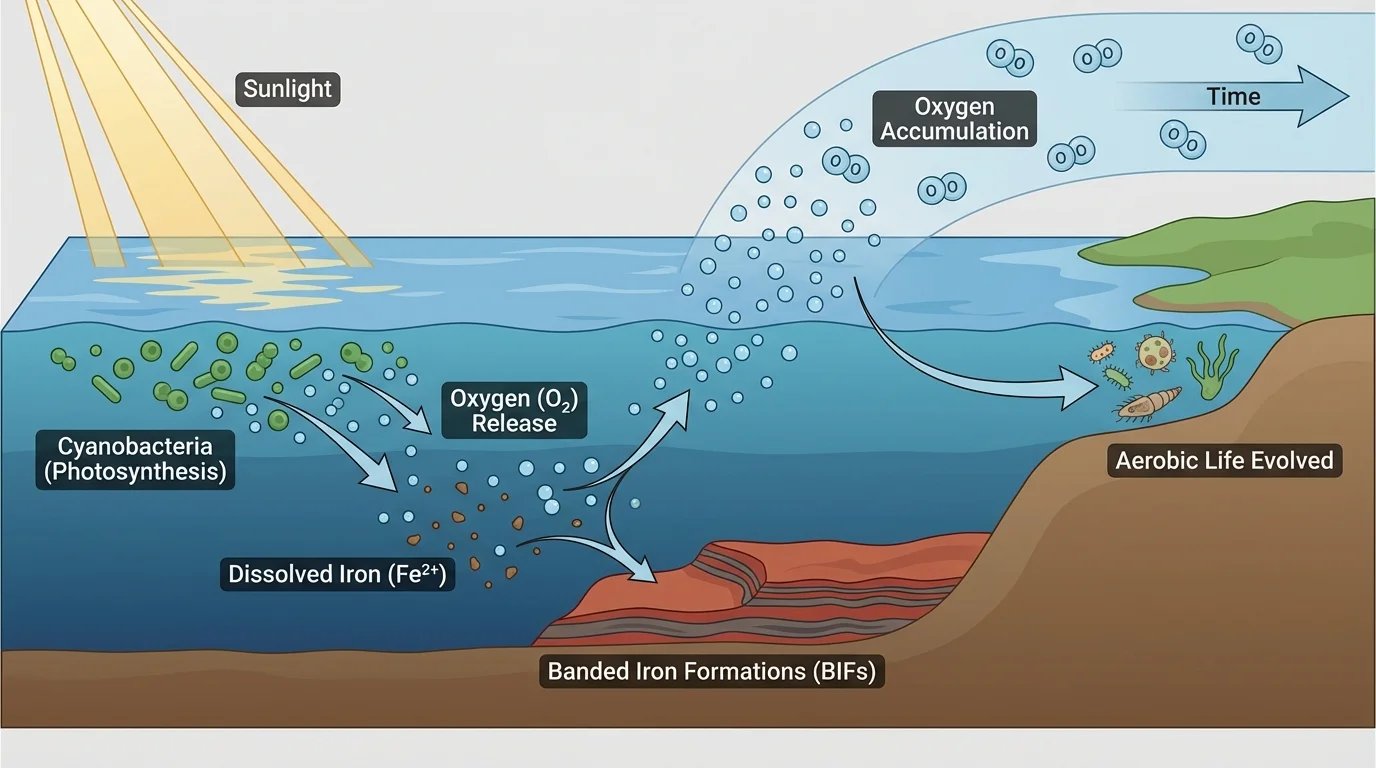
Scientists support this argument with multiple kinds of evidence: banded iron formations, changes in sulfur isotopes, and the appearance or disappearance of minerals that react with oxygen. Each piece alone is useful, but together they make a stronger case. This is the same logic of combining evidence sources that appears again in [Figure 4].
Why oxygen changed everything
Oxygen is chemically reactive. Once it became more common, it altered ocean chemistry, mineral formation, and the kinds of energy-producing reactions organisms could use. This made Earth's surface environments different from earlier periods and set the stage for later biological innovation.
This example is one of the strongest arguments for simultaneous coevolution because it clearly works in both directions. Biological activity changed atmospheric composition, and that atmospheric shift changed future pathways of evolution.
Just as life changed Earth, Earth repeatedly changed life through climate shifts, volcanic activity, mountain building, sea-level change, and changes in ocean chemistry. Organisms do not evolve in empty space. They evolve in environments that create opportunities and limits.
[Figure 3] For example, when continents move, coastlines, shallow seas, and ocean circulation patterns change. Those physical changes can alter habitats and climate. A cooler climate may expand ice, lower sea levels, and reduce warm shallow marine environments. A warmer climate may do the opposite. Such changes affect where organisms can live and which traits become advantageous.
Climate is especially important because it connects solar energy, atmosphere, oceans, and land. Global climate depends on how incoming solar radiation is absorbed, reflected, and redistributed. Atmospheric gases such as \(\textrm{CO}_2\) influence how much heat Earth retains. If atmospheric \(\textrm{CO}_2\) increases, more energy may remain in the climate system; if it decreases, global temperatures may fall. Over long timescales, these changes can reshape ecosystems and evolutionary paths.
Suppose average global temperature in a simplified model changed from \(14\,\textrm{°C}\) to \(10\,\textrm{°C}\). The change would be \(14 - 10 = 4\,\textrm{°C}\). A shift of \(4\,\textrm{°C}\) on a global average is enormous in climate terms and can move climate zones, alter precipitation, and affect which organisms survive in different regions.
These links matter in Earth history because environmental change can select for new adaptations, contribute to extinction, or open new ecological space. The fossil record captures some of these responses, even though it is incomplete.
When plants spread widely onto land, they did not merely adjust to a new environment. They also changed it. Early land plants helped break down rock, increase soil formation, and affect the movement of water and sediments. This is another major example of coevolution: Earth conditions made life on land possible, and then life on land altered Earth's surface processes.
Plant roots and associated organisms increased weathering, the breakdown of rock at Earth's surface. Weathering can remove \(\textrm{CO}_2\) from the atmosphere over long timescales because carbon becomes involved in chemical reactions that eventually lock some material into sediments and rocks. More plant cover also changed erosion patterns, sediment transport, and habitat structure.
A simple numerical illustration helps. If a process removed \(3\) units of atmospheric \(\textrm{CO}_2\) per year before widespread land plants and \(8\) units per year after plant expansion, then the increase in removal rate would be \(8 - 3 = 5\) units per year. Over very long times, even a modest increase can matter greatly for climate.
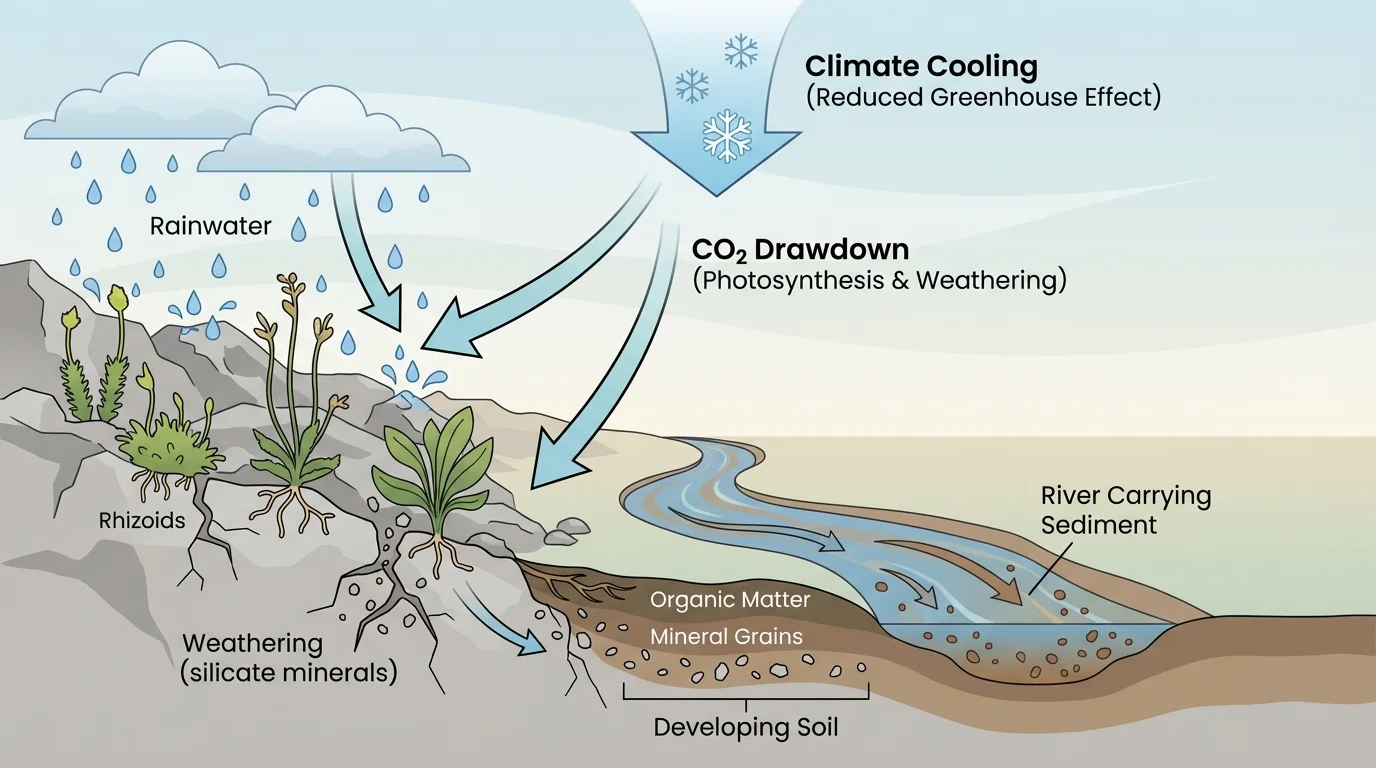
As plant life expanded, oxygen levels and carbon cycling changed as well. More stable soils and new habitats supported additional biodiversity on land. This is important evidence that the biosphere can shape the geosphere, hydrosphere, and atmosphere in ways that then affect future life.
Notice that the argument does not require explaining every mechanism between the biosphere and every other Earth system in complete detail. Instead, the key is to show, with major evidence-based examples, that life and Earth have influenced each other in significant and traceable ways.
Case study: building a claim about land plants and climate
Step 1: State a claim.
A reasonable claim is that the spread of land plants contributed to long-term changes in atmospheric composition and climate.
Step 2: Add evidence.
Evidence includes fossil remains of early land plants, signs of increased soil development, and geochemical evidence consistent with increased weathering and carbon removal.
Step 3: Explain the reasoning.
If plants increase weathering and alter carbon cycling, then widespread plant expansion can reduce atmospheric \(\textrm{CO}_2\) over long timescales, which can influence global temperature.
This argument links biological change to Earth-system change using observable evidence rather than assumption.
The same two-way pattern appeared earlier with microbial oxygen production and later with forests, soils, and changing habitats. The planetary story is not a single event but a repeated pattern of interaction.
Earth's history also includes periods when rapid environmental disruption caused major biological loss. These mass extinctions show how strongly Earth-system changes can affect life. Large volcanic eruptions, asteroid impacts, abrupt climate change, ocean acidification, and oxygen loss in oceans have all been linked to extinction events.
One famous example is the extinction at the end of the Cretaceous Period, associated with a large asteroid impact and major environmental consequences. Dust and aerosols in the atmosphere likely reduced incoming sunlight for a time, which would have disrupted photosynthesis and food webs. This reminds us that solar radiation is central to climate and biological productivity. Blocking or altering that energy flow can affect the entire system.
After extinctions, life often diversifies again, but under new Earth conditions. Recovery does not restore the exact old system. Instead, new groups expand into available ecological roles. Earth and life continue coevolving, just from a different starting point.
Some extinction intervals were associated with warming, while others involved rapid cooling or darkness from atmospheric particles. Different Earth-system disruptions can produce different climate outcomes, but each can strongly affect life.
These episodes strengthen the overall argument because they show the reverse direction clearly: changes in atmosphere, climate, oceans, or surface conditions can reorganize the biosphere on a global scale.
Scientists do not rely on a single fossil or one unusual rock. They combine many clues and look for agreement among them. Common evidence includes fossils, sediment layers, isotope ratios, mineral deposits, glacial features, and evidence of ancient atmospheric gases.
A useful format is claim, evidence, reasoning. The claim is the statement you want to support. The evidence is the data or observation. The reasoning explains why the evidence supports the claim based on accepted scientific ideas.
Consider a sample argument: Claim: photosynthetic microorganisms contributed to a major atmospheric shift. Evidence: banded iron formations, sulfur isotope changes, and later signs of increased oxygen. Reasoning: oxygen produced by photosynthesis first reacted with ocean materials, then accumulated in the atmosphere once those sinks became less dominant.
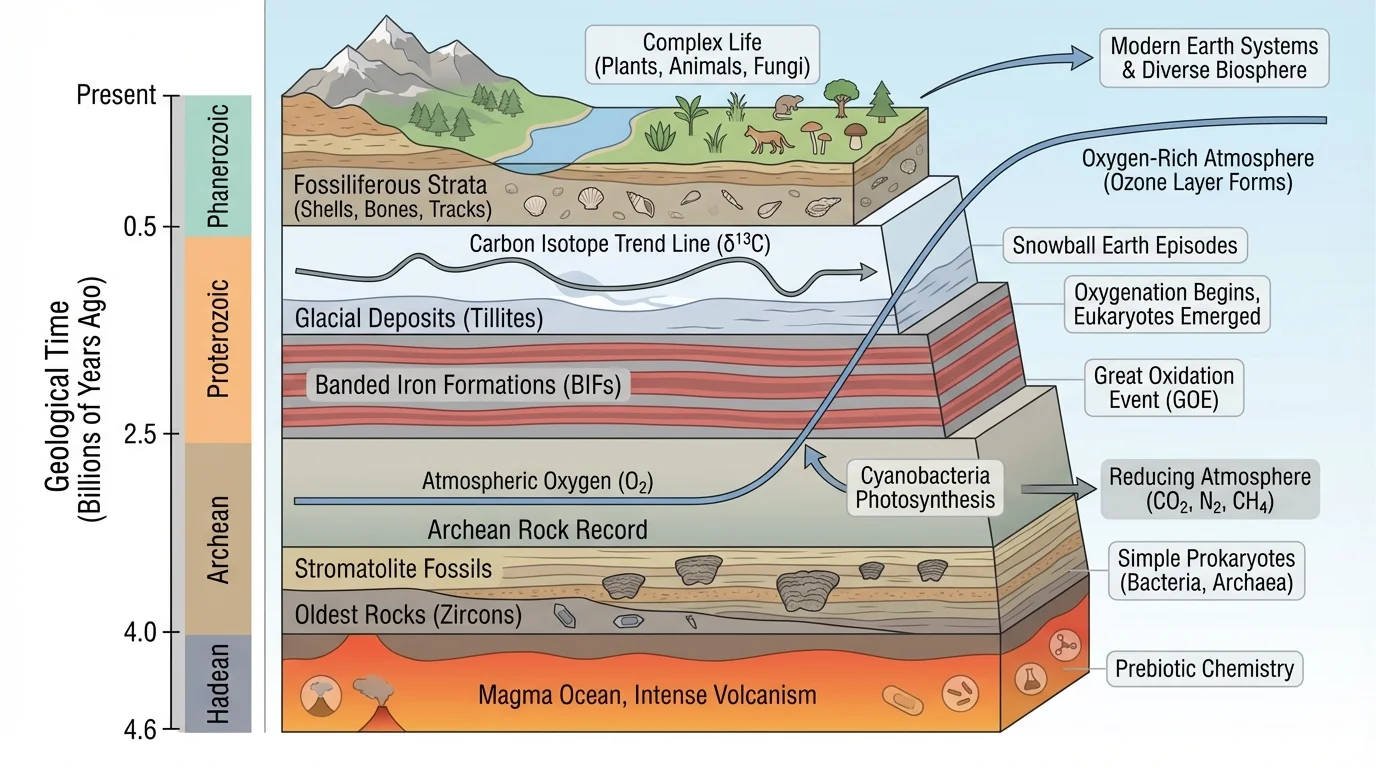
Another sample argument could focus on climate and glaciation. Claim: declining atmospheric \(\textrm{CO}_2\) contributed to global cooling at a certain time. Evidence: geochemical indicators of changing carbon levels, glacial deposits, and shifts in fossil communities. Reasoning: lower greenhouse gas levels allow more heat to escape to space, reducing global temperatures and altering habitats.
| Evidence type | What it can reveal | Example use in an argument |
|---|---|---|
| Fossils | Which organisms lived at a time | Supports claims about biological change or extinction |
| Rock layers | Sequence of events over time | Shows whether one change happened before or after another |
| Minerals | Chemical conditions of past environments | Helps infer oxygen levels or water conditions |
| Isotopes | Past temperature or chemical cycling | Supports claims about climate shifts or carbon cycling |
| Glacial deposits | Evidence of colder climates | Supports claims about major cooling events |
Table 1. Major evidence types scientists use to build arguments about coevolution between Earth systems and life.
When several independent evidence types line up in time and make sense scientifically, the argument becomes much stronger. That is why planetary history is reconstructed like a case built from many clues rather than from one dramatic discovery.
Worked example: evaluating an evidence-based claim
Claim: Rising atmospheric oxygen changed both Earth chemistry and the future evolution of life.
Step 1: Identify evidence for changing Earth chemistry.
Banded iron formations indicate oxygen reacting with dissolved iron in oceans. Oxygen-sensitive minerals also become less common in ways consistent with more oxygen in the environment.
Step 2: Identify evidence for biological consequences.
The rock record later shows conditions that could support organisms using oxygen-based metabolism more effectively.
Step 3: Connect the two with reasoning.
If life produced oxygen and oxygen altered environmental chemistry, then the changed environment would favor different biological strategies than before.
This is a strong argument because it links Earth evidence and life evidence into one coherent explanation.
Using this method keeps scientific arguments focused, testable, and grounded in evidence rather than speculation.
The deep history of coevolution matters today because modern climate is also an Earth-system problem. Solar radiation still drives the climate system, and the atmosphere still controls how much energy is retained. Oceans still store and move heat. Land surfaces still affect reflection, absorption, and water cycling. Life still influences atmospheric composition.
Scientists use global climate models to study how these interacting systems behave and predict future changes. A climate model is not a crystal ball. It is a tool that uses physical laws and observed data to simulate how Earth's atmosphere, oceans, land, and ice respond over time.
For example, if atmospheric \(\textrm{CO}_2\) rises from \(280\) parts per million to \(420\) parts per million, the increase is \(420 - 280 = 140\) parts per million. That change affects Earth's energy balance and can alter temperature, precipitation, ice extent, and habitats. Scientists compare model results with observations to improve predictions.
Earth history helps test these ideas. If we know that changes in greenhouse gases, sunlight reaching the surface, or surface reflectivity affected climate in the past, we gain confidence that these same processes matter now. Past coevolution does not give a perfect map of the future, but it shows that Earth systems and life are tightly connected over both short and long timescales.
The modern situation is especially important because human activity is now altering atmospheric composition rapidly. That means humans are affecting part of the same Earth-system network that shaped climate and life in the past. Understanding coevolution helps explain why such changes can have wide consequences.
"The present is the key to the past, but the past is also a key to the future."
— A guiding principle of Earth science
When you construct an argument about the simultaneous coevolution of Earth's systems and life, your goal is not to memorize disconnected events. Your goal is to identify patterns of interaction, support them with evidence, and explain the logic that links environmental change and biological change together.
