Your phone contains metals mined from the Earth, your lights depend on an energy system designed by engineers, and the price of both is shaped by choices people made long before you woke up today. A city can get electricity from coal, wind, solar, nuclear power, or hydropower. A manufacturer can obtain copper by mining new ore or by recycling old electronics. None of these choices is free, risk-free, or impact-free. The real challenge is not just finding resources. It is deciding which design solution gives the strongest overall benefit compared with its cost.
Human societies have always developed around resource availability. Ancient civilizations grew near fertile soil, fresh water, and useful rocks or metals. Modern societies depend on large networks for electricity, fuels, construction materials, fertilizers, and technology metals such as lithium, cobalt, copper, nickel, and rare earth elements. When a resource becomes easier to access, cheaper to transport, or more efficient to use, societies often expand rapidly. When resources become scarce, expensive, or damaging to obtain, societies are forced to redesign systems.
Earth's surface processes and human activity are tightly connected. Rivers deposit sediment that can concentrate minerals. Plate tectonics creates mountain belts, volcanic zones, and ore deposits. Weathering can expose or break down rock. Humans then drill, mine, refine, transport, burn, recycle, and discard materials. Because these actions change landscapes, air quality, water systems, and ecosystems, evaluating resource choices is both a scientific and an engineering task.
Energy resource means a natural source people use to produce usable energy, such as coal, oil, natural gas, uranium, sunlight, wind, or moving water.
Mineral resource means a naturally occurring material in Earth's crust that is valuable and can be extracted for use, such as iron ore, copper ore, bauxite, or phosphate rock.
Cost-benefit ratio compares the total cost of a design solution with the total benefit it provides. A lower cost for a given benefit, or a higher benefit for a given cost, usually indicates a stronger option.
Evaluating a resource design solution means asking more than "How much money does it cost?" It also means asking: How much energy does it produce? How reliable is it? How much land and water does it use? What pollution does it create? Who gains the benefits, and who experiences the risks?
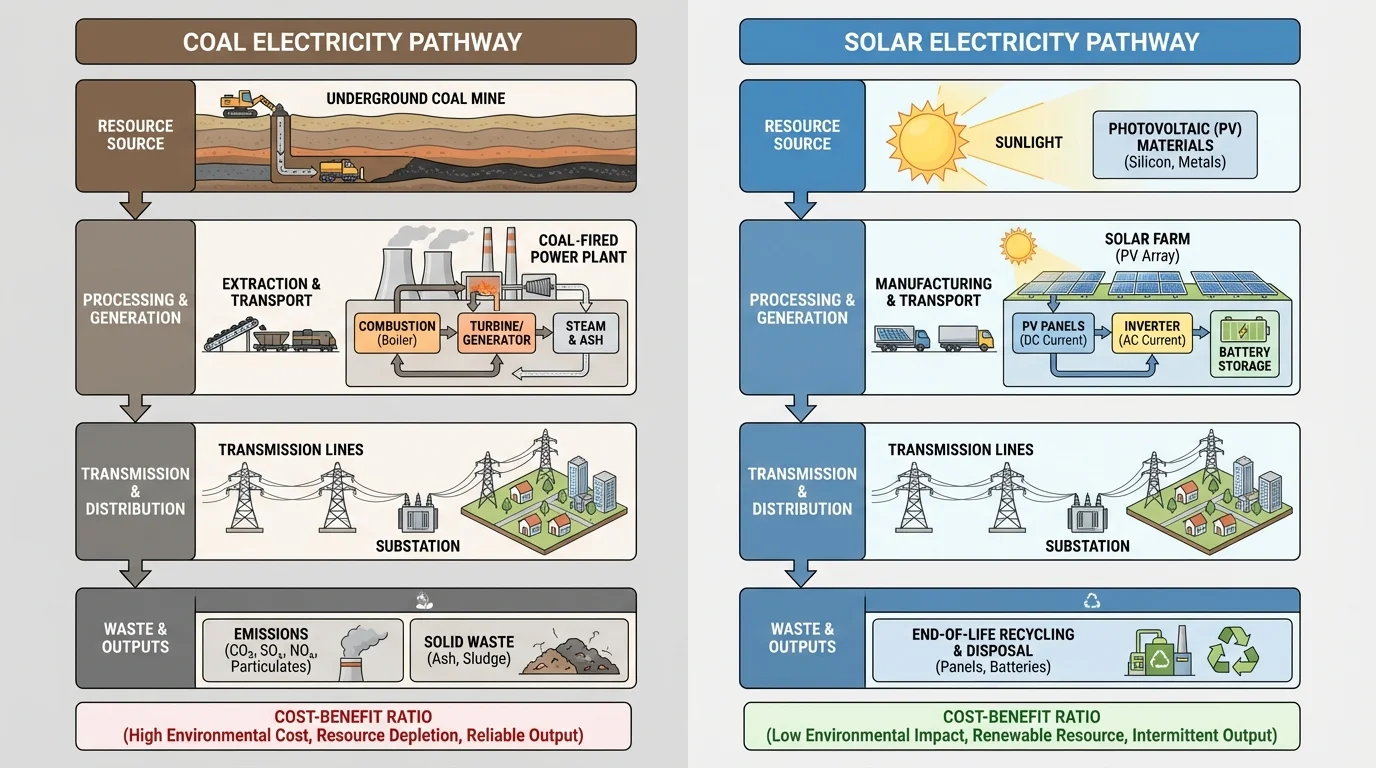
In science and engineering, a trade-off occurs when improving one feature of a design makes another feature worse. For example, a fossil-fuel power plant can provide steady electricity at all hours, but it may release large amounts of carbon dioxide, sulfur compounds, and particulates. A solar farm produces electricity with very low direct emissions, but it depends on daylight and usually requires storage or backup systems.
Many important costs are externalities, meaning they affect people or ecosystems that are not directly included in the market price. If a mining operation contaminates a river, the company may profit while downstream communities pay the health and cleanup costs. A low sticker price can hide high environmental or social damage.
Engineers also use life cycle assessment to study impacts across the full life of a system: extraction, processing, transportation, construction, operation, maintenance, and disposal or recycling. Looking only at one stage can be misleading. For example, solar panels require mining and manufacturing, but during operation they usually avoid the continuous fuel combustion required by coal or oil.
Benefits and costs can be measured in different ways. Some are quantitative, such as electricity output, mass of ore recovered, water used, land disturbed, or dollars spent. Others are qualitative, such as scenic impact, community acceptance, or long-term ecological risk. Good decisions often use both kinds of evidence.
A useful way to organize thinking is to compare multiple criteria at once. A design solution may be excellent in one category and weak in another. That is why real decisions about resource use often involve compromise rather than a perfect answer.
Energy systems differ not only by resource type but also by design. As [Figure 1] shows, the pathway from resource source to electricity can involve extraction, transportation, conversion, and waste management steps, and those steps differ greatly between fossil fuels and renewable systems. A coal plant requires continuous mining, shipping, combustion, and ash handling. A solar installation requires mining and manufacturing up front, then captures incoming sunlight without burning fuel during operation.
Fossil fuels such as coal, oil, and natural gas have high energy density and can often provide controllable power. Their benefits include established infrastructure, predictable operation, and strong performance in many industrial uses. Their costs include greenhouse gas emissions, air pollution, habitat damage from extraction, and in some cases methane leakage. Combustion reactions release energy, but they also form products such as \(\textrm{CO}_2\). For example, burning methane can be represented by \[\textrm{CH}_4 + 2\textrm{O}_2 \rightarrow \textrm{CO}_2 + 2\textrm{H}_2\textrm{O}\]. If burning \(1\) unit of methane fuel produces usable heat for many homes, the immediate benefit is high, but the climate cost is not zero.
Nuclear power uses uranium as fuel and can produce large amounts of electricity with very low direct \(\textrm{CO}_2\) emissions during operation. Benefits include reliability and high energy output from a small amount of fuel. Costs include expensive construction, radioactive waste management, and public concern about accidents, even though modern designs include major safety systems.
Renewable resources such as solar, wind, hydroelectric, and geothermal energy each involve different design choices. Solar systems can be rooftop or utility-scale. Wind systems can be onshore or offshore. Hydropower can come from large dams or small run-of-river facilities. Geothermal systems depend strongly on local geology. These solutions usually reduce direct air pollution during operation, but they may require large land areas, specific locations, expensive transmission lines, or storage systems to match supply with demand.
Energy storage changes the comparison. Batteries, pumped hydro, and thermal storage can increase the reliability of intermittent renewable energy. However, storage systems add cost and often require additional mineral resources such as lithium, cobalt, nickel, graphite, or vanadium. When evaluating a design, students should ask whether the resource system includes the supporting technologies needed to make it work well in the real world.
A modern wind turbine can power thousands of homes under favorable conditions, but the tower, generator, wiring, and grid connection depend on large amounts of steel, copper, concrete, and specialized materials. Clean energy systems still rely heavily on mineral resources.
Mineral resources are not just "found" and used. They are explored, extracted, processed, transported, manufactured into products, and eventually discarded or recycled. The full pathway, illustrated by [Figure 2], helps explain why managing minerals is as important as discovering them. A rich ore deposit may still be difficult to use if it is remote, low in concentration, or expensive to process.
Common mining methods include surface mining, open-pit mining, strip mining, underground mining, and solution mining. Surface methods can access large deposits and often cost less per ton of material moved, but they can disturb huge areas of land. Underground mining reduces surface disturbance in some cases, but it can be more dangerous and expensive. Processing ore may require crushing, chemical separation, high-temperature smelting, and tailings storage.
Management solutions include reclamation of mined land, better waste containment, reduced water use, metal substitution, product redesign, and recycling. If aluminum cans, copper wires, and lithium-ion batteries are recycled effectively, less new mining may be needed. This does not eliminate mining, but it can reduce pressure on land and ecosystems.
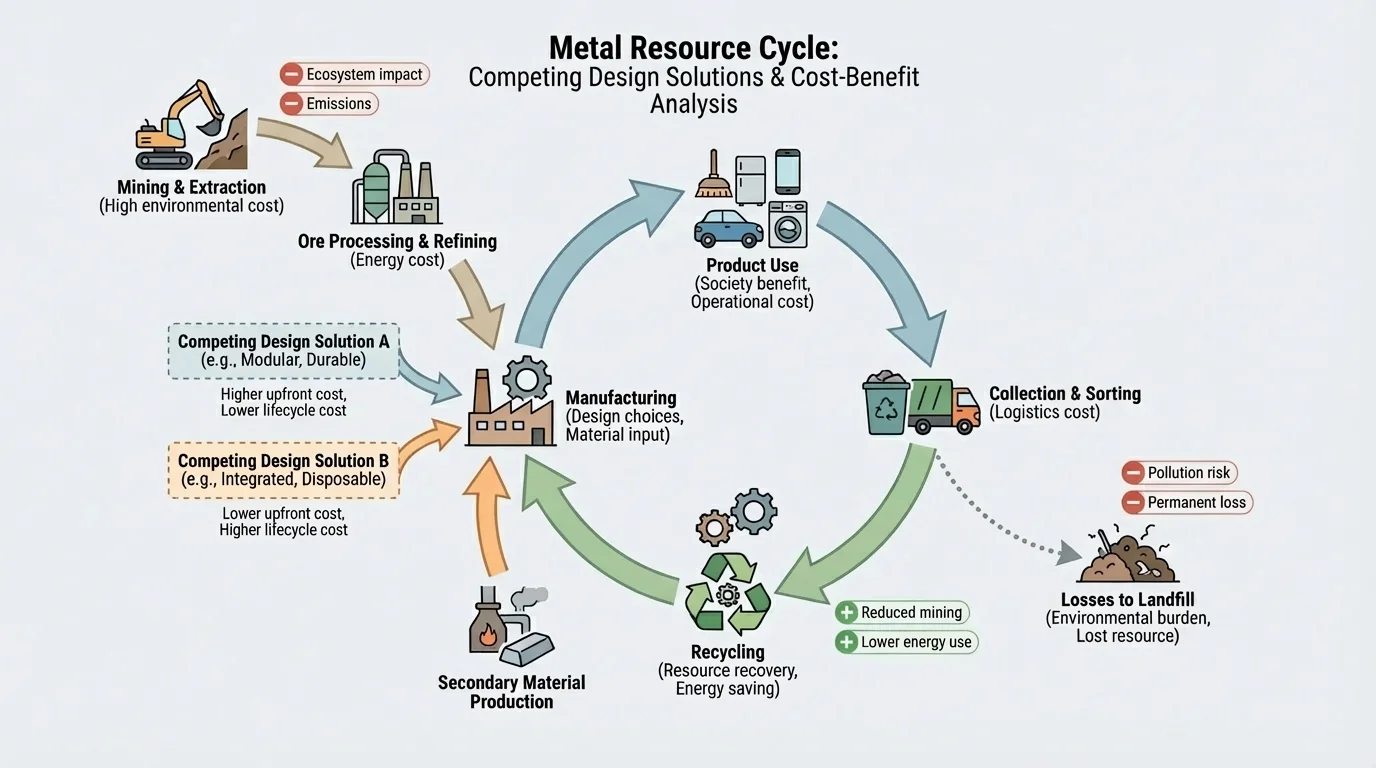
A major idea in modern engineering is the circular economy. Instead of a straight path from extraction to disposal, materials are kept in use as long as possible through repair, reuse, remanufacturing, and recycling. This design approach can improve long-term cost-benefit ratios by reducing waste and lowering demand for newly extracted raw material.
However, recycling also has limits. Collection systems may be incomplete. Some products are difficult to disassemble. Some materials degrade in quality after repeated use. This means engineers and policymakers must compare not only "mine versus recycle," but also the quality, scale, and energy demand of each approach.
A simple way to express a cost-benefit ratio is
\[\textrm{Cost-benefit ratio} = \frac{\textrm{total cost}}{\textrm{total benefit}}\]
If two solutions provide the same benefit, the one with the smaller ratio is usually better because it achieves the benefit at lower cost. If one solution costs more but delivers much greater benefit, the higher cost may still be justified. The ratio is only useful when the costs and benefits being compared are clearly defined.
Numerical example: comparing two electricity options
A town needs \(1{,}000\) units of electricity each day. Option A costs $4,000 per day and provides \(1{,}000\) units. Option B costs $5,000 per day and provides \(1{,}500\) units.
Step 1: Calculate each ratio.
For Option A, \(\dfrac{4000}{1000} = 4\). For Option B, \(\dfrac{5000}{1500} \approx 3.33\).
Step 2: Interpret the values.
Option B has a lower cost per unit of benefit, even though its total daily cost is higher.
Based only on this measure, Option B is more cost-effective.
Real evaluations are more complicated because "benefit" may include several outcomes at once. For an energy project, benefits might include power output, reliability, low emissions, job creation, and energy security. Costs might include construction, operation, maintenance, fuel, waste disposal, water use, and health impacts.
One way to combine these factors is to assign weights. Suppose a community rates reliability at \(0.40\), emissions reduction at \(0.35\), cost at \(0.15\), and water use at \(0.10\). If a solar-plus-battery system scores \(8\), \(9\), \(6\), and \(8\) out of \(10\) on those categories, the weighted score is \(0.40 \times 8 + 0.35 \times 9 + 0.15 \times 6 + 0.10 \times 8 = 3.2 + 3.15 + 0.9 + 0.8 = 8.05\). A competing natural-gas system might score differently. The higher weighted score suggests the better match for that community's priorities.
Why ratios can mislead if used alone
A low cost-benefit ratio does not automatically mean a design is the best choice. A mining method might be cheap and productive in the short term but leave toxic waste that creates huge cleanup costs later. Good evaluation includes time scale, uncertainty, risk, and who experiences the impacts.
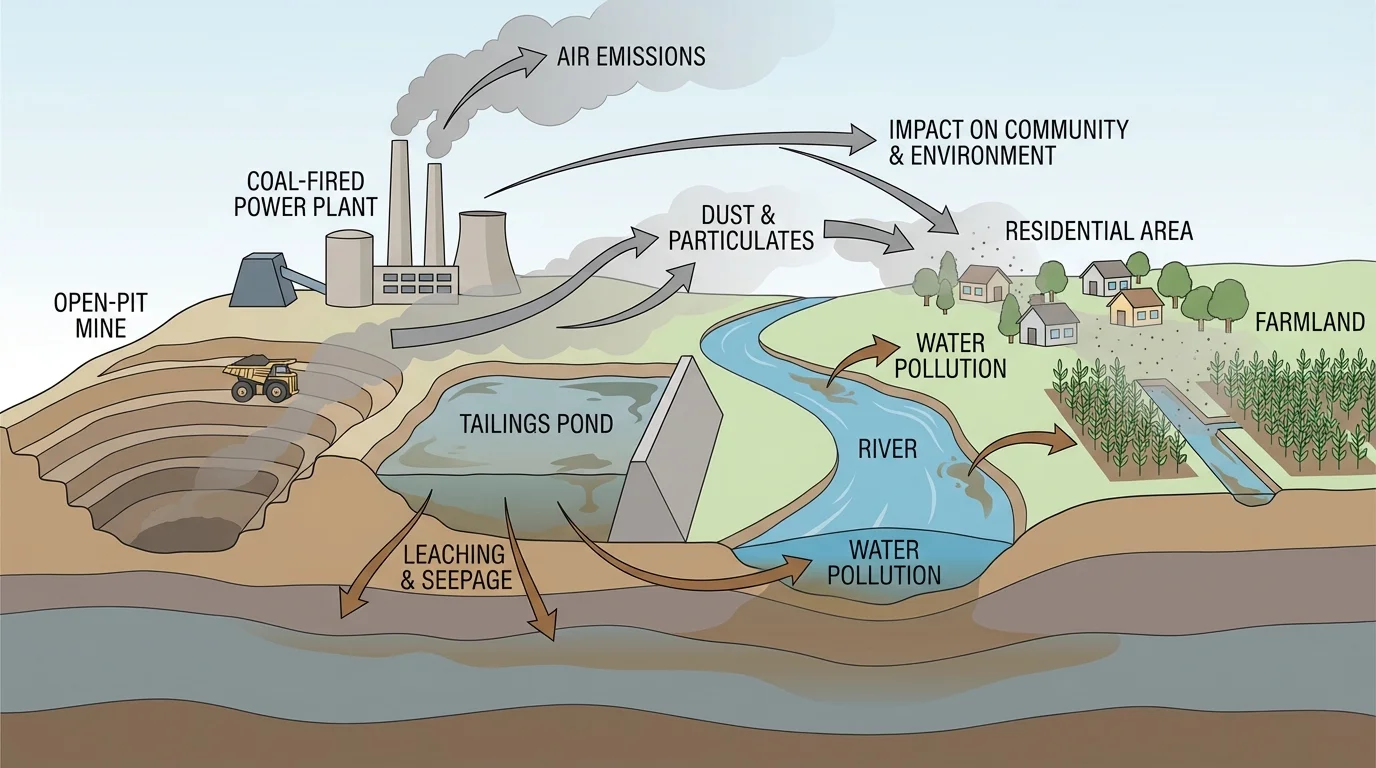
As [Figure 3] illustrates, resource projects often affect more than the site where extraction or power generation occurs. Dust can travel. Water pollution can move downstream. Transmission lines can cut across habitats. Traffic, noise, and land-use change can affect nearby communities. These are not side issues; they are part of the total cost.
Environmental costs include greenhouse gas emissions, acid mine drainage, habitat fragmentation, water depletion, soil erosion, thermal pollution, and toxic waste. In mining, tailings ponds may contain harmful substances. In fossil-fuel combustion, pollutants can include sulfur dioxide, nitrogen oxides, and fine particles. These can damage health and ecosystems even when electricity remains cheap at the point of sale.
Social costs and benefits also matter. A new mine may create jobs, roads, and tax revenue. It may also displace communities or affect Indigenous lands and water access. A hydropower dam may provide electricity and flood control, but it can flood ecosystems and alter fisheries. The best design solution in one region may be unacceptable in another because physical geography and human geography are different.
The term sustainability describes using resources in ways that meet present needs without severely limiting the ability of future generations to meet their own needs. Sustainability does not mean "never use resources." It means using them carefully, efficiently, and with long-term thinking.
Engineers increasingly consider environmental justice, which asks whether pollution and risk are unfairly concentrated in certain populations. If a low-cost design harms communities with less political power, the true benefit-to-cost picture changes. Evidence-based evaluation must include fairness, not just efficiency.
Good engineering does not simply choose between existing resource systems. It improves them. Better insulation reduces total energy demand. More efficient motors and appliances lower electricity use. Smart grids shift power demand to times when renewable generation is high. Water recycling in mining reduces freshwater withdrawal. Sensors can monitor leaks, subsidence, or contamination before problems become disasters.
Design improvements can change cost-benefit ratios dramatically. For example, if a factory upgrades equipment and cuts electricity use from \(10{,}000\) kilowatt-hours per day to \(7{,}500\) kilowatt-hours per day, the reduction is \(10{,}000 - 7{,}500 = 2{,}500\) kilowatt-hours per day. If electricity costs $0.12 per kilowatt-hour, daily savings are \(2{,}500 \times 0.12 = 300\), so the factory saves $300 per day. If the upgrade costs $90,000, the simple payback time is \(\dfrac{90000}{300} = 300\) days. That is a design solution based on using less resource rather than finding more.
Real-world application: reclaimed mining land
Some former surface mines are redesigned into solar energy sites, wildlife habitat, or recreational land. This approach does not erase the original disturbance, but it can increase long-term benefits from land that was already altered.
The same idea applies to materials. Product designers can make electronics easier to repair and disassemble, which increases the recovery of copper, gold, aluminum, cobalt, and lithium. Small design decisions can improve recycling rates across millions of devices.
Case 1: Coal plant retrofit vs solar plus battery storage. A region with an old coal plant must choose between adding pollution controls to keep the plant running or building a solar farm with battery storage. The coal retrofit may cost less upfront and use existing infrastructure. The solar-plus-storage option may cost more initially but reduce fuel costs and direct emissions over time. If the region has strong sunlight and enough land, the long-term benefits of solar may outweigh higher startup costs. If the grid is unstable and battery storage is undersized, reliability could favor a different choice.
Case 2: New copper mine vs expanded copper recycling. A manufacturer needs more copper for electric motors and power lines. A new mine can produce large volumes but may disturb land and require high water use. Expanded recycling uses existing material streams and often requires less energy than extracting copper from low-grade ore. However, recycling supply may be limited by collection rates. The best solution may be a combination: recycle aggressively while opening only the minimum new extraction needed.
Case 3: Desalination powered by fossil fuels vs desalination powered by renewables. Coastal cities may use desalination to increase freshwater supply. A fossil-fuel-powered plant may be easier to run continuously, but it adds emissions and fuel costs. A renewable-powered system reduces those costs but may require storage and careful timing. The local climate, electricity grid, and water scarcity level all influence which design has the stronger overall ratio of benefit to cost.
"There is no such thing as a free resource."
— Guiding principle in environmental science and engineering
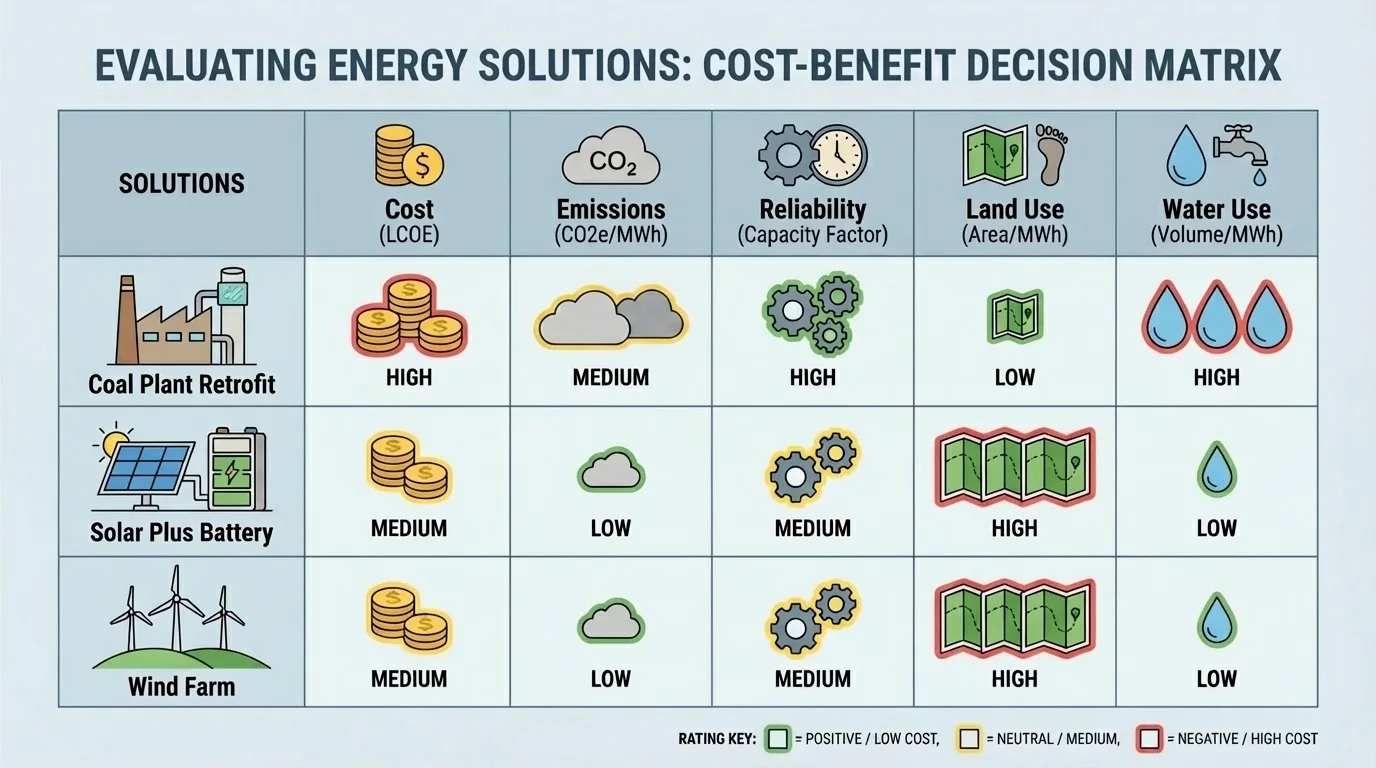
When scientists, engineers, planners, and communities compare options, they often use a decision matrix, as shown in [Figure 4], to organize evidence across several categories. A matrix does not make the decision automatically, but it prevents the discussion from focusing on only one number, such as initial price.
Criteria might include total cost, long-term maintenance, energy output, reliability, emissions, water use, land disturbance, accident risk, waste generation, job creation, and community acceptance. Some criteria are measured directly. Others require estimates or expert judgment. Uncertainty should be stated clearly rather than ignored.
| Solution | Major Benefits | Major Costs/Risks | Best Fit Conditions |
|---|---|---|---|
| Coal or natural gas | Reliable output, existing infrastructure | High emissions, fuel dependence, pollution | Where continuous power is essential and cleaner options are limited |
| Solar plus storage | Low direct emissions, low fuel cost | High upfront cost, mineral demand for batteries | Sunny regions with available land and storage support |
| Wind power | Low direct emissions, strong output in windy areas | Variable generation, visual and wildlife concerns | Consistently windy regions with grid connections |
| New mining | Large material supply | Land disturbance, waste, water use | When demand exceeds recycled supply |
| Recycling and reuse | Less extraction, often lower energy use | Collection and processing limits | Where product recovery systems are strong |
Table 1. Comparison of common resource solutions, major benefits, major costs, and conditions where each is most effective.
Local geography matters greatly. Hydropower may be realistic in a mountainous region with major rivers, but not in a dry flat region. Geothermal energy depends on subsurface heat conditions. Wind power needs steady winds. Mining depends on ore deposits, access to water, transportation, and environmental regulations. There is no universal best design solution independent of place.
Time scale also changes the answer. A project with high upfront cost may become the better solution over \(20\) or \(30\) years if fuel savings, health benefits, and lower cleanup costs are included. In the same way, a decision that looks cheap today may become expensive later if it damages land, water, or public health. This is why we still refer back to life cycle assessment, as seen earlier in [Figure 1] and [Figure 2].
Strong evaluation combines Earth science knowledge, engineering design, mathematics, and ethics. Students should be able to ask: What resource is available here? What technology can use it? What are the short-term and long-term costs? What benefits are gained, and by whom? What risks remain? The best decisions are supported by evidence, transparent criteria, and an understanding that human systems depend on Earth systems.
