A single heavy rainstorm can turn an ordinary parking lot into a pollution delivery system. Water rushes across asphalt, picks up oil, trash, and fertilizer, then carries them into streams where fish, insects, and plants must deal with the consequences. That is the central challenge of modern environmental engineering: human technology can damage natural systems, but carefully designed technology can also help protect and restore them.
Evaluating or refining a solution means more than asking, "Does it work?" A strong solution must reduce harm, fit real-world limits, and avoid creating a different problem somewhere else. A device that lowers air pollution but uses rare materials irresponsibly, or a water-saving system that is too expensive for communities to maintain, may not be the best answer. Science and engineering work together to find better options.
This topic connects directly to sustainability. Human societies depend on reliable water, fertile soil, stable climate patterns, healthy ecosystems, and biodiversity. When these natural systems are stressed, people feel the effects through food shortages, flooding, disease risk, habitat destruction, and economic losses. Responsible management of natural resources often depends on technology, but technology must be tested, measured, and improved.
Natural systems are connected networks involving the atmosphere, hydrosphere, geosphere, and biosphere. Human actions such as burning fossil fuels, clearing forests, paving land, overusing fertilizers, and withdrawing too much groundwater can spread effects across many parts of the Earth system at once, as [Figure 1] illustrates. A change in one part of the system often causes a chain reaction in others.
For example, burning gasoline produces pollutants and greenhouse gases such as \(\textrm{CO}_2\). Extra \(\textrm{CO}_2\) in the atmosphere strengthens the greenhouse effect, which can shift climate patterns. Hotter temperatures can increase drought in some regions, lower soil moisture, and stress ecosystems. Meanwhile, intense rainfall in other places can increase erosion and carry sediment into rivers. One human action can therefore affect air, water, soil, and living things.
Another example is nutrient runoff. Fertilizers contain compounds rich in nitrogen and phosphorus. When too much fertilizer washes into lakes or coastal waters, algae may grow rapidly. This process, called eutrophication, can reduce dissolved oxygen and create "dead zones" where many aquatic organisms cannot survive. A useful technological solution in this context is one that reduces nutrient loss before it reaches the water.
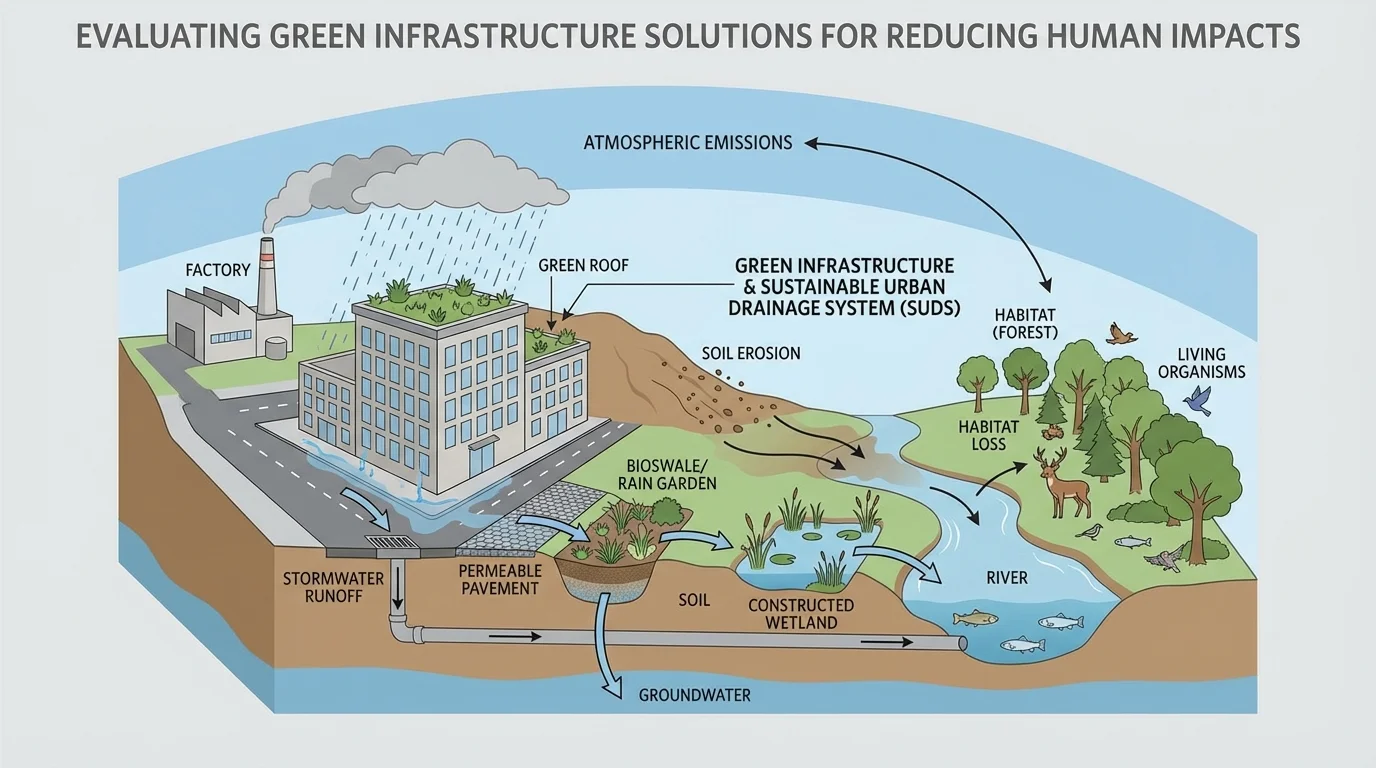
Because natural systems are interconnected, environmental solutions must be evaluated as systems too. A technology that solves a local problem but shifts pollution elsewhere is not truly sustainable. This is why scientists often track multiple indicators at the same time, including water quality, energy use, land disturbance, carbon emissions, and biodiversity.
Criteria are the standards used to judge whether a solution is successful, such as reducing runoff, lowering emissions, or protecting habitat.
Constraints are the limits a solution must work within, such as cost, available materials, space, laws, safety, or climate conditions.
Trade-offs are situations in which gaining one benefit requires accepting one cost or drawback.
Life cycle assessment is the evaluation of environmental impacts across all stages of a product or system, from resource extraction to disposal or recycling.
These ideas are essential because environmental problem-solving is rarely about finding a perfect solution. It is about finding the best available solution for a particular place, time, and set of needs.
A technological solution is any designed tool, process, system, or engineered practice that helps solve a problem. In environmental science, these solutions can be physical devices, computer-based monitoring systems, redesigned infrastructure, or management technologies.
Some examples are easy to recognize. Solar panels generate electricity without burning fuel during operation. Wastewater treatment plants remove harmful substances before water is released back into rivers or reused. Drip irrigation delivers water directly to plant roots, reducing evaporation and runoff. Methane digesters capture methane from animal waste and convert it into usable energy.
Other technologies are less obvious because they blend into landscapes and cities. A green roof uses soil and vegetation on top of a building to absorb rainwater, reduce urban heat, and provide habitat. Permeable pavement allows water to seep through surfaces rather than running off quickly. Precision agriculture uses sensors, satellites, and software to apply water and fertilizer only where they are needed.
The key idea is that technology is not limited to machines. A well-designed system of pipes, wetlands, sensors, filters, and data analysis can be just as important as a single device. What matters is whether the design reduces environmental impact effectively and sustainably.
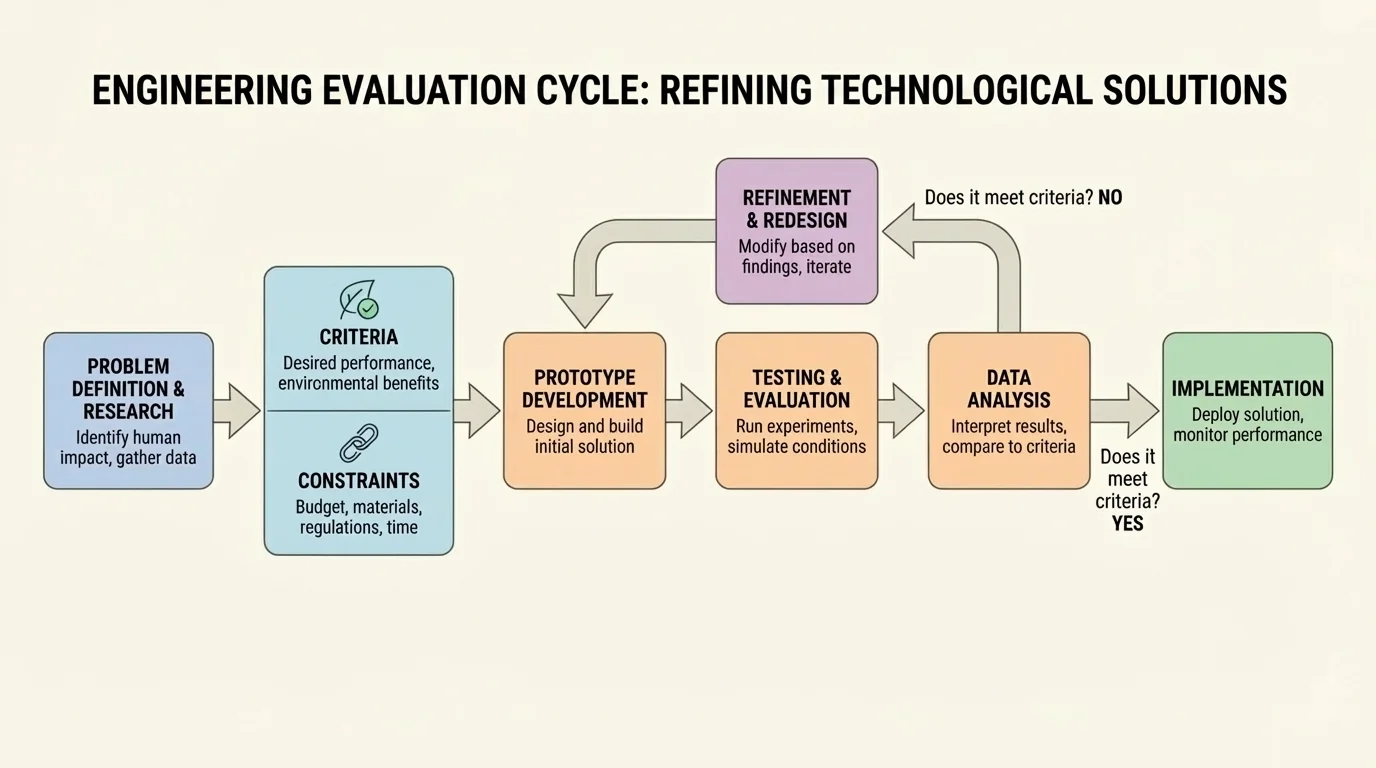
Evaluation is an iterative process, not a one-time decision, and [Figure 2] shows this cycle from identifying a problem to refining a design. Scientists investigate how the natural system works and gather evidence about the problem. Engineers then design, test, compare, and improve possible solutions.
A good evaluation starts with clear criteria. Suppose a city wants to reduce stormwater pollution. Possible criteria might include lowering runoff volume, increasing infiltration, reducing flood risk, lowering water temperature in streams, and keeping maintenance manageable. Constraints might include available land, local rainfall patterns, budget, and public acceptance.
Trade-offs are common. A technology may reduce pollution greatly but cost more at the beginning. Another may be cheaper to install but less durable over time. Engineers therefore compare solutions across several dimensions instead of focusing on just one number.
Another major idea is life cycle assessment. For example, electric vehicles often reduce direct tailpipe emissions, but evaluating them fully also requires asking how the electricity is generated, how the battery materials are mined, and what happens at the end of the battery's life. Looking only at the use stage can be misleading.
Engineers also ask whether a solution is scalable. A method that works in one greenhouse or one building may not work the same way in a dry rural area, a dense city, or a low-income community. Social, geographic, and economic factors matter because a solution must be practical to be effective.
Why refinement matters
Very few environmental technologies are perfect in their first version. Refinement means using test results and field observations to improve a design. Engineers may change materials, alter shape, adjust timing, add sensors, reduce energy use, or redesign maintenance procedures. Refinement often turns a promising idea into a reliable solution.
This process is one reason environmental technology keeps improving. Early solar panels were much less efficient than modern ones. Water treatment methods have become more precise and safer. Irrigation systems now use data rather than fixed schedules. Better evidence leads to better design.
Environmental decisions should be based on data rather than guesses. Scientists and engineers measure flow rate, concentration of pollutants, energy output, biodiversity, soil moisture, temperature, and many other variables. The choice of measurement depends on the problem being studied.
One useful calculation is efficiency, which compares useful output to total input:
\[\textrm{efficiency} = \frac{\textrm{useful output}}{\textrm{total input}} \times 100\%\]
For example, if a water-saving irrigation system delivers \(90\) liters of water to plant roots out of \(120\) liters released, then its efficiency is \(\dfrac{90}{120} \times 100\% = 75\%\). If a redesigned system delivers \(102\) liters to the roots from the same \(120\) liters, the efficiency becomes \(\dfrac{102}{120} \times 100\% = 85\%\). That improvement matters in dry regions.
Another useful measure is percent reduction:
\[\textrm{percent reduction} = \frac{\textrm{original amount} - \textrm{new amount}}{\textrm{original amount}} \times 100\%\]
If runoff from a site drops from \(500\) liters after a storm to \(320\) liters after installing a rain garden, then the percent reduction is \(\dfrac{500 - 320}{500} \times 100\% = 36\%\). This lets engineers compare options clearly.
Worked example: comparing two filtration systems
A factory tests two systems to reduce nitrate in wastewater. The original nitrate concentration is \(50\) milligrams per liter. System A lowers it to \(20\) milligrams per liter, and System B lowers it to \(12\) milligrams per liter.
Step 1: Use percent reduction for System A.
\(\dfrac{50 - 20}{50} \times 100\% = \dfrac{30}{50} \times 100\% = 60\%\)
Step 2: Use percent reduction for System B.
\(\dfrac{50 - 12}{50} \times 100\% = \dfrac{38}{50} \times 100\% = 76\%\)
Step 3: Compare results with other factors.
System B removes more nitrate, but engineers still need to compare cost, energy use, reliability, and maintenance.
Higher pollutant removal does not automatically mean "best" if the system is too expensive or difficult to maintain.
Models are also important. A computer model can estimate how much a wetland restoration project may reduce flooding under different rainfall conditions, or how much carbon emissions could drop if a town replaces diesel buses with electric ones. Models do not replace data, but they help predict performance before large-scale implementation.
Urban areas often replace soil and vegetation with rooftops, roads, and parking lots. As [Figure 3] shows, these hard surfaces prevent infiltration, so water moves quickly into storm drains, carrying pollutants with it. The result can be flash flooding, stream erosion, and lower water quality.
Three common solutions are permeable pavement, rain gardens, and green roofs. Permeable pavement contains pores or gaps that allow water to pass through into layers below. Rain gardens are planted depressions designed to collect and absorb runoff. Green roofs slow rainfall movement, increase evaporation, and reduce heat buildup on buildings.
Suppose a school parking lot produces \(1{,}000\) liters of runoff in a storm. After part of the area is rebuilt with permeable pavement, runoff falls to \(620\) liters. The reduction is \(\dfrac{1{,}000 - 620}{1{,}000} \times 100\% = 38\%\). If a rain garden is added and runoff drops further to \(480\) liters, the total reduction from the original level becomes \(\dfrac{1{,}000 - 480}{1{,}000} \times 100\% = 52\%\).
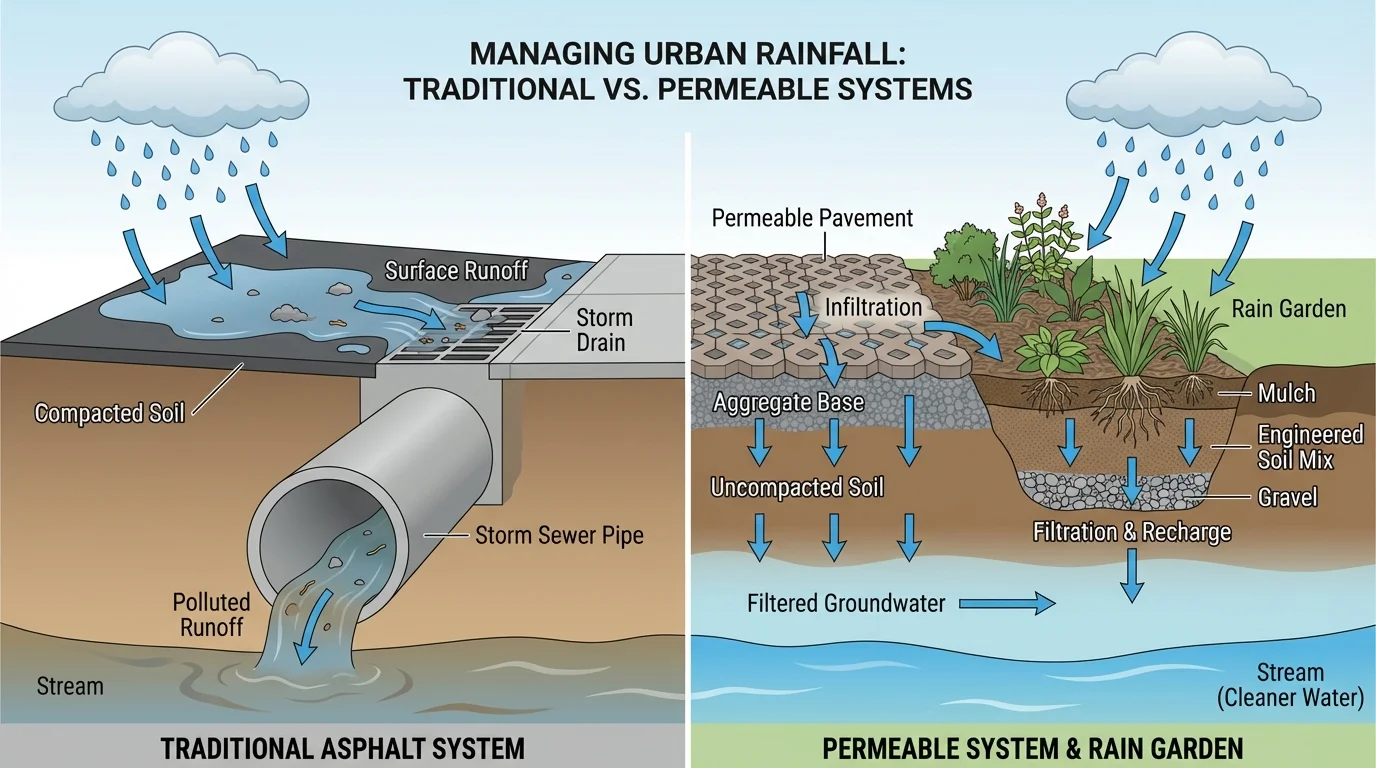
These technologies offer additional benefits. Vegetation can cool local temperatures, support pollinators, and improve appearance. However, they also have constraints. Permeable surfaces may clog if not maintained. Rain gardens need suitable soils and plant choices. Green roofs add weight, so buildings must be designed or reinforced appropriately.
As seen earlier in [Figure 1], runoff is not just a water issue. It connects to soil transport, habitat quality, and even temperature. When cities reduce runoff, they often improve several parts of the natural system at once.
Some cities now design entire neighborhoods around "sponge city" ideas, using parks, wetlands, green roofs, and permeable streets to absorb stormwater instead of pushing it away as fast as possible.
Evaluating stormwater solutions therefore involves more than measuring one storm. Engineers may collect data over months or years to see how systems perform during drought, moderate rain, and extreme events.
Energy technologies are often judged by whether they reduce greenhouse gas emissions and harmful air pollutants. But low emissions during use are only part of the story. Full comparisons need life cycle thinking, as [Figure 4] demonstrates through different stages of energy production.
Fossil-fuel power plants release large amounts of \(\textrm{CO}_2\) during operation because carbon in fuels reacts with oxygen. A simplified chemical equation is \(\textrm{C} + \textrm{O}_2 \rightarrow \textrm{CO}_2\). Solar panels do not produce \(\textrm{CO}_2\) while generating electricity, but energy and materials are still required to manufacture, transport, install, and eventually recycle them.
Wind turbines also have life cycle impacts, including material extraction and land use concerns. Electric vehicles reduce tailpipe pollution, especially when paired with cleaner electricity grids, but battery production involves mining and processing materials such as lithium, nickel, and cobalt. Carbon capture systems can reduce emissions from some power plants or industrial facilities, but they require additional energy and infrastructure.
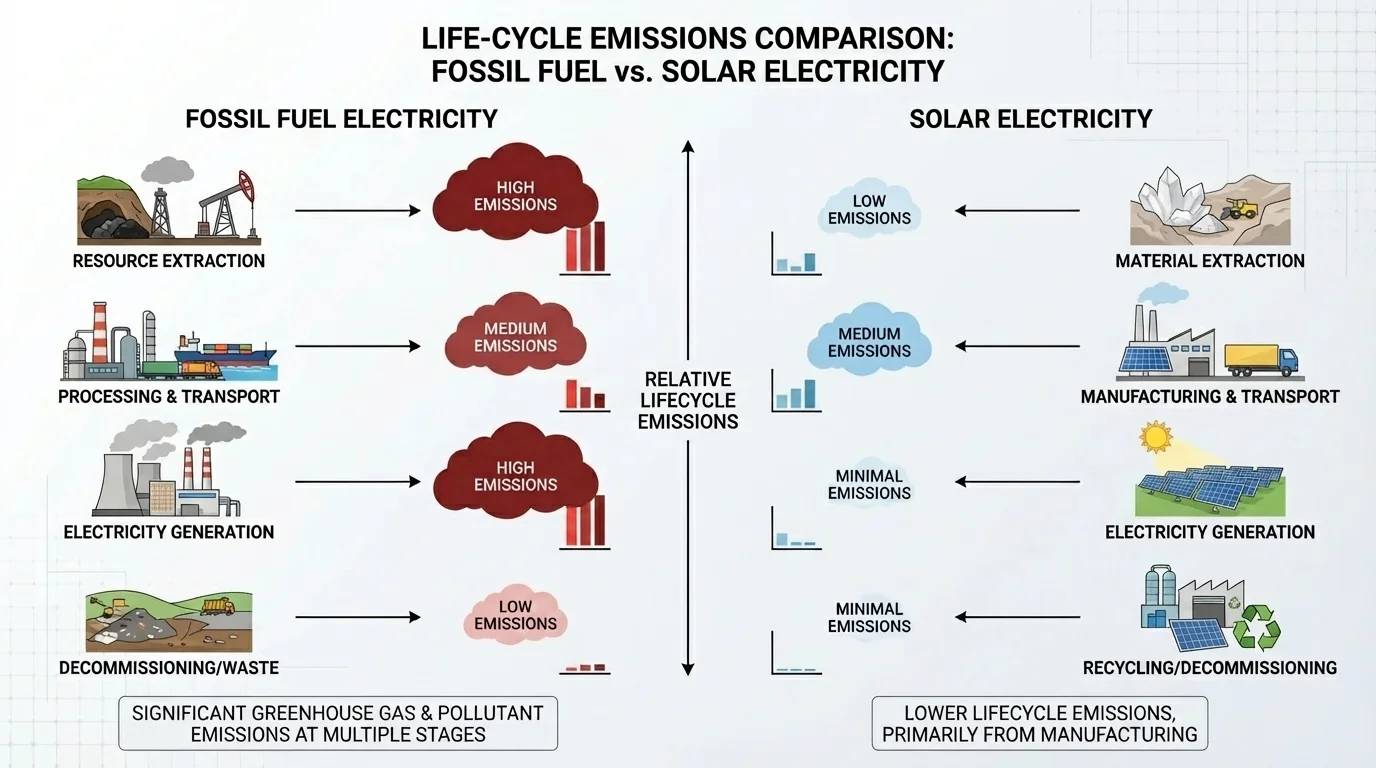
Consider a simple comparison. If a fossil-fuel electricity source produces \(900\) grams of \(\textrm{CO}_2\) per kilowatt-hour and a solar system averages \(60\) grams of \(\textrm{CO}_2\) per kilowatt-hour across its life cycle, then the reduction is \(\dfrac{900 - 60}{900} \times 100\% \approx 93.3\%\). That is a large reduction, but decision-makers still must consider cost, storage, reliability, land area, and local sunlight conditions.
This is where refinement becomes important. Solar systems can be improved with better panel efficiency, longer-lasting materials, and battery systems that reduce waste and increase recycling. Wind farms can be refined by smarter siting to reduce bird and bat collisions. Electric transportation can be improved through battery recycling and cleaner charging networks.
The engineering cycle in [Figure 2] applies strongly here: test performance, identify weaknesses, redesign, and test again. Environmental technology advances through repeated improvement, not single inventions.
Agriculture supports human society, but it can also strain natural systems through water use, soil erosion, nutrient runoff, pesticide exposure, and habitat loss. Sustainable agricultural technology aims to keep food production high while reducing these impacts.
Precision agriculture uses sensors, satellite data, drones, and computer mapping to apply water, fertilizer, or pesticides more accurately. Instead of treating an entire field the same way, farmers can respond to local conditions within different parts of the field. This reduces waste and can lower runoff into nearby water.
Another solution is drip irrigation. Water moves through tubing and exits near the roots of plants, which reduces evaporation compared with spraying water into the air. Riparian buffer zones, strips of vegetation near streams, are also important technologies in a broad sense because they are intentionally designed systems that trap sediment, absorb nutrients, and protect stream habitats.
Livestock operations can use methane digesters to capture methane from manure. Methane is a powerful greenhouse gas, so capturing it reduces atmospheric emissions and can also provide energy. If a digester captures \(250\) kilograms of methane that would otherwise escape, it prevents a significant climate impact while producing useful fuel.
| Technology | Main environmental benefit | Possible constraint |
|---|---|---|
| Drip irrigation | Reduces water loss and runoff | Installation cost, clogging |
| Precision fertilizer application | Lowers nutrient pollution | Requires sensors, software, training |
| Riparian buffers | Protects streams and biodiversity | Takes land out of direct production |
| Methane digester | Captures greenhouse gas and produces energy | High setup and maintenance needs |
Table 1. Agricultural technologies that reduce impacts on water, soil, climate, and biodiversity.
These solutions are especially valuable when combined. A farm that uses drip irrigation, precision fertilizer mapping, and stream buffers often achieves greater overall benefit than one relying on a single method.
Case study: refining fertilizer use
A farm applies \(200\) kilograms of fertilizer to a field. Soil sensors later show that crops only needed \(150\) kilograms for healthy growth.
Step 1: Find unnecessary fertilizer use.
\(200 - 150 = 50\) kilograms
Step 2: Calculate the possible reduction in fertilizer application.
\(\dfrac{50}{200} \times 100\% = 25\%\)
Step 3: Interpret the result.
A precision system could reduce fertilizer use by about \(25\%\), which may lower costs and reduce the risk of nutrient runoff into nearby water.
This kind of refinement helps both productivity and environmental protection.
Protecting biodiversity is part of evaluating success. If a technology increases crop output but destroys stream life, pollinator habitat, or soil organisms, then its overall value becomes questionable. Sustainability requires keeping ecological support systems functioning.
To refine a solution means to improve it using evidence. Engineers may discover that an initial design works in one season but fails in another, or that it performs well environmentally but poorly economically. Refinement uses feedback to increase benefits and reduce unwanted side effects, as [Figure 5] illustrates with fertilizer runoff and redesign.
One common reason for refinement is unintended consequences. For instance, a wetland built to clean water may also become a breeding site for mosquitoes if water flow is poorly managed. A recycling technology may save raw materials but use too much energy. A desalination plant may provide freshwater but create concentrated salty waste that must be handled carefully.
Refinement often involves changing one variable at a time and measuring the result. Engineers may test different filter materials, adjust pump timing, alter slope angles, replace parts with recycled materials, or redesign software controls. In environmental work, field testing matters because natural systems are variable. Rainfall changes, temperatures shift, and ecosystems respond in complex ways.
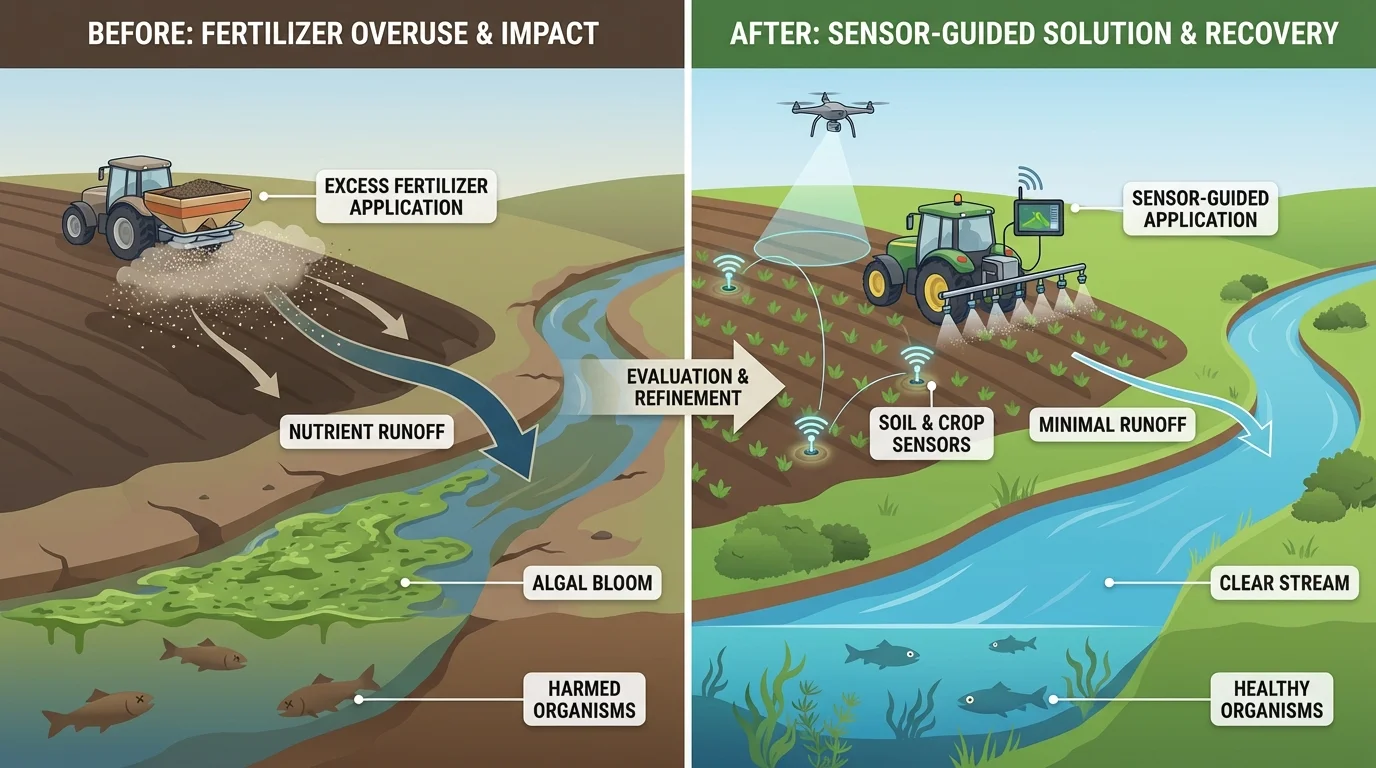
Equity also matters. A strong solution should work not only in wealthy places but also in communities with fewer resources. A water purification system that needs expensive imported parts may fail if replacements are unavailable. Engineers may refine a design so it uses local materials, simpler maintenance, or lower energy.
Refinement is therefore scientific, technical, and social at the same time. As seen in [Figure 5], the goal is not just to make a technology operate, but to make it fit the natural system and the human community it is meant to serve.
When evaluating evidence, remember the difference between a single observation and a pattern. One successful test is not enough. Reliable conclusions come from repeated measurements, comparison groups, and data collected over time.
Local conditions strongly influence refinement. A green roof that works well in a wet climate may need different plants in a dry climate. A wind turbine design suitable for open plains may not fit mountainous terrain. Environmental technology is rarely "one size fits all."
Choosing environmental technologies is ultimately about responsible management of natural resources. This means balancing present needs with the ability of future generations to meet their own needs. It also means recognizing that biodiversity, clean water, stable climate systems, and fertile soil are not optional extras. They are part of the foundation of human life.
Decision-makers often compare solutions using a matrix of criteria. They may rank options by emission reduction, water savings, habitat protection, cost, durability, and community acceptance. Some criteria are quantitative, while others involve values and priorities. Public input can matter because local people understand place-based concerns that designers might miss.
There is no single best technology for every problem. In some cases, the best answer is a combination of solutions working together: renewable energy plus storage, green infrastructure plus zoning changes, precision agriculture plus habitat restoration. The most successful approaches usually treat natural systems as connected, dynamic, and worth protecting.
"The environment is where we all meet; where we all have a mutual interest; it is the one thing all of us share."
— Lady Bird Johnson
That idea captures why evaluation and refinement matter so much. Technological solutions are most effective when they are grounded in evidence, designed for real constraints, and improved over time to protect both people and the natural systems they depend on.
