Your body contains trillions of cells, yet a nerve cell, a muscle cell, and a red blood cell can look and function so differently that they seem almost unrelated. The surprising part is that nearly all of them contain the same DNA. What makes one cell send electrical signals, another contract with force, and another carry oxygen is not a different set of genetic instructions, but which instructions are used, how they are used, and which proteins are built from them.
A cell is the basic unit of life. Some organisms, such as many bacteria, consist of only one cell. Others, including plants and animals, are made of many cells that work together. In multicellular organisms, cells become specialized. That means their structures are suited to particular jobs, just as tools in a workshop are shaped for specific tasks.
Structure and function are closely linked in biology. A cell's shape, internal organization, and surface features affect what it can do. Long, branching nerve cells are well suited for transmitting signals over distance. Thin root hair cells increase surface area for absorption. Packed chloroplasts in leaf cells support photosynthesis. Life depends on these structural adaptations.
The essential functions of life include obtaining and using energy, responding to signals, transporting materials, maintaining internal balance, growing, reproducing, and passing on hereditary information. Cells carry out all of these functions directly or contribute to them as part of a larger system.
Specialized cells are cells with structures and activities adapted for particular functions in an organism. DNA is the molecule that stores hereditary information. Genes are specific regions of DNA that contain instructions for making products, usually proteins. Proteins are large molecules built from amino acids that perform most of the work of cells.
Even though cells vary enormously, they share important features. Understanding those shared features helps explain both the unity and the diversity of life.
All cells have a boundary that separates them from their surroundings. In most cases, this boundary is the cell membrane, which controls what enters and leaves the cell. Cells also contain cytoplasm, where many chemical reactions occur, and ribosomes, which build proteins. Most importantly for this topic, all cells contain genetic information that guides their activities.
In eukaryotic cells, such as those of animals, plants, fungi, and protists, DNA is usually stored inside a nucleus. In prokaryotic cells, such as bacteria, DNA is not enclosed in a nucleus, but it is still present and essential. Whether a cell is simple or complex, it must store information, read that information, and use it to stay alive.
The genetic information in a cell is not there merely as a record. It is active. Cells constantly use DNA-based instructions to make molecules they need. Without that information system, a cell could not maintain its structure, repair damage, or respond to changes in the environment.
Earlier biology study often introduces the idea that cells come from preexisting cells. That principle matters here because when cells divide, they pass DNA to new cells, allowing life processes and inherited traits to continue from one generation of cells to the next.
This raises a deeper question: how is so much information packed, organized, and used inside something so small?
The genetic system has levels of organization, as shown in [Figure 1]. In eukaryotic cells, DNA is found in the nucleus. DNA molecules are extremely long, so they are coiled and packaged with proteins into structures called chromosomes. Each chromosome contains one long DNA molecule and many genes.
Genes are specific stretches of DNA that contain instructions for making a particular protein or functional RNA. You can think of DNA as a vast library, chromosomes as shelves of information, and genes as individual instruction sets. This analogy is not perfect, but it helps show that genes are not separate molecules floating around; they are regions within larger DNA molecules.
DNA has a double-helix structure and is built from repeating units called nucleotides. The order of its bases carries information. In DNA, the bases adenine, thymine, cytosine, and guanine pair in specific ways. The exact sequence of bases in a gene determines the instructions that the cell can use later to build a protein.
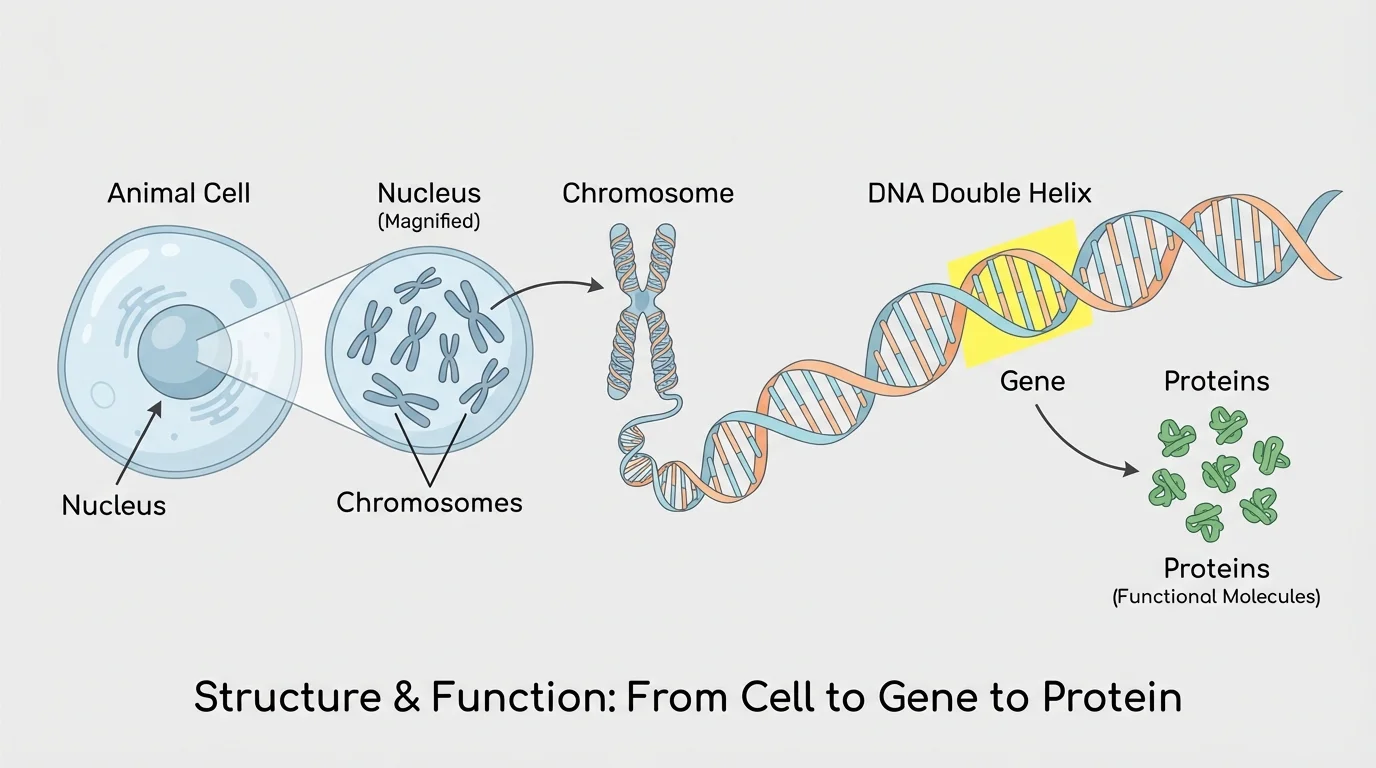
Humans have 46 chromosomes in most body cells, arranged in 23 pairs. Other organisms have different numbers. Chromosome number does not measure complexity, but chromosome organization matters because it helps ensure DNA is copied and separated accurately during cell division.
A change in the DNA sequence is called a mutation. Some mutations have little or no effect, some are harmful, and some can even be helpful under certain conditions. What matters most is whether the change affects a gene product, especially a protein whose function is important to the cell.
Later, when we examine disease and cell specialization, [Figure 1] remains useful because it reminds us that a gene is not an isolated object; it is a specific part of a chromosome, and chromosomes are the packaged form of DNA inside cells.
Information in a gene does not help a cell unless the cell can use it, and that flow of information is illustrated in [Figure 2]. The basic pathway is often described as DNA to RNA to protein. This does not mean DNA turns directly into protein. Instead, cells copy the information in a gene into a temporary RNA message and then use that message to assemble a protein.
The first stage is transcription. In transcription, the cell uses one strand of DNA as a template to build a molecule of messenger RNA, or mRNA. This mRNA carries the genetic instructions from the DNA to a ribosome. In eukaryotic cells, transcription occurs in the nucleus.
The second stage is translation. During translation, a ribosome reads the sequence of the mRNA in sets of three bases called codons. Each codon corresponds to a specific amino acid or a start or stop signal. Transfer RNA molecules bring the correct amino acids, and the ribosome links them together in the correct order. The chain then folds into a functional protein.
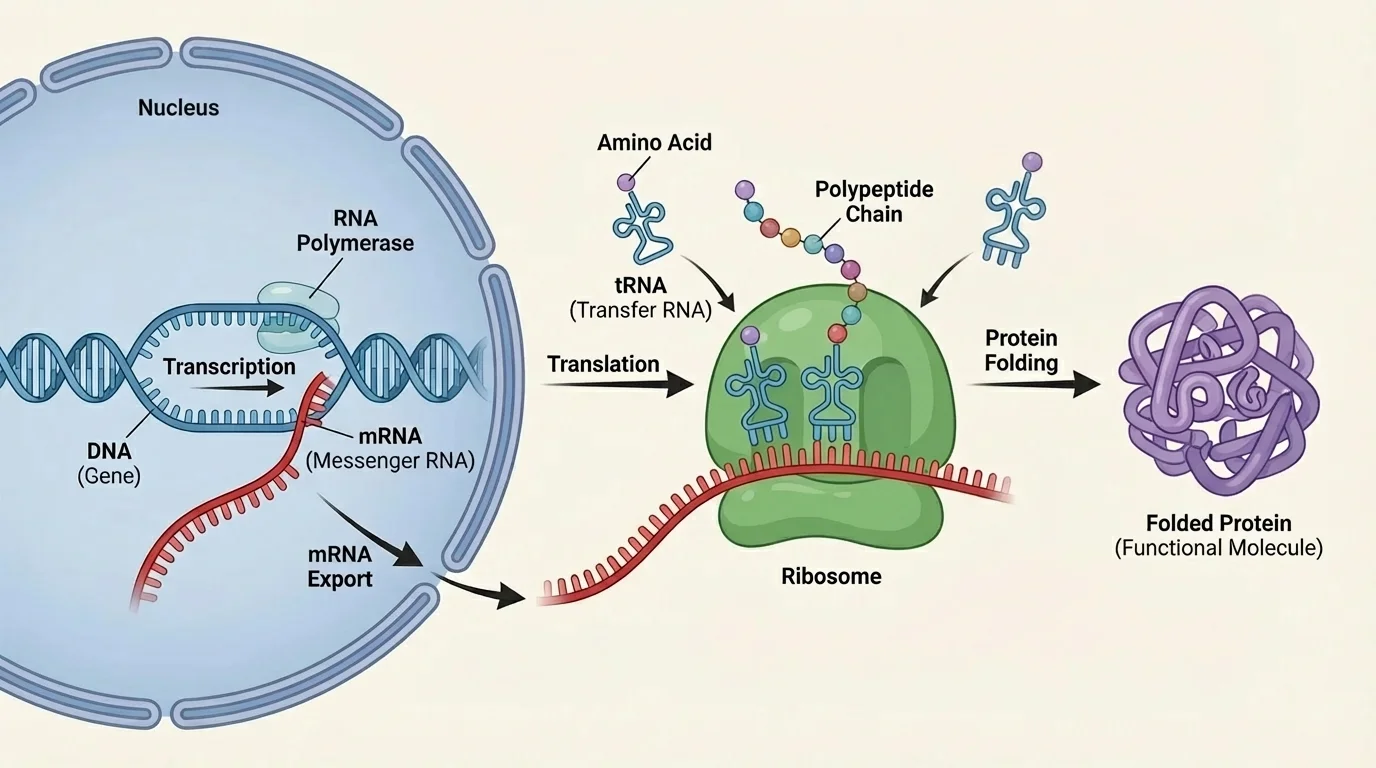
The order of amino acids matters because protein shape determines protein function. If the sequence changes, the folding may change. If folding changes too much, the protein may stop working properly. This is one reason mutations can have strong effects even when they involve a tiny change in DNA.
A simple numerical example helps show how large proteins can be. If a protein contains 150 amino acids, then the coding region of the gene must specify at least 150 codons. Since each codon contains 3 bases, that requires at least \(150 \times 3 = 450\) DNA bases for the amino acid sequence alone, not counting start, stop, or regulatory regions. Even a modest-sized protein therefore requires a substantial amount of encoded information.
Why gene expression matters
Not every gene is active in every cell at every moment. Cells regulate which genes are turned on or off depending on their type, age, and environment. This selective use of genes is called gene expression, and it is one of the main reasons specialized cells can exist in the same organism while sharing the same DNA.
As you continue, keep [Figure 2] in mind: the path from DNA to protein is the central mechanism connecting heredity to cell behavior.
Proteins carry out most of the work of cells. They are not all the same; different proteins have different structures, and those structures allow different functions. Some proteins form cellular structures, while others send messages, control processes, move materials, or speed up chemical reactions.
Structural proteins help give cells and tissues shape and strength. For example, keratin helps form hair and nails, while collagen provides support in connective tissues. Inside cells, proteins of the cytoskeleton help maintain shape and allow movement of organelles.
Signaling proteins and receptor proteins help cells communicate. Hormones such as insulin are proteins that carry messages through the body. Receptor proteins on cell membranes receive those signals and trigger responses. Without signaling proteins, cells could not coordinate activities such as growth, metabolism, or immune defense.
Regulatory proteins influence which genes are active and when. This allows cells to respond to changing conditions. For example, a cell may produce more of a transport protein when more glucose is needed, or it may reduce production when supplies are abundant.
Transport proteins move substances across membranes or within the body. Hemoglobin in red blood cells transports oxygen. Membrane transport proteins help ions and molecules cross the cell membrane when they cannot pass through on their own.
Some of the most important proteins are enzymes. Enzymes are biological catalysts. They speed up chemical reactions without being used up. Because life depends on constant chemical reactions, enzymes make metabolism possible at normal temperatures. For example, the enzyme amylase helps break down starch, and enzymes in mitochondria help release energy from food molecules such as \(\textrm{C}_6\textrm{H}_{12}\textrm{O}_6\).
Protein function in a real process: cellular respiration
Cells release usable energy from glucose through many enzyme-controlled steps.
Step 1: Glucose contains stored chemical energy.
The formula for glucose is \(\textrm{C}_6\textrm{H}_{12}\textrm{O}_6\).
Step 2: Oxygen is used in the overall process.
At the organism level, the simplified reaction is \(\textrm{C}_6\textrm{H}_{12}\textrm{O}_6 + 6\textrm{O}_2 \rightarrow 6\textrm{CO}_2 + 6\textrm{H}_2\textrm{O}\).
Step 3: Enzymes control the reaction sequence.
Instead of happening in one uncontrolled step, many enzymes guide the process in smaller steps so the cell can capture energy efficiently.
This example shows that proteins are not optional extras; they are the machinery that allows essential reactions to occur.
Because proteins depend on gene instructions, the relationship between genes and proteins helps explain how inherited information becomes visible in cell structure and performance.
One of the most important ideas in modern biology is that most cells in a multicellular organism contain the same DNA, but they do not use the same genes in the same way. A skin cell and a neuron usually have the same genome, yet they make different sets of proteins. That difference in protein production leads to different structures and different functions.
When certain genes are active, a cell builds proteins needed for a particular role. A muscle cell produces large amounts of proteins involved in contraction. A pancreatic cell makes proteins used in hormone production. A neuron produces proteins for membranes, ion channels, and signaling connections. Over time, these protein differences shape the cell itself.
This is why structure and function are inseparable. A cell's membrane proteins affect what signals it receives. Its cytoskeleton affects shape and movement. Its enzymes affect metabolism. Its secreted proteins affect communication with other cells. The pattern of protein production gives a cell its identity.
Some human cells lose structures as they mature to improve their performance. Mature red blood cells in mammals eject their nuclei, creating more space for hemoglobin and making oxygen transport more efficient.
Specialization also depends on timing and location. During development, cells receive signals from neighboring cells and their environment. These signals influence gene expression, which then directs the production of different proteins and leads to different cell fates.
Cell shape often reveals cell function, as seen in [Figure 3]. Specialized cells are not just chemically different; they are architecturally different. Their structures are adaptations that support the jobs they perform in the organism.
Red blood cells are adapted to carry oxygen. Their biconcave shape increases surface area for gas exchange, and their high hemoglobin content allows them to transport oxygen efficiently. In mammals, their lack of a nucleus leaves more room for hemoglobin.
Neurons are adapted for communication. They often have long axons that allow signals to travel over long distances, plus branching dendrites that receive input from many other cells. Their membranes contain proteins that control ion movement and electrical signaling.
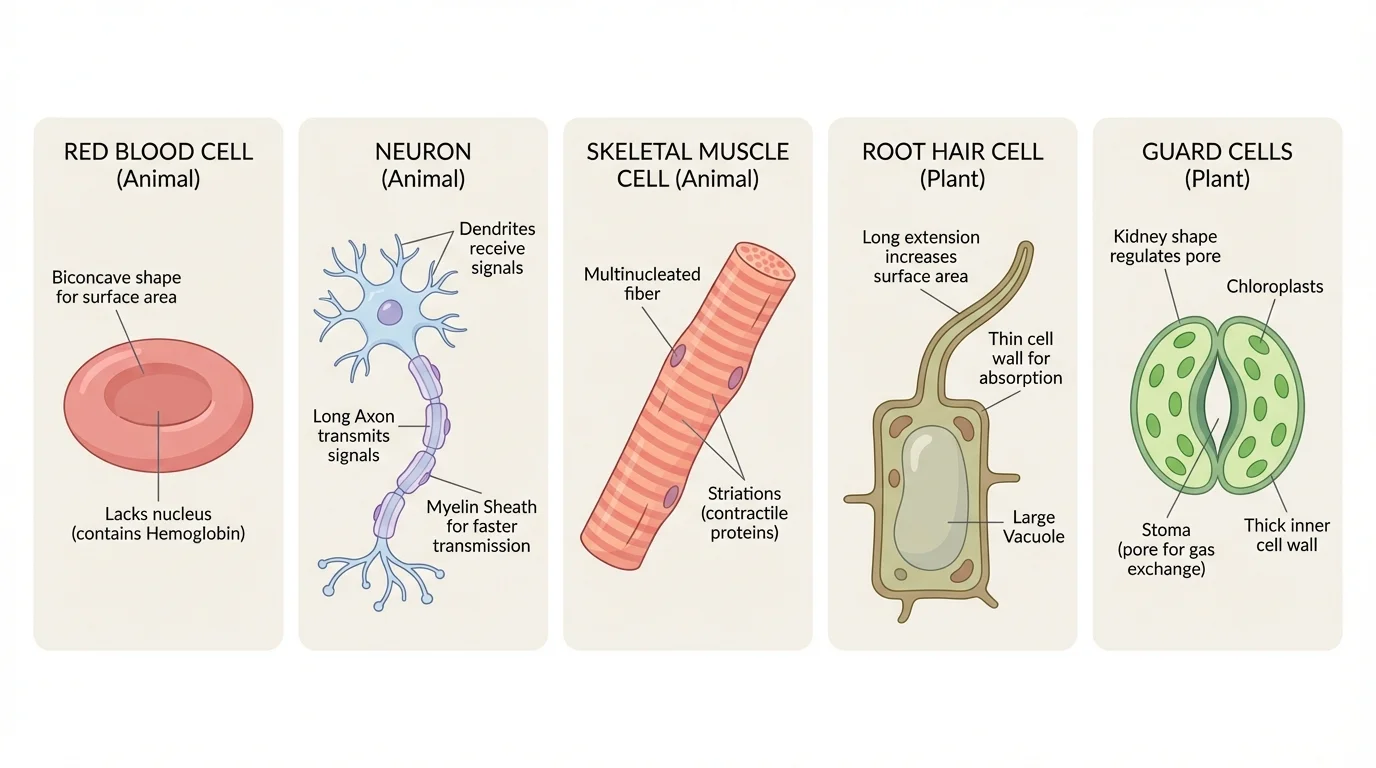
Muscle cells, especially skeletal muscle cells, are packed with protein filaments such as actin and myosin. These interacting proteins allow contraction. Because contraction requires energy, muscle cells also contain many mitochondria.
Root hair cells in plants absorb water and minerals from the soil. Their long extension increases surface area, helping uptake. Membrane transport proteins and a large surface area make them efficient at absorption.
Guard cells surround stomata in leaves and regulate gas exchange. Their shape and wall structure allow them to open and close the pore. This helps the plant balance carbon dioxide intake with water loss.
Palisade mesophyll cells in leaves are specialized for photosynthesis. They contain many chloroplasts, positioning them to capture light energy efficiently. This is a good example of how organelle abundance also reflects function.
| Cell type | Key structural feature | Main function | Important proteins involved |
|---|---|---|---|
| Red blood cell | Biconcave shape, no nucleus in mammals | Transport oxygen | Hemoglobin |
| Neuron | Long axon, branching dendrites | Transmit signals | Ion channels, receptor proteins |
| Muscle cell | Contractile filaments, many mitochondria | Produce movement | Actin, myosin, enzymes |
| Root hair cell | Long hair-like projection | Absorb water and minerals | Transport proteins |
| Guard cell | Paired curved cells around stomata | Control gas exchange | Membrane pumps, signaling proteins |
Table 1. Structural adaptations, functions, and important proteins in several specialized cell types.
When comparing these cells, [Figure 3] makes a key idea visible: different shapes and internal features are not accidental. They arise because different genes are expressed, leading to different protein sets and therefore different functions.
Because proteins are so important, problems in genes or protein folding can disrupt cell function. One example is sickle-cell disease. A mutation in the gene for part of hemoglobin changes one amino acid in the protein. That small change alters the behavior of hemoglobin molecules, causing red blood cells to become sickle-shaped under certain conditions. The altered shape reduces efficient blood flow and oxygen delivery.
This disease is a powerful reminder that biological information is specific. A change in DNA can change a protein. A change in a protein can change cell shape. A change in cell shape can change tissue and organ function. The chain from gene to protein to trait is not abstract; it affects real health outcomes.
Another example involves insulin. If the body cannot produce enough insulin, or if cells do not respond properly to insulin signals, glucose regulation is disrupted. This affects how cells take up and use energy-rich molecules. Here again, proteins are central: insulin itself is a protein hormone, and cell surface receptors involved in insulin signaling are proteins too.
Mutations do not all have the same effect
A mutation may have no noticeable effect if it occurs in a noncritical region, if it does not change the amino acid sequence, or if the altered protein still functions well enough. Other mutations have major effects when they disrupt a crucial protein, change gene regulation, or interfere with development.
Environmental factors can also affect proteins. Temperature, pH, or toxins can alter protein shape and reduce enzyme activity. This is why cells work hard to maintain stable internal conditions.
Understanding DNA, genes, and proteins is not only a biology classroom topic; it is the basis of modern medicine, biotechnology, and agriculture. Genetic testing can identify versions of genes associated with inherited disorders. Doctors and scientists use this information to diagnose disease risk, guide treatment, and sometimes predict how a person may respond to certain drugs.
Biotechnology often uses cells as protein factories. Bacteria can be genetically engineered to produce human insulin. In this process, the human gene for insulin is inserted into bacterial DNA, and the bacteria use that gene instruction to make the protein. This has transformed diabetes treatment and shows how universal the genetic code is across life.
Vaccines and disease research also rely on protein knowledge. Some vaccines train the immune system to recognize a viral protein. If the real virus later enters the body, immune cells can respond more quickly because they recognize that protein structure.
In agriculture, understanding specialized plant cells helps improve crop performance. Scientists may study proteins involved in drought response, root absorption, or disease resistance. By understanding how genes affect proteins and how proteins affect cell function, researchers can develop crops better suited to challenging environments.
"Nothing in biology makes sense except in the light of evolution."
— Theodosius Dobzhansky
This quote matters here because the features of specialized cells and the proteins they depend on have been shaped over time by natural selection. Cells function as they do because their molecular systems support survival and reproduction.
At every scale, from a gene segment to a whole organ system, life depends on information and machinery working together. DNA stores information, genes specify instructions, proteins carry out the work, and specialized cells combine these molecular processes into the functioning of living organisms.
