A forest may look peaceful, but beneath that calm appearance, countless biological interactions are constantly taking place: predators hunt, plants compete for light, fungi break down dead matter, bacteria recycle nutrients, and weather shapes every living thing. The surprising part is that all of this activity can produce a kind of long-term stability. Ecosystems are not frozen in place, yet under stable conditions they often keep roughly similar numbers and types of organisms for many years. That balance is powerful, but it is not unlimited.
To understand this, it helps to think of an ecosystem as a network rather than a collection of separate species. An ecosystem includes living organisms and nonliving factors such as sunlight, water, temperature, soil, and available space. Stability happens because populations influence one another. If one species grows too quickly, it may run short of food, face more predation, spread disease more easily, or encounter stronger competition. These responses tend to push population sizes back toward a sustainable range.
Ecosystem stability refers to the tendency of an ecosystem to maintain its overall structure and function over time, even though individual populations may rise and fall.
Resilience is the ability of an ecosystem to recover after a disturbance and return to a condition similar to its earlier state.
Disturbance is an event that changes ecosystem conditions, such as a fire, flood, drought, storm, disease outbreak, or human activity.
No ecosystem is perfectly constant. Seasons change, rainfall varies, and populations naturally fluctuate. What matters is that, under relatively stable conditions, those fluctuations often stay within limits. A meadow may have more grasshoppers one year and fewer the next, but still remain a meadow with grasses, insects, birds, and soil organisms. This pattern is sometimes called dynamic equilibrium: the system changes continually, yet its overall identity persists.
The relative constancy of ecosystems depends on many interacting controls. One major control is the idea of limiting factors. A limiting factor is anything that restricts the growth, size, or distribution of a population. Food, water, oxygen, sunlight, minerals, nesting sites, and temperature can all act as limits. Even if an organism can reproduce rapidly, it cannot continue growing forever in a finite environment.
Some limiting factors depend on population size. If a rabbit population becomes very large, competition for food increases. Diseases may spread more easily because individuals are crowded together. Predators may also increase because prey is abundant. These are called density-dependent factors. Other factors, such as a freeze or hurricane, can affect populations regardless of how crowded they are. These are density-independent factors.
Biodiversity also supports stability. In ecosystems with many species, several organisms may perform similar ecological roles. If one species declines, another may partly fill its role. For example, if one pollinator species has a bad year, other pollinators may still help flowering plants reproduce. Greater biodiversity does not make an ecosystem invincible, but it often increases the chance that the system can continue functioning when conditions change.
Feedbacks help regulate ecosystems
Many ecosystems contain negative feedback loops. A negative feedback loop reduces the effect of a change and helps keep the system within a stable range. For example, when prey numbers increase, predator numbers may increase later. More predators then reduce the prey population, which prevents unlimited prey growth. This does not create perfect balance, but it helps avoid runaway change under normal conditions.
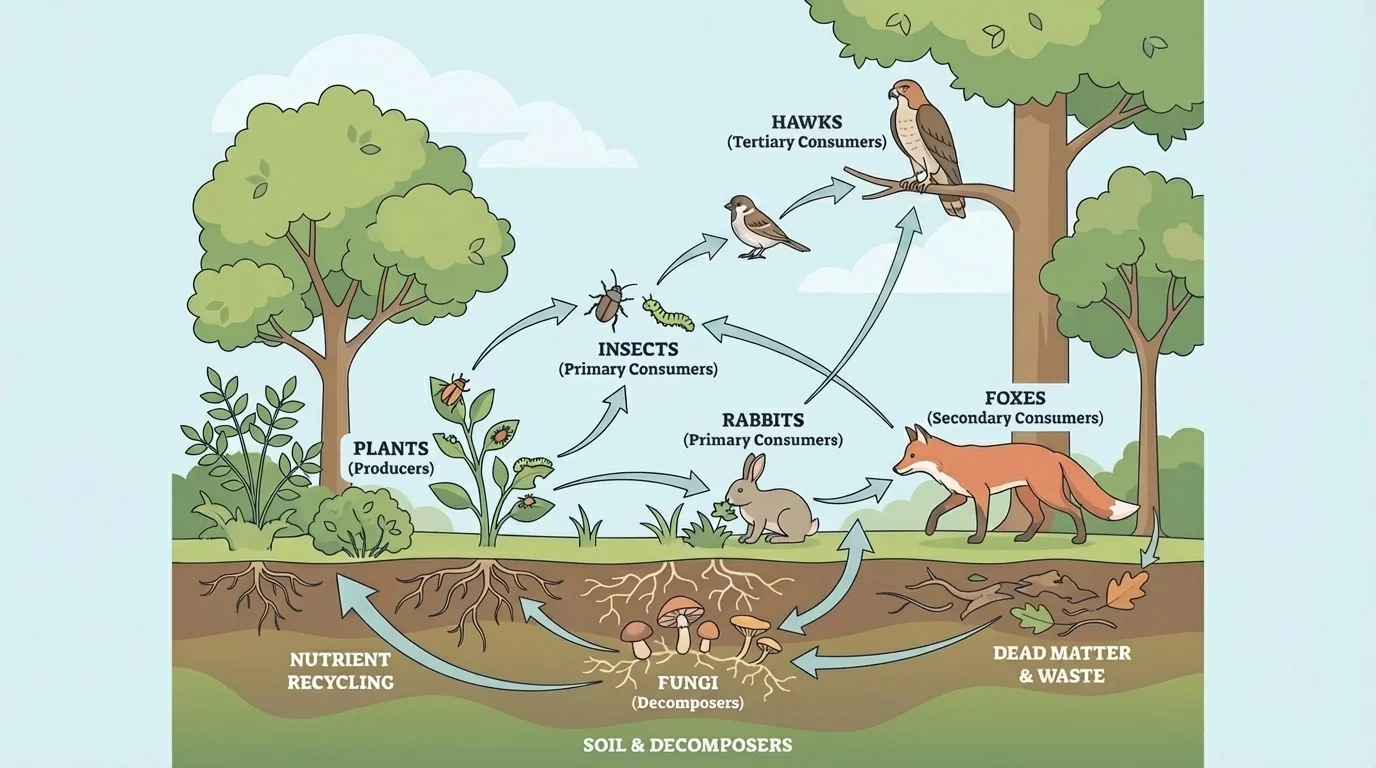
[Figure 1] Another reason ecosystems can remain stable is that matter is recycled while energy flows through the system. Nutrients such as carbon, nitrogen, and phosphorus are reused again and again. Decomposers break down dead organisms and wastes, returning materials to soil, water, and air. Without decomposition, nutrients would remain locked in dead material and become unavailable to living organisms.
One of the best ways to see ecosystem stability is through a food web. A food web links many feeding relationships together, revealing that most organisms interact with several others rather than depending on only one connection. A plant may be eaten by insects, deer, and rabbits; those herbivores may be eaten by snakes, foxes, or hawks; decomposers then process wastes and dead remains.
These connections matter because a change in one population can ripple through the entire system. If insect numbers fall sharply, insect-eating birds may decline. If predators disappear, herbivores may increase and consume vegetation faster than it can regrow. Ecologists call these chain reactions trophic cascades when effects move through multiple feeding levels.
Not all interactions are about eating. Organisms also compete. Plants compete for sunlight, water, and soil nutrients. Birds compete for nesting sites. Animals compete for territory or mates. Competition can prevent any one species from taking over too easily, especially when many species share resources in slightly different ways.
Other interactions are cooperative or mutually beneficial. In mutualism, both species benefit. Pollinators gain nectar, while flowers get their pollen transferred. Nitrogen-fixing bacteria living near plant roots help supply usable nitrogen compounds, and the plants provide energy-rich molecules made during photosynthesis. These partnerships strengthen ecosystem function because they connect species through exchange as well as conflict.
Decomposers are sometimes overlooked, but they are essential. Fungi, bacteria, and detritivores break down organic matter and release nutrients back into the environment. In chemical terms, decomposers help return materials such as carbon and nitrogen to forms that other organisms can use. Carbon may return to the atmosphere as \(\textrm{CO}_2\), while nitrogen compounds return to soil and water in forms other organisms can use. Without decomposers, productivity would eventually collapse because nutrients would stop cycling efficiently.
Later, when we discuss ecosystem shifts, the food-web pattern in [Figure 1] remains important because it shows why the loss of one species can affect many others at once. Ecosystems are stable partly because they are connected, but those same connections can also spread disturbance.
Ecosystems often stay recognizable over long periods not because nothing changes, but because change is constrained, as [Figure 2] illustrates. Population sizes usually rise and fall around a range that the environment can support. This is dynamic equilibrium: motion and fluctuation inside a system whose general structure persists.
A key idea here is carrying capacity, the largest population size of a species that an environment can sustain over time. Carrying capacity depends on available food, water, shelter, territory, and other resources. If resources are abundant, the carrying capacity may increase. If drought reduces plant growth, it may decrease.
Suppose a grassland can support about \(500\) deer. If the population rises to \(620\), overgrazing may reduce food supplies, and more deer may die or reproduce less successfully. If the population falls to \(380\), food may become plentiful again, allowing the population to grow. A simple measure of population change is
\[\textrm{population growth rate} = \frac{\textrm{births} + \textrm{immigration} - \textrm{deaths} - \textrm{emigration}}{\textrm{initial population}}\]
If a fish population starts at \(200\), with \(40\) births, \(10\) immigrants, \(30\) deaths, and \(20\) emigrants over a season, then the net change is \(40 + 10 - 30 - 20 = 0\). The growth rate is \(\dfrac{0}{200} = 0\). The population changed in its internal processes, but the overall size remained the same.
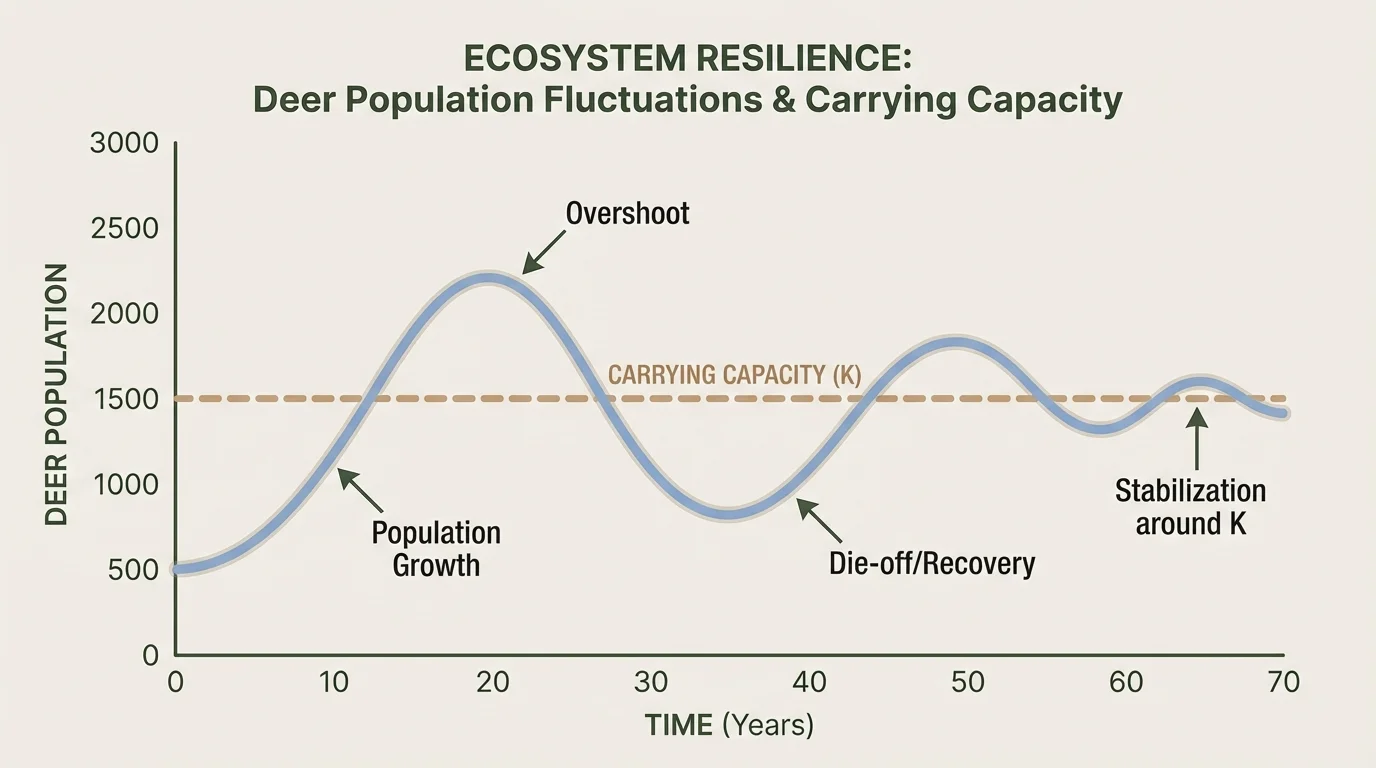
This does not mean every species in the ecosystem has a perfectly stable population. Some fluctuate more than others. Predator populations often lag behind prey populations. Plant populations may vary with rainfall. Migratory species may be present only during part of the year. Yet the ecosystem can still remain broadly stable if its major functions continue: energy transfer, nutrient cycling, reproduction, decomposition, and habitat use.
Some ecosystems that seem extremely stable are actually maintained by regular disturbance. Certain grasslands and pine forests depend on periodic low-intensity fires to prevent woody plants from taking over completely.
That idea may sound contradictory, but it is not. Stability does not always mean absence of disturbance. In some ecosystems, predictable small disturbances are part of what keeps the system functioning.
When a modest disturbance affects an ecosystem, the system may recover because its species, interactions, and resource cycles remain largely intact. This ability to rebound is resilience. A windstorm may knock down trees in part of a forest, but seeds in the soil, surviving roots, nearby organisms, and remaining nutrient cycles can support regrowth.
[Figure 3] Disturbances can be biological or physical. Biological disturbances include insect infestations, disease outbreaks, or the arrival of a new predator. Physical disturbances include fires, floods, droughts, volcanic eruptions, severe freezes, and storms. Human-caused disturbances include deforestation, pollution, dam construction, overfishing, and urban development.
Recovery often involves succession, the gradual process by which ecosystems change and rebuild over time. In secondary succession, soil remains after a disturbance such as a fire or abandoned farmland, so grasses and fast-growing plants usually appear first, followed by shrubs and trees. In primary succession, there is no soil at first, as on new lava or bare rock left by retreating glaciers, so recovery is much slower.
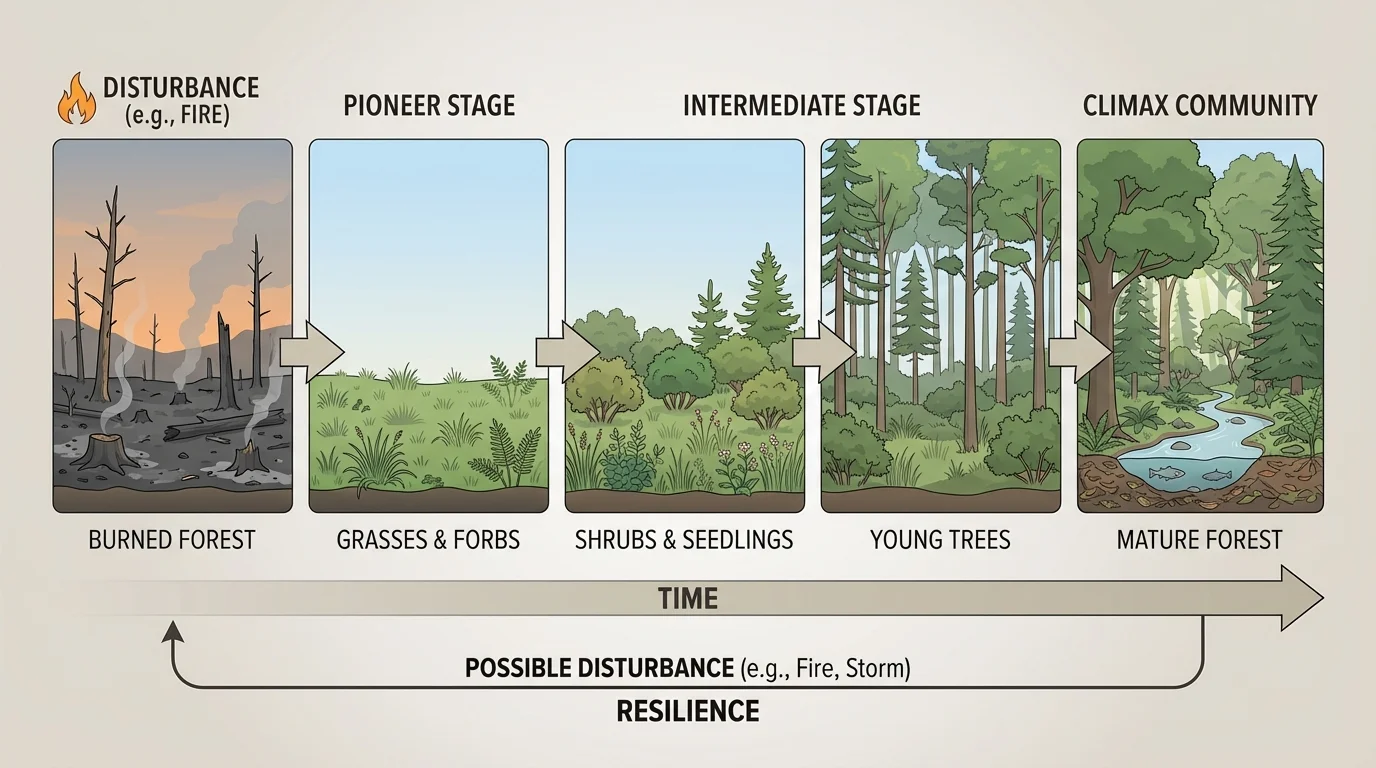
Resilience depends on several factors. Ecosystems recover more easily when disturbances are modest, when biodiversity is high, when soil and water systems remain functional, and when nearby populations can recolonize damaged areas. Recovery is harder when topsoil is lost, pollution persists, keystone species disappear, or climate conditions have changed so much that the original community is no longer favored.
A forest after a low-intensity fire provides a clear example. Some seeds germinate better after heat exposure. Ash can briefly enrich soil with minerals. Sunlight reaches the forest floor where tall trees once blocked it. Because the disturbance is limited and many components remain, the ecosystem may return to a forested state over time. The successional pattern in [Figure 3] shows that recovery is not instant, but it can be remarkably effective.
Case study: Yellowstone wolves and ecosystem recovery
When wolves were reintroduced to Yellowstone National Park in the 1990s, they changed more than just prey numbers.
Step 1: Wolves affected elk behavior and population size.
Elk spent less time overgrazing certain river valleys and young tree stands.
Step 2: Plants such as willow and aspen recovered in some areas.
More plant growth created better habitat for birds, beavers, and other organisms.
Step 3: Physical conditions changed too.
With more vegetation along streams, erosion decreased and stream banks became more stable.
This example shows that restoring one species can strengthen resilience across many parts of an ecosystem.
[Figure 4] Resilience, however, has limits. If fires become too frequent, droughts become too severe, or pollution continues for years, recovery may fail. Then the ecosystem may not return to its earlier condition.
Sometimes an ecosystem crosses a threshold and changes into a different long-lasting condition. These tipping points occur when disturbances or population changes become large enough to reorganize the system. A clear lake can become a murky, algae-dominated lake. A coral reef can shift to dominance by algae. A grassland can become shrubland or desert-like terrain.
Consider a lake receiving excess fertilizer runoff rich in nitrogen and phosphorus. Those nutrients stimulate heavy algal growth. When algae die, decomposers use large amounts of oxygen while breaking them down. Dissolved oxygen levels may fall so low that fish and many invertebrates die. If rooted aquatic plants disappear, sediment becomes easier to stir up, water stays cloudy, and the lake can remain in a degraded state even if nutrient input is reduced later.
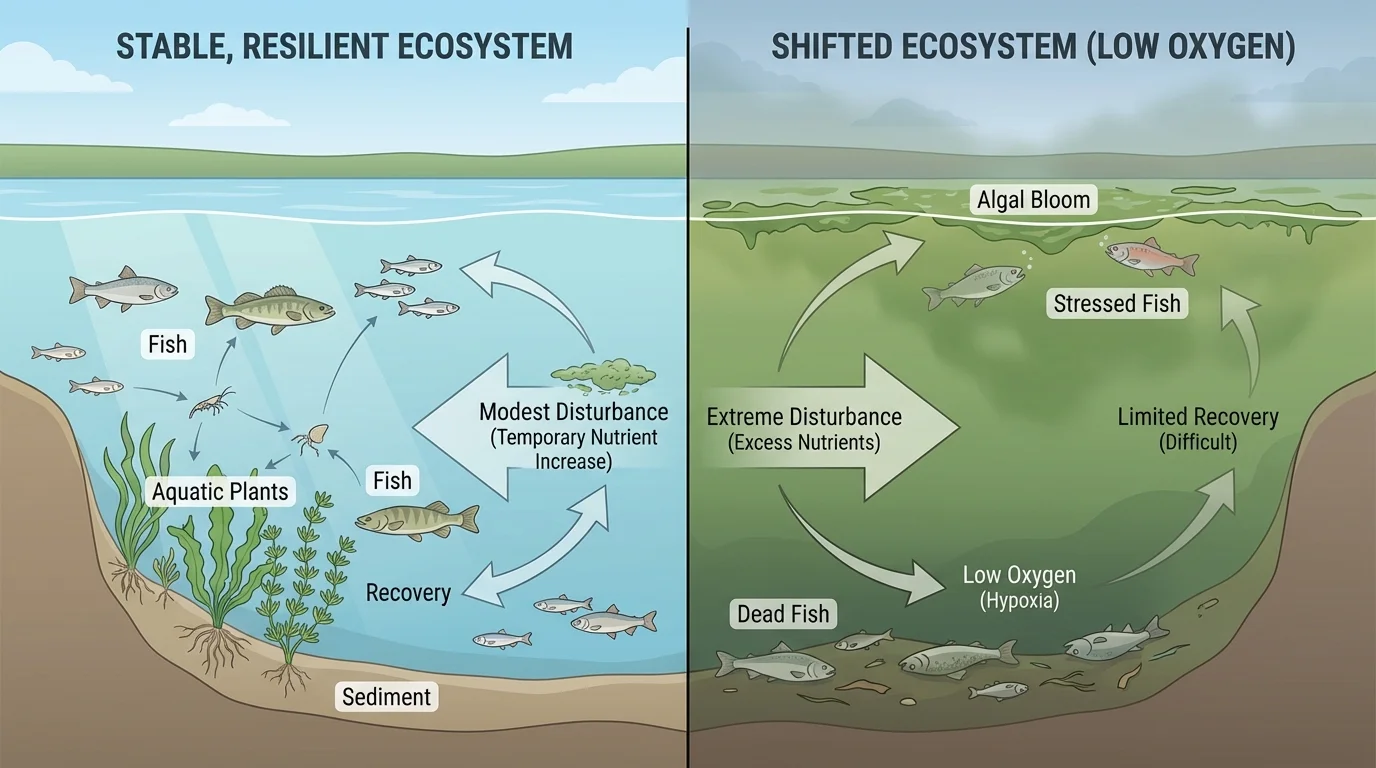
This process is connected to habitat availability and resource access. Fish need oxygen-rich water. Aquatic plants need light. When algal blooms block light and oxygen drops, the habitat itself changes. The issue is not only fewer individuals of one species; the ecosystem's basic conditions are altered.
Extreme fluctuations in population size can also challenge ecosystem function. If a herbivore population explodes because predators are removed, vegetation may be consumed faster than it can regrow. Soil may erode, stream temperatures may rise because of lost shade, and habitat for birds and insects may shrink. On the other hand, if a crucial pollinator or prey species crashes suddenly, many other populations may decline because food or reproduction becomes limited.
Invasive species are especially important here. An invasive species is one that spreads into a new area and causes harm. Without its usual predators, parasites, or competitors, it may multiply rapidly and disrupt food webs, habitat structure, and nutrient cycles. Invasive zebra mussels, for example, have altered freshwater ecosystems in North America by filtering huge amounts of plankton and changing water clarity and nutrient movement.
Alternative stable states
An ecosystem can sometimes be stable in more than one form. A lake may be stable as a clear-water system or stable as an algae-dominated system. Stability, therefore, does not always mean healthy or desirable. It only means the system tends to remain in that condition unless major changes push it elsewhere.
The lake comparison in [Figure 4] makes this idea visible: both sides are stable states, but one supports far greater biodiversity and oxygen availability than the other.
Coral reefs are among the most diverse ecosystems on Earth, yet they are highly sensitive to temperature change. Coral animals live in partnership with photosynthetic algae. During marine heat waves, corals may expel those algae, a process called bleaching. If heat stress is brief, reefs can recover. If it is prolonged or repeated, many corals die, and algae may take over the reef surface.
Kelp forests show another example. Sea otters eat sea urchins, and sea urchins eat kelp. If otter populations fall, urchin numbers may rise dramatically, creating "urchin barrens" where kelp forests once stood. Since kelp forests provide shelter and food for many species, this shift affects the entire ecosystem.
Forest ecosystems can be resilient after ordinary fires, but climate change may intensify heat and drought so much that repeated severe fires prevent tree regrowth. In such cases, a forest may shift into shrubland because seedlings cannot survive the new conditions.
Agricultural ecosystems also reveal the balance between stability and vulnerability. Monocultures, in which one crop dominates a large area, often have low biodiversity. That can make them productive under controlled conditions, but more vulnerable to pests, disease, and weather extremes because there are fewer backup pathways in the system.
| Ecosystem | Modest Disturbance | Possible Resilient Response | Extreme Disturbance | Possible Shift |
|---|---|---|---|---|
| Forest | Low-intensity fire | Secondary succession, tree regrowth | Repeated severe fires plus drought | Shrubland or grass-dominated landscape |
| Lake | Short-term sediment input | Water clears as plants recover | Chronic nutrient pollution | Algal bloom state with low oxygen |
| Coral reef | Brief storm damage | Coral regrowth and recolonization | Repeated heat waves and acidification | Algae-dominated reef |
| Grassland | Seasonal grazing | Plant regrowth | Overgrazing and prolonged drought | Desertification risk |
Table 1. Examples of how ecosystems may recover from modest disturbance or shift under more extreme stress.
These examples reveal a central idea: the same ecosystem can seem stable for decades and then change rapidly if conditions cross important biological or physical thresholds.
People depend on stable ecosystems for clean water, fertile soil, pollination, climate regulation, fisheries, timber, and recreation. When ecosystems lose resilience, human societies feel the effects. Fisheries collapse, crop yields become less reliable, flood risks increase, and disease patterns may shift.
Conservation biology and ecosystem management aim to preserve or restore resilience. Common strategies include protecting biodiversity, limiting habitat fragmentation, reducing pollution, controlling invasive species, restoring wetlands, maintaining predator populations, and planning harvests that stay below replacement rates. In fisheries, for example, if a population reproduces slowly and too many adults are removed, the stock may crash and recovery may take years or fail entirely.
Energy enters most ecosystems through photosynthesis. Producers convert light energy into chemical energy stored in molecules such as \(\textrm{C}_6\textrm{H}_{12}\textrm{O}_6\). Consumers obtain that energy by eating producers or other consumers, and decomposers return nutrients to the environment.
Restoration efforts often succeed best when they rebuild interactions, not just species counts. Planting trees alone may not restore a forest if soils are degraded, seed dispersers are absent, water flow is altered, or invasive plants dominate the site. Healthy ecosystems depend on relationships, feedbacks, and physical conditions working together.
Scientists monitor ecosystems using measurements such as species richness, population size, dissolved oxygen, nutrient concentration, vegetation cover, and rates of primary productivity. These data help identify early warning signs before a system reaches a tipping point.
Although ecology often focuses on patterns rather than exact prediction, simple quantitative tools can still help us understand what is happening. One useful measure is percent change.
If a bird population drops from \(800\) individuals to \(600\), then the change is \(600 - 800 = -200\). The percent change is
\[\frac{-200}{800} \times 100 = -25\%\]
A \(25\%\) decline may be manageable in some cases, but if that bird is a key seed disperser or predator, the ecological effect could be much larger than the number alone suggests.
Numeric example: oxygen decline in a lake
A healthy lake area has dissolved oxygen of \(9 \textrm{ mg/L}\). After a major algal bloom, oxygen falls to \(4 \textrm{ mg/L}\).
Step 1: Find the change.
The change is \(4 - 9 = -5 \textrm{ mg/L}\).
Step 2: Calculate percent change.
\(\dfrac{-5}{9} \times 100 \approx -55.6\%\)
Step 3: Interpret the result.
An oxygen decrease of about \(55.6\%\) can severely reduce habitat quality for fish and many invertebrates.
This is a good example of how a physical change in resources can reshape an ecosystem.
Ecologists also compare diversity across places or time periods. If two meadows each contain \(20\) species, they may still differ in stability if one is dominated almost entirely by one species while the other has a more even distribution. Diversity is not just about the number of species, but also their relative abundance.
The biggest lesson from ecosystem dynamics is that stability is real, but it is not guaranteed. Ecosystems can absorb some change because of the complex interactions among organisms and their environment. Yet when fluctuations become extreme, resources and habitats can be pushed beyond the limits that keep the system functioning in its familiar way.
