A healthy forest, lake, reef, or grassland can look permanent, but many ecosystems are more delicate than they appear. A single new highway can split a forest into isolated patches. Excess fertilizer can turn a lake into a low-oxygen zone. A fish population that seems abundant can collapse if people harvest it faster than it can reproduce. Human activity has become powerful enough to reshape ecosystems on local, regional, and global scales.
An ecosystem includes living organisms and the nonliving parts of their environment, such as water, temperature, sunlight, soil, and air. Within an ecosystem, organisms interact with one another through feeding, competition, cooperation, decomposition, and reproduction. Energy flows through food webs, while matter cycles through air, water, and soil. When these interactions remain within certain limits, the system can stay relatively stable over time.
But stability does not mean the ecosystem cannot change. Ecosystems are dynamic. Fires, storms, droughts, disease outbreaks, and seasonal shifts all affect them naturally. Many ecosystems can recover from limited disturbances because populations adapt, species recolonize, and nutrient cycles continue. This ability to absorb change and still function is called resilience.
Ecosystem disruption happens when environmental changes alter the normal interactions among organisms and between organisms and abiotic factors, reducing stability or damaging the ability of the system to function. Biodiversity refers to the variety of life in an area, including genetic variation, species diversity, and ecosystem diversity.
When disturbances become too intense, too frequent, or too widespread, ecosystems may not recover easily. Species can decline, food webs can weaken, and important ecological processes can break down. Human-caused changes often create exactly this kind of pressure because they can happen rapidly and affect many parts of the system at once.
Anthropogenic change means environmental change caused by human activity. Some of these changes are direct, such as cutting down forests or releasing waste into rivers. Others are indirect, such as changing atmospheric concentrations of greenhouse gases or moving species to new continents through trade and travel. In many places, several human pressures act together, making the impact more severe than any one factor alone.
The major drivers discussed in ecology are habitat destruction, pollution, introduction of invasive species, overexploitation, and climate change. These drivers often overlap. For example, climate change can make habitats less suitable, while pollution may weaken populations and make them easier for invasive species to outcompete. Understanding ecosystems means understanding these combined effects, not just isolated problems.
Food webs connect producers, consumers, and decomposers. If one major population changes sharply, the effects can spread to many other organisms. That is why ecosystem disruption is often not a single-species problem but a network problem.
Because ecosystems involve many interacting parts, a small change in one place can trigger larger consequences elsewhere. This is why ecologists pay attention to feedback loops, thresholds, and long-term population trends rather than only short-term observations.
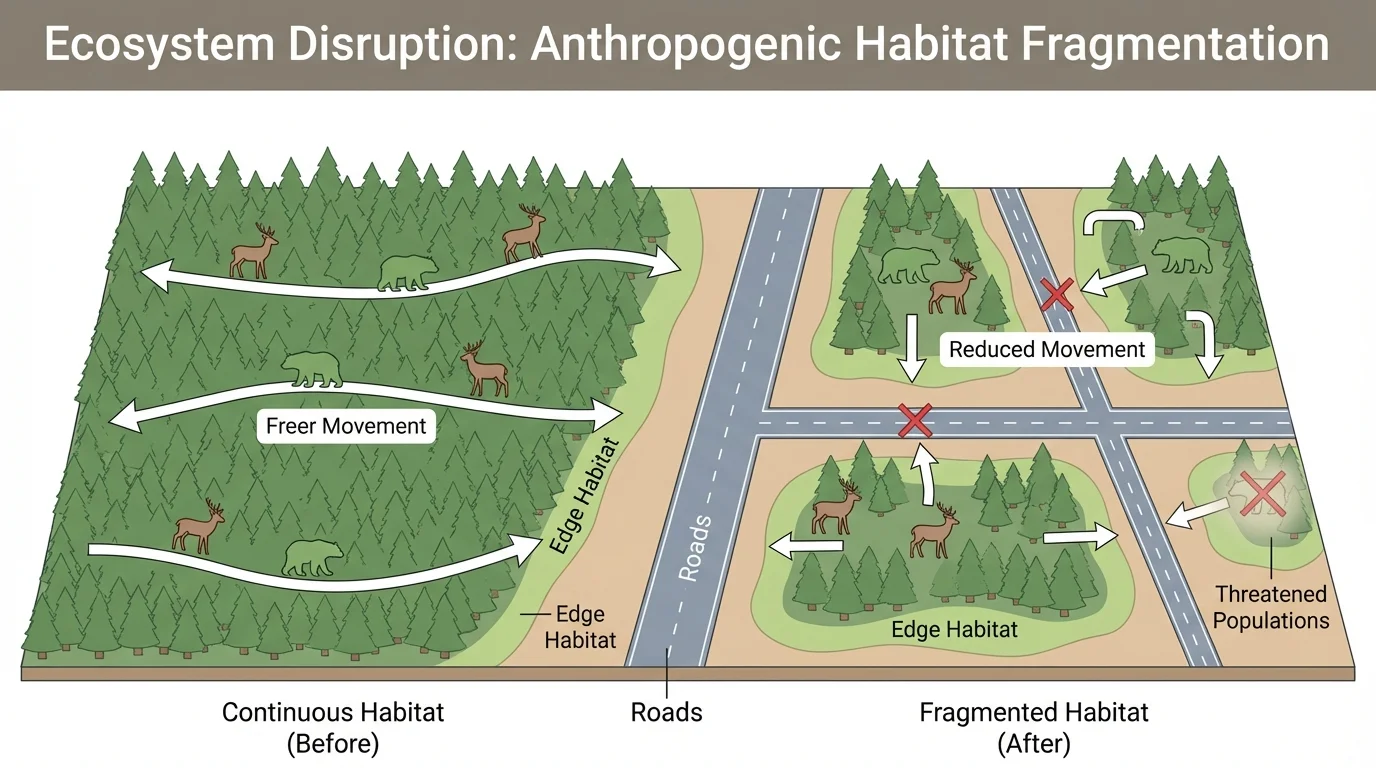
Among the most serious human impacts is habitat fragmentation, the breaking of a large, continuous habitat into smaller isolated pieces, as [Figure 1] illustrates. Roads, cities, farms, dams, mines, and logging operations can all reduce or divide habitat. Even when some habitat remains, it may no longer function the same way if species cannot move freely through it.
Habitat destruction removes shelter, food sources, nesting sites, and breeding areas. Tropical deforestation is a strong example. When forests are cleared for agriculture or development, species that depend on dense tree cover may lose the conditions they need to survive. Orangutans in Southeast Asia, for example, are threatened partly because palm oil plantations replace large areas of rainforest.
Fragmentation creates smaller populations separated by human-made barriers. A bird, wolf, frog, or pollinating insect may not be able to move between patches to find mates, food, or new territory. Smaller populations are more vulnerable to disease, inbreeding, and random events. Edge habitats also increase. Conditions at the edge of a forest patch, such as light, wind, temperature, and predator exposure, can differ greatly from the interior.
Wetlands offer another example. Draining wetlands for housing or agriculture destroys breeding grounds for amphibians, feeding sites for birds, and natural filters that improve water quality. Coral reefs can also be physically damaged by destructive fishing practices, coastal construction, and sediment runoff from land.
Some species can survive in surprisingly small areas for a while, but that does not mean the population is secure. Ecologists call this an extinction debt: the full loss may happen years after the habitat damage occurs.
The importance of fragmentation returns later when we discuss climate change. Species under warming conditions often need to shift their ranges, but isolated habitat patches, as shown in [Figure 1], can block that movement.
Pollution introduces harmful substances or excess materials into the environment. It can affect air, water, and soil, and its ecological effects range from immediate poisoning to subtle long-term changes in reproduction, growth, and behavior. Pollution does not always kill organisms directly; sometimes it weakens them or disrupts the conditions they need.
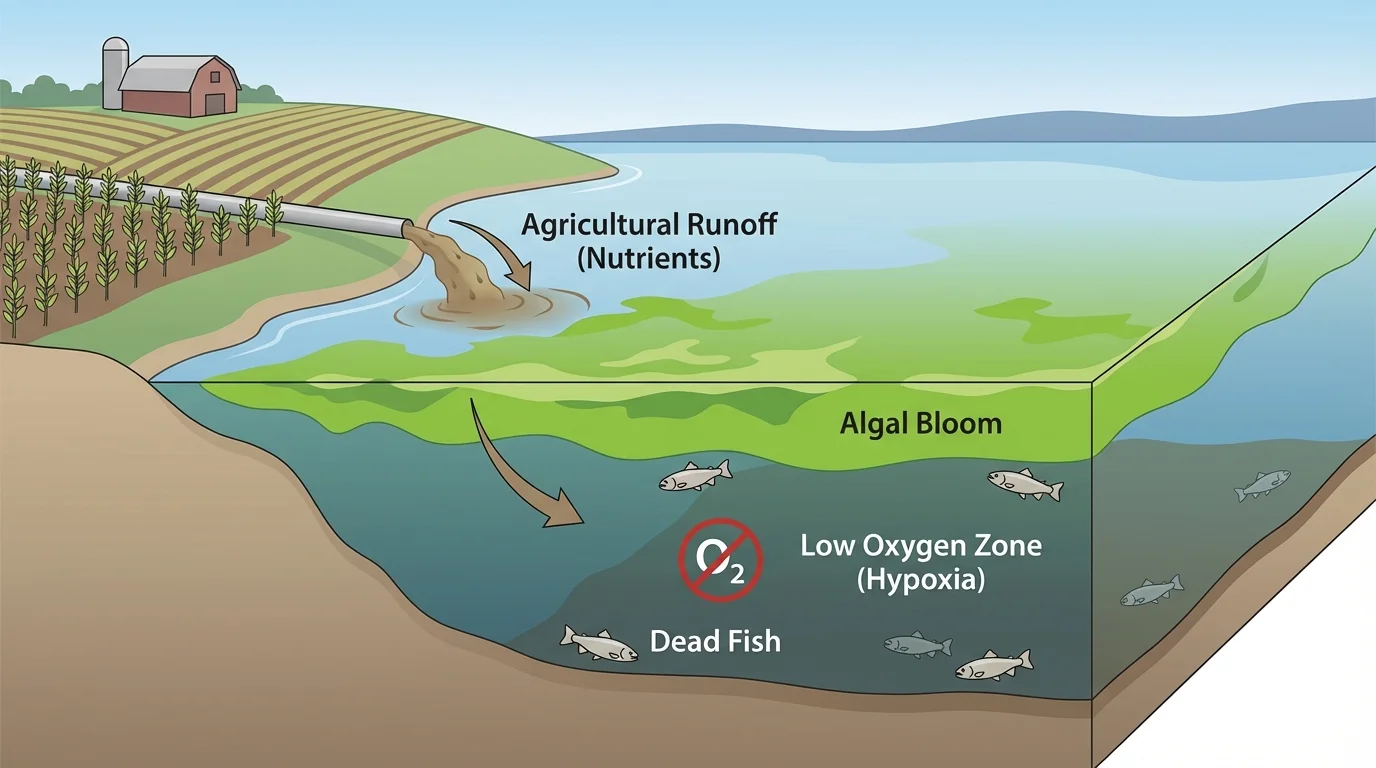
Water pollution is especially important in ecosystems because many pollutants move easily through rivers, lakes, groundwater, and oceans. Fertilizer runoff from farms often contains compounds rich in nitrogen and phosphorus. When too many nutrients enter a lake or coastal zone, producers such as algae grow rapidly. This process is called eutrophication, and [Figure 2] shows the sequence clearly. After the algal bloom, decomposition by bacteria consumes dissolved oxygen, sometimes creating conditions too oxygen-poor for fish and many invertebrates.
The chemistry matters. Fertilizers often contain nitrate compounds, including forms with the ion \(\textrm{NO}_3^-\), which can wash into waterways. Phosphate, often present in forms related to \(\textrm{PO}_4^{3-}\), also stimulates excessive growth. If dissolved oxygen in water drops from about \(8 \textrm{ mg/L}\) to \(2 \textrm{ mg/L}\), many aquatic organisms experience severe stress or die. This numerical drop helps explain why nutrient pollution can transform an ecosystem quickly.
Some pollutants become more concentrated at higher levels of a food chain. This process is called biomagnification. A toxin may be present in tiny amounts in water, then accumulate in small organisms, then in fish, and then in birds or mammals that eat many fish. Historic declines in birds of prey were linked to pesticides such as DDT, which interfered with eggshell formation.
Air pollution also affects ecosystems. Sulfur dioxide and nitrogen oxides can contribute to acid rain, which changes soil and water chemistry. Ground-level ozone can damage plant tissues and reduce photosynthesis. Plastic pollution harms marine life when animals ingest plastic fragments or become entangled in fishing gear.
| Pollution type | Common source | Major ecological effect |
|---|---|---|
| Nutrient pollution | Fertilizer runoff, sewage | Algal blooms, low oxygen, fish kills |
| Toxic chemicals | Pesticides, industrial waste | Poisoning, reproductive failure, food web contamination |
| Air pollutants | Vehicles, factories, power plants | Acid rain, plant damage, altered soil and water chemistry |
| Plastic pollution | Waste mismanagement, fishing gear | Ingestion, entanglement, habitat contamination |
Table 1. Major types of pollution, their common sources, and key ecological effects.
Pollution often interacts with other environmental stresses. A fish population already under pressure from warming water may tolerate much less oxygen loss. A top predator exposed to toxins may have lower reproductive success, which can ripple through the food web. The low-oxygen zone in [Figure 2] is not just a chemistry problem; it becomes a population and biodiversity problem.
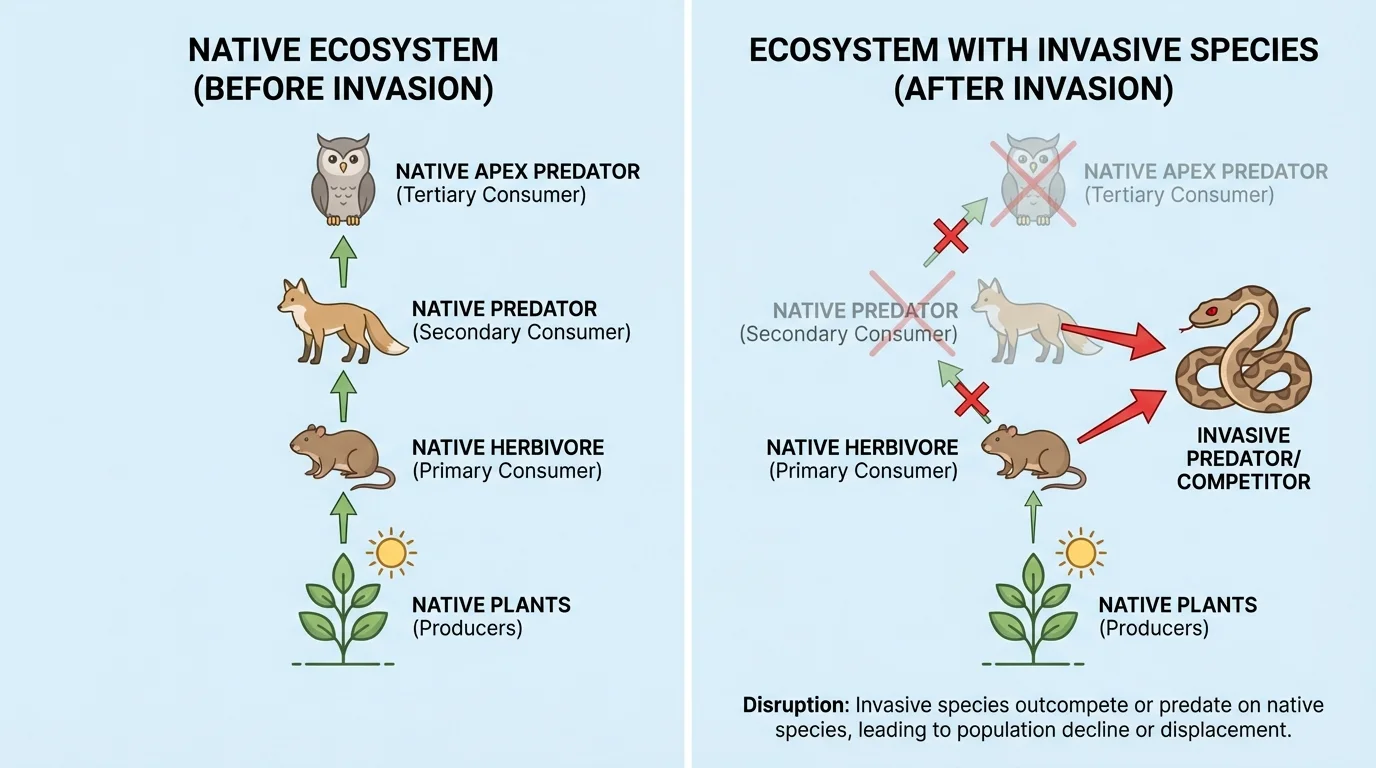
An invasive species is a nonnative organism that spreads in a new environment and causes harm. Not every introduced species becomes invasive, but when one does, it can transform ecosystem interactions. As [Figure 3] shows, adding one new competitor or predator can alter multiple feeding relationships at once.
Invasive species may outcompete native species for food, light, nesting sites, or territory. They may have no natural predators in the new location, allowing their populations to grow rapidly. Some also reproduce quickly or tolerate a wide range of conditions. Zebra mussels in North America, for example, spread through waterways, attach to hard surfaces, and filter large amounts of water, changing nutrient flow and harming native aquatic organisms.
On islands, invasive predators are often especially destructive because many island species evolved without them. Rats, cats, and snakes introduced by humans have caused severe declines in birds, reptiles, and small mammals. In Guam, the brown tree snake devastated native bird populations after it was introduced.
Plants can be invasive too. Kudzu in the southeastern United States grows rapidly and can smother native vegetation by blocking sunlight. Invasive plants may alter soil chemistry, fire frequency, or water availability, changing habitat conditions for many other species.
Why invasive species are ecosystem problems, not just species problems
When a new species enters a food web, it may affect prey, predators, competitors, decomposers, and even nutrient cycling. The visible decline of one native species is often only the first sign of broader ecological reorganization.
Invasive species also connect to global trade and climate change. Cargo ships, imported plants, pet releases, and accidental transport all move organisms around the world. Warming temperatures can then help some invaders survive in places that were once too cold. The altered food web in [Figure 3] helps explain why ecologists monitor invasions early, before they become hard to reverse.
Overexploitation occurs when humans remove organisms from a population faster than the population can replace them through reproduction. This can happen through overfishing, overhunting, excessive logging, wildlife trade, and even overcollection of medicinal or ornamental plants.
The logic is simple. If a fish population adds about \(10{,}000\) new individuals per year through reproduction, but fishing removes \(15{,}000\) individuals per year, then the net change is \(10{,}000 - 15{,}000 = -5{,}000\) individuals per year. A decline like that cannot continue forever without collapse. Real populations are more complex, but the principle remains: removal must not consistently exceed replacement.
Case study: Atlantic cod collapse
For many years, cod in the North Atlantic seemed abundant enough to support large fisheries.
Step 1: Harvesting technology improved.
Larger boats, sonar, and industrial nets allowed fish to be caught more efficiently than before.
Step 2: Fish were removed faster than the population recovered.
Even though adults were still present, too many breeding individuals were lost.
Step 3: The population crashed.
Once the population dropped below a critical level, recovery became difficult even after fishing restrictions increased.
This case shows that ecosystems can appear productive right up until a tipping point is reached.
Overexploitation can also target top predators, herbivores, or keystone species. Removing too many sea otters, for example, can allow sea urchin populations to increase, which can then overgraze kelp forests. This kind of chain reaction is known as a trophic cascade.
Illegal wildlife trade adds another layer of risk. Species with slow reproduction, such as elephants, rhinos, many sharks, and some parrots, are especially vulnerable because their populations recover slowly after losses.
Climate change differs from many other human impacts because it can affect nearly every ecosystem on Earth. As [Figure 4] illustrates, increasing concentrations of atmospheric gases such as \(\textrm{CO}_2\), \(\textrm{CH}_4\), and \(\textrm{N}_2\textrm{O}\) strengthen the greenhouse effect, trapping more heat in the lower atmosphere. This changes temperature patterns, precipitation, ice cover, sea level, and ocean chemistry.
The greenhouse effect itself is a natural process that keeps Earth warm enough for life. The problem is the additional warming caused by human activities such as burning fossil fuels, deforestation, and some agricultural practices. If average temperature rises even by a few degrees Celsius, that shift can strongly affect migration, breeding, flowering, and food availability.
Marine ecosystems show the danger clearly. Corals live in partnership with microscopic algae. When ocean temperatures stay too high for too long, corals may expel these algae, leading to bleaching. If stressful conditions continue, reefs can die. Coral reefs support huge biodiversity and protect coastlines, so the loss affects both ecosystems and people.
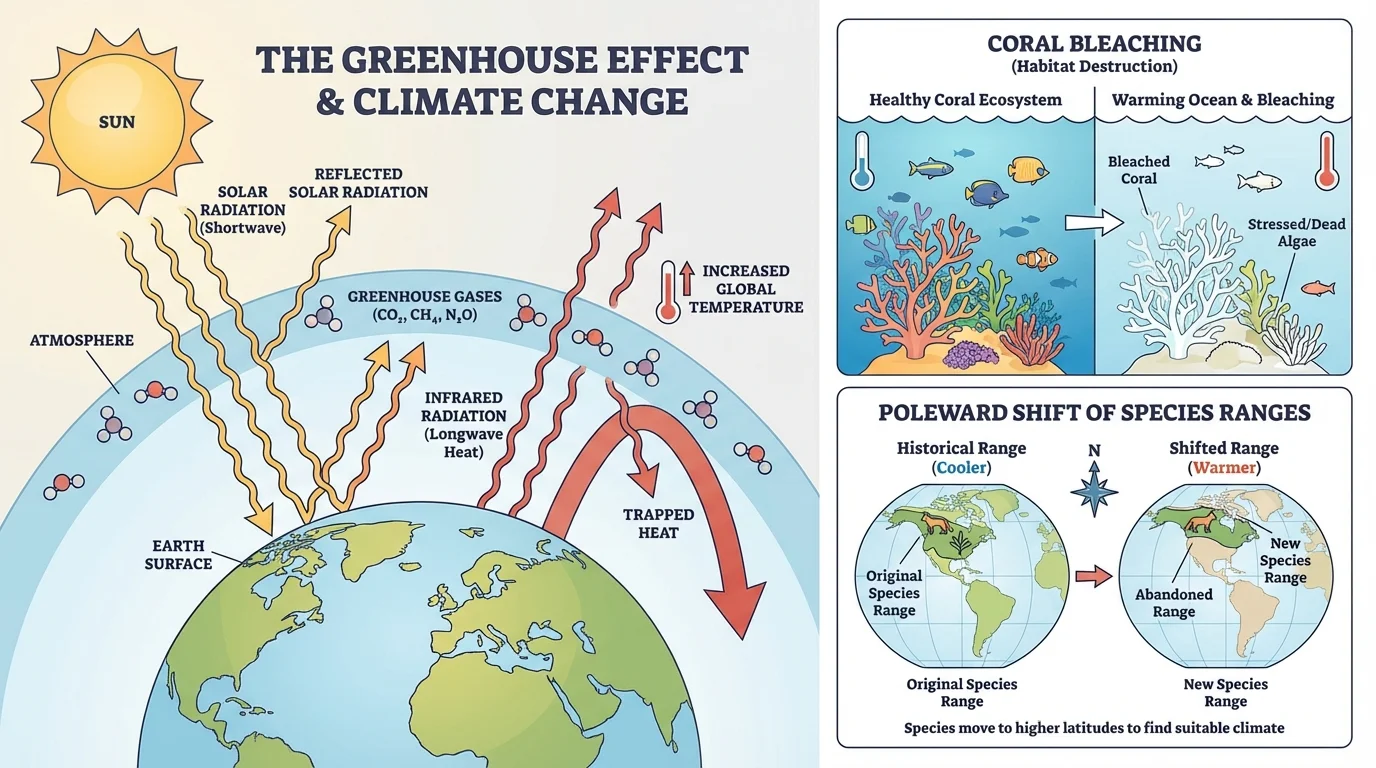
Climate change also shifts where species can live. Some species move poleward or to higher elevations where conditions remain cooler. Others cannot move fast enough or are blocked by fragmented landscapes. This is one reason habitat corridors matter. A species already isolated by roads or development, as we saw in [Figure 1], may not be able to track changing climate zones.
Timing matters too. Many species depend on seasonal cues. If plants flower earlier because of warmer springs, but pollinators do not emerge at the same time, both may be affected. Birds may arrive from migration after peak insect abundance has passed. These timing mismatches can reduce reproductive success and survival.
Climate change interacts with pollution and disease as well. Warmer water holds less dissolved oxygen, worsening the kind of low-oxygen stress illustrated in [Figure 2]. Warmer conditions can also allow some pests, pathogens, and invasive species to expand their ranges.
Not all species face the same level of risk. Specialist species depend on narrow habitat conditions or specific food sources, so they are often more vulnerable than generalists. A panda that depends heavily on bamboo or a coral species sensitive to a narrow temperature range has fewer options when conditions change.
Species with low reproductive rates are also at greater risk. If a species produces few offspring and takes years to reach maturity, recovery from habitat loss or overharvesting can be slow. Small populations often have lower genetic diversity, which reduces their ability to adapt to new conditions or resist disease.
Some species are disproportionately important because they play a major role in maintaining ecosystem structure. A keystone species has an effect larger than expected from its abundance. Sea otters, wolves, and some starfish are classic examples. If a keystone species declines, ecosystem change can spread quickly through multiple trophic levels.
"Everything is connected to everything else."
— A core idea of ecology
Humans are part of these systems too. Ecosystems provide ecosystem services such as pollination, water purification, climate regulation, fisheries, flood control, soil formation, and carbon storage. When ecosystems are disrupted, these benefits become less reliable, which affects agriculture, health, economies, and communities.
Although the challenges are serious, ecosystem damage is not always irreversible. Conservation biology and restoration ecology aim to protect biodiversity and rebuild damaged systems. Protected areas can preserve habitats. Wildlife corridors can reconnect fragmented landscapes. Pollution controls can reduce nutrient and toxic waste. Invasive species can sometimes be removed or contained, especially if detected early.
Restoration projects often try to restart natural processes. Replanting native vegetation, restoring wetlands, removing obsolete dams, and reintroducing locally extinct species can help ecosystems recover. In some rivers, bringing back native plants reduces erosion and improves habitat for fish and birds. In coastal regions, restoring mangroves protects shorelines while also creating nursery habitat for marine life.
Case study: Yellowstone wolves and ecosystem recovery
The reintroduction of wolves to Yellowstone National Park is often used to show how ecosystem interactions matter.
Step 1: Wolves were restored to part of the food web.
This changed elk behavior and reduced heavy browsing in some areas.
Step 2: Vegetation in certain zones recovered.
Willows and aspens grew more successfully where browsing pressure decreased.
Step 3: Other species benefited.
Habitat quality improved for organisms linked to those plant communities, showing how one species can influence many others.
This example is sometimes simplified in popular media, but it still demonstrates that ecological restoration can have broad effects.
Reducing climate change requires large-scale action, including lower emissions, cleaner energy systems, and protection of carbon-storing ecosystems such as forests, peatlands, and seagrass beds. Sustainable harvesting, careful land-use planning, and international cooperation are also essential because ecosystems do not follow political borders.
The central ecological idea is clear: human actions can push ecosystems beyond the range they can easily absorb. Once that happens, species losses and ecosystem damage can accelerate. Protecting ecosystems is therefore not only about preserving scenery or saving a few rare organisms. It is about maintaining the living systems that support life on Earth, including our own.
