A drill can reach only a tiny fraction of the distance to Earth's center, yet scientists know that thousands of kilometers below our feet there is a solid inner core surrounded by liquid metal, all beneath a slowly moving rocky mantle. That sounds almost impossible—until you realize Earth constantly sends out clues through earthquakes, volcanic rocks, ocean crust, and its magnetic field. By putting those clues together, scientists have built a remarkably detailed model of a planet that is active from the inside out.
The deepest human-made holes reach only a small part of the crust. Earth's radius is about 6,371 kilometers, so direct sampling tells us very little about the deep interior. Instead, geologists and geophysicists rely on seismic waves, high-pressure experiments, meteorite comparisons, chemical analysis of volcanic materials, and the magnetic signatures locked into rocks.
This kind of investigation involves building a model, and [Figure 2] helps show why direct sampling alone is not enough. In science, a model is not a guess; it is an evidence-based explanation that accounts for observations. Earth's interior model has become stronger over time because many different types of evidence point to the same layered structure.
Matter can be solid, liquid, or gas depending on temperature and pressure. In Earth science, pressure matters enormously because it rises with depth. A material that would melt near the surface can remain solid deep inside Earth if the pressure is high enough.
That idea is essential for understanding one of the most surprising facts about Earth: the center is incredibly hot, yet part of it remains solid.
When an earthquake occurs, it releases energy that travels through Earth in different ways, as [Figure 1] helps visualize. The paths, speeds, and shadow zones of these waves reveal hidden layers through the bending of waves and the absence of some wave types in certain regions. Seismic evidence is one of the strongest foundations of our understanding of Earth's interior.
There are two major types of body waves. P-waves, or primary waves, are compressional waves. They move by squeezing and expanding material in the same direction the wave travels, so they can pass through solids and liquids. S-waves, or secondary waves, move material side to side and can travel only through solids. That difference turns out to be extremely important.
As seismic waves move through Earth, they change speed and direction when they enter materials with different densities and compositions. This bending is called refraction. Scientists record earthquake waves at stations around the world and compare when the waves arrive. If Earth were uniform all the way through, the waves would follow much simpler paths. Instead, they form patterns that show major internal boundaries.
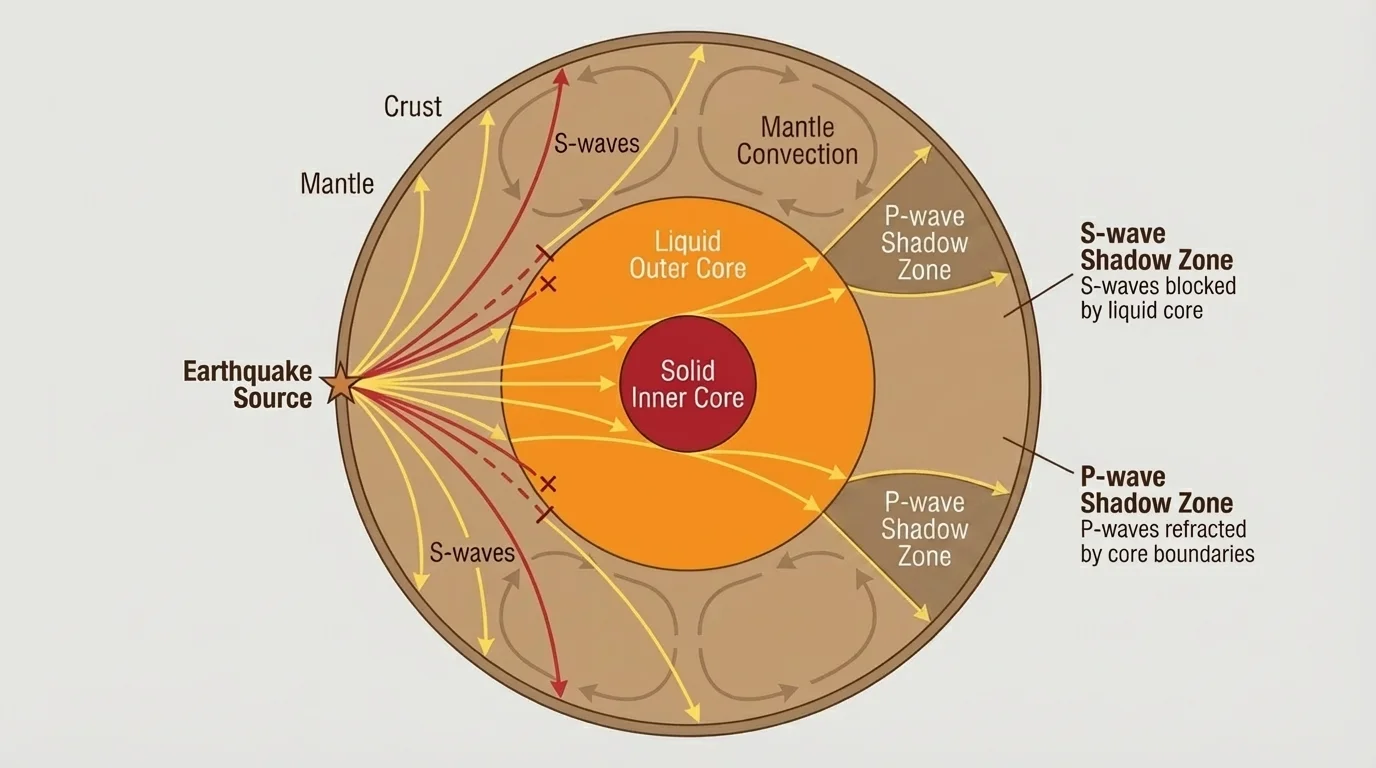
One crucial observation is that S-waves do not pass through the outer core. Since S-waves cannot travel through liquids, this tells us the outer core must be liquid. P-waves do pass through the core, but they slow down and bend strongly there, creating a shadow zone where fewer direct P-waves arrive. This behavior indicates a major boundary between the mantle and the outer core.
Seismic data also show that the inner part of the core behaves differently from the outer core. Some P-waves speed up again deep inside Earth, which supports the conclusion that the inner core is solid. So from wave behavior alone, scientists can infer a solid mantle, a liquid outer core, and a solid inner core.
P-waves are seismic waves that can travel through solids and liquids because they compress material in the direction of motion.
S-waves are seismic waves that travel only through solids because they shear material side to side.
Shadow zone is a region on Earth's surface where certain seismic waves from an earthquake are not directly detected because they are blocked or strongly bent by internal layers.
Later studies using many earthquakes and highly sensitive instruments have refined this picture even further. Scientists can now map zones in the mantle where waves move faster or slower, indicating colder, denser sinking slabs or hotter rising material. These details connect directly to plate tectonics and mantle flow.
The modern model of Earth includes a thin crust, a thick mantle, a liquid outer core, and a solid inner core. These layers differ not only in depth but also in composition, physical state, density, and behavior.
The crust is Earth's outermost solid layer. Oceanic crust is generally thinner and denser than continental crust. Beneath the crust lies the mantle, which is made mostly of solid silicate rock rich in elements such as oxygen, silicon, magnesium, and iron. Although the mantle is solid overall, it can flow very slowly over geologic time.
Below the mantle is the outer core, composed mainly of liquid iron and nickel. Deeper still is the inner core, also mostly iron and nickel, but solid. This seems like a contradiction at first: how can the deeper part be solid if it is even hotter?
The answer is pressure. Temperature increases with depth, but so does pressure. In the outer core, temperatures are high enough that the metallic material is liquid under those pressure conditions. In the inner core, the pressure becomes so extreme that atoms are forced into a solid structure despite the intense heat. In other words, both temperature and pressure determine whether a layer is solid or liquid.
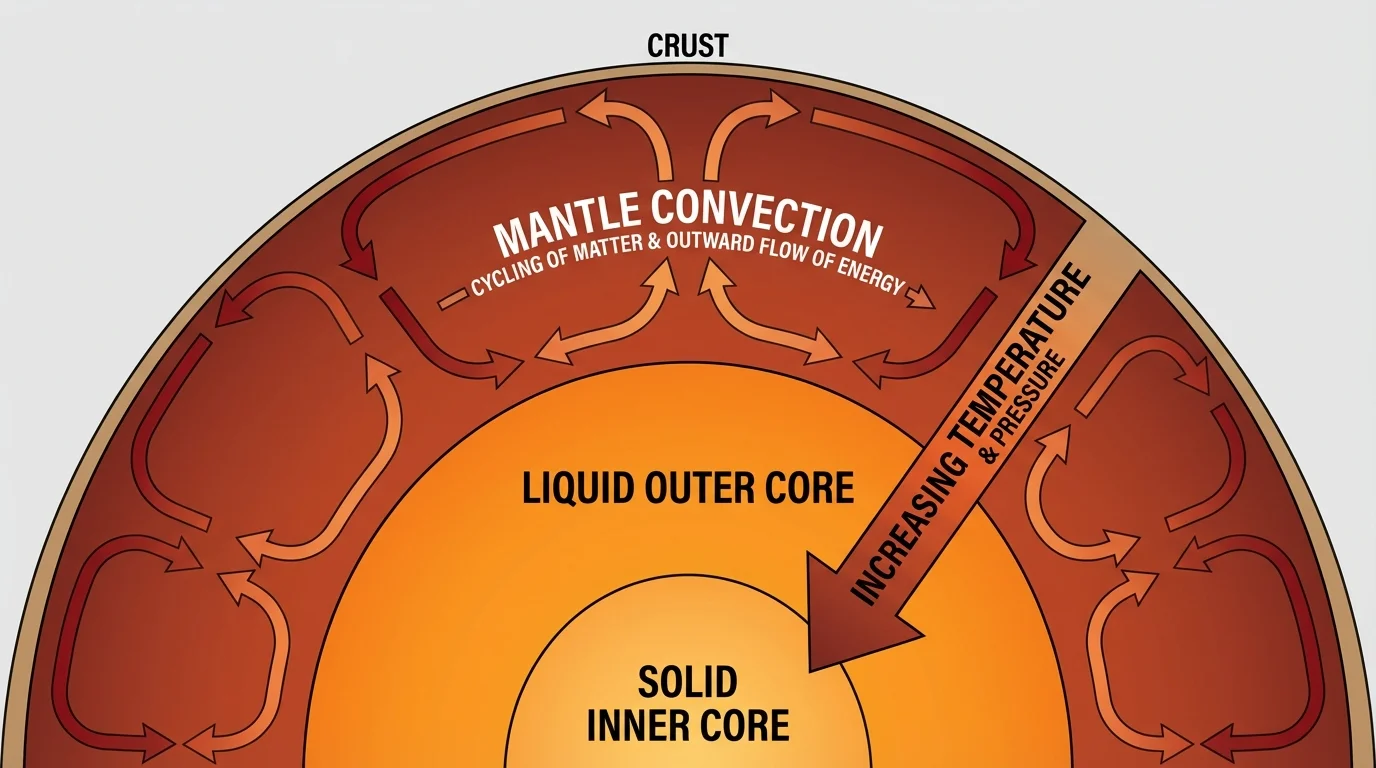
Scientists also distinguish between layers based on mechanical behavior. The rigid outer shell made of the crust and uppermost mantle is called the lithosphere. Beneath it lies a weaker, slowly flowing part of the upper mantle called the asthenosphere. Tectonic plates are pieces of lithosphere that move over the asthenosphere.
| Layer | Main composition | Physical state | Key evidence |
|---|---|---|---|
| Crust | Silicate rock | Solid | Direct sampling, surface geology |
| Mantle | Silicate rock rich in magnesium and iron | Mostly solid, slowly flowing | Seismic waves, mantle rocks from volcanism |
| Outer core | Mainly iron and nickel | Liquid | S-waves blocked, P-waves refracted |
| Inner core | Mainly iron and nickel | Solid | P-wave behavior, density models |
Table 1. Major Earth layers, their compositions, physical states, and the evidence used to identify them.
The layered structure also helps explain Earth's density. Earth's average density is greater than the density of surface rocks, which suggests that denser materials must be concentrated deeper inside. Gravity pulls denser materials inward, so early in Earth's history, heavy substances such as iron sank toward the center while lighter silicate materials remained above.
Even though the mantle is solid rock, it can still flow over millions of years. A material does not need to be liquid to move; glacier ice is solid too, yet it slowly deforms and flows.
This separation of materials, often called planetary differentiation, was a major event in Earth's early history and helped create the layered planet we observe today.
No drill has reached the mantle, but deep drilling and other subsurface investigations still matter. Drilling reveals the structure, temperature, and composition of the crust, while volcanic eruptions can bring mantle-derived material closer to the surface. Combined with laboratory experiments that recreate extreme pressure and temperature, these data help scientists test whether their interior model is physically realistic.
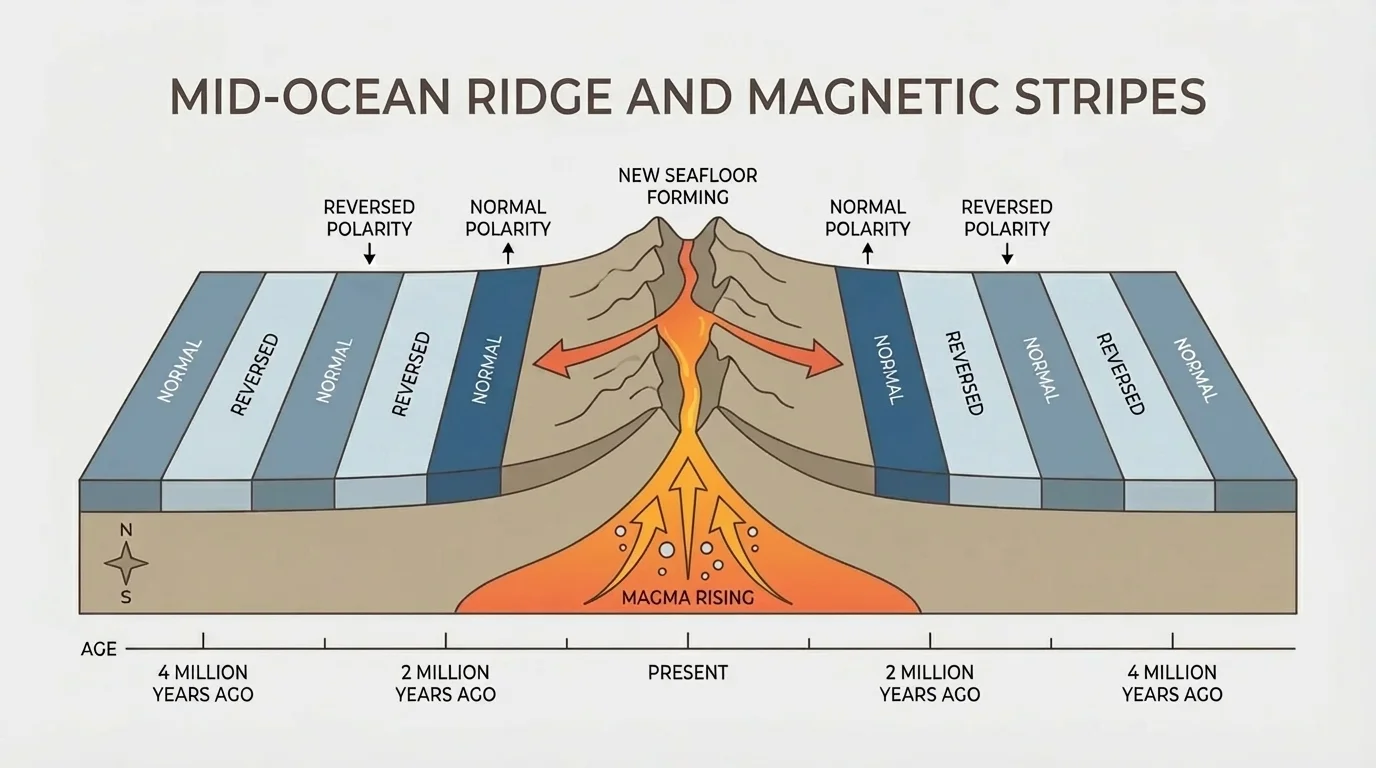
Another powerful line of evidence comes from Earth's magnetic field. Certain iron-bearing minerals in cooling lava align with the direction of the magnetic field at the time the rock forms. This preserved record is called paleomagnetism. When scientists study ancient basalt on the ocean floor, they find alternating bands of normal and reversed magnetic polarity arranged symmetrically about mid-ocean ridges.
[Figure 3] This pattern means two things. First, new ocean crust forms at ridges and moves outward on both sides. Second, Earth's magnetic field has reversed many times in the past. During a reversal, the magnetic north and south poles switch. The rock record preserves this history like a barcode written into the seafloor.
The magnetic field itself is generated by motion in the liquid outer core. As electrically conducting liquid iron moves, it creates electric currents, and those currents generate a magnetic field. This process is called the geodynamo. It links Earth's internal heat and fluid motion directly to a planetary-scale feature that extends far into space.
Rocks also preserve evidence of surface change. Marine fossils high in mountain ranges, layers of volcanic ash, folded rock strata, and ancient shorelines all help reconstruct earlier landscapes. These clues show that continents have collided, oceans have opened and closed, and mountain belts have risen and eroded over vast spans of time.
Why magnetic reversals matter
Magnetic reversals do not mean Earth's core suddenly flips like a solid bar magnet. Instead, the flowing liquid metal in the outer core changes pattern over time. Because lava records the magnetic direction as it cools, reversals provide a timeline that geologists can compare across different places. This makes paleomagnetism a powerful tool for dating ocean crust and confirming seafloor spreading.
Far from being separate topics, interior structure, magnetic history, and surface change are deeply connected parts of one Earth system.
One of the most important scientific ideas in Earth science is that the surface has not always looked the way it does now. Continents shift, oceans widen and shrink, and mountains rise where plates converge. These changes can be reconstructed from multiple kinds of evidence: matching fossils across oceans, identical rock layers on distant continents, glacial scratches in now-warm regions, and the age pattern of ocean crust.
Ocean-floor rocks become progressively older away from mid-ocean ridges. That age pattern matches the magnetic stripes discussed earlier. Together, these observations show that seafloor spreading creates new crust at ridges and carries it outward. Eventually, older oceanic lithosphere can sink back into the mantle at subduction zones.
These reconstructions have allowed scientists to rebuild past supercontinents such as Pangaea. South America and Africa fit together not only by shape but also by rock belts, fossils, and ancient mountain structures. This is much stronger evidence than coastline shape alone.
Case study: reconstructing an ancient ocean basin
Suppose geologists compare the two sides of a modern ocean and find matching fossils, similar rock ages, and a symmetric magnetic pattern on the ocean floor.
Step 1: Identify the matching evidence.
Matching fossils and rock types suggest the regions were once connected.
Step 2: Use magnetic stripes and crust age.
If the youngest crust is at the ridge and older crust lies farther away on both sides, the ocean basin has grown by seafloor spreading.
Step 3: Infer past geography.
Working backward, geologists can estimate where the continents were before the ocean opened.
This is how Earth scientists turn rock evidence into maps of the past.
The same evidence that reconstructs surface motion also supports the idea that Earth's outer shell is broken into moving plates rather than fixed forever in place.
[Figure 4] What actually moves tectonic plates? The main driving process is thermal convection in Earth's interior, together with gravity-driven sinking of denser material. The circulation pattern of hotter rising material and cooler sinking material beneath the plates helps explain why Earth's surface is constantly reshaped.
Earth's internal energy comes from leftover heat from its formation, heat released as dense materials sank early in Earth's history, and heat from radioactive decay of isotopes inside the planet. That energy moves outward. When mantle material is heated, it expands slightly and becomes less dense. Less dense material tends to rise. As it rises and later cools, it can become denser and sink again.
This is the essence of convection: the transfer of heat through the movement of matter. In Earth's mantle, convection is extremely slow, but over millions of years it is powerful enough to move plates, open oceans, and drive subduction. Gravity strengthens this process because colder, denser slabs of lithosphere sink into the mantle at convergent boundaries.
A simple density relationship helps explain the motion: density is mass divided by volume, \[\rho = \frac{m}{V}\]. If a parcel of mantle rock is heated and expands while its mass stays nearly the same, its volume increases and its density decreases. For example, if a sample has mass \(m = 330 \textrm{ g}\) and volume changes from \(100 \textrm{ cm}^3\) to \(110 \textrm{ cm}^3\), its density changes from \(\rho = \dfrac{330}{100} = 3.3 \textrm{ g/cm}^3\) to \(\rho = \dfrac{330}{110} = 3.0 \textrm{ g/cm}^3\). The lower-density material is more buoyant and tends to rise.
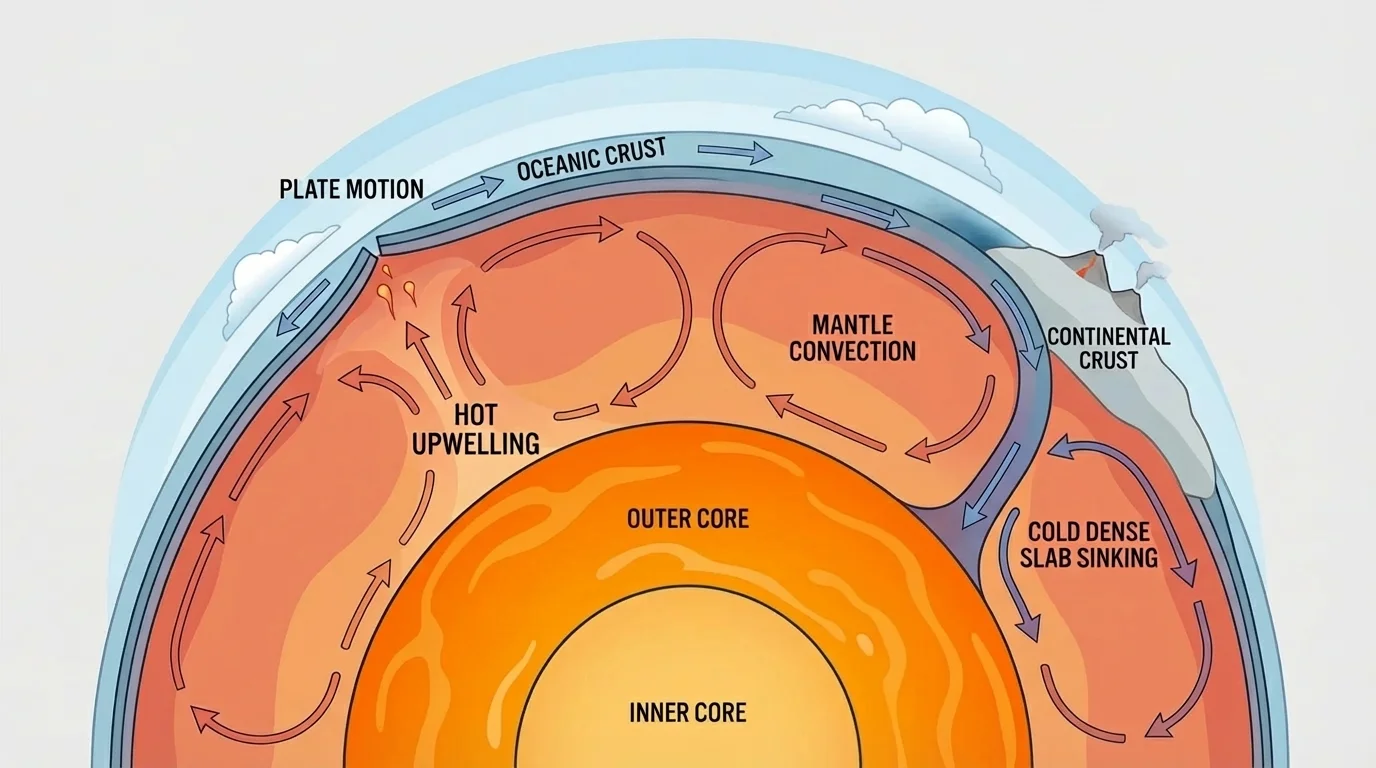
At divergent boundaries, rising mantle helps separate plates and generate new crust. At convergent boundaries, one plate may descend beneath another in a subduction zone. At transform boundaries, plates slide past each other. These different motions produce earthquakes, volcanoes, trenches, ridges, and mountain belts.
Convection in Earth is not as simple as neat circular cells in a textbook sketch. Real mantle flow is complex, three-dimensional, and influenced by plate geometry, temperature differences, composition, and phase changes in minerals. Even so, the basic idea remains the same: heat moves outward, matter circulates, and denser materials tend to sink inward under gravity.
Real-world analogy: convection in everyday life
A pot of soup on a stove gives a useful comparison, although Earth's mantle moves much more slowly and is composed of solid rock.
Step 1: The bottom of the pot heats first.
The warmer soup expands and becomes less dense.
Step 2: The warmer soup rises.
Cooler, denser soup sinks to replace it.
Step 3: A circulation pattern develops.
That circulation transfers heat through movement of material, just as mantle convection transfers Earth's internal heat outward.
The analogy is helpful, but unlike soup, the mantle is solid rock that deforms very slowly.
The evidence from seismic imaging fits this mechanism well. Regions where old plates sink into the mantle often show faster seismic wave speeds, consistent with colder, denser material. Hotter regions tend to slow waves and are often linked with upwelling mantle. This connects back to the seismic patterns first introduced in [Figure 1].
Earth's interior is not isolated from the surface. Plate motion influences the carbon cycle through volcanism and weathering, shapes continents and ocean basins, and affects where earthquakes occur. The liquid outer core generates the magnetic field, which helps shield Earth from charged particles from the Sun. In this way, deep interior processes influence conditions at the surface and even in near-Earth space.
Modern technologies depend on understanding these systems. Seismology helps assess earthquake hazards. Magnetic studies help date rocks and map seafloor spreading. Satellite measurements track plate motions that are often only a few centimeters per year—about as fast as fingernails grow. These tiny annual motions become enormous over millions of years.
Understanding Earth's structure also matters for resources and risk management. The formation of ore deposits, geothermal energy systems, and volcanic hazard zones is tied to plate boundaries and mantle processes. A scientifically accurate model of Earth is not just an academic idea; it guides real decisions that affect communities.
The inner core is thought to be mostly iron, and its temperature is comparable to the surface of the Sun. It remains solid because the pressure at Earth's center is so great that melting is suppressed.
The big picture is powerful: evidence from seismic waves, deep rock samples, magnetic records, and reconstructions of past surface changes all support one coherent model. Earth has a hot but solid inner core, a liquid outer core, a solid mantle that can flow slowly, and a crust broken into moving plates. Energy flows outward from the interior, and gravity pulls denser materials inward. Together, those processes keep the planet dynamic.
