A jet takes off, a soccer ball bends through the air, a car stops at a red light, and a rocket turns fuel into motion. These events look very different, but they are tied together by a small set of powerful ideas: forces change motion in predictable ways, and momentum helps track motion during interactions. Remarkably, the same physics used to explain a skateboard push also helps engineers design airbags and enables mission planners to guide spacecraft.
To understand motion, begin with velocity, which describes how fast something moves and in what direction. A change in velocity is called acceleration. An object accelerates not only when it speeds up, but also when it slows down or changes direction. For example, a car turning a corner has acceleration even if its speed stays the same, because its direction changes.
A force is a push or pull that can change an object's motion. If several forces act on an object at once, what matters most is the net force, the overall force after combining all the individual forces with their directions. If the net force is zero, the object's velocity does not change. It may stay at rest, or it may keep moving at constant velocity.
Remember: motion is always described relative to a chosen reference point. Saying that an object is moving only makes sense if you also know relative to what.
This idea is important because Newton's second law does not say that force is needed for motion itself. Force is needed for a change in motion. That distinction explains why an ice puck can glide for a long distance after being hit: once friction is small, there may be little net force acting on it.
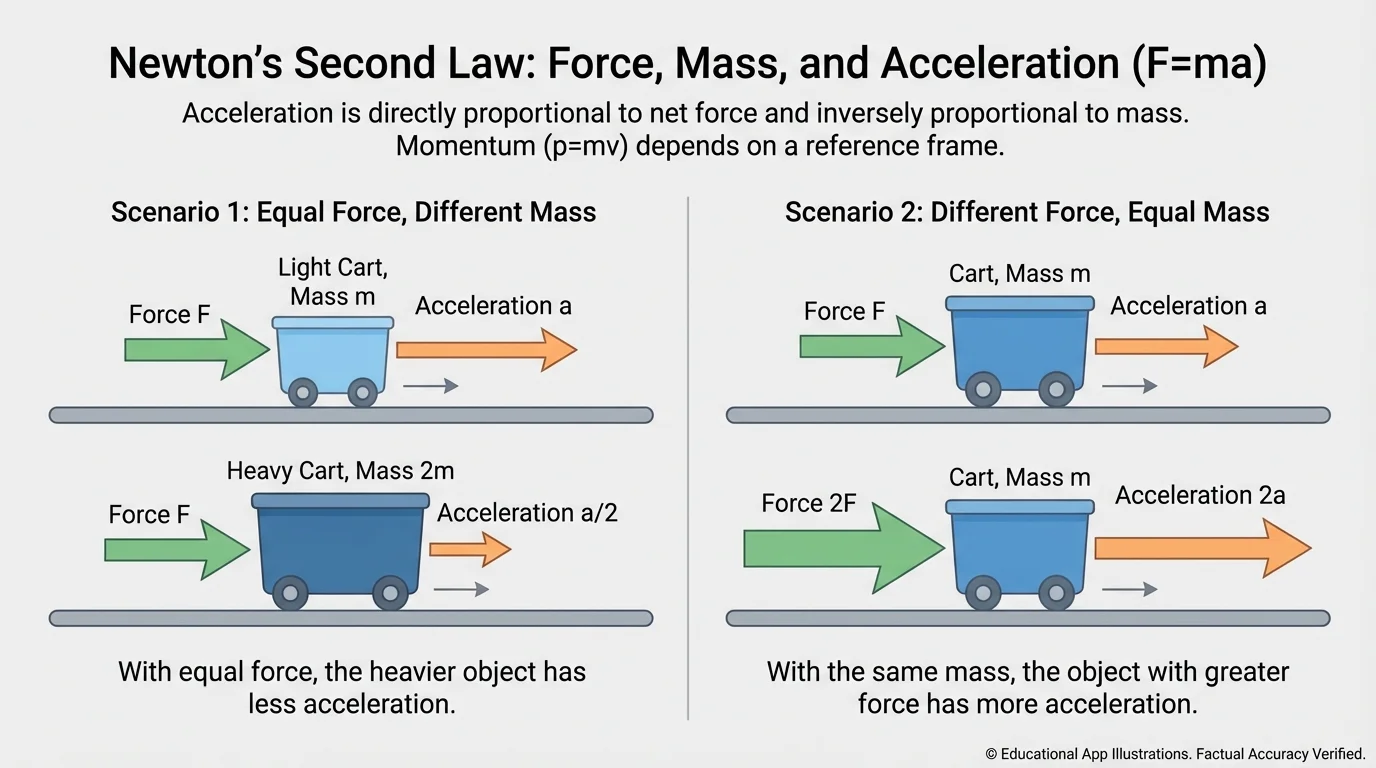
[Figure 1] Newton's second law connects force and motion in a precise way. The law states that the acceleration of an object depends on the net force acting on it and the object's mass. In equation form,
\[F_{\textrm{net}} = ma\]
Here, \(F_{\textrm{net}}\) is the net force, \(m\) is the mass, and \(a\) is the acceleration. The law can also be written as \(a = \dfrac{F_{\textrm{net}}}{m}\), which makes the relationships easier to read: larger net force means larger acceleration, while larger mass means smaller acceleration for the same force.
Mass measures inertia, which is an object's resistance to changes in motion. A shopping cart with a few items is easier to accelerate than the same cart loaded with heavy boxes. If you push both carts with the same force, the lighter cart has the greater acceleration. Likewise, if you push one cart harder, its acceleration increases.
Direction matters too. Because force and acceleration are vectors, acceleration points in the same direction as the net force. If the net force on a bicycle is backward, the bicycle slows down. If the net force is to the left, the bicycle accelerates left.
Newton's second law states that the net force on an object equals the product of its mass and acceleration: \(F_{\textrm{net}} = ma\).
Mass is a measure of how much matter an object has and how strongly it resists acceleration.
Acceleration is the rate at which velocity changes.
This law works extremely well for everyday, macroscopic objects such as balls, bicycles, cars, and machines. At speeds much lower than the speed of light and for objects much larger than atoms, it accurately predicts how motion changes when forces act.
Consider a \(4 \textrm{ kg}\) cart pushed with a net force of \(12 \textrm{ N}\). Its acceleration is \(a = \dfrac{12}{4} = 3 \textrm{ m/s}^2\). If the same force acts on a \(6 \textrm{ kg}\) cart, then \(a = \dfrac{12}{6} = 2 \textrm{ m/s}^2\). The heavier cart accelerates less.
Worked example: finding acceleration
A runner pushes backward on the ground, and the ground exerts a forward net force of \(240 \textrm{ N}\) on a \(60 \textrm{ kg}\) runner. Find the acceleration.
Step 1: Use Newton's second law in the form \(a = \dfrac{F_{\textrm{net}}}{m}\).
Step 2: Substitute the values: \(a = \dfrac{240}{60} = 4 \textrm{ m/s}^2\).
The runner's acceleration is \(4 \textrm{ m/s}^2\) forward.
Braking gives another useful example. Suppose a \(1{,}200 \textrm{ kg}\) car experiences a net braking force of \(-4{,}800 \textrm{ N}\). The acceleration is \(a = \dfrac{-4{,}800}{1{,}200} = -4 \textrm{ m/s}^2\). The negative sign shows that the acceleration points opposite the car's initial forward motion.
Figure [Figure 1] remains useful here because it highlights two core patterns students often mix up: increasing force increases acceleration, but increasing mass decreases acceleration. Those two trends are at the heart of engineering design, from truck braking systems to athletic training equipment.
Modern crash-test design depends heavily on Newton's second law. Engineers cannot eliminate force during a crash, but they can increase the time over which momentum changes, which reduces the average force on passengers.
[Figure 2] Another important way to describe motion is with momentum. Momentum combines mass and velocity into one quantity. It is defined by
\(p = mv\)
Here, \(p\) is momentum, \(m\) is mass, and \(v\) is velocity. Because velocity has direction, momentum also has direction. A bowling ball and a tennis ball can move at the same speed, but the bowling ball has much greater momentum because its mass is much larger.
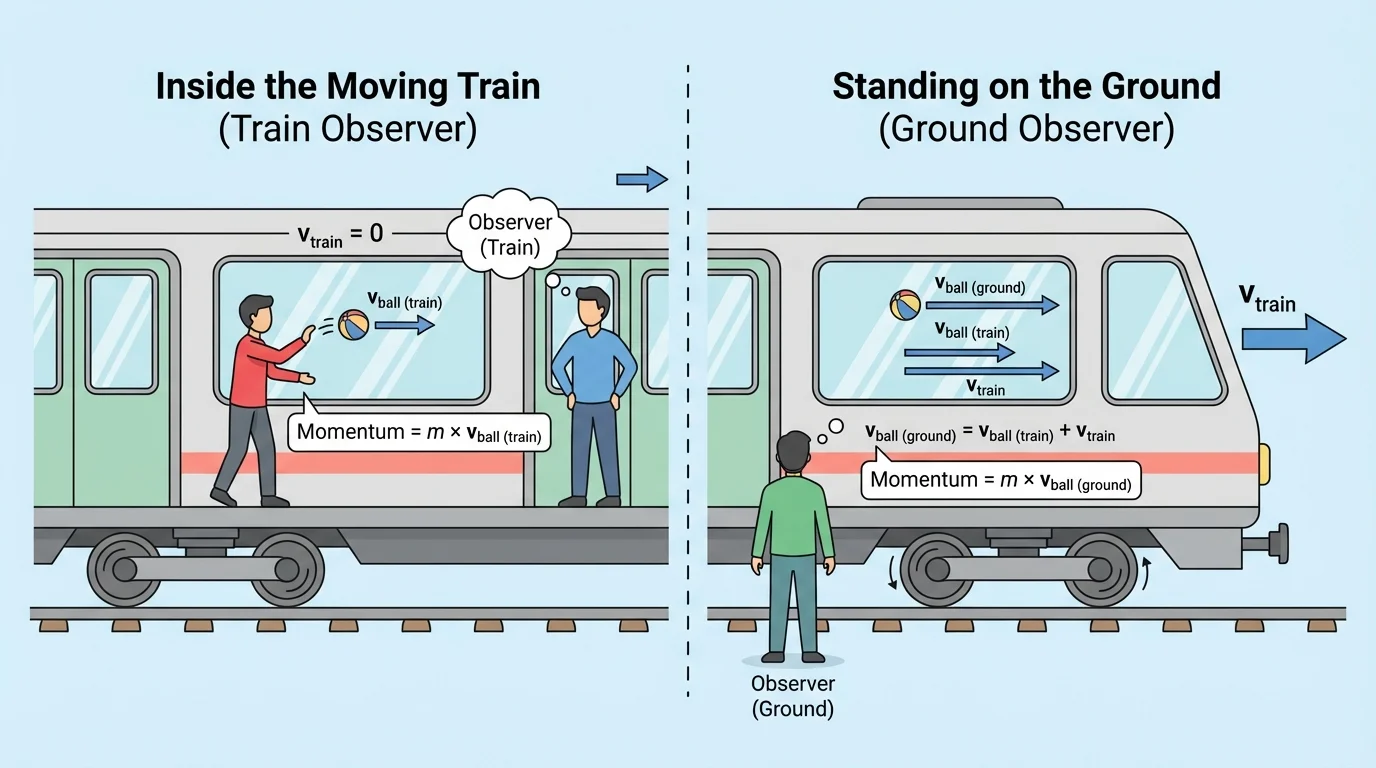
Momentum is defined for a particular frame of reference. This means the measured velocity depends on who is observing the motion. If you toss a ball forward at \(5 \textrm{ m/s}\) inside a train moving at \(20 \textrm{ m/s}\) relative to the ground, a passenger on the train may measure the ball's speed as \(5 \textrm{ m/s}\), while an observer on the ground may measure it as about \(25 \textrm{ m/s}\) in the same direction. Since momentum depends on velocity, the ball's momentum is different in those two frames.
This does not mean momentum is unreliable. It means the reference frame must be clearly stated. Physicists do this all the time. In many everyday problems, the ground is chosen as the frame of reference because it is convenient.
Worked example: calculating momentum
A \(0.15 \textrm{ kg}\) baseball travels at \(40 \textrm{ m/s}\) relative to the ground. Find its momentum.
Step 1: Use \(p = mv\).
Step 2: Substitute the values: \(p = 0.15 \times 40 = 6 \textrm{ kg}\cdot\textrm{m/s}\).
The baseball's momentum is \(6 \textrm{ kg}\cdot\textrm{m/s}\) in the direction of motion.
If the same baseball is viewed from a car moving alongside it at \(35 \textrm{ m/s}\), its speed relative to the car is only about \(5 \textrm{ m/s}\). In that frame, its momentum is \(p = 0.15 \times 5 = 0.75 \textrm{ kg}\cdot\textrm{m/s}\). Figure [Figure 2] makes that difference visible: same object, same mass, different measured velocity, different momentum.
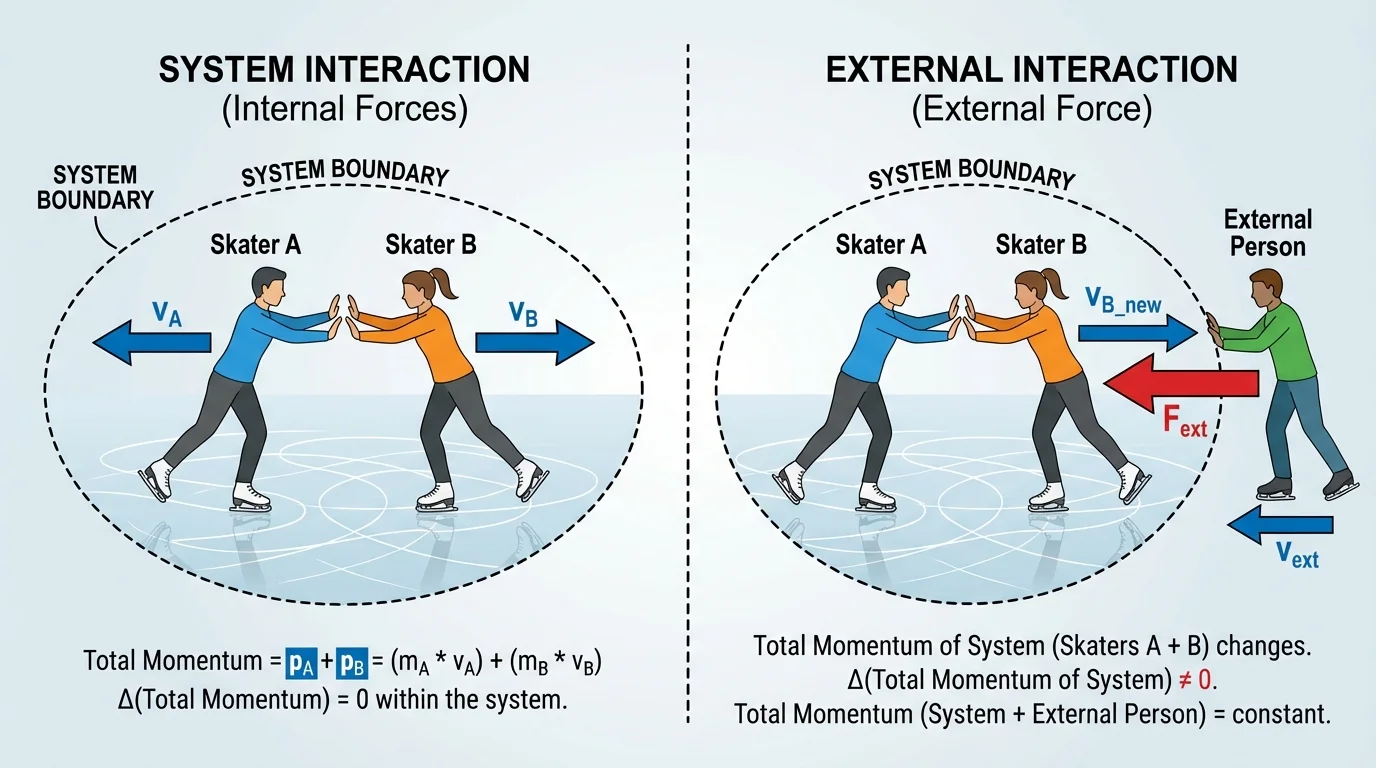
[Figure 3] To analyze momentum clearly, physicists choose a system, which is the set of objects being studied. What counts as "inside" the system and what counts as "outside" matters. If two skaters push off each other and both skaters are included in the system, their interaction is internal to the system. If a person standing outside pushes one skater, that is an external interaction.
When a system does not interact with external objects, its total momentum stays constant. This idea is often called conservation of momentum. Internal forces can move momentum from one object to another inside the system, but they do not change the system's total momentum.
If a system does interact with objects outside itself, the total momentum of the system can change. However, that change is balanced by changes in the momentum of objects outside the system. In other words, momentum is not appearing from nowhere or disappearing; it is being transferred through interactions.
This is a powerful idea because it depends on how the system is chosen. Suppose you choose "one skateboarder" as the system. When that skateboarder pushes backward on the ground and speeds up, the skateboarder's momentum changes because the ground is outside the system. If you enlarge the system to include both the skateboarder and Earth, then the momentum changes of the skateboarder and Earth balance each other, although Earth's change in speed is too tiny to notice.
Why system boundaries matter
The statement "momentum is conserved" is always about a specific system. If external forces act on that system, its momentum can change. To decide whether momentum stays constant, first identify which objects are included and then ask whether anything outside the system exerts a significant force during the interaction.
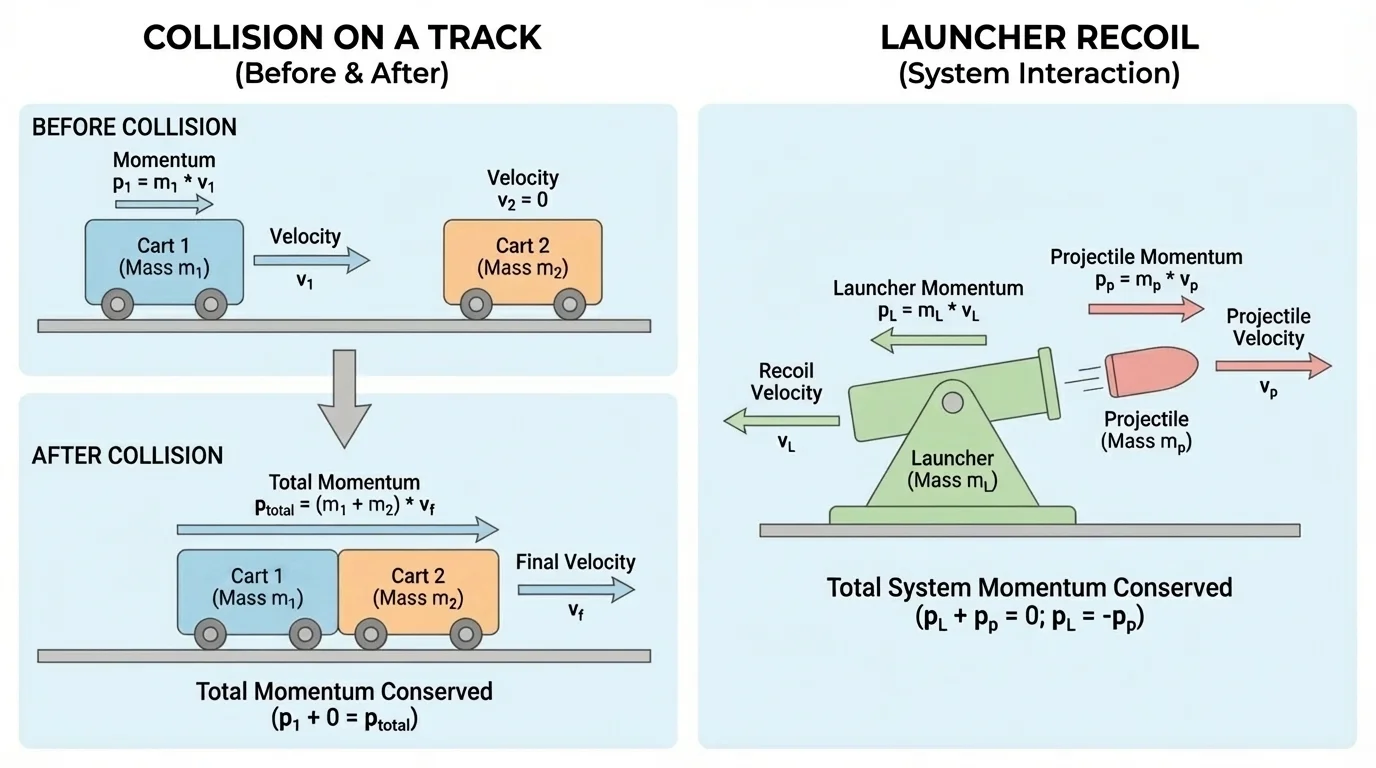
[Figure 4] Collisions are classic examples of momentum transfer. In a collision, one object can lose momentum while another gains it. If the system includes both objects and external forces are negligible during the short collision, the total momentum before and after is the same.
Suppose cart A with mass \(2 \textrm{ kg}\) moves right at \(3 \textrm{ m/s}\), and cart B with mass \(1 \textrm{ kg}\) is initially at rest. Before collision, the total momentum is \(p_{\textrm{total}} = 2 \times 3 + 1 \times 0 = 6 \textrm{ kg}\cdot\textrm{m/s}\). If the carts stick together, their combined mass is \(3 \textrm{ kg}\), so their final velocity is \(v = \dfrac{6}{3} = 2 \textrm{ m/s}\) to the right.
Worked example: recoil
A \(50 \textrm{ kg}\) student stands on a very low-friction skateboard and throws a \(2 \textrm{ kg}\) backpack forward at \(5 \textrm{ m/s}\). If the system starts at rest, find the student's recoil velocity.
Step 1: Initial total momentum is zero.
Step 2: Backpack momentum after the throw is \(p = 2 \times 5 = 10 \textrm{ kg}\cdot\textrm{m/s}\) forward.
Step 3: The student must have \(-10 \textrm{ kg}\cdot\textrm{m/s}\) of momentum so the total remains zero.
Step 4: Student velocity is \(v = \dfrac{-10}{50} = -0.2 \textrm{ m/s}\).
The student rolls backward at \(0.2 \textrm{ m/s}\).
Recoil explains how guns, launchers, and even squid move. It also explains rockets. A rocket pushes exhaust gases backward at high speed. The gases gain momentum in one direction, and the rocket gains momentum in the opposite direction. If the system is just the rocket, its momentum changes because exhaust leaves the system. If the system includes both rocket and exhaust, the momentum changes balance.
Figure [Figure 4] helps connect collisions and recoil under one idea: momentum is exchanged during interactions. The details differ, but the accounting rule is the same.
Vehicle safety is one of the clearest applications of these ideas. Seat belts and airbags reduce injury by increasing the time over which a passenger's momentum changes during a crash. For the same change in momentum, spreading the interaction over more time lowers the average force on the body.
Sports offer constant examples. A baseball player follows through while catching a fast ball, increasing the time needed to bring the ball's momentum to zero and reducing the force on the glove. A sprinter produces large acceleration by generating a large forward net force against the ground. A heavier shot put has more momentum than a tennis ball at the same speed, which is why it is much harder to stop.
Spacecraft often change motion with tiny thrusts applied over long times. Even a small force can produce a large change in velocity if it acts long enough.
In engineering, momentum analysis helps design safer roads, better packaging for fragile equipment, and industrial machines that handle moving parts. In medicine, understanding forces and momentum helps biomechanical engineers study injuries, prosthetic limbs, and the stresses placed on joints during walking or jumping.
One common mistake is thinking that force causes motion. More accurately, net force causes changes in motion. An object moving at constant velocity does not need a net force to keep moving.
Another mistake is confusing mass with weight. Mass is the amount of matter and the measure of inertia. Weight is the force of gravity on that mass. On the Moon, an astronaut's mass stays the same, but weight is smaller because gravity is weaker.
A third misunderstanding is assuming momentum is the same for all observers. It is not. Because velocity depends on the chosen frame of reference, momentum does too. That does not weaken the concept; it makes it more precise.
| Quantity | Definition | Equation | Direction? |
|---|---|---|---|
| Net force | Overall force acting on an object | \(F_{\textrm{net}} = ma\) | Yes |
| Acceleration | Rate of change of velocity | \(a = \dfrac{F_{\textrm{net}}}{m}\) | Yes |
| Momentum | Mass times velocity | \(p = mv\) | Yes |
Table 1. Core motion quantities used to describe how forces affect objects and how motion is tracked in interactions.
These ideas form a coherent picture. Newton's second law predicts how motion changes when forces act, while momentum helps track what happens during interactions among objects and systems. Together, they explain a huge range of familiar and technological phenomena with impressive accuracy.
