A spoon feels smooth. A teddy bear feels soft. In water, some things sink and some things float. The world is full of little details, and you can learn from them every day. When children look closely at real things, they are doing science.
Science starts when we look carefully. We notice what things are like. We can see color and shape. We can touch to feel if something is hard or soft. We can hear loud and quiet sounds. These real-life experiences help us learn about the world.
Objects and materials have properties. A property is something we can notice about a thing, like its color, size, texture, or whether it feels heavy or light. Knowing these properties helps us understand how things are alike and different.
Observation is something we notice with our senses.
Prediction is a careful guess about what may happen.
Explanation is telling why something happened.
Generalization is saying what usually happens after we notice a pattern many times.
When we observe, predict, explain, and generalize, we are thinking like scientists. We do not need big machines. We can learn from a cup of water, a toy car, a shoe, or a rainy day.
An observation is what we notice about something. We might say, "The ball is round," or "The blanket is soft." These are observations because they tell what we see or feel.
[Figure 1] helps us think about how observations use our senses. We can say, "The bell is loud." We can say, "The ice is cold." We can say, "The block is rough." Good observations are about real things we can notice.
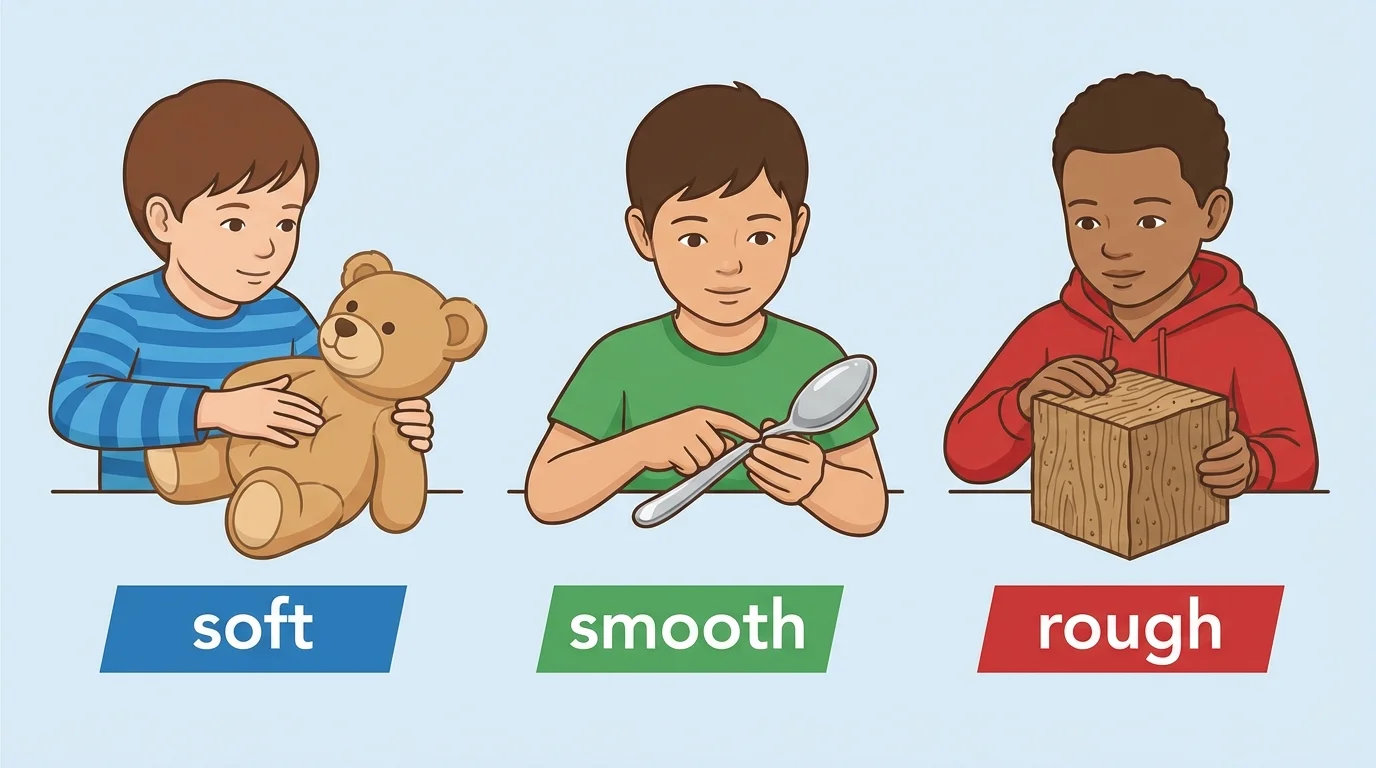
Sometimes we compare two objects. One cup may be bigger. One toy may be heavier. One surface may be smoother. Comparing helps us notice more.
A prediction is a careful guess. If we see a rock and a leaf, we might predict that the rock will sink and the leaf will float.
[Figure 2] helps show that a prediction is not just any guess. We use what we already know before something happens. A prediction comes from an observation. If the sidewalk is dark and the clouds are gray, we may predict rain. If a toy car is at the top of a ramp, we may predict it will roll down.
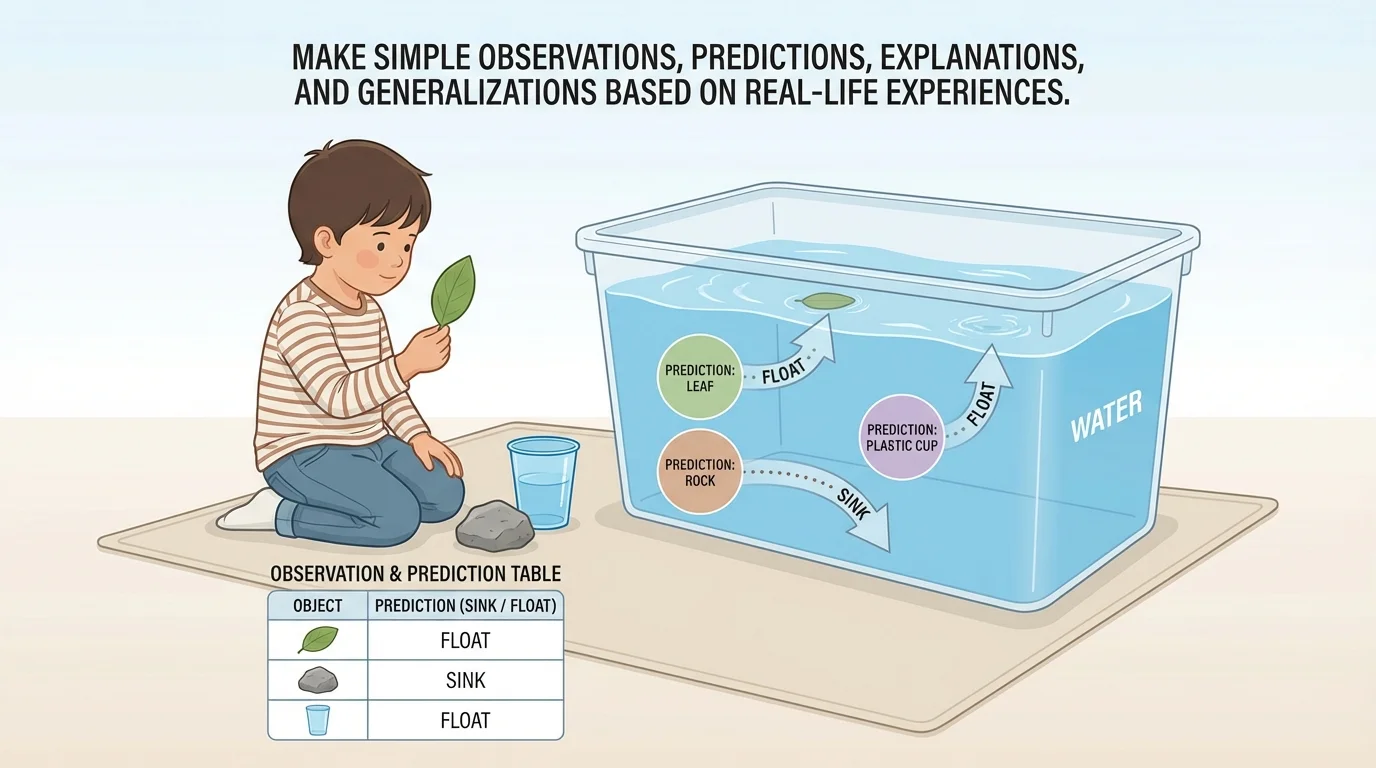
Predictions can be right or wrong, and that is okay. Science helps us learn by checking what happens next.
Real-life example
Step 1: Observe the banana.
The banana is green.
Step 2: Make a prediction.
You may say, "I think it will turn yellow later."
Step 3: Check what happens.
After some time, the banana turns yellow.
The child used a real observation to make a reasonable prediction.
We also make predictions when we get dressed. If it looks rainy, we may predict we need boots. If the sun is bright, we may predict it will feel warm outside.
An explanation tells why something happened. If a cup spills, we may explain, "It tipped over." If a paper towel gets wet, we may explain, "It touched water."
Explanations connect a cause and an effect. The cause is what makes something happen. The effect is what happens next. For example, the ice melts because it gets warm. The toy moves because someone pushed it.
Simple explanations are enough. A young scientist can say, "The rock sank because it is heavy," or "The crayon mark is red because I used the red crayon." These are short ways to tell why.
Cause and effect helps us explain events. When one thing makes another thing happen, we can use words like because. "The floor is wet because water spilled." "The hat stayed on because it fits."
Later, when we talk again about sink and float, [Figure 2] stays helpful because it reminds us that predictions come first and explanations come after we see the result.
A generalization is something we say after noticing the same kind of thing again and again. We might say, "Boots help keep feet dry in puddles." That does not mean every single moment is the same, but it tells what usually happens.
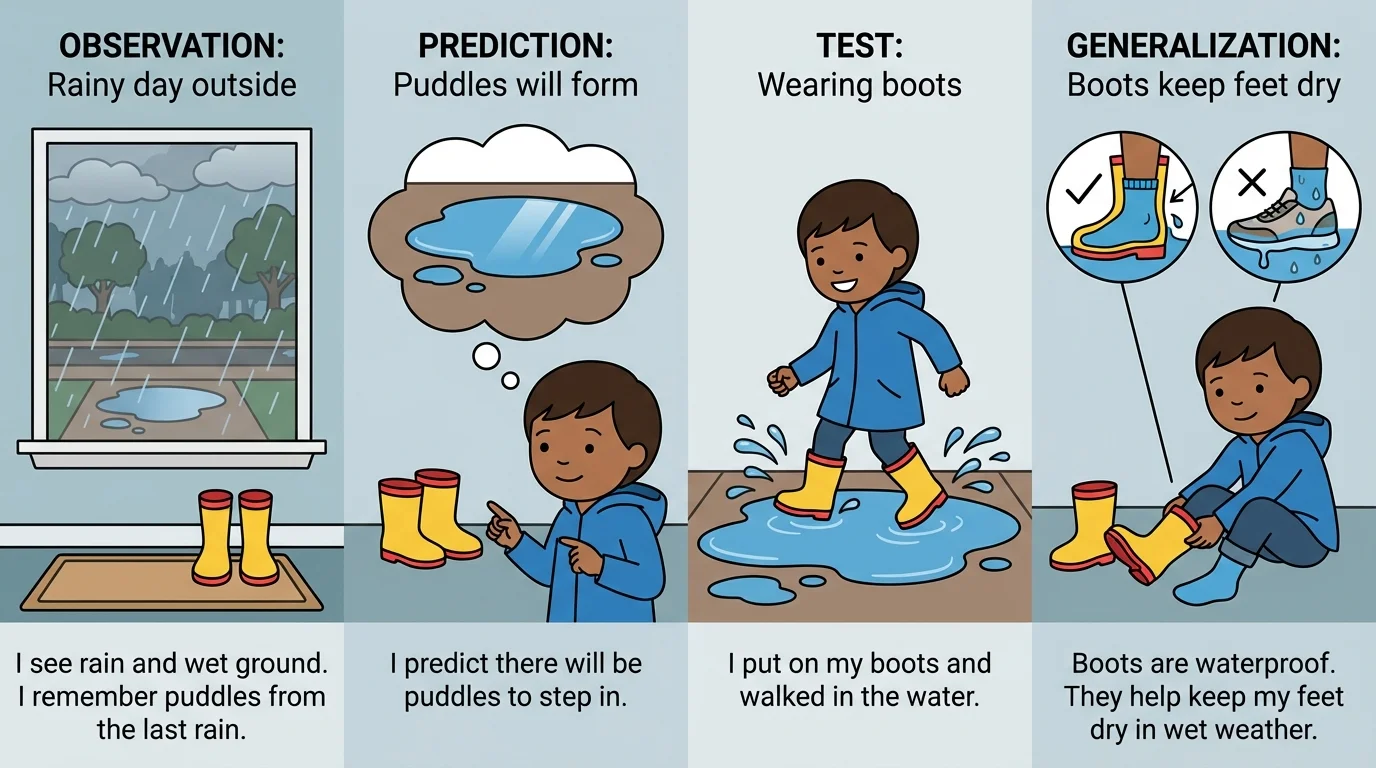
[Figure 3] helps explain that generalizations begin with many experiences. If children see that wooden blocks feel hard on many days, they may say, "Blocks are usually hard." If they see that ice feels cold many times, they may say, "Ice is usually cold."
Good generalizations come from real observations. They should be simple and careful. Instead of saying "Everything floats," we learn to say, "Some light things float," because we have seen that rocks and some other things sink.
Physical properties help us make good observations. We can notice if something is hard or soft, smooth or rough, wet or dry, big or small. These words help us describe objects clearly.
We can also notice what materials do. Some objects bend. Some stay stiff. Some float in water. Some sink. These properties matter in real life. A towel is useful because it soaks up water. A spoon is useful because it is hard and keeps its shape.
| Object | Property we can notice | Simple idea we may say |
|---|---|---|
| Teddy bear | Soft | Soft things feel gentle. |
| Rock | Hard | Hard things do not squish easily. |
| Leaf | Light | Light things may blow in the wind. |
| Boot | Water-resistant | Boots help in puddles. |
| Ice cube | Cold, smooth | Ice feels cold and can melt. |
Table 1. Everyday objects, simple properties, and ideas children can form from observing them.
When we touch, look, and compare, we learn more. Earlier, [Figure 1] showed that different objects feel different. That helps us use words that match the real property of each object.
Some things can feel different in more than one way at the same time. An ice cube can be cold and smooth, and a sponge can be soft and able to soak up water.
Noticing properties helps us solve simple problems too. If we want to keep hands dry, we choose something that does not soak up water quickly. If we want to build a tower, we choose things that are stiff and easy to stack.
Science is all around you. At snack time, you may observe that crackers are crunchy and bananas are soft. On the playground, you may predict that a ball will bounce. After it bounces, you may explain, "It bounced because I dropped it." After seeing many bounces, you may generalize, "Balls usually bounce on hard ground."
At home, a child may see steam near warm soup and observe that it looks like a mist. Outside, a child may see a shadow and notice that it changes position as the Sun appears to move across the sky. In the bath, a child may observe which toys float and which toys sink.
Real-life example
Step 1: Observe a toy car on a ramp.
The ramp is slanted, and the toy car is at the top.
Step 2: Make a prediction.
You may say, "The car will roll down."
Step 3: Watch what happens.
The car rolls down the ramp.
Step 4: Explain it.
You may say, "It rolled because the ramp was slanted."
After seeing this many times, a child may generalize, "Toy cars usually roll down ramps."
Real-life experiences are important because they are easy to remember. Children learn best when they can connect science ideas to things they see and do every day.
You can use simple sentence starters to share your thinking. Say, "I see..." for an observation. Say, "I think..." for a prediction. Say, "It happened because..." for an explanation. Say, "Usually..." for a generalization.
These speaking tools help children organize ideas. They also help teachers and families hear how a child is thinking. Clear words make science thinking stronger.
When we use our senses safely and talk about what we notice, we are already doing early science. Looking closely, comparing objects, and describing what happens are important habits.
We do not need long answers. We need true answers that match what we observed. A child who says, "The cup is wet," "I think it spilled," "It spilled because it tipped," and "Cups spill when they fall over," is using science ideas in a strong and simple way.
