Describe how to take more personal responsibility for eating healthy foods.
Taking Personal Responsibility for Eating Healthy Foods 🍎
If someone secretly recorded everything you ate for a week and then showed you the video, would you be proud of it? Or a little surprised by how many snacks, drinks, and last‑minute choices shaped your days? That “food highlight reel” already exists — in your body, your energy, your mood, and your long‑term health. What you eat is one of the few major health decisions you make several times every single day.
Why Your Food Choices Matter
Your body is basically running a 24/7 high-performance system: brain, muscles, hormones, immune system, skin — everything. Food is the fuel and the building material for that system.
Some key ways your choices matter:
Energy and focus: A breakfast with protein and whole grains can keep your blood sugar steadier than just sugary cereal or pastries. That means fewer crashes in the middle of class.
Sports and strength: Athletes who eat enough carbohydrates, protein, and fluids perform better and recover faster than those who “forget” to eat or live on energy drinks.
Mood and mental health: Diets high in ultra-processed foods and sugary drinks are linked in research to higher risks of depression and anxiety. They don’t “cause” mental illness by themselves, but they can make things worse.
Future health: The patterns you build now can raise or lower your risk for conditions like type 2 diabetes, high blood pressure, and heart disease later.
Taking personal responsibility for what you eat is not about perfection or guilt. It is about realizing that your daily choices have real power — and you can learn to use that power on purpose. 💡
What Personal Responsibility Really Means with Food
Personal responsibility is not the same as blame. It is about owning what you can control, even when outside forces make things harder.
There are many things you do not fully control:
What foods your family buys.
How much money is available for groceries.
Cultural foods your family prefers.
What your school cafeteria serves.
Advertisements and social media trends.
But within those limits, you still have important choices:
How much of each food you eat.
Whether you choose water or a sugary drink when both are available.
Whether you add a fruit or vegetable when you can.
What snacks you keep in your backpack or room.
How you respond when you feel stressed, bored, or pressured by friends.
Taking responsibility means shifting from “I just eat what’s there” to “I notice what’s there, and I actively choose the best option I can right now.”
Understanding What “Healthy Eating” Looks Like
To take responsibility, you need a clear picture of what you are aiming for. Healthy eating is not a single “perfect diet.” It is a set of patterns:
Balance: Getting carbohydrates, protein, and fats in reasonable amounts.
Variety: Eating different foods over the week so you get a range of vitamins and minerals.
Moderation: Not overdoing foods high in added sugar, salt, and unhealthy fats.
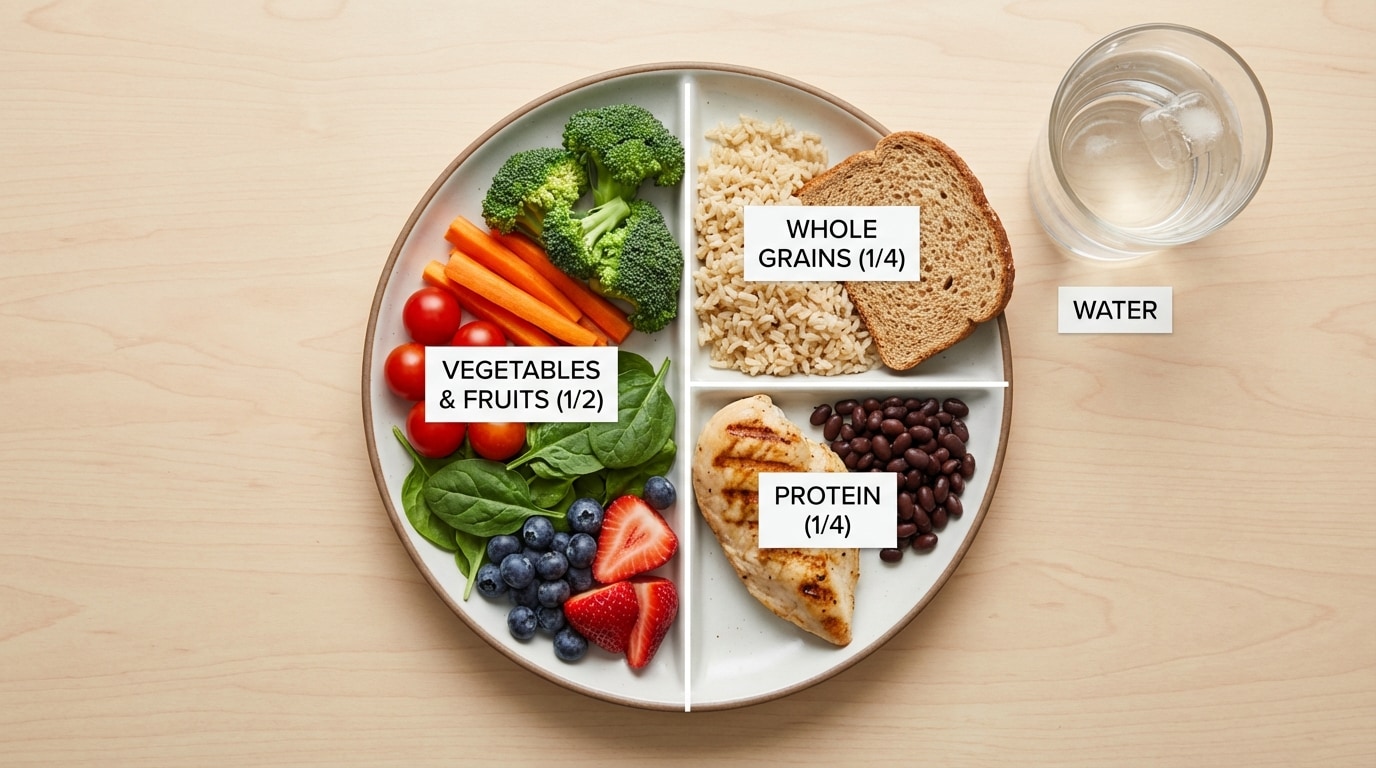
A simple way to think about a balanced meal, as shown in [Figure 1], is the “plate model”:
About half your plate: vegetables and fruits (fresh, frozen, or cooked).
About one-quarter: protein (beans, lentils, eggs, fish, chicken, tofu, lean meat, yogurt, etc.).
Drink: water or low-sugar options most of the time.
Examples of balanced teen-friendly meals:
Brown rice bowl with black beans, grilled chicken, salsa, lettuce, and water.
Whole wheat pasta with tomato sauce, vegetables, and grated cheese, plus an apple.
Stir-fry with tofu or chicken, plenty of mixed vegetables, and rice.
Snacks can also be part of healthy eating if you think of them as mini-meals instead of just “junk.” For example:
Yogurt with fruit.
Peanut butter on whole grain toast.
Carrot sticks and hummus.
A handful of nuts and a piece of fruit.
Figure 1: Diagram of a plate divided into sections labeled vegetables/fruits (half), whole grains (one-quarter), protein (one-quarter), with a glass of water beside it, representing a balanced teen meal.
Step 1: Becoming Aware of Your Current Eating Habits
You cannot change what you do not notice. The first step in taking responsibility is simple awareness.
Ways to increase awareness:
Food journal for 3–7 days: Write down what you eat and drink, approximate amounts, and times. You can use a notes app or paper.
Note your feelings and situations: Were you bored, stressed, tired, rushed, with friends, on your phone, studying?
Notice patterns: Do you skip breakfast? Eat most of your food late at night? Snack while gaming? Drink sugary beverages daily?
Questions to ask yourself:
When do I feel most hungry during the day?
When does “mindless eating” happen for me?
How often do I eat vegetables or fruits?
Do I usually drink water, or something else?
Awareness is not about judging yourself. It is like collecting data in a science experiment so you can make better decisions.
Step 2: Setting Realistic, Specific Goals
Once you see your patterns, choose a small number of clear goals. Vague goals like “eat better” are hard to follow. Specific goals give you a target.
Stronger, more specific goals look like:
“I will eat some source of protein at breakfast at least 4 school days each week.”
“I will drink water instead of sugary drinks at lunch on weekdays.”
“I will include at least one fruit or vegetable with my afternoon snack 5 days a week.”
“I will limit fast food to once per week.”
Helpful tips:
Start small: Changing one or two habits at a time works better than trying to transform everything overnight.
Make goals measurable: Include how often per week, or at which meal.
Use your own life: Set goals that fit your schedule, access to food, and culture.
Plan for mistakes: Expect that some days will not go as planned. Responsibility means you adjust and try again, not give up.
For example, if you notice that you often skip breakfast and then overeat at lunch, a realistic first goal might be: “I will keep quick breakfast foods at home (like oats, yogurt, eggs, or bananas) and eat something within an hour of waking up at least 3 school days this week.”
Step 3: Planning Ahead So Healthy Choices Are Easier
Willpower is not enough, especially when you are busy and stressed. Planning ahead changes your environment so that the healthier option becomes the easiest one.
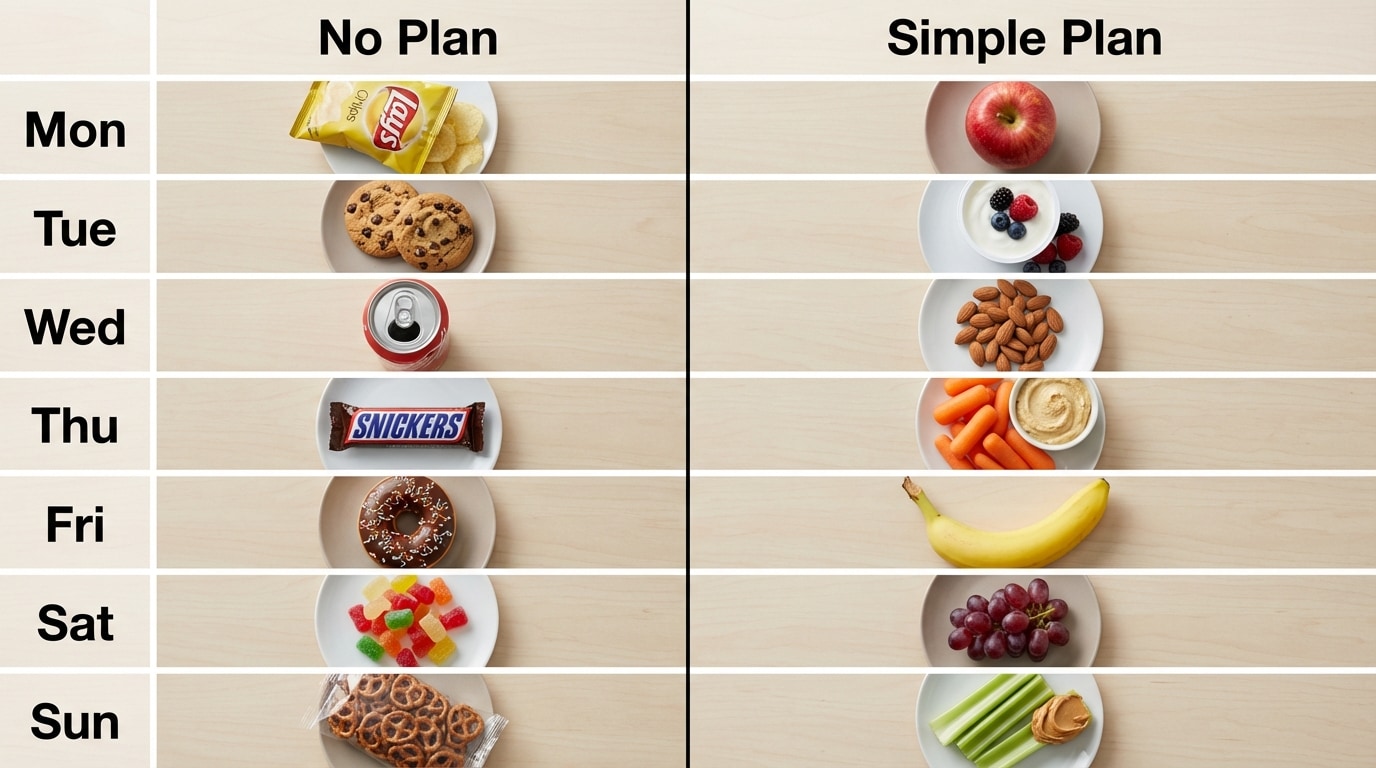
Think about your typical week. After school, are you super hungry and grabbing whatever is fastest? Imagine two different weeks of after-school snacks, as in [Figure 2]:
No plan: You come home starving, open the pantry, and eat cookies or chips straight from the bag. The next day you stop for a sugary drink. The pattern repeats all week.
Simple plan: On Sunday, you (and maybe a family member) prepare snack options: sliced veggies with dip, boiled eggs, pre-portioned nuts, yogurt, fruit. Each day after school, one of these is ready.
Both weeks require the same number of snack “decisions,” but the planned week makes the healthier choice much easier.
Figure 2: Side-by-side weekly chart showing 7 days of unplanned snacks (chips, cookies, sugary drinks) vs 7 days of planned snacks (fruit, yogurt, nuts, veggies with hummus), labeled “No Plan” and “Simple Plan”.
Practical planning strategies:
Talk with your family: Share one or two goals and ask if they can help buy certain foods or let you help with grocery lists.
Pack ahead: The night before school, pack a water bottle and at least one healthy snack in your backpack.
Use “default choices”: Decide in advance: “At school lunch, my default is to grab a vegetable or fruit plus water, unless that’s impossible.”
Prepare in batches: Cook extra rice, beans, or chicken and use them for several meals. Wash and cut vegetables and fruit once, then store them for quick access.
Have a backup plan: If there’s nothing healthy available, what is your “least unhealthy” choice? Maybe a grilled instead of fried option, a smaller portion of fries, or choosing water instead of soda.
Planning is a major part of responsibility: you are not just reacting to hunger; you are preparing for it.
Step 4: Building Skills in the Kitchen and at the Store
It is hard to take responsibility for healthy eating if you lack basic skills. The more confident you feel in the kitchen and at the store, the more power you have over your food.
Some key skills:
Basic cooking: Learn how to safely use a knife, boil pasta or rice, scramble eggs, bake or stir-fry vegetables, and cook simple proteins like beans or chicken (with an adult’s guidance if needed).
Quick meals: Practice throwing together fast, balanced meals like eggs with veggies and toast, bean and cheese quesadillas with salsa, or stir-fry with frozen vegetables.
Reading labels: On packaged foods, look at:
The first few ingredients (are they mostly whole foods or mostly sugar and refined flour?).
The amount of added sugar per serving.
The serving size, so you know how much you are actually eating.
You do not need to obsess over every gram, but noticing that a “sports drink” has as much added sugar as a soda can influence your choices.
Cost is another important factor. More responsible eating does not always mean more expensive eating. For example:
Dried or canned beans, eggs, oats, rice, and frozen vegetables are usually cheaper than fast food in the long run.
Buying a large container of plain yogurt and adding your own fruit can be cheaper and lower in sugar than individual flavored yogurts.
Taking responsibility includes learning how to make the healthiest choices you can within your budget and situation.
Step 5: Managing Social Situations, Cravings, and Stress
A lot of eating happens around other people: friends, teammates, family, dates, parties. You cannot control everything in these situations, but you still have choices.
Peer pressure and social eating:
If your friends always want to hit fast food, you might suggest rotating in a place with some healthier options.
You can choose smaller portions, skip the sugary drink, or add a side salad or fruit when that is available.
You do not have to comment on what others eat; just quietly choose what lines up with your goals.
Family and cultural foods:
Cultural foods are an important part of identity and connection. Responsibility does not mean rejecting them.
Instead, focus on portions and balance. For example, fill half your plate with vegetables or lighter dishes, and enjoy traditional dishes in reasonable amounts.
You might also help prepare meals and suggest including more vegetables or less frying when possible.
Cravings and emotional eating:
Notice if you tend to eat when you are stressed, lonely, or bored rather than physically hungry.
Before grabbing a snack, pause and ask: “Am I hungry, or am I feeling something else?”
Create a short list of non-food coping strategies: a quick walk, music, texting a friend, journaling, stretching, or breathing exercises.
If you still really want the food, choose a portion, sit down, and enjoy it mindfully instead of eating out of the bag while distracted.
Taking responsibility here means you do not let your emotions totally control your eating. You recognize them and respond on purpose.
Using Technology and Media Wisely 📱
Technology can either support your healthy eating or totally distract you from it.
Helpful uses of technology:
Tracking apps: You can log what you eat to see patterns. Focus on awareness, not perfection.
Reminder apps: Set reminders to drink water or pack snacks.
Recipe and cooking videos: Learn quick, cheap, healthy meals that fit your culture and taste.
Risks to watch out for:
Unreliable information: Many influencers share extreme or unscientific diet advice. Be skeptical of anything that sounds too good or too strict: “never eat X,” “this one food burns fat,” etc.
Body comparison: Constantly seeing edited, filtered bodies can push you toward unhealthy dieting instead of realistic, healthy changes.
Taking responsibility includes choosing which voices you listen to. Look for information from registered dietitians, trusted health organizations, or school health education — not just whoever goes viral.
Respecting Your Body, Culture, and Mental Health
A huge part of personal responsibility is understanding the goal of healthy eating: feeling stronger, more energetic, and healthier — not punishing yourself or chasing an unrealistic body image.
Important principles:
Avoid extremes: Crash diets, starving yourself, or cutting out entire food groups without medical reasons can harm your body and mind.
Focus on behavior, not appearance: You have more control over your habits (like drinking water, eating breakfast, moving your body) than over your exact weight or shape.
Honor your culture: Traditional foods can absolutely be part of a healthy pattern. Focus on overall balance and portions rather than trying to copy someone else’s idea of “healthy.”
Watch for warning signs: If you are constantly thinking about food, terrified of weight changes, hiding what you eat, or regularly bingeing and then trying to “make up for it,” that is a sign to reach out for help (trusted adult, counselor, or health professional).
Real responsibility includes asking for support when you need it. You do not have to handle food and body image struggles alone. 💬
Summary of Key Strategies for Taking Responsibility
To take more personal responsibility for eating healthy foods, you can:
Recognize impact: Understand how your daily food choices affect your energy, focus, mood, performance, and long-term health.
Own your choices: Notice what you can control (portions, drink choices, snacks, add-ons) even when options are limited.
Know what healthy looks like: Aim for balanced meals with vegetables/fruits, whole grains, and protein, as in the plate model shown in [Figure 1].
Increase awareness: Track your eating for a few days and identify patterns, triggers, and times when you tend to eat mindlessly.
Set specific goals: Choose clear, realistic habits to change, like adding protein to breakfast or replacing some sugary drinks with water.
Plan ahead: Prepare snacks and meals, pack food and water, and arrange your environment so the healthier choice is easier, similar to the “simple plan” week in [Figure 2].
Build skills: Learn basic cooking, label reading, and budgeting so you have more control over what you eat.
Navigate social and emotional eating: Develop strategies for parties, family meals, cravings, and stress so you can enjoy food while staying aligned with your goals.
Use technology carefully: Let apps and online resources support awareness and skills, not pressure you into extreme or unsafe behaviors.
Protect your mental health: Aim for long-term, realistic habits, respect your body and culture, and seek help if eating or body image starts to feel out of control.
Over time, these steps turn healthy eating from something that “happens to you” into something you actively shape. That is what personal responsibility for nutrition really looks like — not a perfect diet, but consistent, thoughtful choices that support the life you want to live. 🌱