Understand and apply basic principles of training to improving physical fitness.
Understand and Apply Basic Principles of Training to Improve Physical Fitness
Did you know that even professional athletes sometimes train the “wrong” way and do not get better, or even get hurt? 🤔 The difference between smart training and random exercise is understanding a few basic training principles. These principles work for everyone: soccer stars, dancers, skateboarders, and also you in your everyday life.
In this lesson, you will learn what those training principles are, how they connect to different parts of fitness, and how you can use them to become healthier, stronger, and more active in a safe way.
Why Training Principles Matter for Your Body
Your body is amazing. When you give it the right kind of challenge, it becomes stronger, faster, and more flexible. When you move less, it becomes weaker and tires more quickly. Training principles are simple “rules” that help you give your body the right kind of challenge so you can reach a health-enhancing level of fitness and feel good doing it. 💪
These principles help you:
Improve in the activities you care about (sports, dancing, biking, playing with friends).
Stay safe and avoid overdoing it.
Plan your physical activity so you can keep it going for a long time, not just one week.
The main principles we will focus on are overload, specificity, progression, and FITT. You will also learn about rest and safety, which are just as important as the hard work.
Components of Physical Fitness
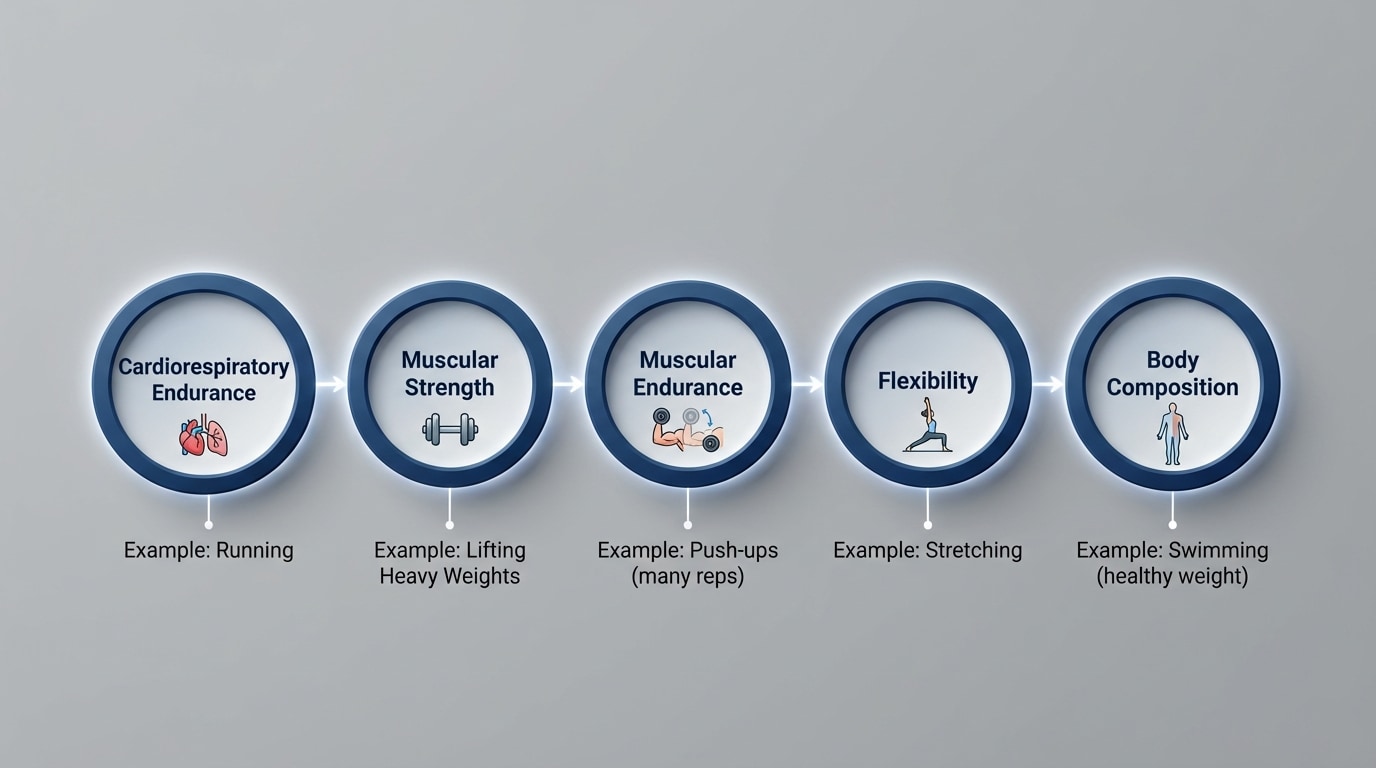
Before talking about training principles, it helps to know what “fitness” includes. There are five main parts, or components, of health-related physical fitness that we want to improve, as shown in [Figure 1]. Each one helps your body stay healthy and able to do daily activities.
1. Cardiorespiratory endurance
This is how well your heart, lungs, and blood vessels work together to supply oxygen to your body when you move for a long time. Activities that use this component include:
Jogging or running
Brisk walking
Swimming
Cycling
Jumping rope
When you have good cardiorespiratory endurance, you can do these activities longer without feeling completely out of breath.
2. Muscular strength
Muscular strength is how much force your muscles can produce at one time. It is used when you:
Lift a heavy backpack
Do a single hard push-up
Pick up a heavy box
Stronger muscles help you move things, protect your joints, and perform better in many sports.
3. Muscular endurance
Muscular endurance is how long your muscles can work without getting tired. It is used when you:
Hold a plank for a long time
Do many curl-ups or sit-ups in a row
Keep rowing, pedaling, or swimming lap after lap
Good muscular endurance helps you keep going and not get tired too quickly.
4. Flexibility
Flexibility is how far your joints can move. Stretching improves flexibility. It is important for:
Reaching down to tie your shoes
Doing cartwheels or dance moves
Moving freely without feeling tight or stiff
Good flexibility helps prevent muscle strains and makes many movements feel easier.
5. Body composition
Body composition is the balance of fat, muscle, bone, and other tissues in your body. Moving regularly and eating well helps keep this balance healthy.
Different activities work on different components. Training principles help you choose the right activities and the right way to do them so each part can improve.
Figure 1: Chart with five circles labeled Cardiorespiratory Endurance, Muscular Strength, Muscular Endurance, Flexibility, Body Composition, each with a small icon (heart/lungs, dumbbell, repeated reps, stretching person, body silhouette) and one example activity in text below each
The Overload Principle: Challenging Your Body Safely
Overload means doing a little more than your body is used to, so it has a reason to improve. If you always do exactly the same thing, your body gets used to it and stops changing.
You can think of overload like this: if you normally do 8 push-ups, doing 8 is “normal” and probably will not make you much stronger over time. If you try 9 or 10 push-ups, you are giving your muscles a slightly bigger challenge. That is overload.
For different components of fitness, overload looks like:
Cardiorespiratory endurance: Walk or jog a little faster, go a bit longer, or add one more lap.
Muscular strength: Use a heavier weight, or do a harder exercise (for example, from knee push-ups to full push-ups).
Muscular endurance: Do more repetitions, or hold a position longer (like a longer plank).
Flexibility: Hold a stretch a little longer, or gently stretch a tiny bit farther without pain.
Overload should feel like “this is hard, but I can still do it with good form.” It should not feel like sharp pain or make you feel sick. If you go from 8 push-ups to 30 in one day, that is too much overload and may lead to sore muscles or injury.
Signs of healthy overload include:
Breathing faster, but still able to talk in short sentences.
Muscles feeling tired or burning a little at the end of the set.
Heart beating faster, but slowing down again a few minutes after you stop.
Signs of too much overload include:
Sharp or sudden pain.
Dizziness or feeling like you might faint.
Chest pain or trouble breathing.
Pain that does not go away the next day or gets worse.
By using overload carefully, you tell your body, “I need you to be stronger and fitter,” and your body responds. 🎯
Specificity: Train for What You Want to Improve
Specificity means that your body improves at exactly what you practice. If you want to get better at one thing, you need to train with activities that are similar to that thing.
Examples of specificity:
If you want to run faster in soccer, jogging, sprinting, and running drills help more than only lifting weights.
If you want to be better at push-ups, you should practice push-ups or similar pushing exercises (like wall push-ups or bench push-ups).
If you want to do the splits, you need to stretch the muscles in your legs and hips, not just do more sit-ups.
Specificity also connects to the fitness components:
To build cardiorespiratory endurance, choose rhythmic, whole-body activities like running, swimming, or cycling that keep your heart rate up.
To build muscular strength in your arms, do pushing and pulling moves for your arms and shoulders, not just running.
To improve flexibility of your hamstrings (back of your thigh), you need stretches that lengthen that exact muscle group.
Specificity keeps your training focused. If a friend says, “I want to be able to do 20 curl-ups,” but only goes for walks, you know something is missing. Walking is healthy, but it is not specific to curl-ups.
Progression: Improving Step by Step
Progression means increasing your activity slowly and steadily over time. Your body needs time to adapt to each new level of overload.
At first, a new exercise might feel very hard. After a couple of weeks, it might feel easier. That is your body getting fitter. Progression means you keep making small changes so your body continues to improve.
Examples of progression:
You start by walking for 15 minutes, 3 days a week. After 2 weeks, you walk 20 minutes, 3 days a week. Later, you walk 20 minutes, 4 days a week.
You can do 6 push-ups with good form. After a week or two of practice, you can do 8. Then you increase to 10, then 12.
You can hold a plank for 20 seconds. After training, you move to 30 seconds, then 40 seconds.
Progression protects you from doing too much too soon. It also keeps training interesting because you see and feel your progress over time. Remember, jumping from very easy to extremely hard in one step is not progression; it is a risk.
FITT Principle: A Simple Way to Plan Activity
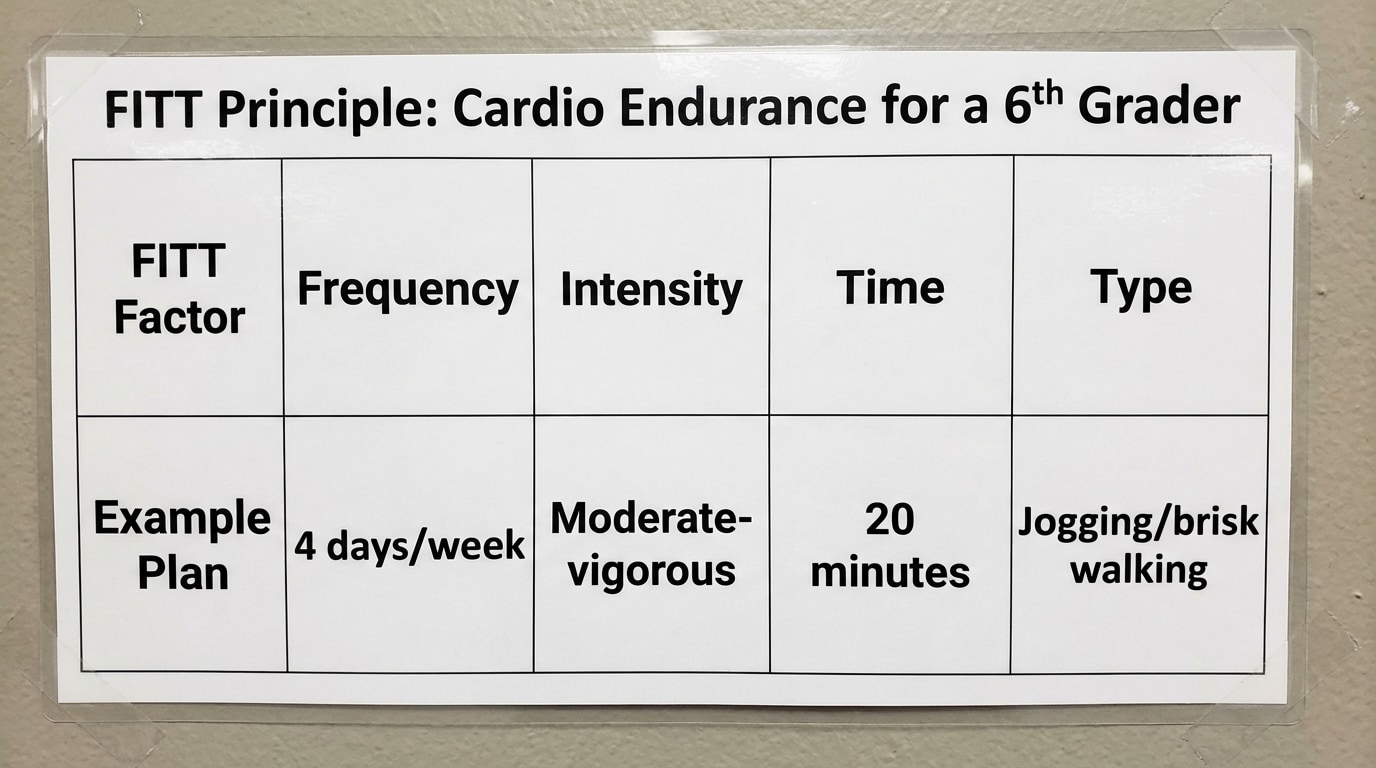
The FITT principle is a way to remember four key parts of a good activity plan. Many coaches and PE teachers show it in a chart, like the one in [Figure 2], because it makes planning clear and simple.
FITT stands for:
F – Frequency: How often you are active.
I – Intensity: How hard you work.
T – Time: How long you are active.
T – Type: What kind of activity you do.
Frequency
Frequency answers the question, “How many days per week?” For health, kids your age should aim to be active at least most days of the week, and try to have some stronger, more vigorous activity on at least 3 days.
Examples:
Walking or biking to school 5 days a week.
Playing a sport (like basketball or soccer) 3 days a week.
Doing strength exercises (like body-weight circuits) 2 or 3 days a week, with rest days between.
Intensity
Intensity answers, “How hard am I working?” You can think of intensity levels like this:
Light: You are moving, but your heart is not beating much faster. You can talk and sing easily.
Moderate: Your heart beats faster. You can talk, but singing would be hard.
Vigorous: Your heart is beating a lot faster. You can maybe say a few words at a time, but not complete sentences without taking a breath.
For training your heart and lungs, you usually want moderate to vigorous intensity, at least some of the time. For muscular strength, intensity can mean using enough resistance that the last few repetitions feel challenging.
Time
Time means, “How long do I do this activity?” For cardiorespiratory endurance, many guidelines suggest a total of at least 60 minutes of physical activity each day, including play, sports, and PE. This can be broken into smaller parts, like 10–20 minutes at a time.
Examples:
Jogging for 20 minutes.
Doing a strength circuit for 15 minutes.
Playing a fast-paced game like tag or basketball for 20–30 minutes.
Type
Type answers, “What activity am I doing?” This is where specificity shows up again. The type you choose should match what you want to improve.
To improve flexibility: Static stretching, yoga, gentle dynamic stretches.
Putting FITT together: An example
Imagine your goal is to improve your cardiorespiratory endurance so you can run longer in PE and at recess. Here is one sample FITT plan:
Frequency: 4 days per week
Intensity: Moderate to vigorous (you can talk, but not sing)
Time: 20 minutes of continuous movement
Type: Jogging, brisk walking, or a mix of both
At first, you might do 2 minutes of jogging and 1 minute of walking, repeating this several times. As you follow the progression principle, you can slowly jog longer and walk less.
Figure 2: Simple FITT table with rows Frequency, Intensity, Time, Type and a filled-in example for improving cardio endurance in a 6th grader (e.g., 4 days/week, moderate-vigorous, 20 minutes, jogging/brisk walking)
As you get used to using FITT, it becomes easier to plan balanced workouts that follow overload, specificity, and progression all at once. 🏃♀️
Rest, Recovery, and Safety
Working hard is only one side of training. The other side is rest and safety. Your body gets stronger during rest, not while you are actually exercising.
Rest and recovery
Have at least 1 rest day between hard strength workouts for the same muscles.
Try to get enough sleep each night so your body can repair and grow.
If a muscle is very sore, give it time to feel better before working it hard again.
Warm-up and cool-down
Warm-up: Start with 5–10 minutes of light movement (like easy jogging or marching) and gentle dynamic stretches. This slowly raises your heart rate and warms your muscles.
Cool-down: End your activity with a few minutes of slowed movement and then some gentle static stretches. This helps your body return to normal and can reduce stiffness.
Listening to your body
Some tiredness and mild muscle soreness after training can be normal.
Sharp pain, joint pain, or pain that gets worse is a warning sign to stop and rest.
Drink water before, during, and after activities, especially in hot weather.
When you combine hard work with smart rest and safety, training becomes something you can keep doing for many years.
Applying Training Principles to Everyday Life
Now that you know the main ideas—overload, specificity, progression, and FITT—you can use them to make better choices about how you move every day. 🌟
Example: Getting better at the mile run in PE
Specificity: Practice running or jogging, not just playing video games or lifting only your arms.
Overload: If you usually jog slowly for 8 minutes, try adding 1–2 more minutes, or include short bursts of faster running.
Progression: Increase your jogging time or speed a little each week, not all at once.
FITT: Plan to run 3 days a week (Frequency), at a moderate to vigorous pace (Intensity), for 15–20 minutes (Time), using jogging and short sprints (Type).
Example: Improving upper-body strength for push-ups
Specificity: Practice push-ups and other pushing exercises, like wall push-ups or chair dips.
Overload: Start with a number you can do with good form, then add 1–2 more repetitions over time.
Progression: Move from wall push-ups to knee push-ups, then to full push-ups as you get stronger.
FITT: Do strength exercises 2–3 days per week, with rest days between, at an intensity that makes the last few reps challenging.
Example: Becoming more flexible for dance or gymnastics
Specificity: Stretch the muscles you need most, like hamstrings, hip flexors, and shoulders.
Overload: Gently hold each stretch a bit longer, such as moving from 10 seconds to 20 seconds.
Progression: Over weeks, gradually increase how far you can move without pain and how long you hold each stretch.
FITT: Stretch most days of the week, at a comfortable intensity (a pull but not pain), holding each stretch for 15–30 seconds.
You can also use these principles to balance your week. For example, combine:
Cardio activities (walking, running, biking) on most days.
Strength activities (push-ups, squats, planks) 2–3 days per week.
Flexibility activities (stretching, yoga) several days per week.
This mix helps all components of fitness and supports your overall physical and personal wellness.
Key Points to Remember
To finish, here are the most important ideas to keep in mind when you think about training and physical fitness:
Your fitness has several parts: cardiorespiratory endurance, muscular strength, muscular endurance, flexibility, and body composition, as shown in [Figure 1].
Overload means doing a little more than usual so your body can improve, but not so much that you get hurt.
Specificity means training in a way that matches what you want to get better at.
Progression means increasing your activity slowly and steadily over time.
The FITT principle (Frequency, Intensity, Time, Type), illustrated in [Figure 2], helps you plan your physical activity in a clear and organized way.
Rest, recovery, and safety are essential for your body to get stronger and stay healthy.
Using these principles, you can create simple, safe activity plans that help you reach and keep a health-enhancing level of physical fitness.
When you understand and apply these basic principles, you are not just exercising—you are training your body in a smart, effective way that supports your wellness now and in the future. 🚴♂️