Have you ever noticed how often things come in groups? Eggs come in cartons, chairs are arranged in rows, and crayons are shared among friends. Math helps us solve these everyday problems quickly. When groups are equal, we can use multiplication and division to find totals, missing groups, or missing amounts in each group.
Multiplication and division are connected. If you know one, you can use it to help with the other. In this lesson, you will learn how to solve story problems with equal groups, arrays, and measurement quantities. You will also learn how to use an unknown symbol in an equation, such as \(n\), to show what you need to find.
Multiplication finds the total when the same number is added again and again.
Division splits a total into equal groups or finds how many equal groups can be made.
Equal groups means each group has the same number of items.
An array is a set of objects arranged in rows and columns.
Measurement quantities are amounts like length, weight, or volume that can be repeated equally.
An unknown is the number you need to find, shown by a symbol such as \(n\) or \(?\).
Sometimes a word problem asks for the total. Sometimes it asks for the number in each group. Other times it asks for the number of groups. Reading carefully helps you understand what the problem is really asking.
[Figure 1] When a problem has equal groups, the same amount is repeated. This is a strong clue that multiplication or division can help, as the diagram shows with groups that all have the same size. For example, if there are \(4\) bags with \(3\) marbles in each bag, the total number of marbles can be found by multiplying.
We can write that as \(4 \times 3 = 12\). This means \(4\) groups of \(3\) make \(12\). We could also add: \(3 + 3 + 3 + 3 = 12\). Multiplication is a faster way to show repeated addition.
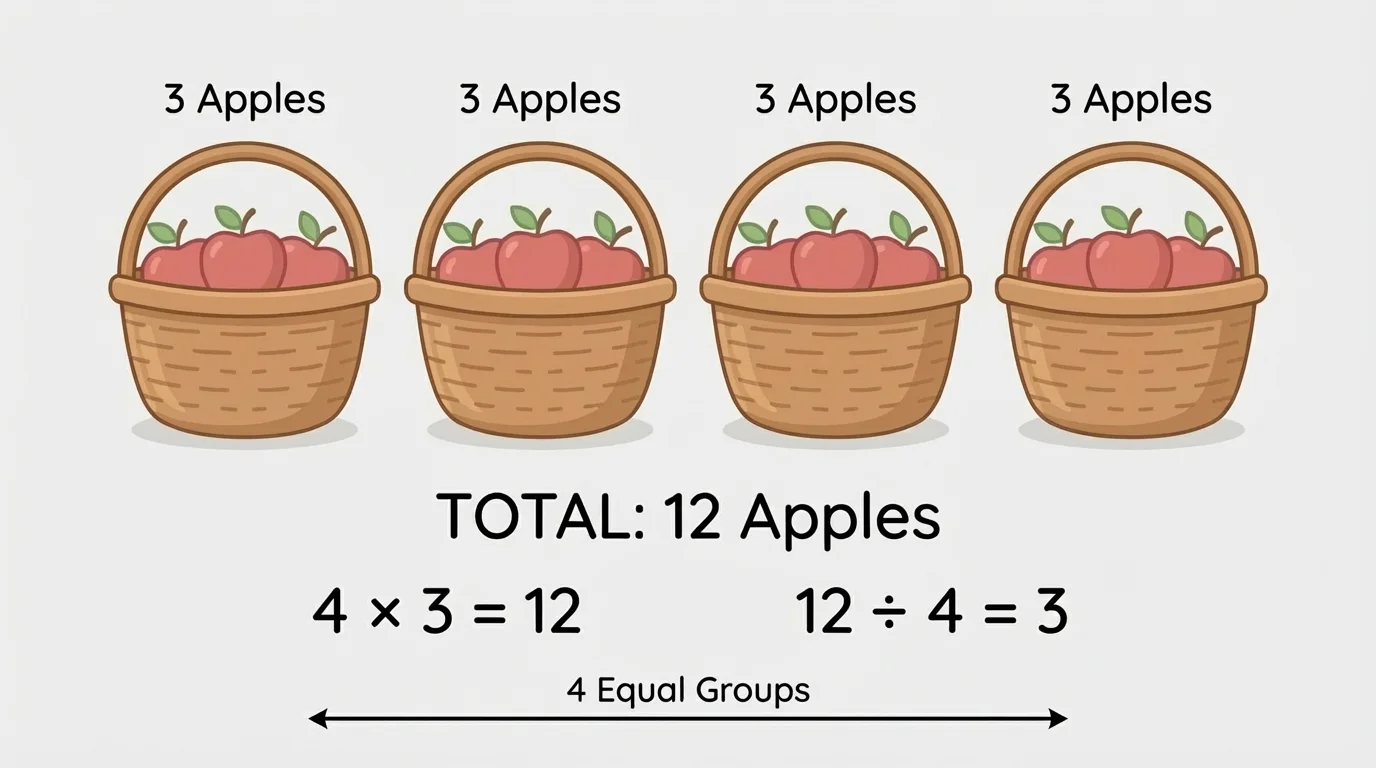
Division is used when the total is known, but one part of the grouping is missing. Suppose \(12\) cookies are placed into \(4\) equal plates. How many cookies go on each plate? We divide: \(12 \div 4 = 3\). Each plate gets \(3\) cookies.
Or maybe the size of each group is known, but the number of groups is missing. If \(12\) cookies are put into groups of \(3\), then the number of groups is \(12 \div 3 = 4\). Division helps find a missing part of an equal-group story.
Think back to repeated addition. If you know that \(5 + 5 + 5 + 5 = 20\), then you also know \(4 \times 5 = 20\). Multiplication is a shortcut for repeated addition.
The numbers in multiplication and division facts belong to the same fact family. For example, if \(4 \times 6 = 24\), then \(6 \times 4 = 24\), \(24 \div 4 = 6\), and \(24 \div 6 = 4\). Knowing these connected facts makes solving word problems easier.
[Figure 2] An array puts objects into rows and columns. This makes it easier to see multiplication, and the diagram illustrates how rows and columns help us count equal groups without missing any objects. If there are \(3\) rows with \(5\) stars in each row, then the total is \(3 \times 5 = 15\).
Arrays are helpful because they are neat and organized. You can count by rows or by columns. In a \(3\)-by-\(5\) array, there are \(3\) rows of \(5\) and also \(5\) columns of \(3\). Both give the same total, \(15\).
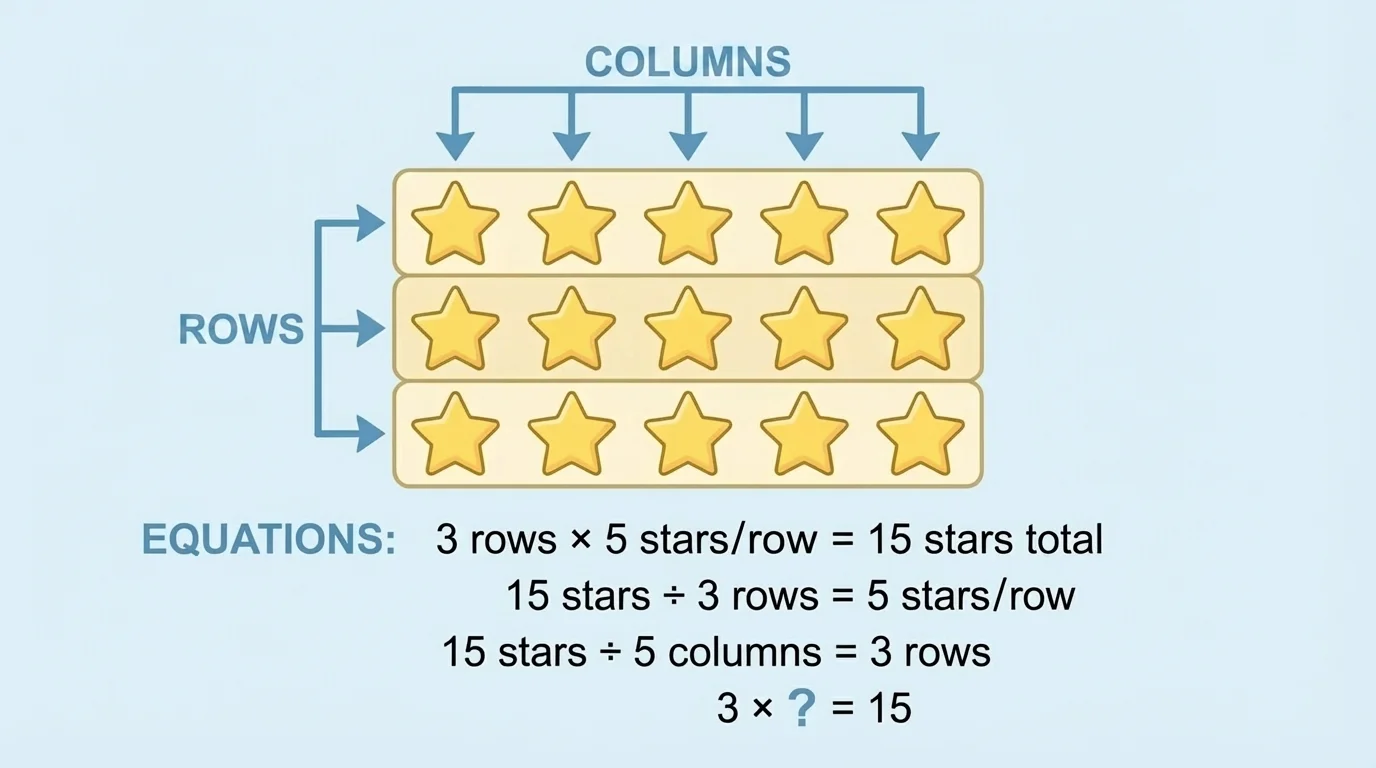
This shows an important idea: \(3 \times 5 = 5 \times 3\). The order changes, but the total stays the same. Arrays make this easy to see.
Arrays also help with division. If \(18\) stickers are arranged into \(3\) equal rows, how many stickers are in each row? Since \(18 \div 3 = 6\), there are \(6\) stickers in each row. You can picture the array to understand what the division means.
[Figure 3] Some multiplication and division problems use measurements instead of separate objects. In these problems, the same measurement amount is repeated, as the diagram shows with equal pieces placed one after another. For example, if one ribbon is \(4\) centimeters long and there are \(5\) ribbons of the same length, the total length is \(5 \times 4 = 20\) centimeters.
Measurement quantities can include length, cups of water, meters of rope, or pounds of fruit. If each jar holds \(2\) cups of juice and there are \(6\) jars, the total is \(6 \times 2 = 12\) cups.
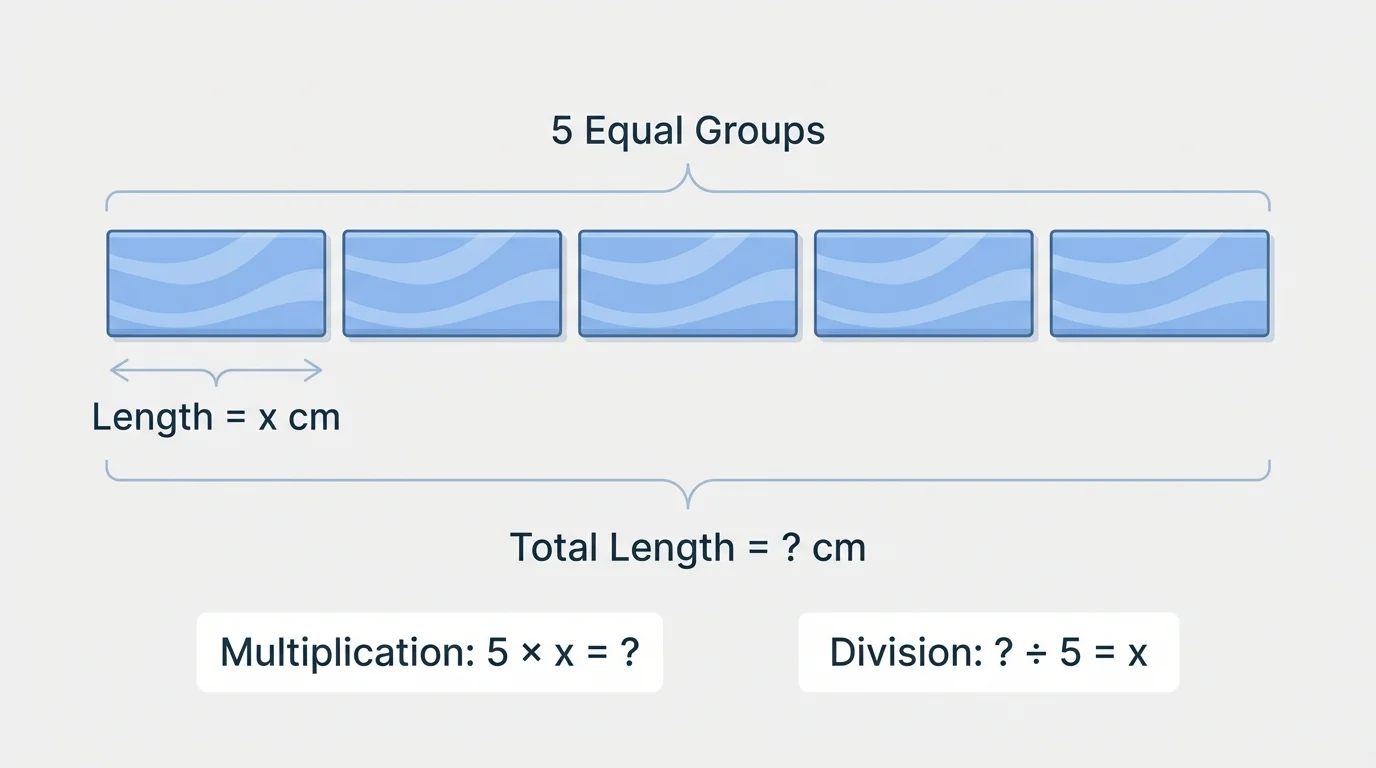
Division also works with measurement. If a rope is \(20\) centimeters long and it is cut into pieces that are each \(4\) centimeters long, the number of pieces is \(20 \div 4 = 5\). If \(20\) centimeters of ribbon are shared equally into \(5\) pieces, each piece is \(20 \div 5 = 4\) centimeters long.
These stories may sound different from cookie or toy problems, but the math idea is the same: equal amounts are being grouped or repeated.
Sometimes we do not know the total. Sometimes we do not know the number of groups. Sometimes we do not know how many are in each group. We can show the missing number with a symbol.
For example, if \(7\) boxes hold \(8\) pencils each, and we want the total, we can write \(7 \times 8 = n\). The unknown number \(n\) stands for the total. Since \(7 \times 8 = 56\), we know \(n = 56\).
If \(56\) pencils are placed into \(7\) equal boxes, we can write \(56 \div 7 = n\). Then \(n = 8\). If \(56\) pencils are placed so that each box has \(8\) pencils, we can write \(56 \div 8 = n\). Then \(n = 7\).
One story, three questions
The same numbers can make different problems. With \(56\), \(7\), and \(8\), you can ask for the total, the number of groups, or the amount in each group. The operation changes because the question changes.
That is why reading the question carefully matters just as much as doing the calculation.
A good strategy is to ask yourself: Am I joining equal groups, or am I breaking a total into equal groups?
Use multiplication when equal groups are being put together to find a total. Use division when a total is being split into equal groups, or when you need to find how many equal groups can be made.
| Situation | Operation | Example |
|---|---|---|
| Find the total from equal groups | Multiplication | \(6\) bags with \(4\) apples each: \(6 \times 4 = 24\) |
| Find the amount in each group | Division | \(24\) apples in \(6\) bags: \(24 \div 6 = 4\) |
| Find the number of groups | Division | \(24\) apples in groups of \(4\): \(24 \div 4 = 6\) |
Table 1. How word-problem questions connect to multiplication or division.
Words can help, but do not rely only on clue words. The most important thing is understanding the action in the story. Ask what is known, what is repeated, and what is missing.
Let's work through some problems carefully. Notice how the equation matches the story.
Worked example 1: Equal groups
A farmer packs \(5\) boxes. Each box has \(7\) oranges. How many oranges are there in all?
Step 1: Identify the equal groups.
There are \(5\) groups, and each group has \(7\) oranges.
Step 2: Write a multiplication equation.
\(5 \times 7 = n\)
Step 3: Solve.
\(5 \times 7 = 35\), so \(n = 35\).
The farmer has \(35\) oranges.
This is a multiplication problem because equal groups are being combined into one total.
Worked example 2: Array
There are \(24\) chairs arranged in \(4\) equal rows. How many chairs are in each row?
Step 1: Decide what is known.
The total is \(24\), and there are \(4\) rows.
Step 2: Write a division equation.
\(24 \div 4 = n\)
Step 3: Solve.
\(24 \div 4 = 6\), so \(n = 6\).
There are \(6\) chairs in each row.
Because arrays use rows and columns, they connect very well to both multiplication and division, just as we saw earlier with [Figure 2].
Worked example 3: Measurement quantity
A jump rope is cut into pieces that are each \(5\) centimeters long. The rope is \(40\) centimeters long. How many pieces are made?
Step 1: Understand the measurement situation.
The total length is \(40\) centimeters, and each piece is \(5\) centimeters.
Step 2: Write a division equation.
\(40 \div 5 = n\)
Step 3: Solve.
\(40 \div 5 = 8\), so \(n = 8\).
The rope makes \(8\) pieces.
This is like the ribbon picture from [Figure 3], where equal lengths repeat again and again.
Worked example 4: Find the number of groups
A teacher has \(18\) markers and puts \(3\) markers in each cup. How many cups are needed?
Step 1: Find what is missing.
The total is \(18\), and each group has \(3\). The number of groups is unknown.
Step 2: Write the equation.
\(18 \div 3 = n\)
Step 3: Solve.
\(18 \div 3 = 6\), so \(n = 6\).
The teacher needs \(6\) cups.
Notice that examples \(2\), \(3\), and \(4\) all use division, but the stories are a little different. In one story, division finds how many are in each row. In another, it finds how many pieces can be made. In the last, it finds how many groups are needed.
After solving, it is smart to check your answer. One way is to use the opposite operation. If you solved \(24 \div 4 = 6\), you can check with \(6 \times 4 = 24\).
You can also estimate. If there are \(5\) boxes with \(7\) oranges each, the total should be more than \(25\) and less than \(50\). So an answer like \(35\) makes sense, but an answer like \(85\) does not.
Drawings can help too. A quick sketch of equal groups, rows, or repeated lengths can help you see whether your equation matches the story. The group drawing in [Figure 1] is a good model for how a simple picture can make a problem clearer.
Professional builders, cooks, coaches, and store workers all use multiplication and division ideas when they organize equal amounts, rows, and repeated measurements.
Math is not only about getting an answer. It is also about understanding whether the answer fits the situation.
These kinds of problems appear everywhere. A gardener plants \(8\) rows of \(9\) flowers. A coach arranges \(30\) players into \(5\) equal groups. A baker uses \(4\) trays with \(6\) muffins on each tray. A craft maker cuts \(36\) centimeters of string into pieces that are each \(6\) centimeters long.
Students use these ideas at school too. Desks in rows make arrays. Art supplies in cups make equal groups. Measuring paper strips or ribbon uses repeated measurement quantities. Once you can spot the structure of the problem, you can choose the right operation.
As you become stronger at multiplication and division facts within \(100\), solving word problems becomes faster and easier. But the most important skill is understanding the story: what is repeated, what is total, and what is unknown.
