Have you ever read a line in a story that made you feel cold, nervous, excited, or peaceful even though you were just sitting in a chair? That is one of the powers of literature. Writers do much more than tell what happens. They choose special kinds of language to help readers see scenes, hear sounds, notice clues, and understand feelings. These special language choices are called literary devices, and learning to notice them can turn reading into detective work.
Authors do not choose words randomly. They make careful decisions so that a scene feels vivid, a poem sounds musical, or an event seems mysterious. A literary device is a tool a writer uses to create an effect. Some devices help readers imagine a place. Some create a pattern in the language. Some give hints about what may happen later. Some compare one thing to another in a surprising way.
Literary devices are language tools authors use to add meaning, feeling, and style to writing. They help readers understand ideas more deeply and respond to a text in a thoughtful way.
When readers notice literary devices, they begin to ask strong questions: Why did the author describe the rain that way? Why does this line sound fast? Why does this warning matter? Why compare fear to ice? These questions help readers move beyond just telling what happened. They begin to explain how the writing works.
Good readers also connect literary devices to the big ideas in a text. If a story uses dark, stormy imagery, that may connect to danger. If a poem has a smooth rhythm, that may connect to calm. If an author uses foreshadowing, the text may be preparing the reader for a turning point. If a character is described with a metaphor, that comparison may reveal personality or emotion.
Imagery uses words that appeal to the senses. It helps readers imagine sights, sounds, smells, tastes, and touch. Strong imagery makes writing feel alive instead of flat.
[Figure 1] Look at the difference between these two sentences: "The yard was messy." and "Wet leaves stuck to the fence, the grass sagged under muddy footprints, and a broken kite trembled in the wind." The second sentence uses imagery. It gives details that let a reader build a clear picture.
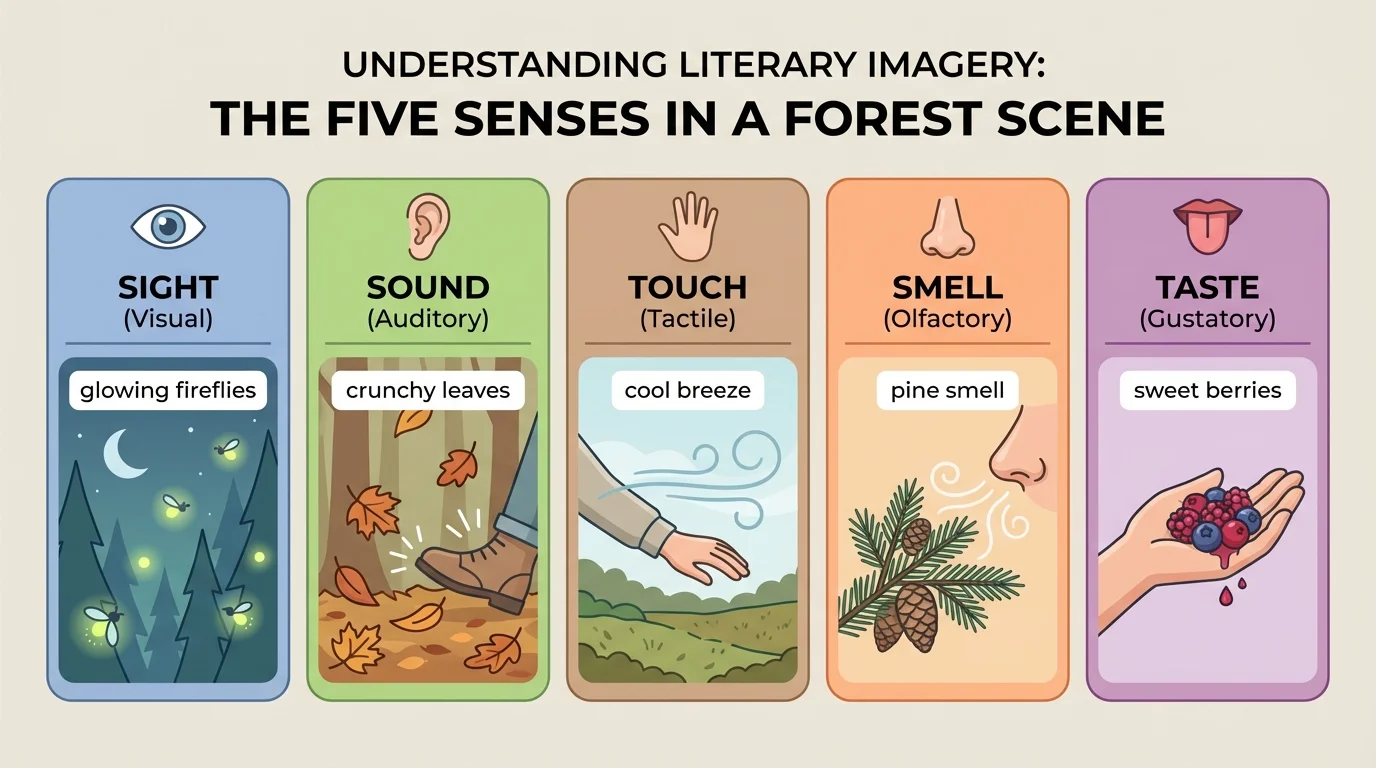
Imagery can involve all five senses. A writer might describe the sight of silver moonlight, the sound of snapping twigs, the smell of smoke, the taste of salty soup, or the feel of rough bark. Not every passage uses all five senses, but even one or two sensory details can make a scene much stronger.
Imagery also helps reveal mood, which is the feeling a text creates for the reader. Compare these examples. "Golden light spilled across the porch, and the lemonade sparkled with ice." This imagery creates a warm, cheerful mood. Now compare it to: "The hallway smelled of dust, and the flickering bulb made the shadows jump." This creates a tense or uneasy mood.
Reading imagery in a short passage
Passage: "The snow squeaked under Maya's boots, and her scarf scratched her chin while the wind slipped like cold fingers through her coat."
Step 1: Notice the sensory details.
"Squeaked" is a sound detail. "Scratched" and "cold fingers" are touch details.
Step 2: Ask what those details help the reader experience.
The reader can almost hear the snow and feel the uncomfortable cold.
Step 3: Explain the effect.
The imagery makes the winter setting feel real and uncomfortable, so the reader understands Maya's situation better.
When you respond to imagery, avoid only saying, "It uses details." Go further. Explain what kind of details they are and what they do. For example: "The author's imagery helps the reader feel the sharp cold of winter." That is a stronger response than simply naming the device.
Later, when you compare devices, return to [Figure 1]. It shows that imagery is not just about seeing; it can involve many senses at once, which is why rich descriptions often feel so powerful.
Rhythm is the beat or flow of language. It often appears in poetry, but it can also appear in prose, which is writing in ordinary sentences rather than verse. Rhythm comes from repeated sounds, repeated words, sentence length, and the natural pattern of stressed and unstressed syllables.
You can hear rhythm when language sounds smooth, quick, slow, bouncy, or heavy. Read these aloud: "Run. Duck. Dash. Breathe." The short words and short sentences create a quick, urgent rhythm. Now read: "The river rolled quietly under the evening sky." The longer, smoother sounds create a gentler rhythm.
How rhythm affects meaning
Rhythm is not only about sound. It helps shape the reader's experience. Fast rhythm can build excitement, action, or panic. Slow rhythm can create calm, sadness, or seriousness. Repetition can make a line memorable and can focus attention on an important idea.
Writers may repeat sounds or words to create rhythm. In a poem, a repeated phrase such as "I remember" can sound steady and thoughtful. In an action scene, several short sentences in a row can make the moment feel rapid. Rhythm can even match what is happening. A pounding rhythm can fit a race, while a soft rhythm can fit a lullaby or a quiet night scene.
Consider this line: "Tap, tap, tap went the rain on the window." The repeated word creates a beat. It also imitates the sound of rain. Here, rhythm works together with sound and imagery. This reminds us that literary devices often overlap rather than stay in separate boxes.
When responding to rhythm, think about two questions: What does the language sound like? How does that sound connect to meaning? A strong response might say, "The short repeated words create a quick rhythm that makes the storm feel sudden."
Poets often revise a line many times just to improve its rhythm. A single changed word can make a sentence sound smoother, stronger, or more dramatic.
Rhythm is especially important in poetry because poems are often meant to be heard as well as read. Still, you can find it in novels and short stories too. Dialogue, repeated sentence patterns, and action scenes often have noticeable rhythm.
Foreshadowing is when a writer gives clues about something that may happen later. These clues are often small. They may appear in a description, a warning, a strange object, or a character's uneasy feeling. Foreshadowing does not tell the future directly. Instead, it gently points readers toward what may come.
[Figure 2] Suppose a story says, "As Lena left the cabin, her grandfather called after her, 'Stay away from the frozen lake after sunset.'" That warning may be important later. Maybe Lena goes near the lake anyway. Maybe the ice cracks. The early warning prepares the reader.
Another example might be: "A dark line of clouds rested on the horizon all afternoon." At first, this seems like a simple description. Later, a storm may arrive at a very important moment. That earlier detail becomes foreshadowing because it hinted at the future event.
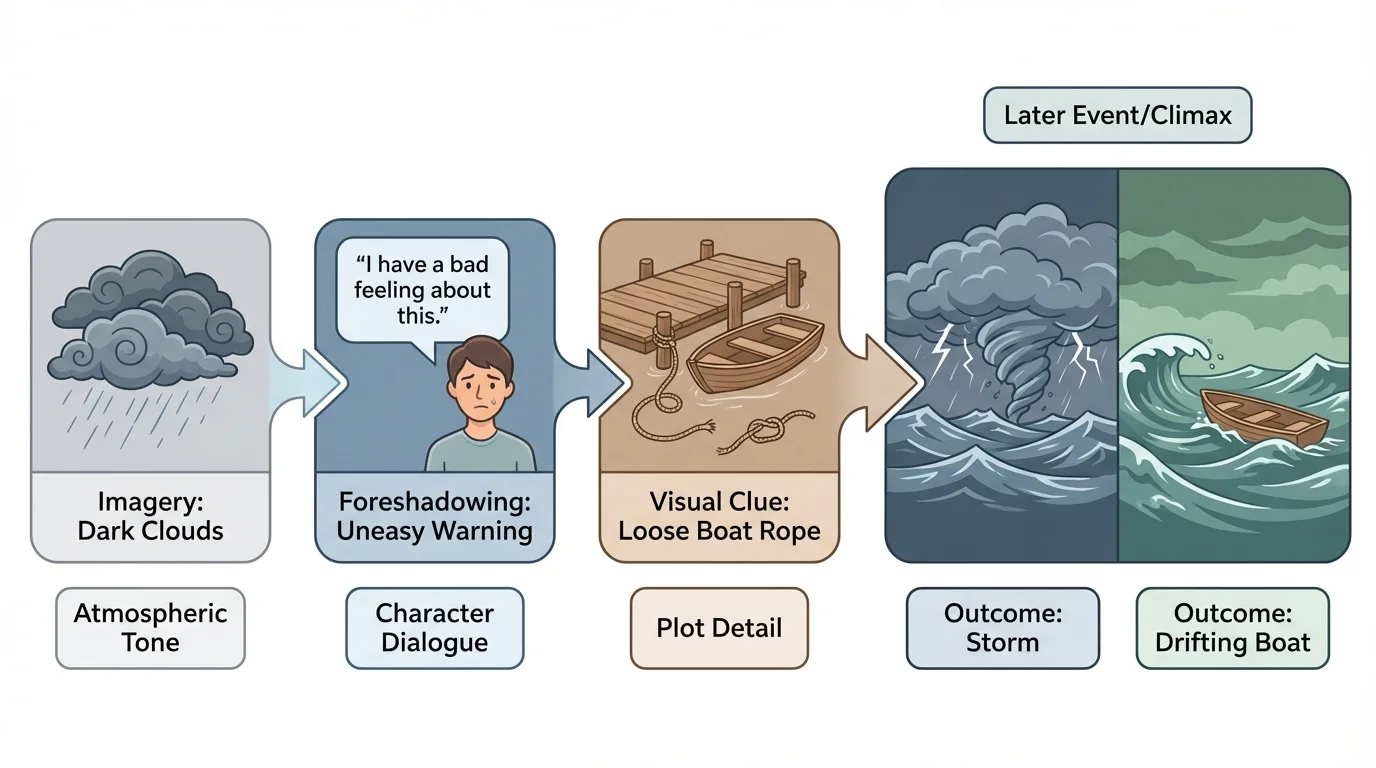
Foreshadowing builds suspense. It makes readers wonder, "Why did the author mention that?" It also helps later events feel believable. If a surprise event has no clues at all, it can feel random. But if the author plants careful hints, the story feels well built.
Not every clue is obvious. Sometimes foreshadowing is hidden in mood or imagery. A cheerful scene that suddenly includes a crow flapping from a dead tree may suggest trouble ahead. In this way, foreshadowing can work together with imagery.
Finding foreshadowing in a story moment
Passage: "Before the race began, Amir noticed that one strap on his backpack was frayed, but he shrugged and hurried on."
Step 1: Identify the detail that seems important.
The frayed strap stands out because it is specific.
Step 2: Ask why the author included it.
The author probably wants the reader to remember it.
Step 3: Predict what might happen later.
The strap may break at an important moment.
Step 4: Explain the effect.
This detail creates suspense because the reader expects trouble before it actually happens.
When you write about foreshadowing, support your idea with text evidence. You might say, "The warning about the lake is foreshadowing because it hints that the lake will become dangerous later." That response names the clue and explains its purpose.
As you continue reading, think back to [Figure 2]. It shows that a clue in the beginning can connect clearly to an event later, which is exactly how foreshadowing helps readers track a story's structure.
A metaphor is a comparison between two unlike things without using the words like or as. A simple metaphor helps readers understand an idea or feeling in a fresh way. If a writer says, "The classroom was a zoo," the writer does not mean there were real animals. The writer means the classroom was loud, wild, and hard to control.
Metaphors are powerful because they connect one idea to another. "Her smile was sunshine" suggests warmth and brightness. "Fear was ice in his stomach" suggests cold, stiffness, and discomfort. These comparisons do more than decorate writing. They reveal emotion and sharpen meaning.
Remember the difference between a simile and a metaphor. A simile compares using like or as. A metaphor compares directly without those words.
Some metaphors are easy to understand right away. Others make readers stop and think. That is one reason metaphors are useful in literature. They invite deeper interpretation. If a character says, "I'm carrying a mountain," the reader understands that the character feels heavily burdened, even though there is no actual mountain.
Metaphors can also help create tone. Saying "The city was a giant drum" gives a different feeling than "The city was a sleeping cat." The first feels energetic and noisy. The second feels calm and quiet. The comparison changes the reader's impression.
When responding to a metaphor, explain both parts of the comparison and the idea it expresses. For example: "The metaphor 'fear was ice in his stomach' shows that the character's fear feels physical, cold, and intense." This kind of explanation shows true understanding.
"Words are, in my not-so-humble opinion, our most inexhaustible source of magic."
— J.K. Rowling
That idea fits literary devices well. The right comparison can make a feeling seem almost real. A few carefully chosen words can change how a reader understands an entire scene.
A single passage often includes more than one device at the same time. Strong readers do not look for just one feature. They notice how different choices work together to create meaning.
[Figure 3] Read this passage: "The starting line shimmered in the heat. Marcus bounced on his toes. Behind the trees, thunder muttered. The track was a hungry mouth waiting to swallow every slow step." This short passage uses several devices. "Shimmered in the heat" is imagery. "Marcus bounced on his toes" adds movement and energy. "Thunder muttered" may be foreshadowing if a storm is coming. "The track was a hungry mouth" is a metaphor.
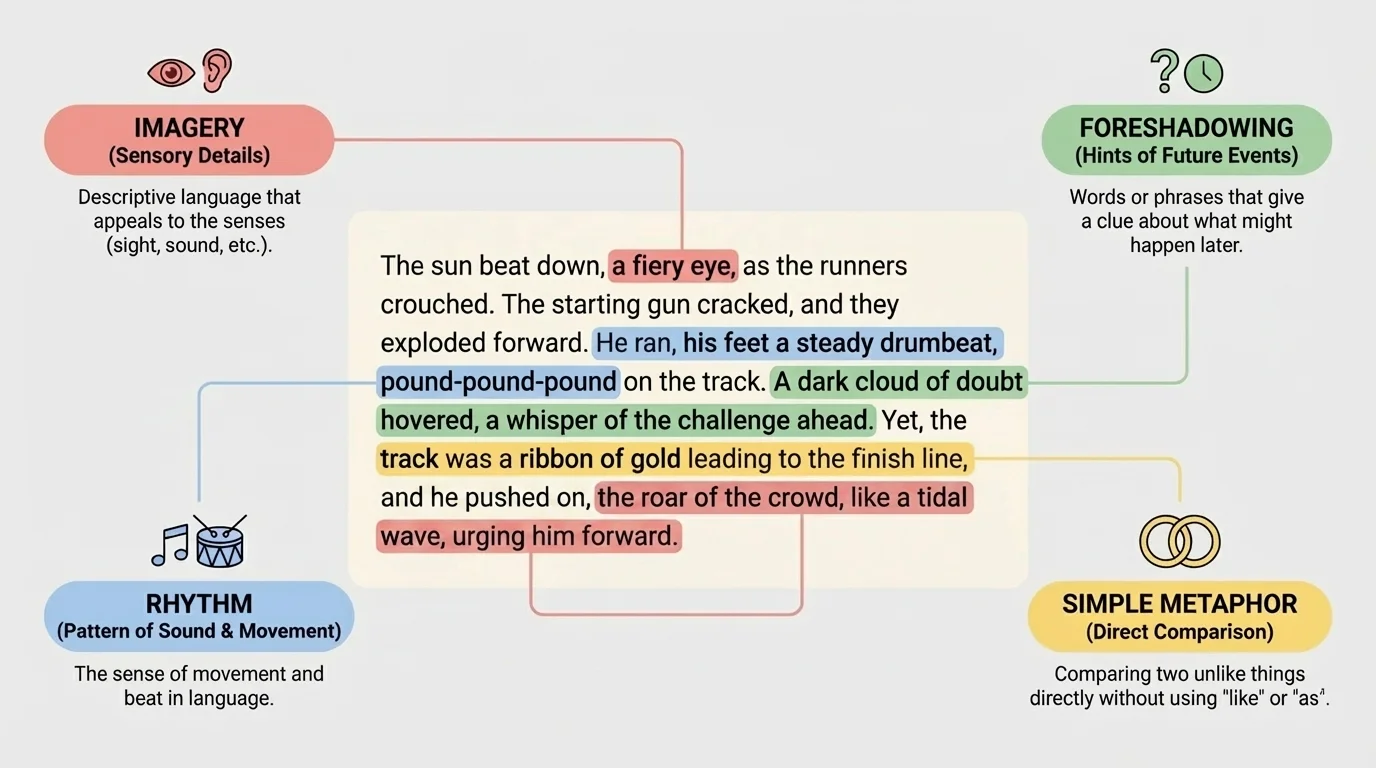
The rhythm of the short sentences also matters. They create tension and speed, which fit the scene before a race. The devices combine to make the moment feel hot, nervous, and dangerous. A reader's response should explain that combination, not just list the devices.
Here is an example of a strong response: "The author uses imagery and short sentences to make the race feel intense. The thunder may foreshadow trouble, and the metaphor of the track as a hungry mouth makes the race seem threatening." This kind of response is specific and supported by details from the text.
From noticing to interpreting
Naming a device is the first step, but interpretation goes further. Readers should explain what the device suggests, how it affects mood or meaning, and why the author might have used it at that moment.
That is why literary analysis is more than a hunt for labels. If a student says, "This is imagery," that is only a start. A stronger reader says, "This imagery makes the setting feel lonely," or "This metaphor shows that the character feels trapped." The explanation is what reveals understanding.
Later, when you return to the race passage, [Figure 3] helps you see how several devices can appear in just a few lines. Real literary reading often works this way: readers gather several clues and connect them.
When you respond to literature, support your ideas with evidence from the text. Evidence can include quoted words, paraphrased details, and exact references to what happens. The most useful responses do three things: identify the device, give evidence, and explain the effect.
A helpful pattern is: Device + evidence + effect. For example: "The author uses imagery in the phrase 'flickering bulb' to create an uneasy mood." Or: "The warning about the frozen lake is foreshadowing because it hints that the setting will become dangerous later."
| Device | What to Notice | Question to Ask | Possible Effect |
|---|---|---|---|
| Imagery | Sensory details | What can I see, hear, smell, taste, or feel? | Builds a picture or mood |
| Rhythm | Repeated sounds, repeated words, sentence flow | What does this language sound like? | Creates speed, calm, tension, or music |
| Foreshadowing | Warnings, strange details, important clues | What might happen later? | Builds suspense and prepares readers |
| Metaphor | Direct comparison | What idea or feeling does this comparison express? | Deepens meaning and emotion |
Table 1. Questions and effects that help readers analyze major literary devices.
Notice that every question pushes the reader toward explanation. That is the heart of interpretation. Instead of stopping at "what," readers continue to "why" and "how." Why did the author choose this image? How does the rhythm affect the scene? Why does the clue matter?
Thoughtful responses also pay attention to character and theme. If a metaphor shows a character feels trapped, that may connect to a larger theme about freedom. If gloomy imagery appears whenever a character remembers the past, that may show regret or sadness. Literary devices often point toward larger meanings.
These devices appear in many kinds of literary texts. In poetry, rhythm may stand out strongly because poets pay close attention to sound. In realistic fiction, imagery may help a setting feel believable. In fantasy, metaphors may make strange worlds easier to understand. In historical fiction, foreshadowing may build tension around events the reader senses are coming.
For example, a poem about the ocean might use rhythm to echo waves. A mystery story might use foreshadowing through a missing key or a suspicious glance. A realistic story about friendship might use imagery to show the mood of a silent lunchroom. Even though the genres differ, the reading skills stay connected.
Many authors reread their own writing aloud to hear rhythm, check whether imagery is vivid enough, and decide whether clues are too obvious or too hidden.
As a reader, you can use the same habits in any genre: notice important language, ask what it suggests, and connect it to the larger meaning of the text. The more carefully you notice literary devices, the more deeply you understand what you read.
Literary devices are not extras added on top of a story or poem. They are part of how the text communicates. They guide emotions, shape meaning, hint at future events, and help readers remember important moments. When readers understand these tools, they are better able to interpret a text and respond with clear, thoughtful ideas.
