What number squared gives \(-1\)? Over the real numbers, there is no answer. That simple question led mathematicians to expand the number system and create a powerful new idea: complex numbers. These numbers are not just a mathematical curiosity. They are used in electronics, waves, quantum physics, and computer science. To work with them, you need one special fact, \(i^2=-1\), and the same algebra properties you already know.
In the real number system, equations like \(x^2=9\) have solutions because \(3^2=9\) and \((-3)^2=9\). But the equation \(x^2=-1\) has no real solution, because the square of any real number is never negative. To handle equations like this, mathematicians defined a new number called the imaginary unit.
Imaginary unit: The number \(i\) is defined so that
\(i^2=-1\)
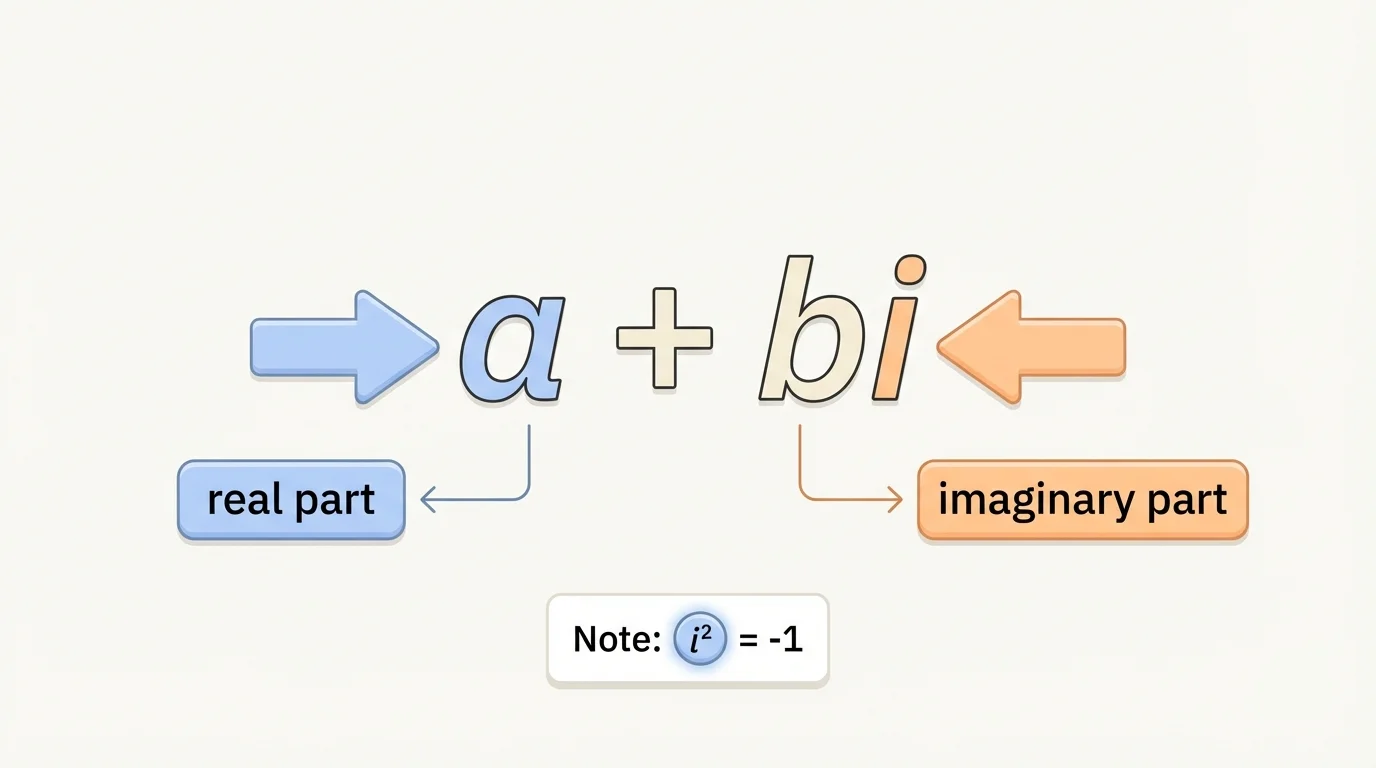
A complex number is any number that can be written in the form \(a+bi\), where \(a\) and \(b\) are real numbers.
[Figure 1] Once \(i\) is defined, new kinds of arithmetic become possible. Complex numbers still follow the familiar commutative, associative, and distributive properties. That means the algebra skills you already have still work; you just need to remember how powers of \(i\) simplify.
A complex number has two parts: a real part and an imaginary part. In the expression \(a+bi\), the number \(a\) is called the real part, and \(bi\) is called the imaginary part.
This form, \(a+bi\), is called standard form. For example, \(5+2i\), \(-3-7i\), and \(4i\) are all complex numbers. Notice that \(4i\) can be written as \(0+4i\), and the real number \(6\) can be written as \(6+0i\).
It helps to think of a complex number the same way you think about unlike terms in algebra. In the expression \(3+2x\), the constant term and the \(x\)-term are different kinds of terms. In the expression \(3+2i\), the real term and the imaginary term are also different kinds of terms, so they are combined only with matching types.
Recall from algebra that like terms can be combined, but unlike terms cannot. For example, \(4x+3x=7x\), while \(4x+3\) cannot be simplified further. Complex numbers work the same way: real parts combine with real parts, and imaginary parts combine with imaginary parts.
The most important simplification rule is still
\(i^2=-1\)
From that fact, you can find higher powers. For instance, \(i^3=i^2\cdot i=-i\), and \(i^4=i^2\cdot i^2=1\). These patterns will matter most when you multiply complex numbers.
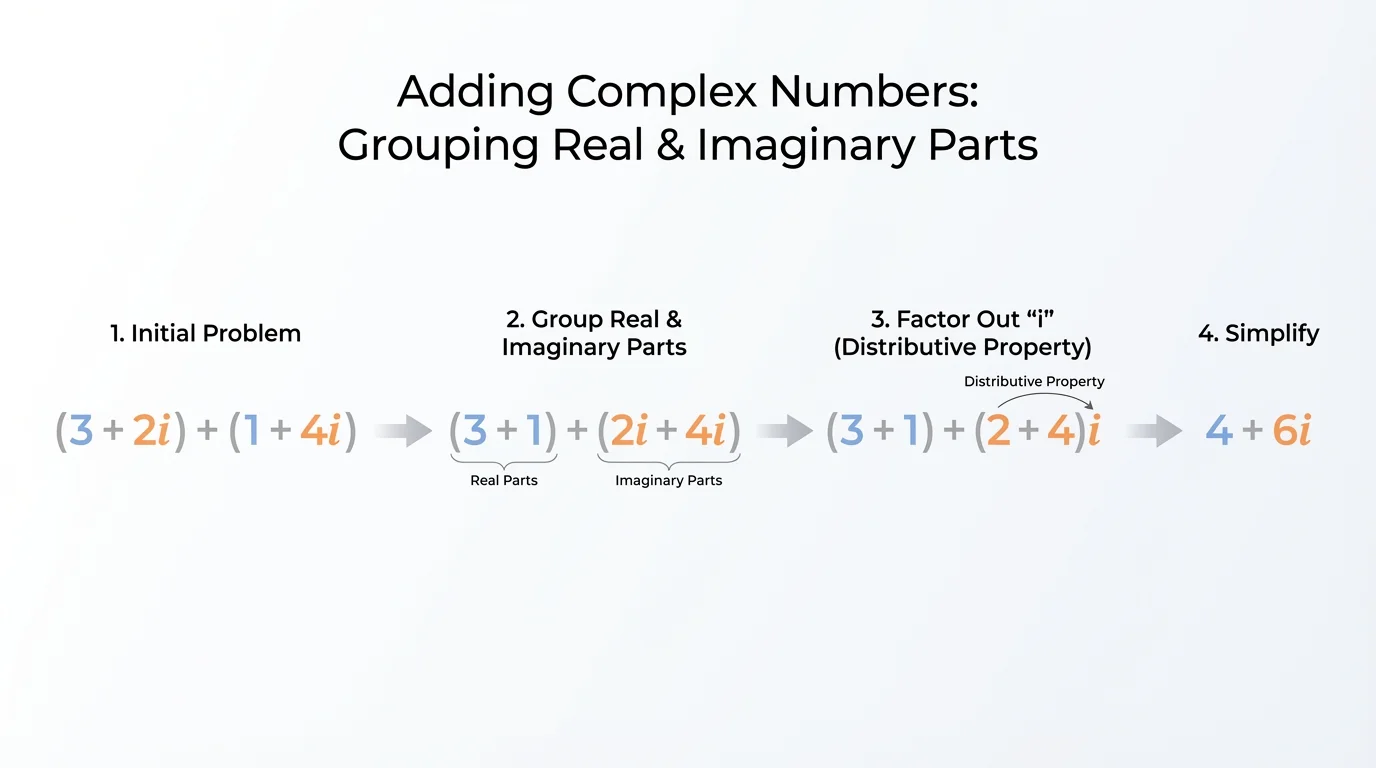
To add or subtract complex numbers, combine the real parts and combine the imaginary parts. This works because of the commutative and associative properties, which let you rearrange and regroup terms.
[Figure 2] For addition, if you have \((a+bi)+(c+di)\), you can rewrite it as \((a+c)+(b+d)i\). For subtraction, \((a+bi)-(c+di)=(a-c)+(b-d)i\).
These formulas are not new rules from nowhere. They come from ordinary algebra:
\[(a+bi)+(c+di)=a+bi+c+di=(a+c)+(bi+di)=(a+c)+(b+d)i\]
And similarly,
\[(a+bi)-(c+di)=a+bi-c-di=(a-c)+(b-d)i\]
If you see parentheses, be especially careful in subtraction. The minus sign must affect every term inside the second set of parentheses. This is one of the most common places where sign mistakes happen.
Worked example 1: Add two complex numbers
Find \((3+4i)+(5-2i)\).
Step 1: Group real parts and imaginary parts.
\((3+4i)+(5-2i)=3+5+4i-2i\)
Step 2: Combine like terms.
\(3+5=8\) and \(4i-2i=2i\).
Step 3: Write the answer in standard form.
\(8+2i\)
The sum is \(8+2i\).
You can check whether your answer is in standard form by making sure the real term comes first and the imaginary term comes second.
Worked example 2: Subtract two complex numbers
Find \((7-3i)-(2+6i)\).
Step 1: Apply the subtraction sign to each term inside the second set of parentheses.
\((7-3i)-(2+6i)=7-3i-2-6i\)
Step 2: Group like terms.
\(7-2=5\) and \(-3i-6i=-9i\).
Step 3: Write the result in standard form.
\(5-9i\)
The difference is \(5-9i\).
Multiplying complex numbers uses the distributive property. You multiply each term in the first factor by each term in the second factor, then combine like terms and simplify any \(i^2\) using \(-1\).
[Figure 3] For two complex numbers \((a+bi)(c+di)\), multiply as you would multiply two binomials:
\[(a+bi)(c+di)=ac+adi+bci+bdi^2\]
Since \(i^2=-1\), the last term becomes \(-bd\). Then combine the real and imaginary parts:
\[(a+bi)(c+di)=(ac-bd)+(ad+bc)i\]
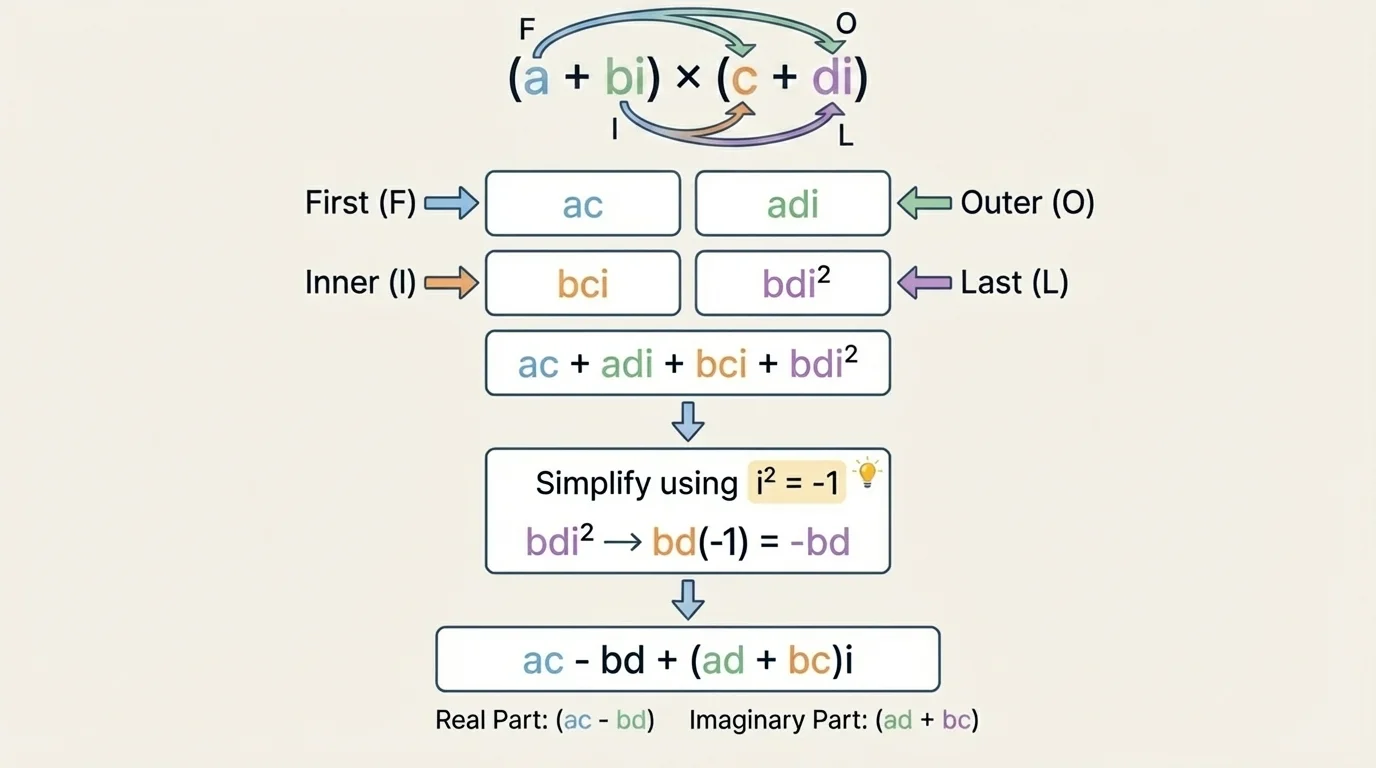
This formula is useful, but it is even more important to understand where it comes from. If you rely only on memorization, it is easy to forget a sign. If you work carefully with distribution and simplification, your reasoning stays solid.
Worked example 3: Multiply two complex numbers
Find \((2+3i)(4-i)\).
Step 1: Distribute each term in the first factor across the second factor.
\((2+3i)(4-i)=2(4)+2(-i)+3i(4)+3i(-i)\)
Step 2: Simplify each product.
\(2(4)=8\), \(2(-i)=-2i\), \(3i(4)=12i\), and \(3i(-i)=-3i^2\).
Step 3: Use \(i^2=-1\).
\(-3i^2=-3(-1)=3\).
Step 4: Combine like terms.
\(8-2i+12i+3=11+10i\).
The product is
\(11+10i\)
Notice how the \(i^2\) term turns into a real number. That is a major feature of complex multiplication: multiplying imaginary parts can produce a real term.
Worked example 4: Multiply conjugate-like expressions
Find \((5+2i)(5-2i)\).
Step 1: Distribute.
\((5+2i)(5-2i)=25-10i+10i-4i^2\)
Step 2: Combine like terms.
The imaginary terms cancel: \(-10i+10i=0\).
Step 3: Replace \(i^2\) with \(-1\).
\(-4i^2=-4(-1)=4\).
Step 4: Finish the arithmetic.
\(25+4=29\).
The product is
\(29\)
This kind of product is interesting because the result is purely real. Expressions like \(5+2i\) and \(5-2i\) are called conjugates.
The powers of \(i\) follow a repeating cycle. Starting from \(i\), each multiplication by \(i\) moves to the next value in the cycle:
\[i^1=i, \quad i^2=-1, \quad i^3=-i, \quad i^4=1\]
[Figure 4] Then the pattern repeats:
\[i^5=i, \quad i^6=-1, \quad i^7=-i, \quad i^8=1\]
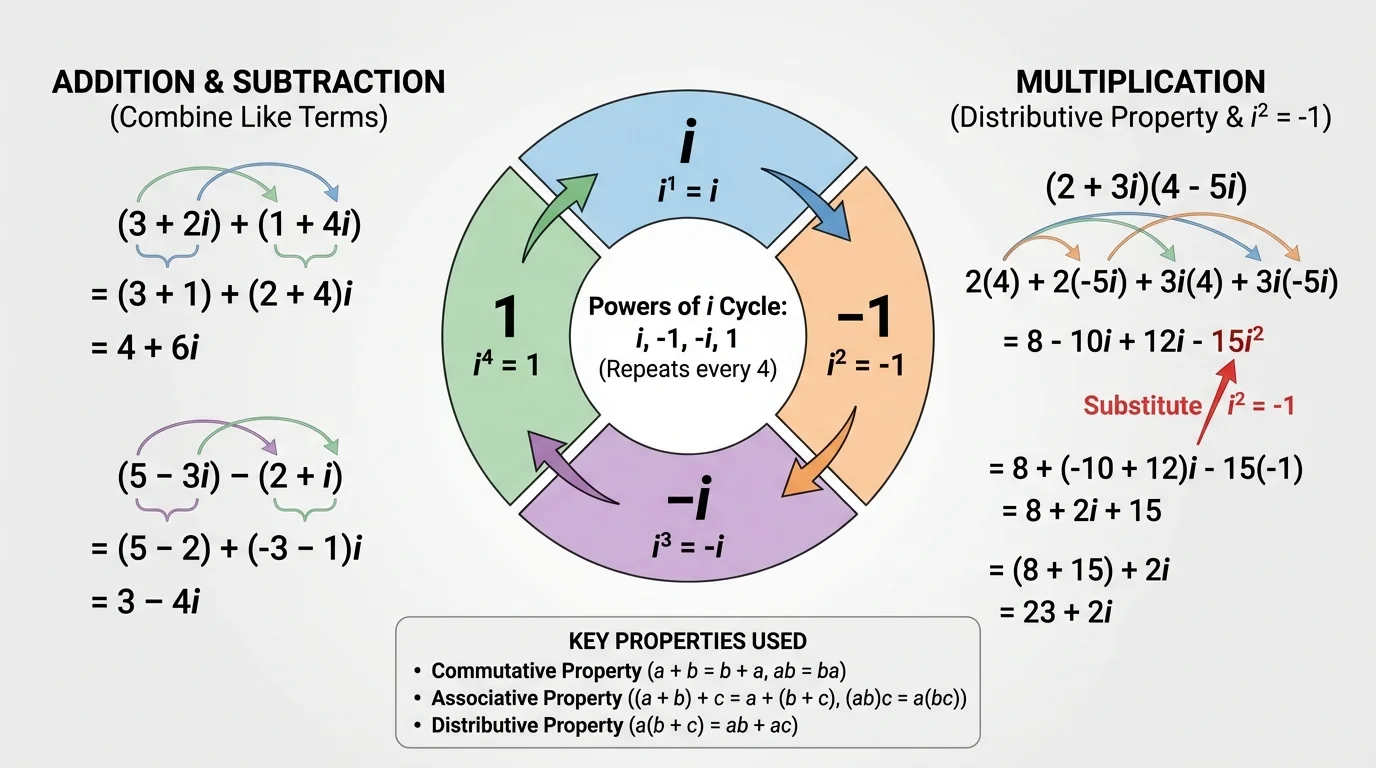
This cycle is helpful when simplifying expressions involving larger powers of \(i\). Every fourth power brings you back to \(1\), because \(i^4=1\).
Worked example 5: Simplify an expression with powers of \(i\)
Simplify \(6i^2-3i^3+i^4\).
Step 1: Replace each power with its simplified form.
\(i^2=-1\), \(i^3=-i\), and \(i^4=1\).
Step 2: Substitute.
\(6i^2-3i^3+i^4=6(-1)-3(-i)+1\)
Step 3: Simplify.
\(-6+3i+1=-5+3i\).
The simplified form is
\(-5+3i\)
Later in algebra, this repeating pattern helps when solving polynomial equations and working with more advanced forms of complex numbers.
The same properties that govern arithmetic with real numbers also govern arithmetic with complex numbers. The commutative property tells you that order does not matter for addition and multiplication: \(z_1+z_2=z_2+z_1\) and \(z_1z_2=z_2z_1\), where \(z_1\) and \(z_2\) are complex numbers.
The associative property tells you that grouping does not matter for addition and multiplication: \((z_1+z_2)+z_3=z_1+(z_2+z_3)\) and \((z_1z_2)z_3=z_1(z_2z_3)\).
The distributive property says multiplication distributes over addition:
\[z_1(z_2+z_3)=z_1z_2+z_1z_3\]
These properties justify the rearranging and regrouping you do when adding, subtracting, and multiplying complex numbers. When you used them earlier to collect real terms and imaginary terms, you were applying exactly the same algebra structure used throughout mathematics.
| Operation | General form | Result |
|---|---|---|
| Addition | \((a+bi)+(c+di)\) | \((a+c)+(b+d)i\) |
| Subtraction | \((a+bi)-(c+di)\) | \((a-c)+(b-d)i\) |
| Multiplication | \((a+bi)(c+di)\) | \((ac-bd)+(ad+bc)i\) |
Table 1. General rules for adding, subtracting, and multiplying complex numbers in standard form.
One frequent mistake is treating \(i^2\) as \(1\) instead of \(-1\). Since \(i\) is defined by \(i^2=-1\), getting this wrong changes the whole answer.
Another mistake is combining unlike terms. For example, \(3+2i\) cannot be simplified to \(5i\) or \(5\). The real part and imaginary part are different kinds of terms.
A third common mistake appears in subtraction. In \((4+7i)-(1-2i)\), the subtraction must apply to both terms in the second parentheses:
\[(4+7i)-(1-2i)=4+7i-1+2i=3+9i\]
In multiplication, students sometimes forget to distribute every term. If there are two terms in each factor, there should be four products before combining like terms, just as shown earlier in [Figure 3].
Complex numbers were once considered suspicious or even "imaginary" in the sense of unreal. Today they are essential in engineering and physics, and many modern technologies depend on calculations that use them.
Complex numbers are especially useful in electrical engineering. Alternating current circuits involve quantities that change direction and size over time. Engineers use complex numbers to represent voltage, current, and impedance because the real and imaginary parts can encode different aspects of oscillating behavior.
They also appear in wave motion and signal processing. Sound waves, radio signals, and digital communications often involve repeated cycles. The cycle of powers of \(i\), like the one shown in [Figure 4], connects naturally to repeated rotations and oscillations.
In advanced science and mathematics, complex numbers help describe quantum mechanics, fluid flow, and transformations in the plane. Even if you are only beginning the topic now, the arithmetic you learn here is the foundation for all of those later applications.
"The shortest path to the future often begins with extending the number system."
When you add, subtract, and multiply complex numbers correctly, you are not learning a disconnected trick. You are seeing how mathematics grows: by keeping logical structure, preserving useful properties, and extending ideas when old systems are no longer enough.
