Have you ever had a box with room for \(10\) crayons and only \(8\) crayons inside? You can ask, "How many are missing?" That question is really a subtraction question. When we solve subtraction this way, we think about addition too. For example, to solve \(10 - 8\), we can ask, "What number goes with \(8\) to make \(10\)?"
Subtraction can mean taking away, but it can also mean finding what is missing. If you know the whole amount and one part, subtraction helps you find the other part.
Look at \(10 - 8\). We know the whole is \(10\). We know one part is \(8\). We want the missing part. So we ask:
\[8 + \square = 10\]
The missing number is \(2\), because \(8 + 2 = 10\). So:
\(10 - 8 = 2\)
Unknown addend means a missing number in an addition problem. In \(8 + \square = 10\), the unknown addend is the number that makes \(10\) when added to \(8\).
This is why subtraction and addition are connected. A subtraction problem can become an addition problem with a missing number.
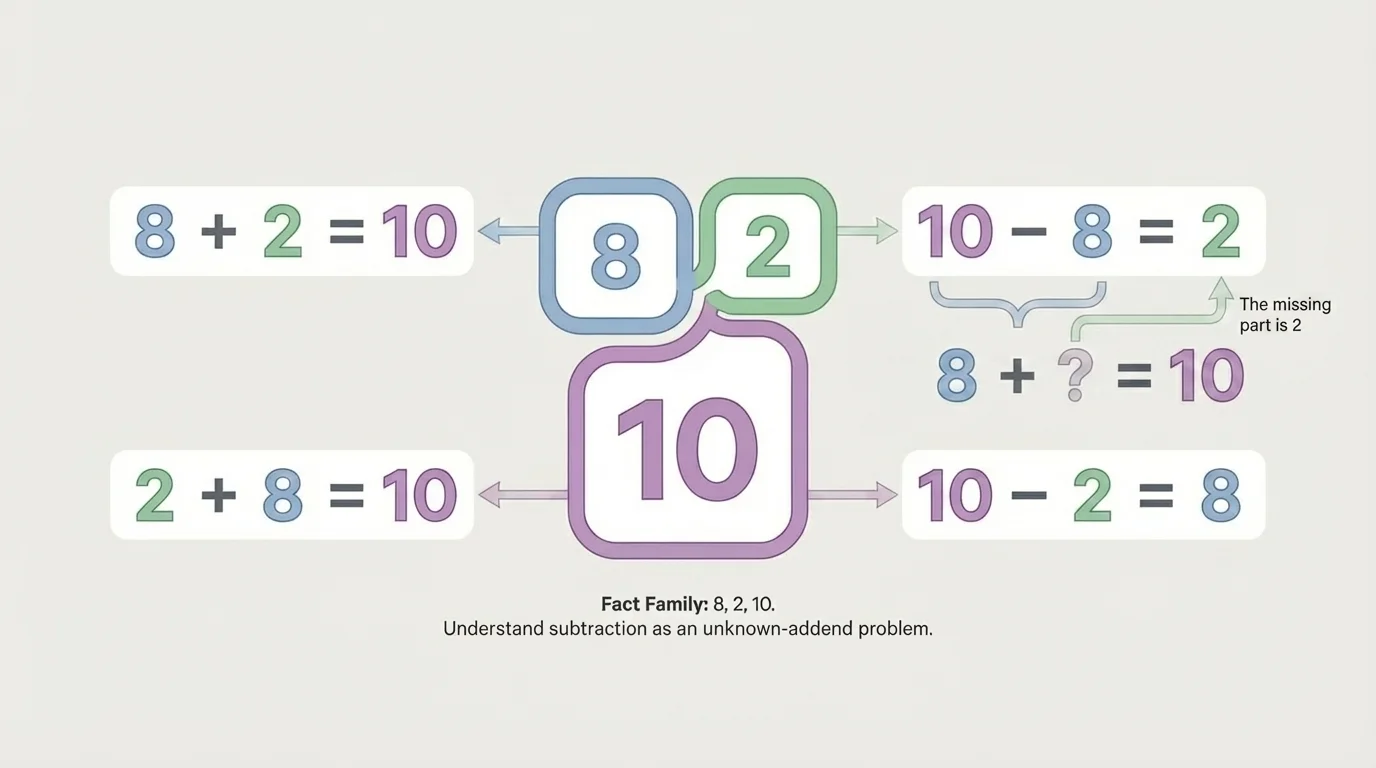
[Figure 1] A fact family is a group of numbers that belong together. If you know \(8\), \(2\), and \(10\), you can make addition and subtraction sentences with the same three numbers.
These number sentences are all connected:
\(8 + 2 = 10\)
\(2 + 8 = 10\)
\(10 - 8 = 2\)
\(10 - 2 = 8\)
When you know one addition fact, you can use it to help with subtraction. If you know \(9 + 1 = 10\), then you also know \(10 - 9 = 1\).
You already know how to add small numbers like \(7 + 3 = 10\). Now you can use that addition fact to solve subtraction: \(10 - 7 = 3\).
That is a smart way to solve. Instead of thinking only about taking away, you can think, "What number makes the whole?"
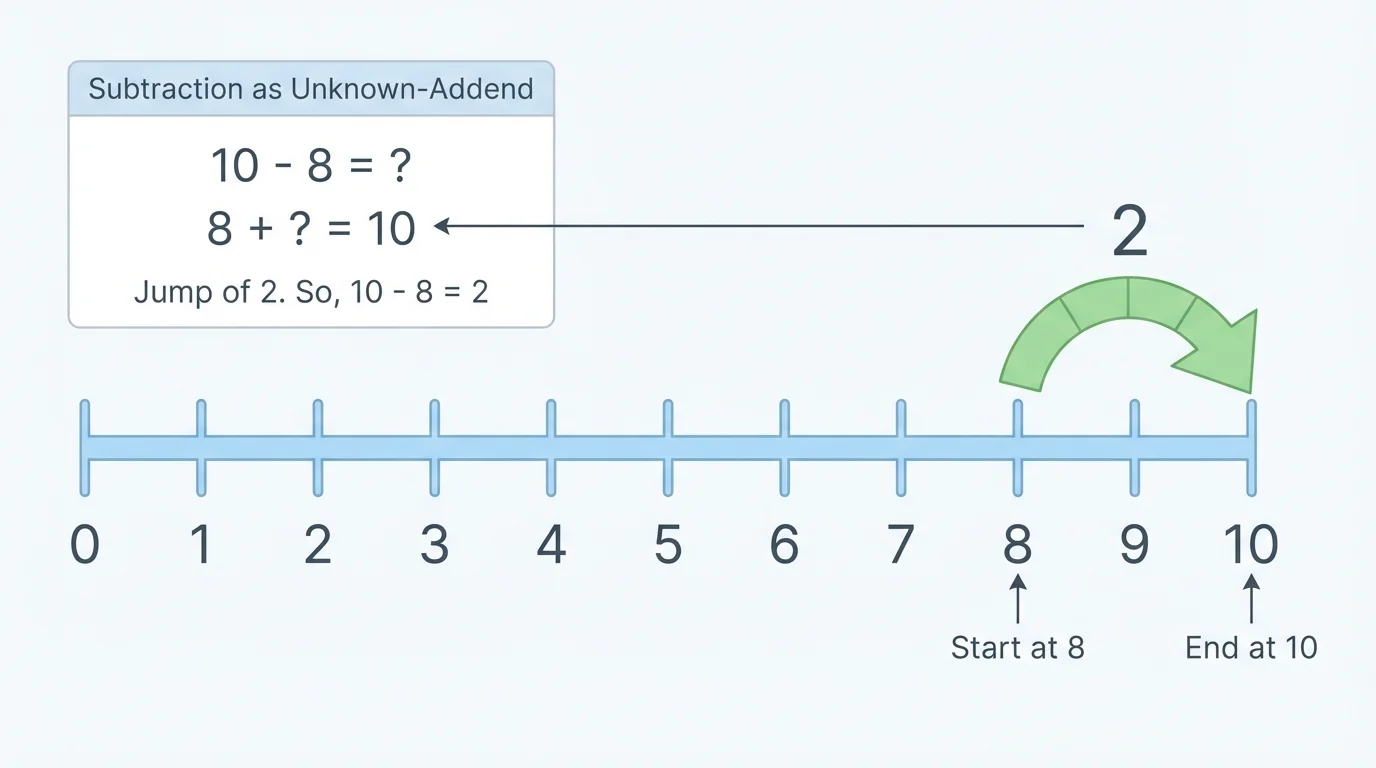
[Figure 2] When you see a subtraction problem, you can ask a new question. For \(10 - 8\), ask, "What makes \(10\) when added to \(8\)?" You can count on from \(8\) to \(10\).
Start at \(8\). Count up: \(9\), \(10\). You moved \(2\) steps. So the missing number is \(2\).
This means:
\(8 + 2 = 10\)
and also
\(10 - 8 = 2\)
This strategy is called thinking of subtraction as an unknown-addend problem. The addend is the number being added. If one addend is missing, we find it.
You can use this with many subtraction problems. For \(7 - 5\), ask, "What number makes \(7\) when added to \(5\)?" The answer is \(2\), so \(7 - 5 = 2\).
Add on to find the difference
The difference is the answer in a subtraction problem. One way to find the difference is to add on from the smaller number to the greater number. From \(8\) to \(10\) is \(2\), so the difference between \(10\) and \(8\) is \(2\).
This works especially well when the numbers are close together, like \(10\) and \(8\), or \(9\) and \(6\).
Example 1
Solve \(10 - 8\).
Step 1: Change the subtraction to a missing-addition problem.
Ask: \(8 + \square = 10\)
Step 2: Find the missing number.
\(8 + 2 = 10\)
Step 3: Write the subtraction answer.
\(10 - 8 = 2\)
The answer is \(2\).
The missing part is the same number in both equations. That is why the strategy works.
Example 2
Solve \(9 - 6\).
Step 1: Ask the addition question.
\(6 + \square = 9\)
Step 2: Find the missing number.
\(6 + 3 = 9\)
Step 3: Write the subtraction fact.
\(9 - 6 = 3\)
The answer is \(3\).
You can check your answer by adding. If \(6 + 3 = 9\), then your subtraction answer is correct.
Example 3
Solve \(7 - 4\).
Step 1: Think about the missing addend.
\(4 + \square = 7\)
Step 2: Find what makes \(7\).
\(4 + 3 = 7\)
Step 3: Write the subtraction answer.
\(7 - 4 = 3\)
The answer is \(3\).
Here is one more example: \(6 - 5\). Ask, "What number makes \(6\) when added to \(5\)?" The missing number is \(1\), so \(6 - 5 = 1\).
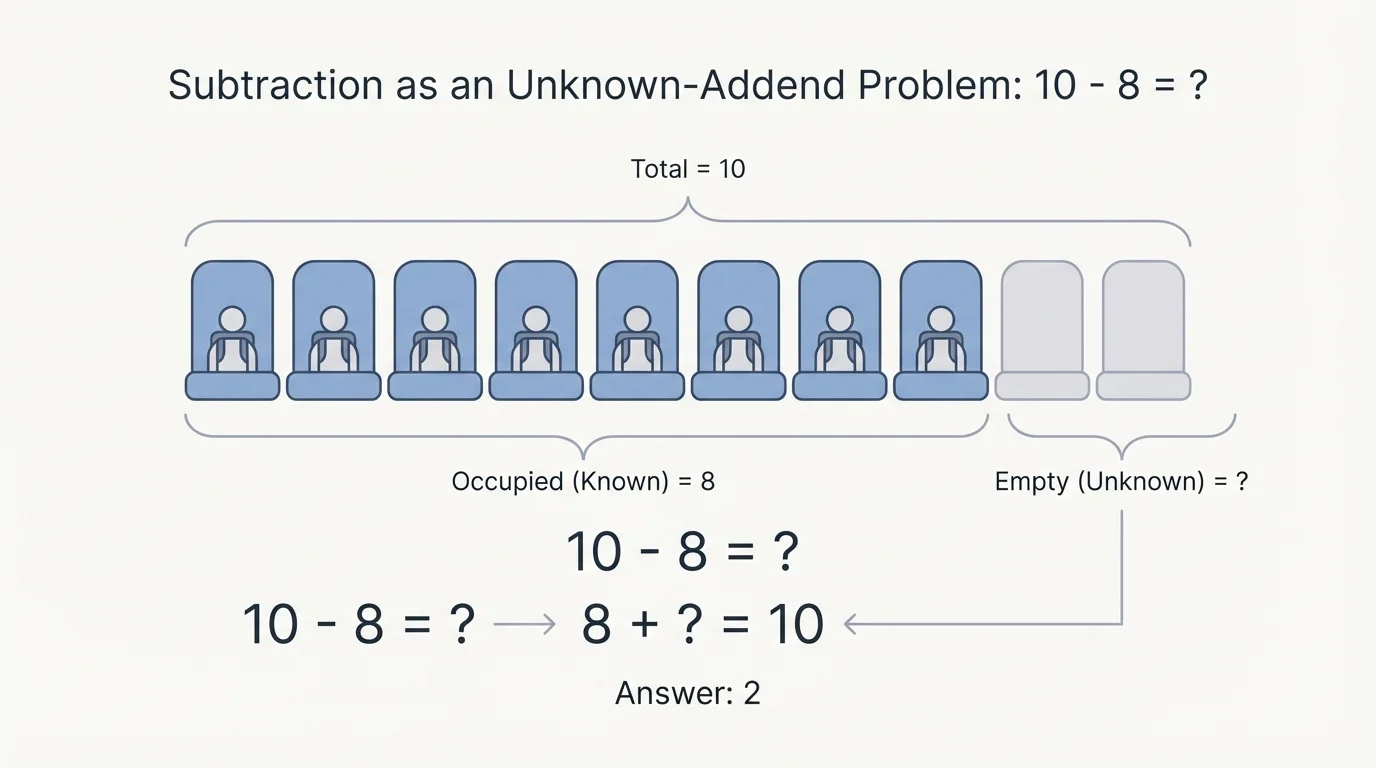
[Figure 3] You can use this idea in everyday life. If a row has \(10\) seats and \(8\) seats are filled, you can ask, "How many more seats will make \(10\)?" Since \(8 + 2 = 10\), there are \(2\) empty seats. So \(10 - 8 = 2\).
If you have \(9\) apples and \(7\) are on the table, how many are not on the table? Think: \(7 + \square = 9\). The missing number is \(2\). So \(9 - 7 = 2\).
If a toy shelf holds \(6\) toys and \(4\) are on it, then \(4 + \square = 6\). The missing number is \(2\), so \(6 - 4 = 2\).
When numbers are close together, thinking with addition is often faster than counting all the way back. For \(10 - 9\), it is easy to see that \(9 + 1 = 10\).
The same idea works with crayons, chairs, blocks, and spots in a game. You know the whole amount, you know one part, and you find the missing part.
Sometimes the same math idea looks different on the page. You might see:
| Problem | What to Think |
|---|---|
| \(10 - 8 = \square\) | \(8 + \square = 10\) |
| \(\square + 8 = 10\) | What number with \(8\) makes \(10\)? |
| \(8 + \square = 10\) | Find the missing addend. |
| \(10 = 8 + \square\) | The whole is \(10\); one part is \(8\). |
Table 1. Different ways to show the same missing-part idea.
All of these forms can have the same answer. If the missing number is \(2\), then each one shows the same relationship.
This is just like the fact family in [Figure 1]. The numbers stay connected even when the equation changes its order.
Sometimes children make small mistakes when using this strategy. One mistake is starting at \(8\) and counting \(8, 9, 10\) and saying the answer is \(3\). But when you count on, do not count the starting number as a jump. From \(8\) to \(9\) is one jump, and from \(9\) to \(10\) is one more jump. That makes \(2\) jumps.
Another mistake is mixing up the whole and the part. In \(10 - 8\), the whole is \(10\). The part is \(8\). We find the missing part, which is \(2\).
You can always check by adding. If you think \(10 - 8 = 2\), check: \(8 + 2 = 10\). It works.
