A calculator can solve many equations in seconds, but it cannot always tell you why an answer works or whether it is even allowed. This distinction is important in algebra. Some equations appear solvable by standard algebraic steps, yet those same steps can create answers that do not actually satisfy the original equation. This is especially important for equations with variables in denominators and for equations involving square roots. In these cases, the process of solving is also a process of careful reasoning.
Two kinds of equations often require extra attention: rational equations and radical equations. A rational equation contains one or more fractions with a variable in the denominator, such as \[\frac{2}{x-3}=5.\] A radical equation contains a variable inside a root, such as \[\sqrt{x+4}=6.\]
These equations are not hard because they are mysterious. They are hard because not every algebraic move preserves the exact same set of solutions. For example, multiplying both sides by an expression that might equal zero or squaring both sides of an equation can lead to extra answers. These false answers are called extraneous solutions.
Rational equation: an equation that includes a rational expression, usually a fraction with a variable in the denominator.
Radical equation: an equation in which a variable appears inside a root, such as a square root.
Extraneous solution: a value found during solving that does not satisfy the original equation.
Domain restriction: a value that is not allowed because it makes part of the expression undefined, such as making a denominator equal to zero or putting a negative number inside a square root when working in the real numbers.
Whenever you solve one of these equations, a smart habit is to ask two questions: What values are not allowed? and Does my answer work in the original equation? Those two questions prevent many mistakes.
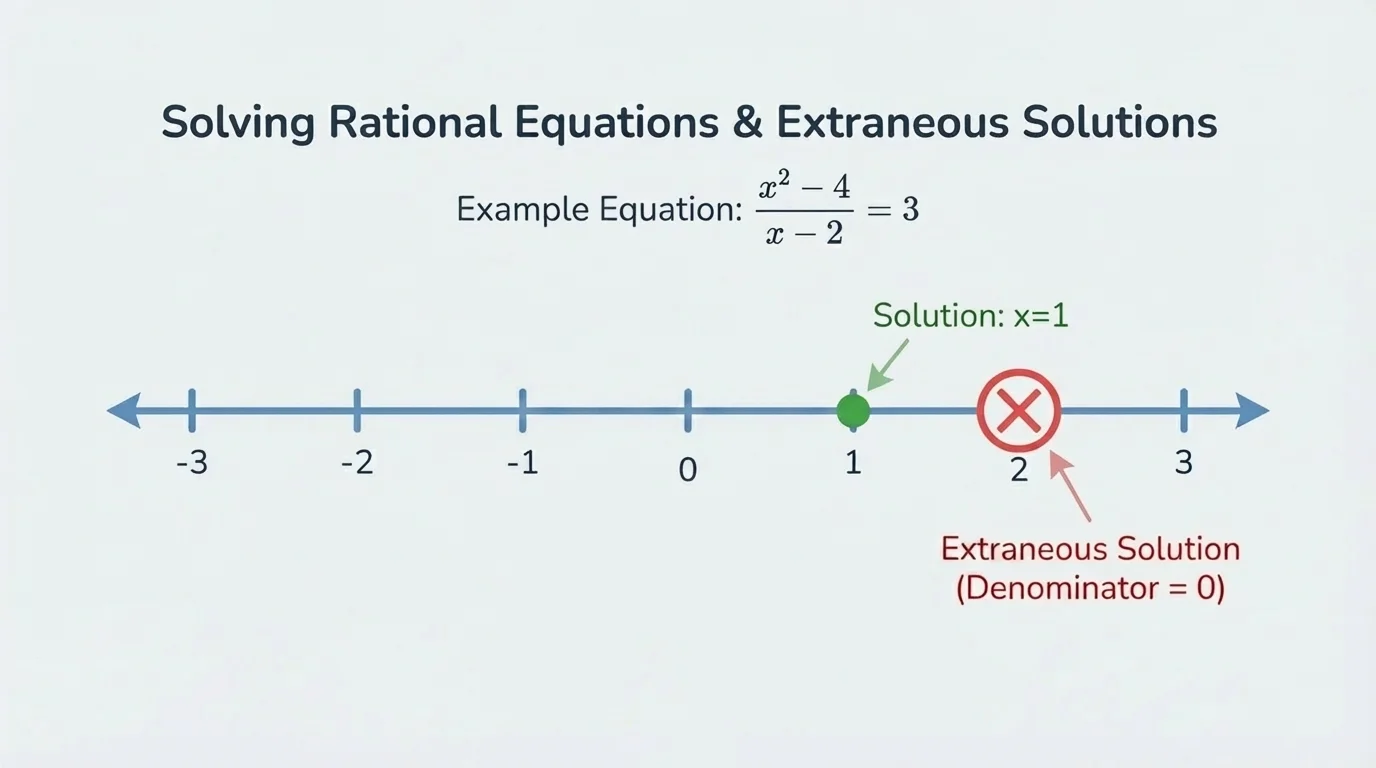
In a rational equation, the first job is often to identify the domain restrictions. As [Figure 1] suggests, excluded values can be marked on a number line to show where the expression is undefined. If a denominator becomes zero, the expression is undefined, so that value can never be a solution. This idea matters before you even start simplifying.
After finding restrictions, a common strategy is to multiply both sides by the least common denominator, often abbreviated as the least common denominator. This removes the fractions and turns the equation into a simpler form. But the restrictions do not disappear; they still matter at the end.
For example, if an equation contains denominators of \(x\), \(x-2\), and \(3x\), then the least common denominator is \(3x(x-2)\). Multiplying both sides by that expression can simplify the equation, but if \(x=0\) or \(x=2\), the original equation is still undefined. Those values must be excluded.
A key reasoning idea is this: when you multiply both sides of an equation by the same nonzero expression, the solution set stays the same. But if that expression can be zero for some value of the variable, you must be careful. That is one reason checking solutions in the original equation is essential.
Worked example 1: a simple rational equation
Solve \[\frac{3}{x}=6.\]
Step 1: State the restriction.
The denominator cannot be zero, so \(x\neq 0\).
Step 2: Clear the denominator.
Multiply both sides by \(x\): \(x\cdot \dfrac{3}{x}=x\cdot 6\), so \(3=6x\).
Step 3: Solve.
Divide by \(6\): \(x=\dfrac{3}{6}=\dfrac{1}{2}\).
Step 4: Check.
Substitute \(x=\dfrac{1}{2}\) into the original equation: \(\dfrac{3}{1/2}=6\), and \(\dfrac{3}{1/2}=6\). The equation is true.
The solution is \[x=\frac{1}{2}.\]
Some rational equations simplify to linear equations, while others simplify to quadratic equations. Even if the algebra produces two values, one or both may fail because of restrictions. This is why the visual idea of excluded values in [Figure 1] remains useful even after the fractions are gone.
Worked example 2: rational equation with restrictions
Solve \[\frac{1}{x-1}+\frac{1}{x+1}=1.\]
Step 1: Find restrictions.
\(x-1\neq 0\) and \(x+1\neq 0\), so \(x\neq 1\) and \(x\neq -1\).
Step 2: Use the least common denominator.
The least common denominator is \((x-1)(x+1)\).
Step 3: Multiply every term by the least common denominator.
\((x-1)(x+1)\cdot \dfrac{1}{x-1}+(x-1)(x+1)\cdot \dfrac{1}{x+1}=(x-1)(x+1)\cdot 1\).
This simplifies to \((x+1)+(x-1)=x^2-1\).
Step 4: Solve the resulting equation.
\(x+1+x-1=x^2-1\) gives \(2x=x^2-1\).
Move all terms to one side: \(x^2-2x-1=0\).
Use the quadratic formula: \(x=\dfrac{2\pm \sqrt{(-2)^2-4(1)(-1)}}{2} = \dfrac{2\pm \sqrt{8}}{2}=1\pm \sqrt{2}\).
Step 5: Check the restrictions and the original equation.
Neither \(1+\sqrt{2}\) nor \(1-\sqrt{2}\) equals \(1\) or \(-1\), so both are allowed. Substituting either value into the original equation works.
The solutions are \[x=1+\sqrt{2}\quad \textrm{or} \quad x=1-\sqrt{2}.\]
Extraneous solutions in rational equations often appear when an algebraic step changes the conditions of the equation. Sometimes the restricted value appears during solving and looks like a solution, but it must be rejected because it makes a denominator zero.
Worked example 3: a rational equation with an extraneous solution
Solve \[\frac{x+2}{x-2}=\frac{4}{x-2}.\]
Step 1: State the restriction.
\(x-2\neq 0\), so \(x\neq 2\).
Step 2: Clear the denominator.
Multiply both sides by \(x-2\): \(x+2=4\).
Step 3: Solve.
\(x=2\).
Step 4: Check against the original equation.
If \(x=2\), then both denominators become zero, so the original equation is undefined. Therefore \(x=2\) is not a valid solution.
There is no solution.
This example is a clear reminder that solving is not just symbol manipulation. The equation \(x+2=4\) came from multiplying by \(x-2\), but that step quietly assumes \(x-2\neq 0\). Since the only candidate is \(x=2\), the original equation has no solution.
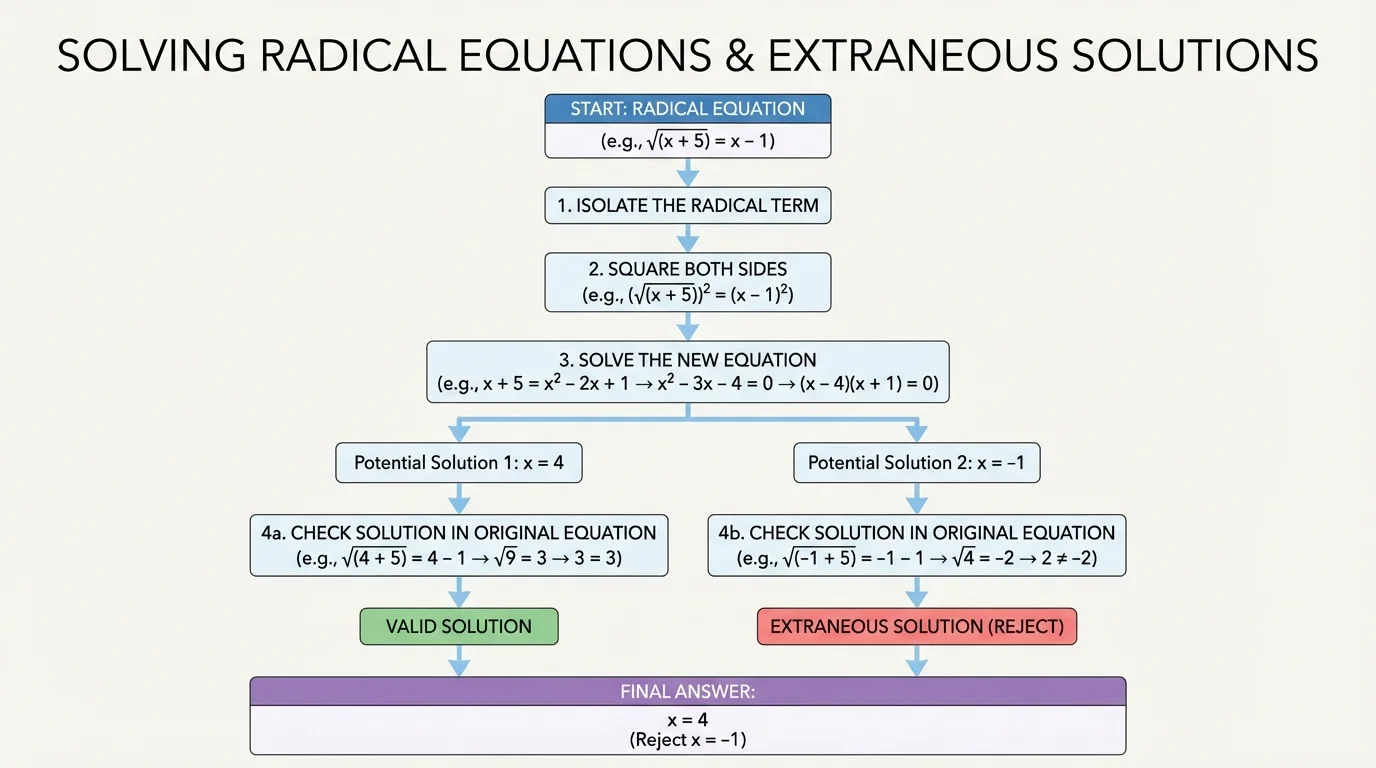
As [Figure 2] illustrates, a radical equation usually requires isolating the radical first and then removing it by using an inverse operation. For square roots, that operation is squaring. But squaring both sides can create new equations that have more solutions than the original one. That is why checking after solving is necessary.
Suppose you have \(\sqrt{x+5}=7\). If you square both sides, you get \(x+5=49\), so \(x=44\). This works because the right side was already positive and the square root was isolated.
Now consider \(\sqrt{x+1}=x-1\). Squaring both sides may give one or more candidates, but some may fail because the principal square root is always nonnegative. That means the right side of the original equation must also be nonnegative. Domain and sign conditions matter here just as much as denominator restrictions matter in rational equations.
Another important fact is that a square root like \(\sqrt{x+3}\) is defined in the real numbers only when \(x+3\geq 0\). So before solving, you can often identify a useful condition on the variable.
Worked example 4: simple radical equation
Solve \[\sqrt{x+9}=5.\]
Step 1: Identify the condition.
\(x+9\geq 0\), so \(x\geq -9\).
Step 2: Square both sides.
\((\sqrt{x+9})^2=5^2\), so \(x+9=25\).
Step 3: Solve.
\(x=16\).
Step 4: Check.
\(\sqrt{16+9}=\sqrt{25}=5\), so the equation is true.
The solution is \(x=16.\)
When the radical is not already isolated, isolate it first. If there are two radicals, you may need to square twice. Each squaring step increases the chance of an extraneous solution, so checking becomes even more important.
Worked example 5: radical equation with an extraneous solution
Solve \[\sqrt{x+1}=x-1.\]
Step 1: Note the conditions.
Because \(\sqrt{x+1}\) is defined, \(x+1\geq 0\). Also, since a square root is nonnegative, the right side must satisfy \(x-1\geq 0\), so \(x\geq 1\).
Step 2: Square both sides.
\((\sqrt{x+1})^2=(x-1)^2\), so \(x+1=x^2-2x+1\).
Step 3: Solve the quadratic equation.
\(x+1=x^2-2x+1\) gives \(0=x^2-3x\).
Factor: \(x(x-3)=0\).
So the candidates are \(x=0\) and \(x=3\).
Step 4: Check in the original equation.
For \(x=0\): \(\sqrt{0+1}=1\), but \(0-1=-1\). Since \(1\neq -1\), \(x=0\) is extraneous.
For \(x=3\): \(\sqrt{3+1}=2\) and \(3-1=2\). This works.
The only valid solution is \(x=3.\)
The extra answer appeared because squaring both sides removes sign information. The equations \(a=b\) and \(a^2=b^2\) are not equivalent in both directions. If \(a=b\), then \(a^2=b^2\). But if \(a^2=b^2\), then \(a=b\) or \(a=-b\). That is exactly why checking is required, and it is the central warning shown in [Figure 2].
Worked example 6: radical equation with a radical expression
Solve \[\sqrt{x+4}=x-2.\]
Step 1: State conditions.
\(x+4\geq 0\), and because the square root is nonnegative, \(x-2\geq 0\). So \(x\geq 2\).
Step 2: Square both sides.
\(x+4=(x-2)^2=x^2-4x+4\).
Step 3: Rearrange and solve.
\(x+4=x^2-4x+4\) gives \(0=x^2-5x\).
Factor: \(x(x-5)=0\).
The candidates are \(x=0\) and \(x=5\).
Step 4: Check.
\(x=0\) fails immediately because \(x\geq 2\) is required, and in the original equation \(\sqrt{4}=2\) but \(0-2=-2\).
\(x=5\) works because \(\sqrt{9}=3\) and \(5-2=3\).
The solution is \(x=5.\)
Although rational and radical equations look different, the reasoning behind solving them is similar. In both cases, you often transform the equation into an easier one, then check whether the resulting values still make sense in the original equation.
| Equation type | Main concern | Typical strategy | Why extraneous solutions may appear |
|---|---|---|---|
| Rational equation | Denominators cannot equal zero | Find restrictions, then clear denominators using the least common denominator | A candidate may make a denominator zero, so it must be rejected |
| Radical equation | Expressions under even roots must be nonnegative, and square roots are nonnegative | Isolate the radical, square both sides, solve, then check | Squaring both sides can create values that satisfy the squared equation but not the original one |
Table 1. Comparison of solving methods, restrictions, and sources of extraneous solutions for rational and radical equations.
One useful way to think about this is that some algebra steps are fully reversible, while others are only partly reversible. Adding the same number to both sides is reversible. Multiplying by a nonzero constant is reversible. Squaring both sides is not always reversible in a one-to-one way, so it may enlarge the solution set.
When solving any equation, the goal is not simply to produce values. The goal is to find all and only the values that make the original equation true.
This phrase, "all and only," is a good test of your reasoning. If you miss a valid solution, your work is incomplete. If you include an extraneous solution, your work is incorrect.
These equations are not just classroom exercises. Rational equations appear in rate problems, electronics, and formulas involving reciprocals. Radical equations appear in geometry, physics, and engineering when distances or square-root relationships are involved.
For example, suppose the stopping distance of a vehicle under certain conditions is modeled by \(d=k\sqrt{v}\), where \(d\) is distance, \(v\) is speed, and \(k\) is a constant. If you know \(d\) and \(k\), solving for \(v\) requires reasoning with a radical relationship. In a real setting, a negative speed would make no sense, so checking the meaning of solutions matters just as much as checking the algebra.
Rational relationships also show up in combined work problems. If one machine completes a job in \(x\) hours and another in \(x+2\) hours, their combined rate may be written using fractions like \(\dfrac{1}{x}\) and \(\dfrac{1}{x+2}\). Solving for \(x\) requires the same careful treatment of denominators that we used earlier. A value like \(x=0\) might appear in algebraic work, but it would not be physically possible.
Engineers, scientists, and computer models routinely reject mathematically possible answers if they violate the conditions of the original problem. In real applications, an answer must be both algebraically correct and physically meaningful.
This is one reason algebra is such a powerful subject: it teaches not only computational skill, but also judgment. You learn when a transformation is safe, when an answer must be checked, and how conditions in a problem limit what counts as a solution.
One common error is forgetting restrictions at the start. In a rational equation, always ask which values make denominators zero. In a radical equation, always ask what values keep the expression inside the root allowed and what sign conditions the equation implies.
Another common error is checking a solution in the transformed equation instead of the original equation. That is not enough. A value may satisfy the simplified equation but fail the original one. Extraneous solutions hide exactly in that gap.
A strong solving routine looks like this: identify restrictions, transform the equation carefully, solve the resulting equation, and then test every candidate in the original equation. If a value makes the original equation undefined or false, reject it.
When students become more advanced, they meet equations with more complicated rational expressions or multiple radicals. The same reasoning still applies. The algebra may get longer, but the logic does not change.
