Have you ever noticed that a book cover, a tabletop, and a floor can all be measured in a special way? We do not just ask how long they are. We can also ask how much flat space they cover. That idea is called area, and it helps us describe the size of surfaces all around us.
A plane figure is a flat shape. Squares, rectangles, triangles, and many other flat shapes are plane figures. The area of a plane figure is the amount of flat space inside it.
Think about a rug on the floor. The rug covers part of the floor. The amount of floor it covers is its area. A larger rug covers more area. A smaller rug covers less area.
Area is not the same as how far it is around a shape. The distance around a shape is called perimeter. Area tells about the inside. Perimeter tells about the border.
You already know how to measure length with units such as inches, feet, centimeters, or meters. Area is different because it measures a flat surface, not just one straight distance.
To measure area fairly, we need equal-size pieces. If one person uses big tiles and another uses tiny tiles, they will get different counts. So mathematicians use a standard idea: the same-sized square each time.
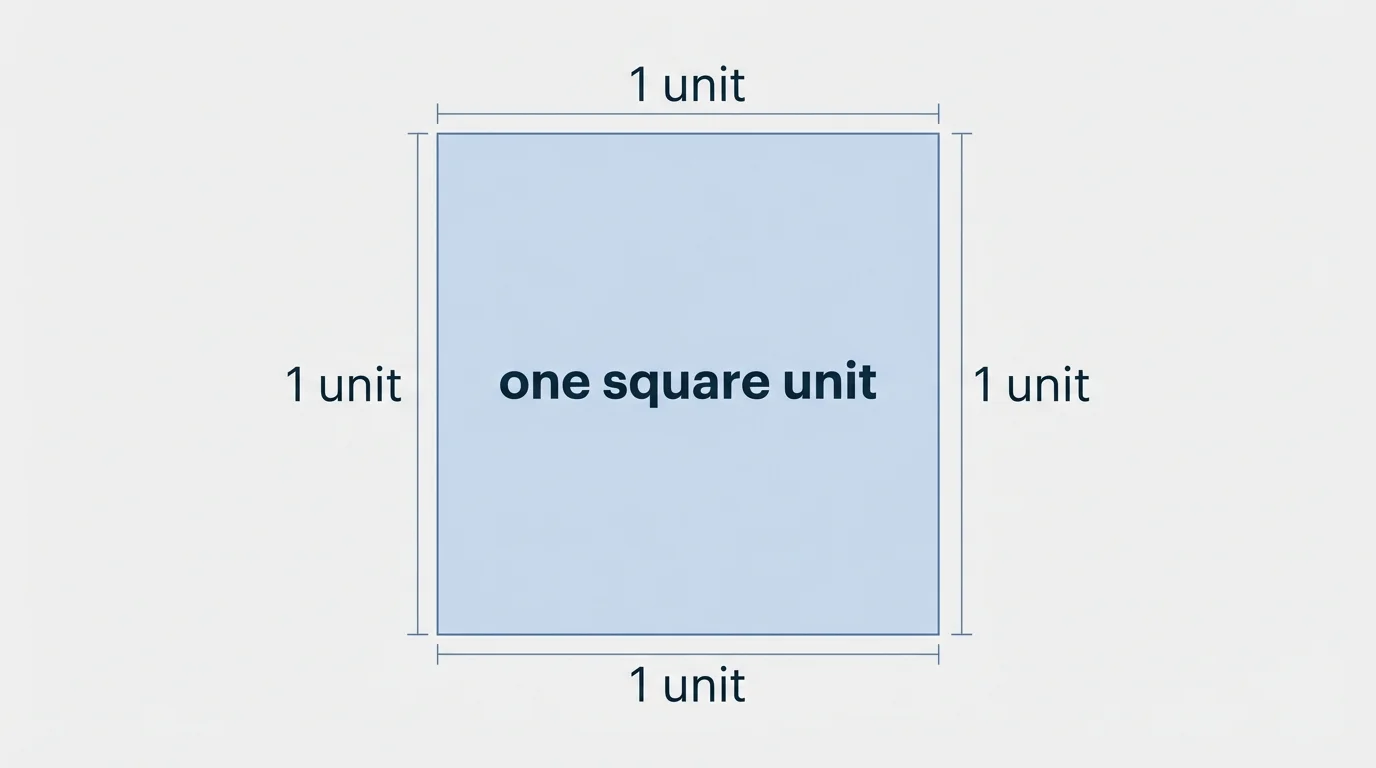
A unit square is a square with side length \(1\) unit. That unit might be inches, centimeters, feet, or another unit of length. The important idea is that each side is exactly \(1\) unit long. When a square is \(1\) unit long and \(1\) unit wide, it makes one standard piece for measuring area.
As shown in [Figure 1], because the square is \(1\) unit by \(1\) unit, it has an area of one square unit. We can write that as \(1\) square unit.
The words square unit are important. They tell us that we are measuring area, not just length. A unit square is like one little tile used to cover a shape.
If a rectangle can be covered exactly by \(6\) unit squares, then its area is \(6\) square units. If a shape can be covered by \(12\) unit squares, then its area is \(12\) square units.
Area is the amount of space inside a flat shape.
Unit square is a square with side length \(1\) unit.
Square unit is the area of one unit square.
Notice that we count the number of unit squares, not the side lengths all over again. The unit square gives us one piece of area, and then we count how many of those pieces fit inside the shape.
One way to measure area is to cover a shape with unit squares, as [Figure 2] illustrates. The squares must cover the shape completely with no gaps and no overlaps. If there are spaces left open, or if squares pile on top of each other, the measurement is not correct.
Suppose a small rectangle is covered by \(8\) unit squares. Then the area of the rectangle is \(8\) square units. We are really asking, "How many unit squares fit inside?"
Equal-sized squares matter. If one square is larger than another, we cannot just count them together. The unit squares must all be the same size so the measure is fair and accurate.
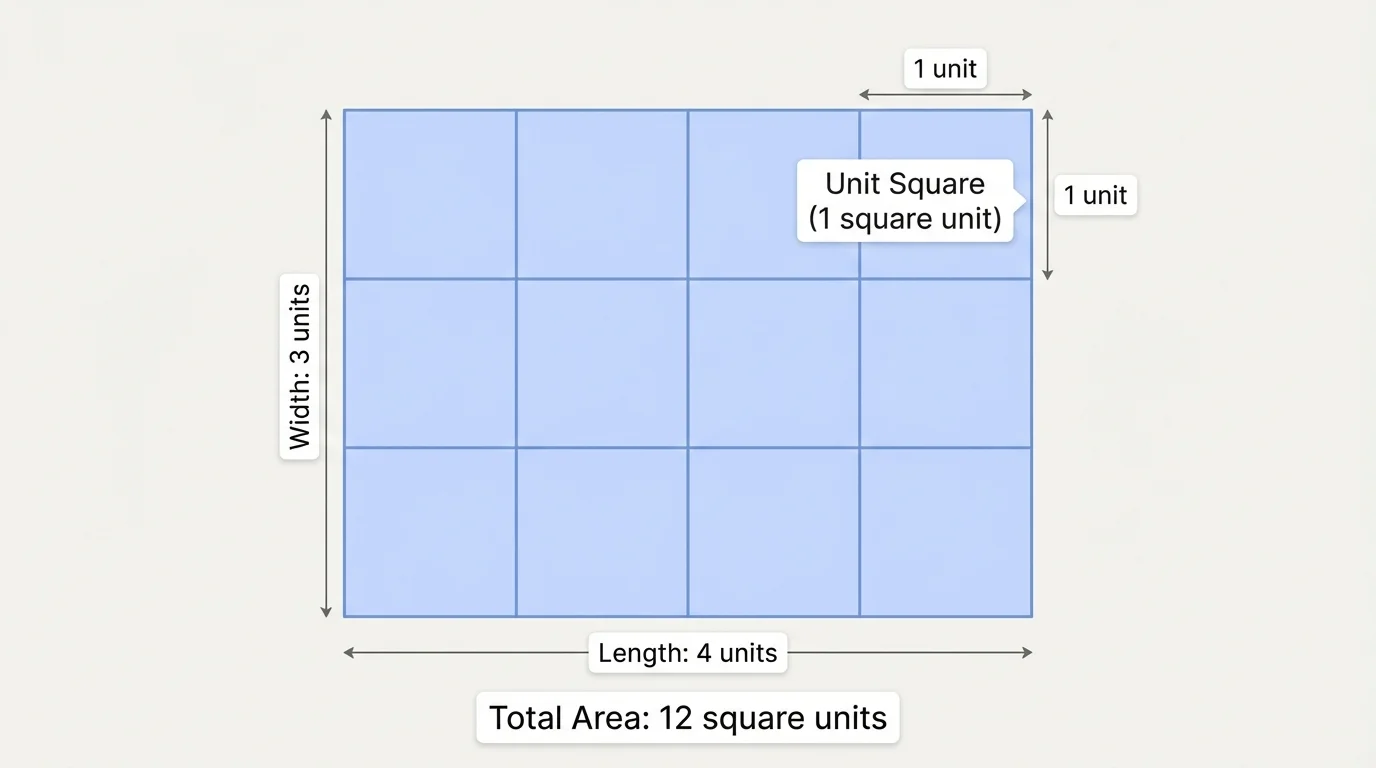
Rectangles are especially helpful because the unit squares line up in rows and columns. This makes counting easier. Instead of counting every square one by one, we can use multiplication.
Tile workers, builders, and designers often think about area. When they cover a floor with square tiles, they are using the same big idea as counting unit squares in math.
Even if a shape is not a rectangle, the idea still begins with unit squares. We imagine the inside covered by equal square pieces and count how many pieces it takes.
When unit squares are arranged in rows and columns, counting the area becomes faster. If a rectangle has \(3\) rows with \(4\) unit squares in each row, then the total number of squares is \(3 \times 4 = 12\). So the area is \(12\) square units.
This shows an important idea: for rectangles, area is connected to multiplication. We multiply the number of rows by the number of squares in each row.
If the side lengths of a rectangle are \(5\) units and \(2\) units, we can picture \(5\) unit squares across and \(2\) rows down. Then the area is \(5 \times 2 = 10\) square units.
Why multiplication works for area
Each row has the same number of unit squares. Instead of counting one square at a time, multiplication lets us count equal groups quickly. Rows and columns turn area into an organized array of unit squares.
As we saw with the tiled rectangle in [Figure 2], rows and columns help us see the total at a glance. A rectangle with \(4\) rows and \(6\) columns has area \(4 \times 6 = 24\) square units.
As [Figure 3] shows, sometimes a shape is not one simple rectangle. We can still find its area by breaking it into smaller rectangles. Then we find the area of each part and add the parts together.
This works because area can be added. If two smaller rectangles fit together without overlapping, the whole area equals the sum of the two smaller areas.
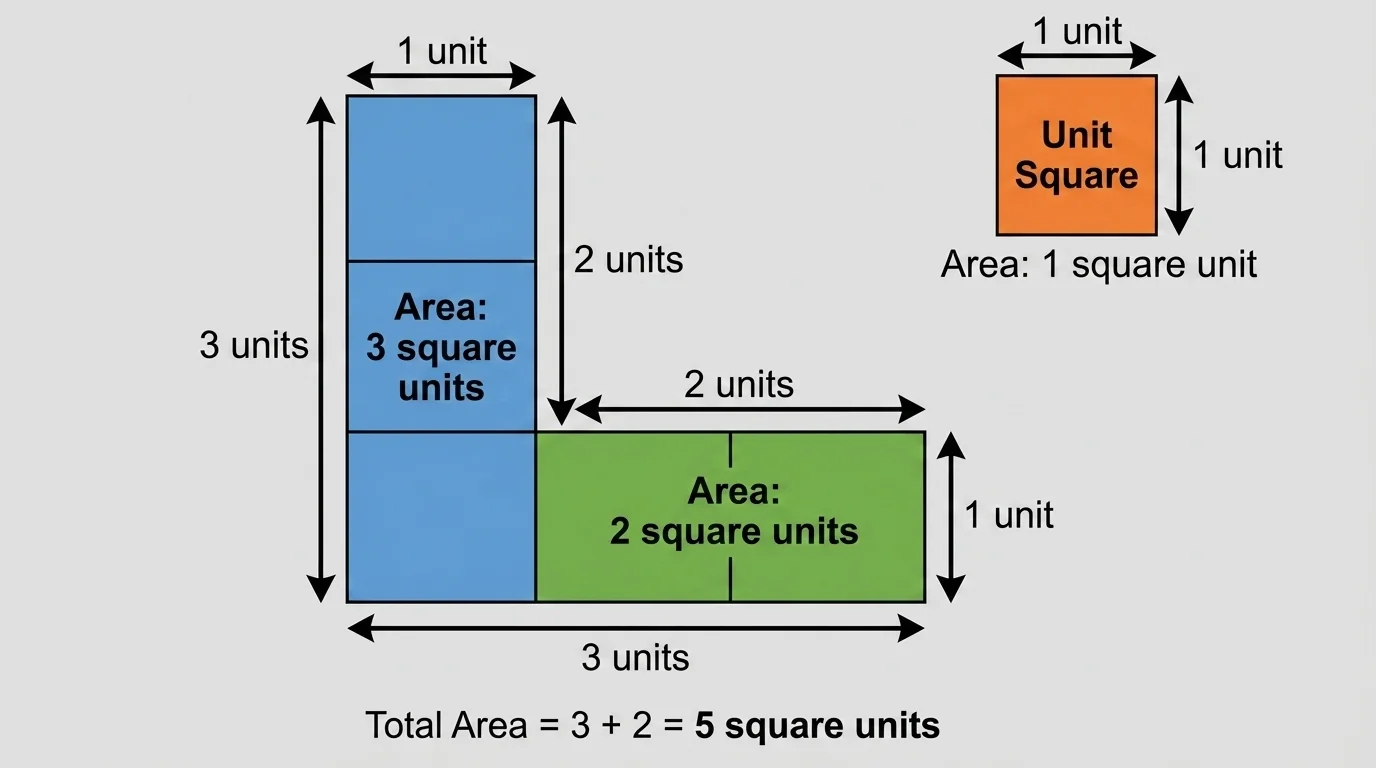
For example, imagine an L-shaped figure made from one rectangle with area \(6\) square units and another rectangle with area \(4\) square units. The total area is \(6 + 4 = 10\) square units.
This is useful for floor plans, playground shapes, and picture frames made from rectangular parts. Addition helps us handle shapes that are more interesting than one plain rectangle.
Now let's look at some step-by-step examples.
Example 1: Counting unit squares
A rectangle is covered by \(7\) unit squares. What is its area?
Step 1: Identify what one unit square means.
Each unit square has area \(1\) square unit.
Step 2: Count the total unit squares.
There are \(7\) unit squares.
Step 3: State the area.
The area is \(7\) square units.
Answer: \[7 \textrm{ square units}\]
This example shows the simplest meaning of area: count how many unit squares cover the shape.
Example 2: Using rows and columns
A rectangle has \(3\) rows of unit squares and \(5\) unit squares in each row. What is its area?
Step 1: Write the multiplication sentence.
\(3 \times 5\)
Step 2: Multiply.
\(3 \times 5 = 15\)
Step 3: Name the unit.
The area is \(15\) square units.
Answer: \[15 \textrm{ square units}\]
This is the same idea shown earlier by rows and columns. Multiplication is a quick way to count many unit squares.
Example 3: Finding area from side lengths
A rectangle has side lengths of \(4\) units and \(6\) units. What is its area?
Step 1: Think of the rectangle as rows and columns of unit squares.
One side measures \(4\) units and the other side measures \(6\) units.
Step 2: Multiply the side lengths.
\(4 \times 6 = 24\)
Step 3: Write the area unit.
The area is \(24\) square units.
Answer: \[24 \textrm{ square units}\]
Whenever a rectangle's side lengths are whole numbers of units, multiplying the side lengths gives the same result as counting unit squares one by one.
Example 4: Adding areas of parts
An L-shaped figure is split into two rectangles. One rectangle has area \(8\) square units, and the other has area \(5\) square units. What is the total area?
Step 1: Find the area of each part.
The parts are already given: \(8\) square units and \(5\) square units.
Step 2: Add the areas.
\(8 + 5 = 13\)
Step 3: State the total area.
The total area is \(13\) square units.
Answer: \[13 \textrm{ square units}\]
Just like in [Figure 3], breaking a shape into rectangles can make a tricky problem much easier.
Area is not just a classroom idea. It helps people in everyday life. If you want to cover a wall with paper, a floor with tiles, or a garden bed with soil, area tells how much surface needs to be covered.
Suppose a game board is \(5\) units by \(5\) units. Its area is \(5 \times 5 = 25\) square units. That tells how much flat space the board covers.
Suppose a small garden patch is \(3\) units by \(7\) units. Its area is \(3 \times 7 = 21\) square units. A gardener may use area to compare one patch with another.
Floor tiles are a strong real-world match to unit squares. Each tile covers the same amount of space. Builders can count tiles or use multiplication, just as we did with the rectangle in [Figure 2].
One common mistake is confusing area with perimeter. A shape may have a large perimeter but not a large area, or a large area but not the same perimeter as another shape.
Another mistake is forgetting to say square units. If an area is \(12\), we should say \(12\) square units, not just \(12\) units.
A third mistake is counting spaces that are not full unit squares without thinking carefully. In this lesson, the main idea is measuring with whole unit squares that cover a shape exactly.
| Idea | What it tells us | Example |
|---|---|---|
| Length | How long something is | \(6\) units |
| Perimeter | Distance around a shape | \(6 + 6 + 4 + 4 = 20\) units |
| Area | Space inside a shape | \(6 \times 4 = 24\) square units |
Table 1. A comparison of length, perimeter, and area.
The unit square gives us a powerful measuring tool. Once we understand that one square with side length \(1\) unit has area \(1\) square unit, we can measure many flat shapes by counting, multiplying, or adding areas of parts.
