Some math problems are like mini-mysteries. You read a story, look at the numbers, and figure out what happened first and what happened next. That is exactly how a two-step word problem works. Instead of using just one operation, you need two connected steps to solve it correctly.
A two-step word problem is a problem that needs two operations, such as addition and subtraction, or multiplication and division. The actions happen in order. As [Figure 1] shows, you may first put amounts together and then take some away, or first find a total and then split it into equal groups.
For example, if Mia has \(12\) stickers, gets \(8\) more, and gives away \(5\), you cannot answer with just one calculation. First you add: \(12 + 8 = 20\). Then you subtract: \(20 - 5 = 15\). The answer is \(15\) stickers.
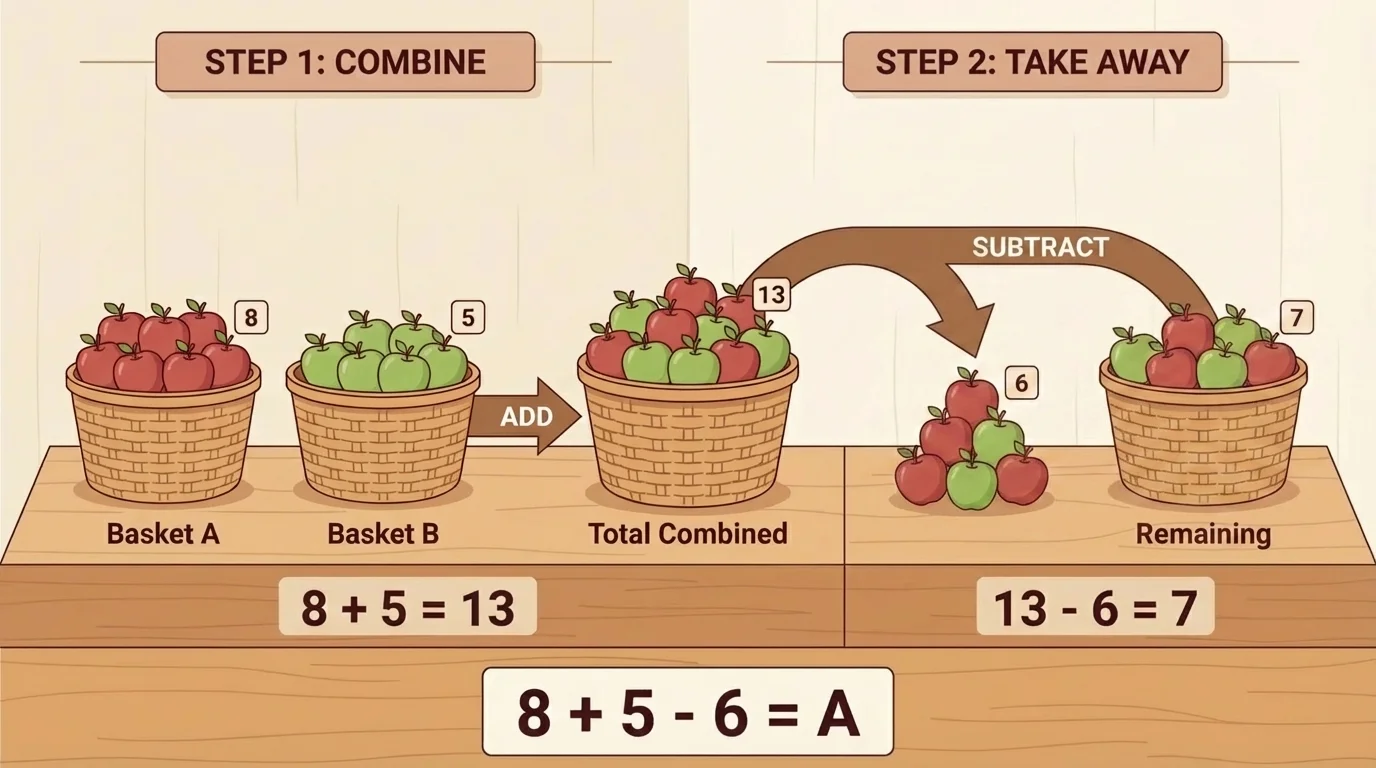
A two-step problem can use any of the four operations: \(+\), \(-\), \(\times\), and \(\div\). The important job is to understand the story, not just grab numbers and start computing.
Equation is a math sentence showing that two amounts are equal, such as \(n + 7 = 19\).
Unknown quantity is the amount you are trying to find.
A reasonable answer is an answer that makes sense for the problem.
When you solve word problems, think like a detective. Ask: What do I know? What do I need to find? What happens first? What happens second?
Before solving, read the problem slowly. Numbers matter, but the action words matter too. Sometimes words like in all suggest addition, and words like left suggest subtraction. Words like each often connect to multiplication or division. But do not depend on clue words alone. The whole story decides the operation.
A smart way to begin is to break the problem into parts:
If a problem says, "There are \(4\) bags with \(6\) marbles in each bag, and then \(3\) more marbles are added," the first step is multiplication because there are equal groups: \(4 \times 6 = 24\). The second step is addition: \(24 + 3 = 27\).
You already know how to add, subtract, multiply, and divide. In two-step problems, you use those same skills, but you must choose the right order.
It also helps to picture the problem in your mind. If the story is about groups, think about equal sets. If the story is about some items being used or lost, think about subtracting. If the story is about putting amounts together, think about adding.
In many problems, a variable, or letter, stands for the amount you do not know. This letter might be \(n\), \(x\), \(m\), or another letter. As [Figure 2] illustrates, the words in the problem can be turned into an equation that matches the story.
Suppose a problem says, "Lena had \(9\) shells. She found some more shells. Now she has \(17\) shells." We can let \(s\) be the number of shells she found. The equation is \(9 + s = 17\). The letter \(s\) stands for the unknown quantity.
In a two-step problem, you might write one equation for the whole situation or solve step by step with a letter. For example, if Noah has \(5\) packs of cards with \(4\) cards in each pack and then loses \(3\) cards, we can write:
\[c = 5 \times 4 - 3\]
This equation means the number of cards, \(c\), equals the total from \(5\) groups of \(4\), then \(3\) are taken away.
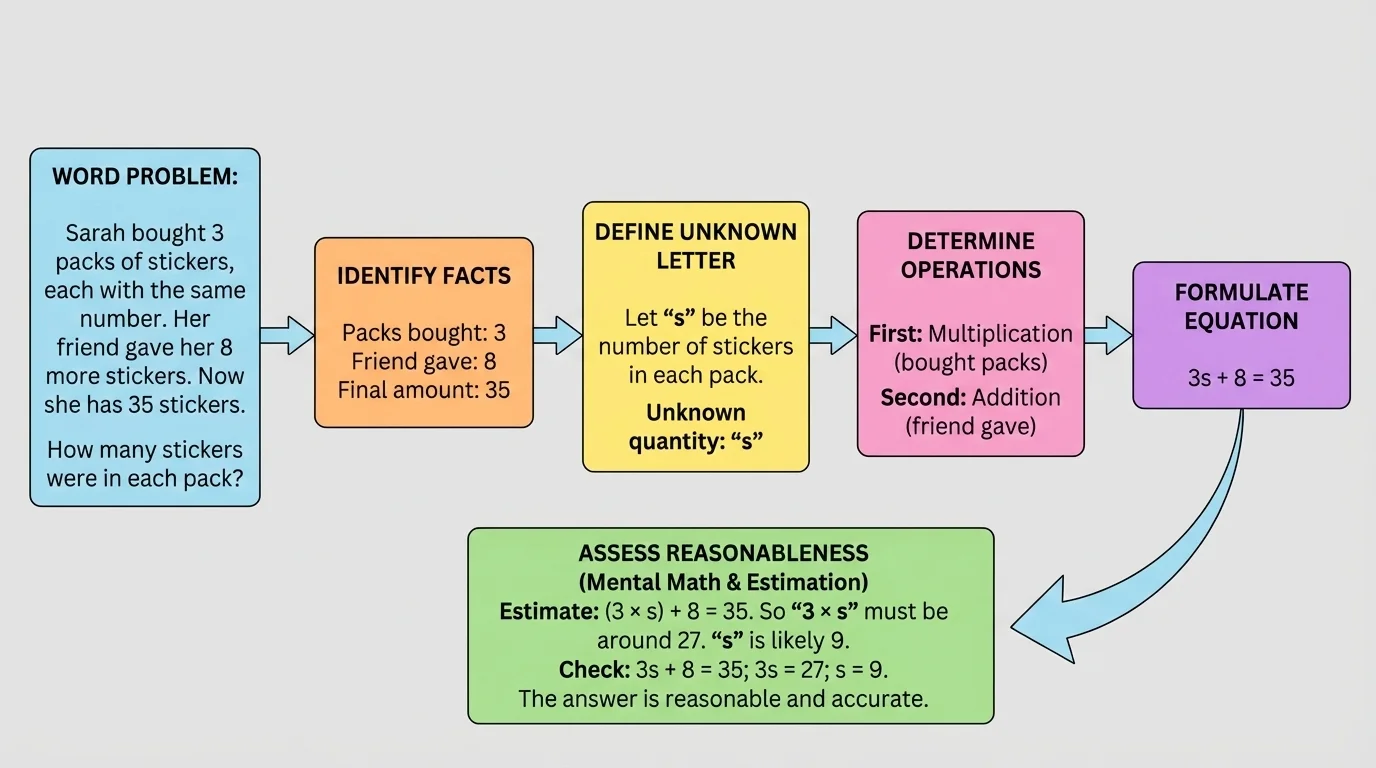
Using a letter helps organize your thinking. It shows exactly what you are trying to find and how the numbers are related.
Some two-step problems use only addition and subtraction. These problems often involve collecting, losing, giving away, or comparing amounts.
Worked example 1
Emma read \(23\) pages on Monday and \(17\) pages on Tuesday. Then she realized that \(6\) pages had been counted twice. How many different pages did she read altogether?
Step 1: Find the total pages read at first.
\(23 + 17 = 40\)
Step 2: Subtract the \(6\) pages that were counted twice so they are not included twice in the final total.
\(40 - 6 = 34\)
We can write the equation as \(p = 23 + 17 - 6\).
\(p = 34\)
Notice that the equation matches the story in order. First add the pages from both days, then subtract the pages counted again.
Worked example 2
A class collected \(18\) cans on Wednesday and \(25\) cans on Thursday. They used \(9\) cans for an art project. How many cans were left?
Step 1: Add the cans collected.
\(18 + 25 = 43\)
Step 2: Subtract the cans used.
\(43 - 9 = 34\)
The equation is \(c = 18 + 25 - 9\).
\(c = 34\)
In both examples, the answer comes from two linked actions: putting together and then taking away.
Other problems use multiplication and division because the story has equal groups, arrays, sharing, or repeated addition.
If there are \(3\) trays with \(8\) muffins on each tray, the total is \(3 \times 8 = 24\). If \(6\) muffins are sold, then \(24 - 6 = 18\). Multiplication helps find the total before the second step happens.
Worked example 3
There are \(6\) tables in the lunchroom. Each table has \(4\) students. Then \(5\) students go to the library. How many students remain in the lunchroom?
Step 1: Find the number of students at the tables.
\(6 \times 4 = 24\)
Step 2: Subtract the students who leave.
\(24 - 5 = 19\)
The equation is \(s = 6 \times 4 - 5\).
\(s = 19\)
Division can also appear in the second step. For example, if there are \(20\) pencils and they are packed equally into \(4\) boxes after \(4\) pencils are set aside, the work is \(20 - 4 = 16\), then \(16 \div 4 = 4\).
Many of the most interesting problems mix different operations. One step might use multiplication, while the next uses addition or subtraction. Some might start with addition and end with division.
Worked example 4
A coach buys \(3\) packs of tennis balls. Each pack has \(4\) balls. Then the coach finds \(2\) extra balls in a box. How many tennis balls are there altogether?
Step 1: Find how many balls are in the packs.
\(3 \times 4 = 12\)
Step 2: Add the extra balls.
\(12 + 2 = 14\)
The equation is \(b = 3 \times 4 + 2\).
\(b = 14\)
Here is another kind: "Sofia has \(14\) crayons. Her teacher gives her \(10\) more crayons. She puts all the crayons into \(4\) equal cups. How many crayons go in each cup?" First add: \(14 + 10 = 24\). Then divide: \(24 \div 4 = 6\). The equation is \(c = (14 + 10) \div 4\), so \(c = 6\).
Parentheses can help show which step happens first. In \(c = (14 + 10) \div 4\), the addition is done before the division because the total crayons must be found before sharing them equally.
Match the equation to the story
Good problem solvers make sure each number and operation has a job. In the equation \(t = 5 \times 3 + 7\), the multiplication can represent \(5\) equal groups of \(3\), and the \(+ 7\) can represent \(7\) extra items added after that. If the story does not happen in that order, the equation needs to change.
That is why reading carefully matters so much. The same numbers can tell different stories depending on the action.
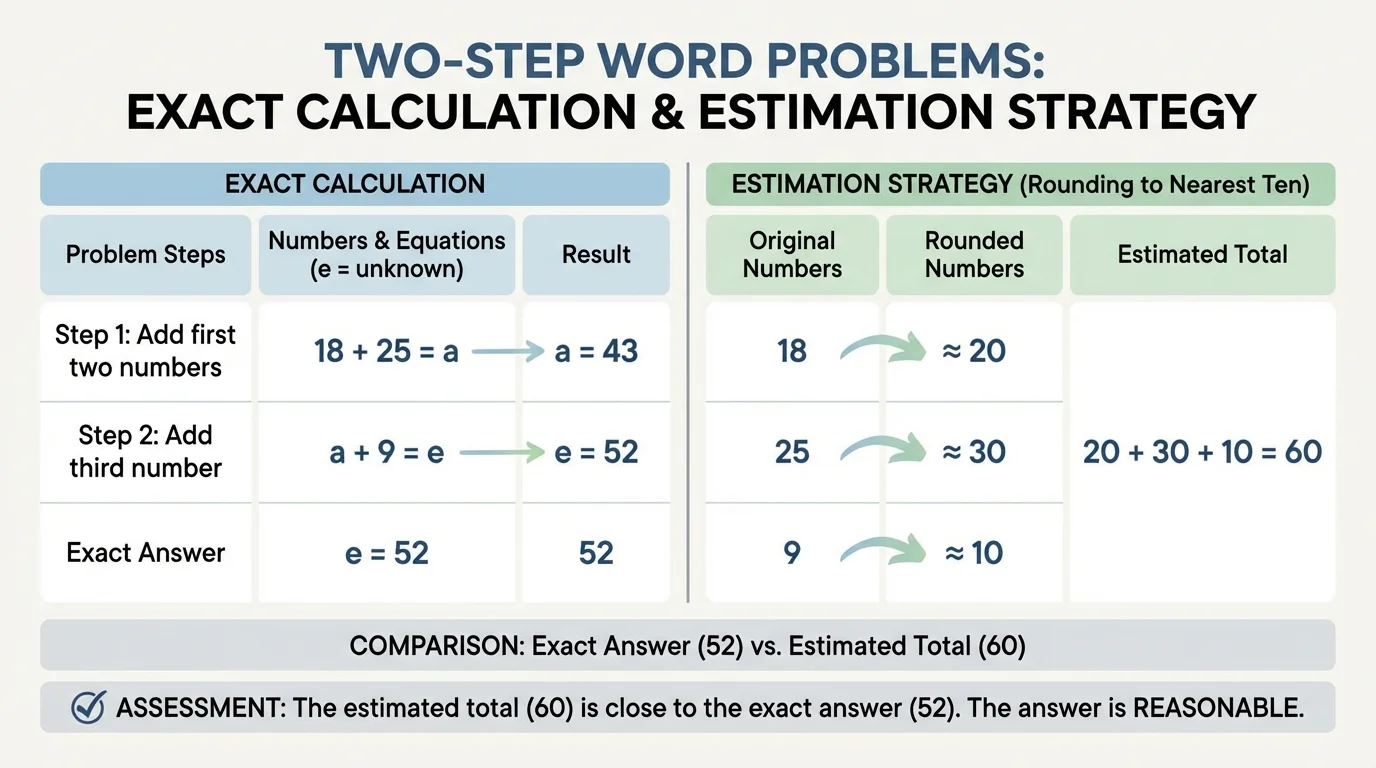
Good mathematicians do not stop when they get an answer. They ask whether the answer makes sense. This is called checking for reasonable answer. As [Figure 3] shows, one helpful way to check is to round numbers and estimate.
estimate means to find a number that is close to the exact answer. You can use mental math and rounding to see whether your exact answer is probably correct.
Suppose a problem is \(18 + 25 - 9\). You might round \(18\) to \(20\), \(25\) to \(30\), and \(9\) to \(10\). Then estimate: \(20 + 30 - 10 = 40\). The exact answer is \(34\). Since \(34\) is close to \(40\), the answer seems reasonable.
Mental computation can also help. For \(6 \times 4 - 5\), you may think: \(6 \times 4 = 24\), and \(24 - 5 = 19\). If someone said the answer was \(49\), you would know right away it is too large.
Sometimes estimation tells you an answer is impossible. If a problem asks how many items are left after some are given away, the answer cannot be greater than the amount you started with after combining all items. If a sharing problem asks for equal groups, the answer should fit the situation.
| Exact Expression | Rounded Estimate | What the Estimate Tells You |
|---|---|---|
| \(18 + 25 - 9\) | \(20 + 30 - 10 = 40\) | The exact answer should be near \(40\). |
| \(3 \times 4 + 2\) | \(3 \times 4 + 2 = 14\) | The exact answer should be near \(14\). |
| \((14 + 10) \div 4\) | \(24 \div 4 = 6\) | The exact answer should be near \(6\). |
Table 1. Examples of checking two-step problems by using estimates.
Later, when you solve more difficult problems, you can return to the idea in [Figure 3]: use nearby friendly numbers to check whether your exact answer is sensible.
Two-step word problems are everywhere. At a store, you may figure out how many items are in several packs and then how many are left after some are used. In sports, you might find the total points scored in two parts of a game and then compare that total to another team's score. In class, you may count supplies in groups and then share them equally.
For example, a teacher has \(5\) boxes of markers with \(6\) markers in each box. She gives \(8\) markers to another class. The number left is \(5 \times 6 - 8 = 30 - 8 = 22\). Problems like this help people organize, plan, and make decisions.
Cashiers, coaches, teachers, and builders all use two-step problem solving. Even when they do not write every equation on paper, they still break a problem into smaller steps and check whether the answer makes sense.
Math becomes more powerful when it helps with real choices. If your answer says each student gets \(50\) markers when there were only \(22\) markers total, the answer is clearly not reasonable.
One common mistake is using only one step when the story needs two. Another is choosing an operation because of one keyword without thinking about the whole problem. A third mistake is answering the wrong question.
For example, in a problem where you first find a total of \(24\) and then subtract \(5\), stopping at \(24\) is incomplete. The problem asks for the result after both actions.
It is also important to label the unknown clearly. If \(n\) stands for the number of notebooks left, then the final answer should tell about notebooks left, not just a number with no meaning.
"The answer is not finished until you know it makes sense."
That idea is true every time you solve a word problem. Compute carefully, then check with reasoning.
You do not have to solve every problem instantly. Strong problem solvers take their time, read carefully, decide on the first step, decide on the second step, write an equation, and then check the answer.
When a letter stands for the unknown amount, the math becomes clearer. When you estimate, your answer becomes more trustworthy. When you match your equation to the story, the problem becomes easier to understand.
As you keep solving two-step problems, you will notice patterns. Some problems combine and then separate. Some make equal groups and then add extras. Some add first and then share equally. The more you connect the story to the equation, the stronger your math thinking becomes.
