Have you ever looked at a race distance, a food label, or a digital clock and noticed different units everywhere? A road sign may use kilometers, a bottle may use milliliters, and a timer may count seconds. These units help us describe length, mass, capacity, and time. To use them well, we need to understand how the units are related.
Measurement is like speaking a language of size. A larger unit can be expressed as many smaller units. If you know how many smaller units fit inside one larger unit, you can convert from the larger unit to the smaller unit. That idea helps in math, science, sports, cooking, and travel.
When we convert within one system of measurement, we stay inside the same family of units. For example, we can change kilometers to meters or pounds to ounces. We do not mix systems in this lesson. The big idea is simple: when you change from a larger unit to a smaller unit, the number gets larger because you need more small parts to make the same amount.
Measurement conversion means changing the name of a measurement into another unit that describes the same amount.
Equivalent measurements are measurements that have different unit names but represent the same quantity.
Larger unit means a larger measuring unit, such as an hour. Smaller unit means a smaller measuring unit, such as a minute.
Think about a chocolate bar broken into tiny pieces. The whole bar is one whole amount, but it can be described as many small pieces. Conversions work the same way. One hour is one larger unit of time, but it is also many minutes and even more seconds.
A unit is a standard amount we use to measure something. We use different units depending on what we are measuring. Length tells how long something is. Mass tells how much matter something has. Capacity tells how much liquid a container can hold. Time tells how long something lasts.
Good measurement helps us compare and solve problems. If one trail length is labeled in kilometers and another is labeled in meters, we can compare them more easily if we understand the unit sizes, as shown in [Figure 1]. If a recipe uses liters and milliliters, we need to know how those units fit together so we can measure the right amount.
You already know that multiplication can show equal groups. Conversion from a larger unit to a smaller unit often uses multiplication because one large unit contains several equal groups of smaller units.
For example, if one foot contains twelve inches, then four feet contain four groups of twelve inches. That means we multiply: \[4 \times 12 = 48\] So a length of \(4\) feet is the same as \(48\) inches.
Within a system of measurement, some units are larger than others. A kilometer is larger than a meter, and a meter is larger than a centimeter. That means one kilometer contains many meters, and one meter contains many centimeters.
Here are important relationships to know. For metric length, \(1\) kilometer equals \(1{,}000\) meters, and \(1\) meter equals \(100\) centimeters. For metric mass, \(1\) kilogram equals \(1{,}000\) grams. For customary mass, \(1\) pound equals \(16\) ounces. For metric capacity, \(1\) liter equals \(1{,}000\) milliliters. For time, \(1\) hour equals \(60\) minutes, and \(1\) minute equals \(60\) seconds.
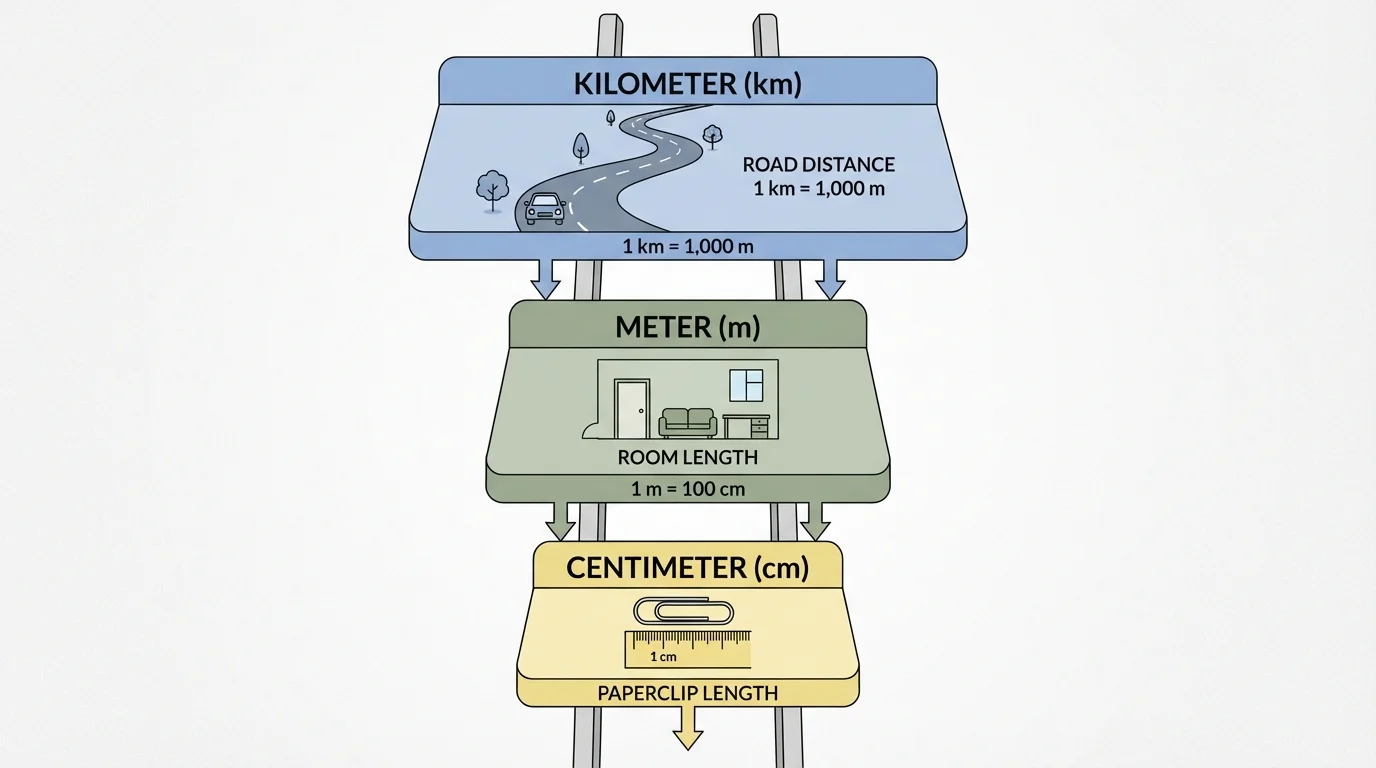
Notice the pattern: when we move from a bigger unit to a smaller unit, we multiply by the number of smaller units inside the larger one. The measurement does not change. Only the unit name changes, and the number changes to match it.
Here is a helpful list of common larger-to-smaller relationships:
| Type of measurement | Larger unit to smaller unit |
|---|---|
| Length | \(1\) kilometer \(= 1{,}000\) meters |
| Length | \(1\) meter \(= 100\) centimeters |
| Mass | \(1\) kilogram \(= 1{,}000\) grams |
| Mass | \(1\) pound \(= 16\) ounces |
| Capacity | \(1\) liter \(= 1{,}000\) milliliters |
| Time | \(1\) hour \(= 60\) minutes |
| Time | \(1\) minute \(= 60\) seconds |
Table 1. Common larger-to-smaller unit relationships used in this lesson.
A single kilometer is \(1{,}000\) meters long, which is why race distances and map distances are often written in kilometers instead of very large numbers of meters.
The same idea works in customary length too. One foot is \(12\) inches. So if an object is several feet long, we can multiply the number of feet by \(12\) to find the number of inches.
To convert means to rewrite a measurement using another unit name. When converting from a larger unit to a smaller unit, use multiplication because you are finding how many small pieces make the same whole.
You can think of the rule like this:
\[\textrm{number of larger units} \times \textrm{smaller units in 1 larger unit} = \textrm{number of smaller units}\]
Suppose you have \(3\) hours. Since each hour has \(60\) minutes, multiply \(3 \times 60\). That gives \(180\). So \(3\) hours equals \(180\) minutes.
Suppose you have \(5\) kilograms. Since each kilogram has \(1{,}000\) grams, multiply \(5 \times 1{,}000 = 5{,}000\). So \(5\) kilograms equals \(5{,}000\) grams.
Why the number gets bigger
Smaller units measure shorter lengths, lighter masses, smaller amounts of liquid, or shorter times. Because each smaller unit covers less, you need more of them. That is why the number becomes larger when you change from a larger unit to a smaller unit.
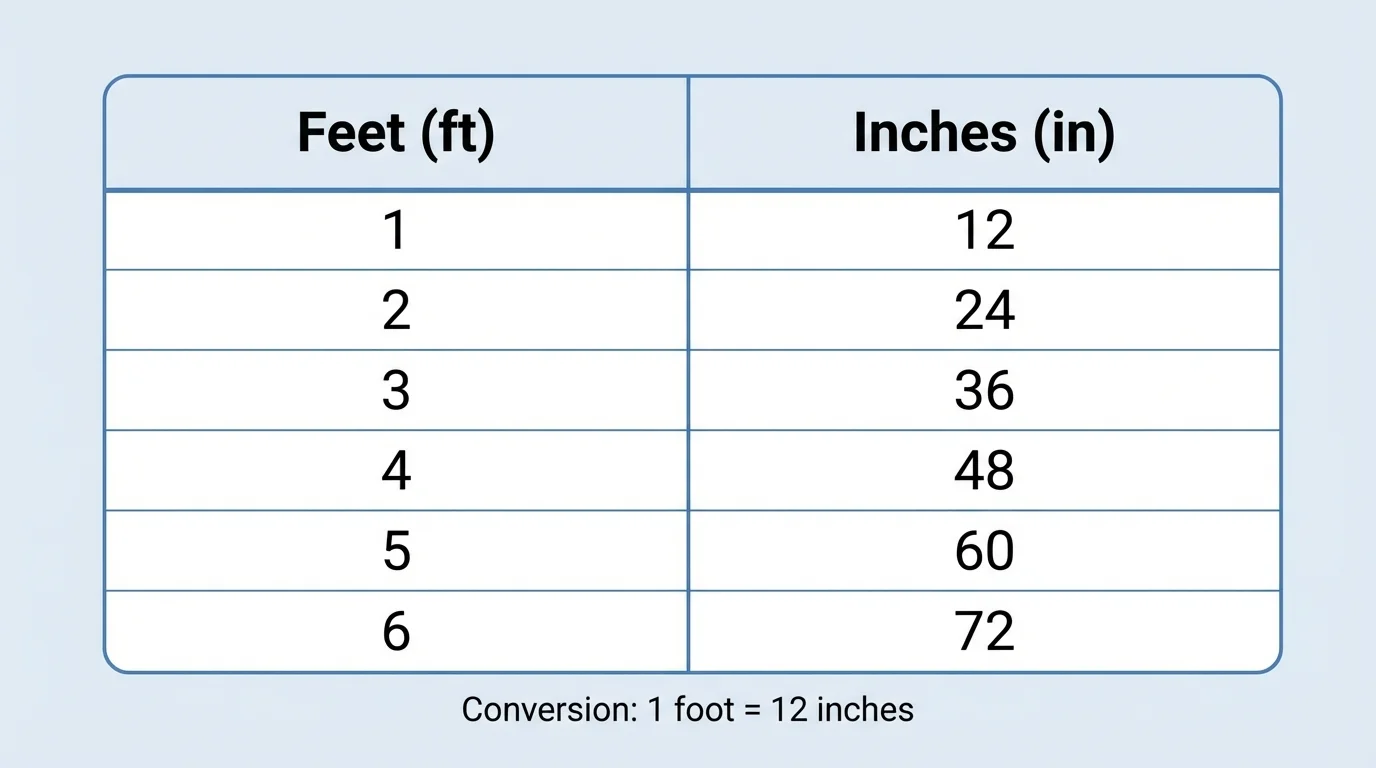
A good check is to ask yourself: "Did I switch to a smaller unit?" If yes, your answer should usually have a larger number. If it does not, check your work again. A two-column pattern like the one in [Figure 2] can help you see whether your values make sense.
A two-column table is a great way to record equivalent measurements. One column shows the larger unit, and the other column shows the matching smaller unit. The pattern helps us see repeated multiplication clearly.
For feet and inches, we know that \(1\) foot equals \(12\) inches. So we can build a table by multiplying the number of feet by \(12\). Each pair shows the same length written in two different ways.
| Feet | Inches |
|---|---|
| \(1\) | \(12\) |
| \(2\) | \(24\) |
| \(3\) | \(36\) |
| \(4\) | \(48\) |
| \(5\) | \(60\) |
| \(6\) | \(72\) |
Table 2. A two-column conversion table showing equivalent lengths in feet and inches.
These pairs can also be written as ordered pairs: \((1, 12)\), \((2, 24)\), \((3, 36)\), \((4, 48)\), and so on. The first number tells the feet. The second number tells the inches.
We can make similar tables for other units. For hours and minutes, multiply each number of hours by \(60\). For liters and milliliters, multiply each number of liters by \(1{,}000\).
| Hours | Minutes |
|---|---|
| \(1\) | \(60\) |
| \(2\) | \(120\) |
| \(3\) | \(180\) |
| \(4\) | \(240\) |
Table 3. A two-column conversion table showing equivalent times in hours and minutes.
Tables help you spot patterns quickly. In the feet-and-inches table, the inches increase by \(12\) each time. In the hours-and-minutes table, the minutes increase by \(60\) each time. These patterns come from the unit relationship.
Now let's solve some conversion problems step by step. Each one starts with a larger unit and changes it to a smaller unit.
Worked example 1
A snake is \(4\) feet long. How many inches long is it?
Step 1: Write the unit relationship.
\(1\) foot \(= 12\) inches.
Step 2: Multiply the number of feet by \(12\).
\(4 \times 12 = 48\)
Step 3: Write the answer with the new unit.
\[4\textrm{ feet} = 48\textrm{ inches}\]
The snake is \(48\) inches long.
This example matches the pattern in the feet-and-inches table. As we saw earlier in [Figure 2], the pair \((4, 48)\) means \(4\) feet equals \(48\) inches.
Worked example 2
A water bottle holds \(3\) liters. How many milliliters does it hold?
Step 1: Write the unit relationship.
\(1\) liter \(= 1{,}000\) milliliters.
Step 2: Multiply.
\(3 \times 1{,}000 = 3{,}000\)
Step 3: Write the equivalent measurement.
\[3\textrm{ liters} = 3{,}000\textrm{ milliliters}\]
The bottle holds \(3{,}000\) milliliters.
Notice that the unit changed to a smaller one, so the number became larger. That is exactly what we expected.
Worked example 3
A bag of rice has a mass of \(2\) kilograms. How many grams is that?
Step 1: Use the unit relationship.
\(1\) kilogram \(= 1{,}000\) grams.
Step 2: Multiply the kilograms by \(1{,}000\).
\(2 \times 1{,}000 = 2{,}000\)
Step 3: State the answer.
\[2\textrm{ kilograms} = 2{,}000\textrm{ grams}\]
The bag has a mass of \(2{,}000\) grams.
Mass conversions in the metric system often use \(1{,}000\), just like kilometers to meters and liters to milliliters. That repeating pattern makes the metric system easier to use.
Worked example 4
A movie lasts \(2\) hours. How many minutes long is it?
Step 1: Write the relationship for time.
\(1\) hour \(= 60\) minutes.
Step 2: Multiply.
\(2 \times 60 = 120\)
Step 3: Write the equivalent time.
\[2\textrm{ hours} = 120\textrm{ minutes}\]
The movie is \(120\) minutes long.
Time can also be converted one more step. Since \(1\) minute equals \(60\) seconds, \(5\) minutes equals \(5 \times 60 = 300\) seconds.
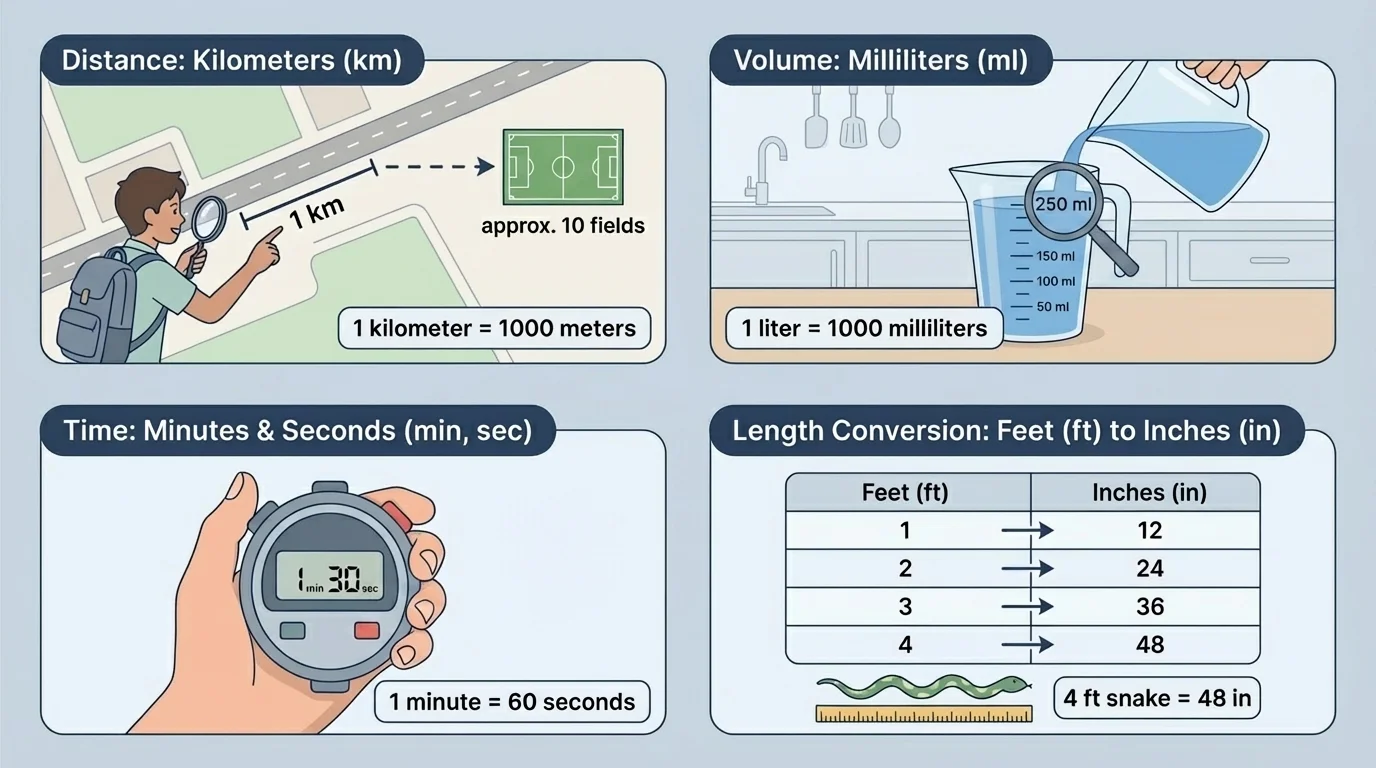
Conversions appear in everyday life more often than many people realize, as illustrated in [Figure 3]. A runner may read minutes and seconds on a stopwatch. A cook may pour milliliters from a measuring cup. A traveler may read kilometers on a map or road sign.
In science class, you may measure plant growth in centimeters, then compare it with a measurement given in meters. In health and nutrition, food packages may list grams. In sports, race times may be shown in hours, minutes, and seconds.
Suppose a charity walk is \(5\) kilometers long. Since \(1\) kilometer equals \(1{,}000\) meters, the walk is \(5 \times 1{,}000 = 5{,}000\) meters. That can help if a route marker is labeled in meters instead of kilometers.
Suppose a recipe needs \(2\) liters of soup. That is \(2{,}000\) milliliters. If a large pitcher is marked only in milliliters, the conversion tells exactly how full it should be.
Later, when you compare distances or times, these visual scenes can remind you that different activities use different units, but the same conversion idea works in all of them.
One common mistake is using the wrong operation. If you are converting from a larger unit to a smaller unit, multiply. For instance, from hours to minutes, use \(\times 60\), not division.
Another mistake is mixing up the unit relationship. For pounds and ounces, the correct fact is \(1\) pound equals \(16\) ounces. If someone used \(12\) instead, that would confuse pounds with feet.
A smart check is to compare unit sizes. A centimeter is smaller than a meter, so a measurement written in centimeters should have a larger number than the same measurement written in meters. For example, \(2\) meters equals \(200\) centimeters, not \(2\) centimeters.
Reasonableness check
After converting, ask: "Does my answer make sense?" If you changed to a smaller unit, the number should be bigger. If your answer does not follow that pattern, look back at the unit relationship and your multiplication.
Here is another quick check. If \(1\) hour is \(60\) minutes, then \(10\) hours cannot be only \(70\) minutes. That answer is far too small. A reasonable answer would be much larger because \(10\) groups of \(60\) is \(600\).
Even though the actual numbers are different, many conversions follow the same kind of thinking. In metric units, you often multiply by \(100\) or \(1{,}000\). In customary units, the numbers may be \(12\) or \(16\). In time, the important number is often \(60\).
For metric length, if \(1\) meter equals \(100\) centimeters, then \(7\) meters equals \(7 \times 100 = 700\) centimeters. For pounds and ounces, if \(1\) pound equals \(16\) ounces, then \(3\) pounds equals \(3 \times 16 = 48\) ounces.
As we saw in the metric length ladder in [Figure 1], understanding which unit is larger and which is smaller is the first step. Once you know that relationship, the multiplication becomes much easier.
Tables are especially useful when several conversions follow a pattern. If one row shows \(1\) liter equals \(1{,}000\) milliliters, then the next rows can be built by repeated addition or multiplication: \(2\) liters equals \(2{,}000\) milliliters, \(3\) liters equals \(3{,}000\) milliliters, and so on.
The more you connect unit facts, multiplication, and patterns in tables, the more confident you become with measurement. Each conversion is really the same idea wearing a different unit name.
