If \(\dfrac{1}{2}\) of a pizza feels easy to picture, what happens when there are several people each eating part of a pizza, or several pieces of ribbon each measuring part of a yard? That is where multiplying a fraction by a whole number becomes useful. This kind of math helps in cooking, building, sharing, and measuring. Instead of thinking about one part, we think about several equal groups of the same part.
Many real-life problems ask for a total amount when each group is a fraction. For example, one person may drink \(\dfrac{1}{2}\) of a bottle, or one craft project may use \(\dfrac{3}{4}\) yard of cloth. If there are several people or several projects, we need to combine equal fractional amounts.
When we multiply a whole number by a fraction, we are really finding repeated groups. For instance, \(4 \times \dfrac{1}{3}\) means \(\dfrac{1}{3} + \dfrac{1}{3} + \dfrac{1}{3} + \dfrac{1}{3}\). The whole number tells how many groups there are, and the fraction tells the size of each group.
You already know that multiplication can mean equal groups and that fractions name equal parts of a whole. In this lesson, those two ideas work together.
A fraction model helps us see these groups clearly. As [Figure 1] shows, we can use fraction bars, circles, or number lines. The important idea is that each whole is split into equal parts, and then we count how many of those parts we have altogether.
Suppose we want to find \(3 \times \dfrac{2}{5}\). This means 3 groups of \(\dfrac{2}{5}\). We can write it as repeated addition:
\(\dfrac{2}{5} + \dfrac{2}{5} + \dfrac{2}{5} = \dfrac{6}{5}\).
This answer, \(\dfrac{6}{5}\), means six fifths. Since \(\dfrac{5}{5} = 1\), six fifths is one whole and one fifth more. So \(\dfrac{6}{5} = 1\dfrac{1}{5}\).
Whole number means a counting number such as \(0, 1, 2, 3\), and so on.
Numerator is the top number in a fraction. It tells how many parts are being counted.
Denominator is the bottom number in a fraction. It tells how many equal parts make one whole.
Notice something important: the denominator tells the size of the parts, so it stays connected to the model. We are counting more parts of the same size. We are not changing the size of the parts.
Visuals make this idea easier to understand. If we have \(5\) groups of \(\dfrac{3}{8}\), we can draw five fraction bars. Each bar is split into \(8\) equal parts, and \(3\) parts are shaded in each bar. Then we count all the shaded eighths together.
When we combine the groups, we get \(3 + 3 + 3 + 3 + 3 = 15\) shaded eighths. That means the total is \(\dfrac{15}{8}\).
We can also think about wholes. Every \(8\) eighths makes one whole. So \(\dfrac{15}{8}\) is \(\dfrac{8}{8} + \dfrac{7}{8} = 1\dfrac{7}{8}\).
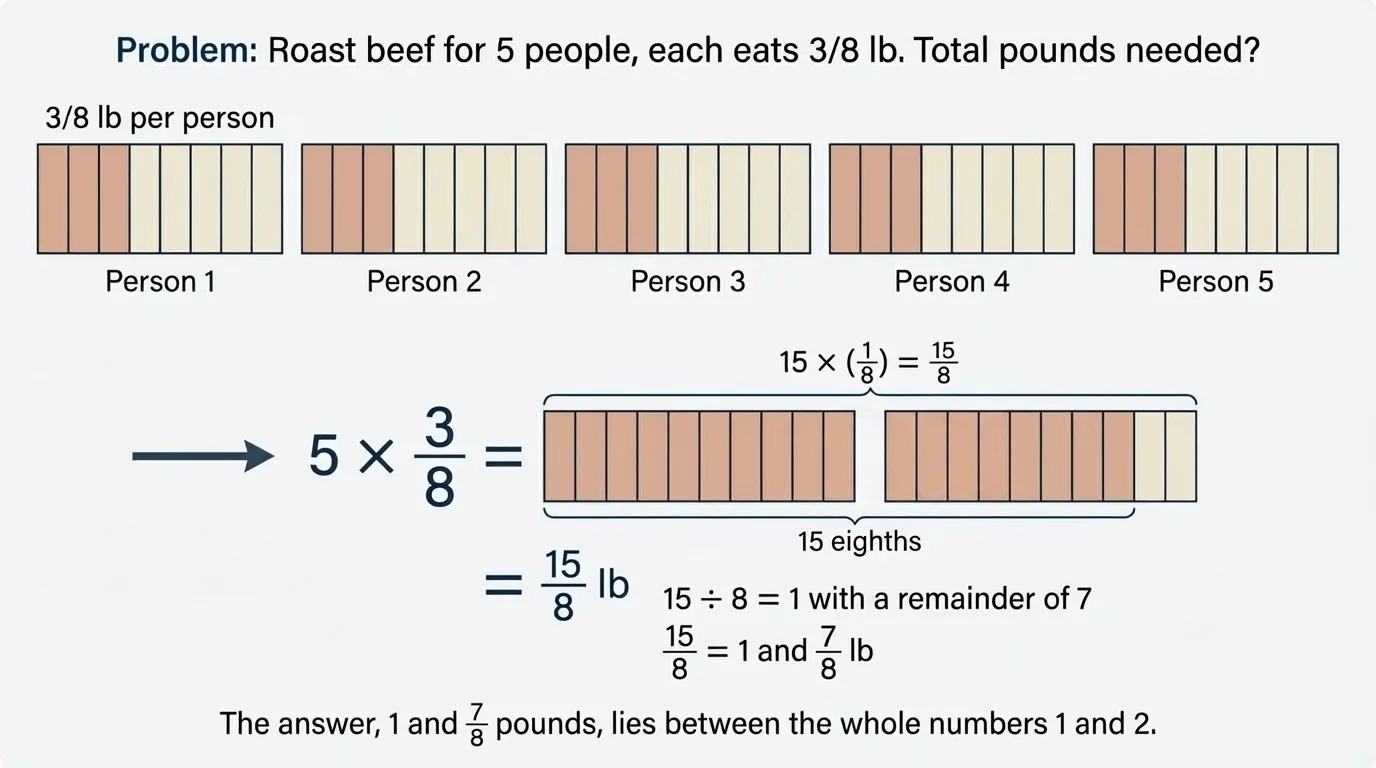
A model does more than give an answer. It shows why the answer makes sense. We see that we are joining equal groups of the same fraction, not using a shortcut without understanding.
Later, when you look back at [Figure 1], notice that the shaded parts are always eighths. The number of parts grows, but the size of each part stays the same.
A equation is a math sentence that shows what is equal. In fraction word problems, we use equations to match the story.
If each child gets \(\dfrac{1}{4}\) of a sandwich and there are \(6\) children, the equation is
\[6 \times \frac{1}{4} = \frac{6}{4}\]
We can also write this as repeated addition:
\[\frac{1}{4} + \frac{1}{4} + \frac{1}{4} + \frac{1}{4} + \frac{1}{4} + \frac{1}{4} = \frac{6}{4}\]
Both equations represent the same situation. The multiplication equation is often faster to write, and the repeated-addition form helps us see the groups.
From words to math
In these problems, look for the number of groups and the size of each group. The whole number tells how many times the fraction is used. The fraction tells how much is in each group.
Some answers stay less than \(1\), some equal a whole number, and some are greater than \(1\). That depends on how many fractional groups we combine.
A party planner needs to know how much food to buy. [Figure 2] helps show the equal groups in this problem by connecting each person to one portion of roast beef. If each person eats \(\dfrac{3}{8}\) of a pound of roast beef and there are \(5\) people, how many pounds of roast beef are needed? Between what two whole numbers does the answer lie?
Worked example
Step 1: Identify the groups.
There are \(5\) people, and each person gets \(\dfrac{3}{8}\) pound.
Step 2: Write an equation.
\(5 \times \dfrac{3}{8}\)
Step 3: Use repeated addition.
\(\dfrac{3}{8} + \dfrac{3}{8} + \dfrac{3}{8} + \dfrac{3}{8} + \dfrac{3}{8} = \dfrac{15}{8}\)
Step 4: Change the answer into a mixed number to understand it better.
\(\dfrac{15}{8} = \dfrac{8}{8} + \dfrac{7}{8} = 1\dfrac{7}{8}\)
Step 5: Decide between which whole numbers the answer lies.
Since \(1\dfrac{7}{8}\) is greater than \(1\) and less than \(2\), it lies between \(1\) and \(2\).
The party needs \(1\dfrac{7}{8}\) pounds of roast beef.
The visual model helps us see all five groups of \(\dfrac{3}{8}\) and why the total is \(\dfrac{15}{8}\). It also helps us understand that the answer is almost \(2\) pounds, but not quite.
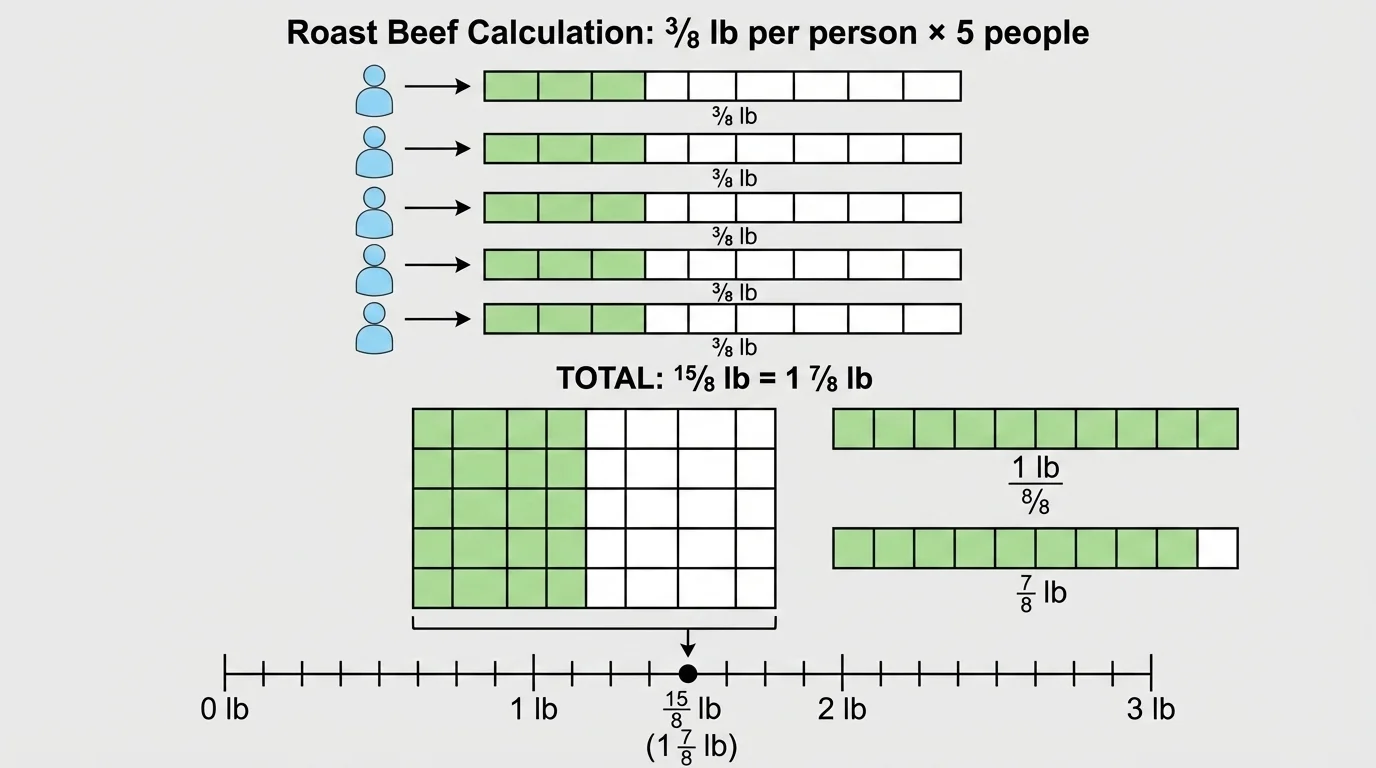
We can check whether the answer makes sense. Since each person gets less than \(\dfrac{1}{2}\) pound, five people should need less than \(5 \times \dfrac{1}{2} = 2\dfrac{1}{2}\) pounds. Our answer, \(1\dfrac{7}{8}\), fits that idea.
A craft club cuts ribbon into equal pieces. Each gift bag uses \(\dfrac{2}{3}\) yard of ribbon. If the club makes \(3\) gift bags, how much ribbon is used altogether?
Worked example
Step 1: Write the multiplication expression.
\(3 \times \dfrac{2}{3}\)
Step 2: Show it as repeated addition.
\(\dfrac{2}{3} + \dfrac{2}{3} + \dfrac{2}{3} = \dfrac{6}{3}\)
Step 3: Interpret the fraction.
Since \(\dfrac{6}{3} = 2\), the total ribbon is \(2\) yards.
The club uses \(2\) yards of ribbon.
This example is interesting because the answer is a whole number. Even though each group is a fraction, the total can still make exactly whole units.
Think about the model: three groups of \(\dfrac{2}{3}\) give us six thirds. Every three thirds makes one whole, so six thirds make two wholes.
After a game, each player drinks \(\dfrac{5}{6}\) of a bottle of water. If \(2\) players drink water, how much water is used?
Worked example
Step 1: Write the equation.
\(2 \times \dfrac{5}{6}\)
Step 2: Add the fractions.
\(\dfrac{5}{6} + \dfrac{5}{6} = \dfrac{10}{6}\)
Step 3: Rename the answer.
\(\dfrac{10}{6} = \dfrac{6}{6} + \dfrac{4}{6} = 1\dfrac{4}{6}\)
Step 4: Simplify when possible.
\(1\dfrac{4}{6} = 1\dfrac{2}{3}\)
The players drink \(1\dfrac{2}{3}\) bottles of water altogether.
This answer lies between \(1\) and \(2\). It is more than one whole bottle because one player already drinks almost a whole bottle, and the second player adds almost another whole bottle.
Fractions are used by cooks, carpenters, athletes, and doctors. Measuring part of a cup, part of an inch, or part of a dose often means combining fractional amounts.
[Figure 3] helps show where fraction totals belong on the number line. Sometimes a problem asks not only for the total but also where the answer belongs on the number line. This becomes easier when we compare the fraction to nearby whole numbers.
For example, \(\dfrac{15}{8}\) has \(8\) eighths in one whole. Since \(\dfrac{15}{8} = \dfrac{8}{8} + \dfrac{7}{8}\), it is more than \(1\) whole but less than \(2\) wholes.
Likewise, \(\dfrac{10}{6}\) has \(6\) sixths in one whole. Since \(\dfrac{10}{6} = \dfrac{6}{6} + \dfrac{4}{6}\), it lies between \(1\) and \(2\).
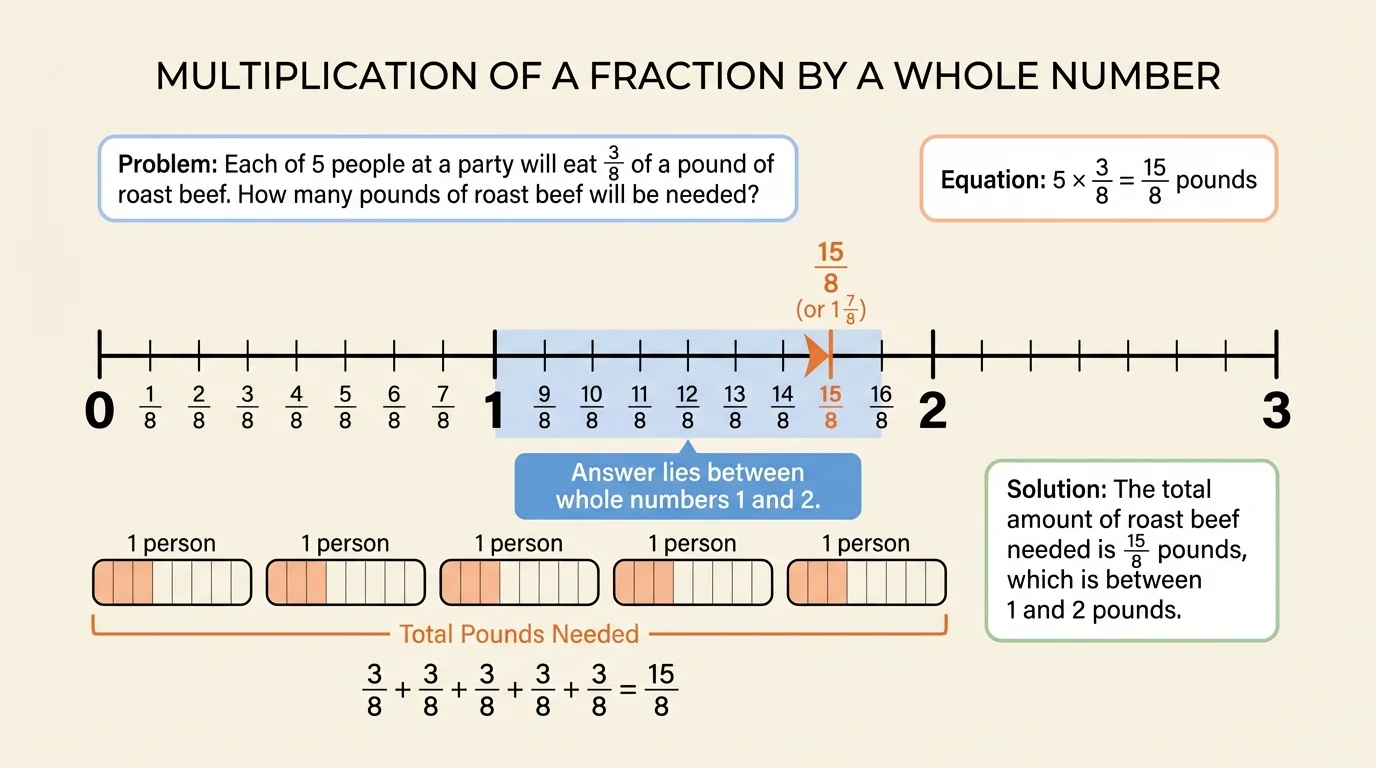
A quick way to think is this: if the numerator is bigger than the denominator, the fraction is greater than \(1\). Then ask how much bigger it is. If the numerator is not yet double the denominator, the fraction is less than \(2\).
Looking again, you can see that both \(\dfrac{15}{8}\) and \(\dfrac{10}{6}\) sit between \(1\) and \(2\), even though they use different-sized parts. The denominator tells the part size, so eighths and sixths are not the same, but each total still lands in the same interval.
One mistake is forgetting that multiplication by a whole number means repeated groups. If you have \(4 \times \dfrac{1}{5}\), you need four copies of \(\dfrac{1}{5}\), not one copy.
Another mistake is confusing the numerator and denominator. In \(\dfrac{3}{8}\), the denominator \(8\) tells that the whole is split into eight equal parts. The numerator \(3\) tells that three of those parts are counted.
A third mistake is giving only an improper fraction and not understanding what it means. An answer like \(\dfrac{12}{5}\) is correct, but it is often easier to picture as \(2\dfrac{2}{5}\). Both names describe the same amount.
| Situation | Equation | Total |
|---|---|---|
| \(4\) groups of \(\dfrac{1}{5}\) | \(4 \times \dfrac{1}{5}\) | \(\dfrac{4}{5}\) |
| \(3\) groups of \(\dfrac{2}{3}\) | \(3 \times \dfrac{2}{3}\) | \(\dfrac{6}{3} = 2\) |
| \(5\) groups of \(\dfrac{3}{8}\) | \(5 \times \dfrac{3}{8}\) | \(\dfrac{15}{8} = 1\dfrac{7}{8}\) |
Table 1. Examples of multiplying a fraction by a whole number and interpreting the total.
Fraction multiplication appears in many everyday situations. In cooking, a recipe may need \(\dfrac{3}{4}\) cup of milk for one batch, and a baker may make \(4\) batches. In sports, each lap may be \(\dfrac{1}{2}\) mile, and a runner may complete \(3\) laps. In art, each picture frame might use \(\dfrac{2}{5}\) meter of border strip, and a class might decorate \(6\) frames.
In each of these cases, the question is the same: how many equal fractional groups are there, and what is the total? The method stays the same whether the context is food, distance, liquid, fabric, or time.
"A picture of the fraction can explain the answer better than a shortcut you do not understand."
That is why visual models matter. They help you see the groups, count the fractional parts, and decide whether the result is less than \(1\), equal to a whole number, or greater than \(1\).
To solve a word problem, first find the number of groups and the fraction in each group. Then write a multiplication equation. Next, use a visual model or repeated addition to combine the fractional parts. Finally, rename the answer if helpful and decide where it belongs between whole numbers.
For example, if \(4\) notebooks each use \(\dfrac{3}{10}\) of a pack of stickers, the total is \(4 \times \dfrac{3}{10} = \dfrac{12}{10} = 1\dfrac{2}{10} = 1\dfrac{1}{5}\). That answer lies between \(1\) and \(2\).
The strongest understanding comes from connecting the story, the picture, and the equation. When all three match, the solution is easier to trust and easier to explain.
