A skateboarder turns down a ramp, a door swings open, and the hands on a clock move all day long. What do those things have in common? They all make angles. Angles are everywhere, and one of the most useful ideas about them is this: if you split one angle into smaller parts that do not overlap, the measures of the parts add up to the measure of the whole angle.
An angle is made when two rays meet at one point. That point is called the vertex. We measure angles in degrees. A degree tells how much turn there is between the two rays.
If one ray starts in one direction and another ray turns away from it, the opening between them is the angle. A small turn makes a small angle. A bigger turn makes a bigger angle. When we write angle measures, we use numbers with the degree symbol, such as \(30^\circ\), \(65^\circ\), or \(120^\circ\).
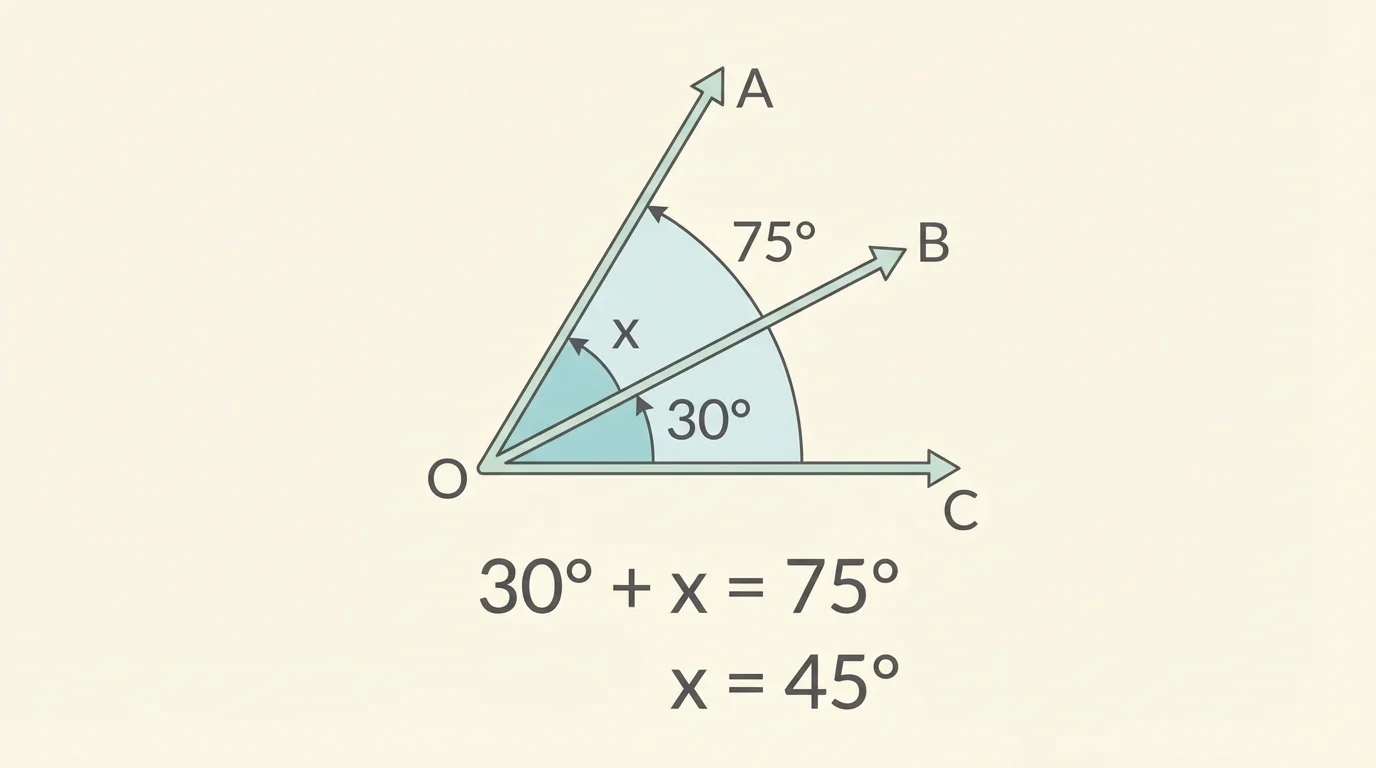
[Figure 1] You can think of angle measure as the amount of turning. If you face forward and then turn a little, you make a small angle. If you turn farther, you make a larger angle. This idea of turning helps us understand why angles can be added.
Angle measure tells how much rotation or turn there is from one ray to another ray.
Non-overlapping parts are parts that do not cover the same space. When an angle is split into non-overlapping parts, the parts fit together without crossing over one another.
It is important to notice that we are measuring the opening, not the length of the rays. Long rays and short rays can make the same angle if the turn is the same.
[Figure 2] Angle measure is additive. This means if one angle is broken into smaller angles that do not overlap, then the measure of the whole angle is the sum of the smaller angle measures.
Suppose a large angle is split into two smaller angles. If one part measures \(25^\circ\) and the other part measures \(40^\circ\), then the whole angle measures \(25^\circ + 40^\circ = 65^\circ\).
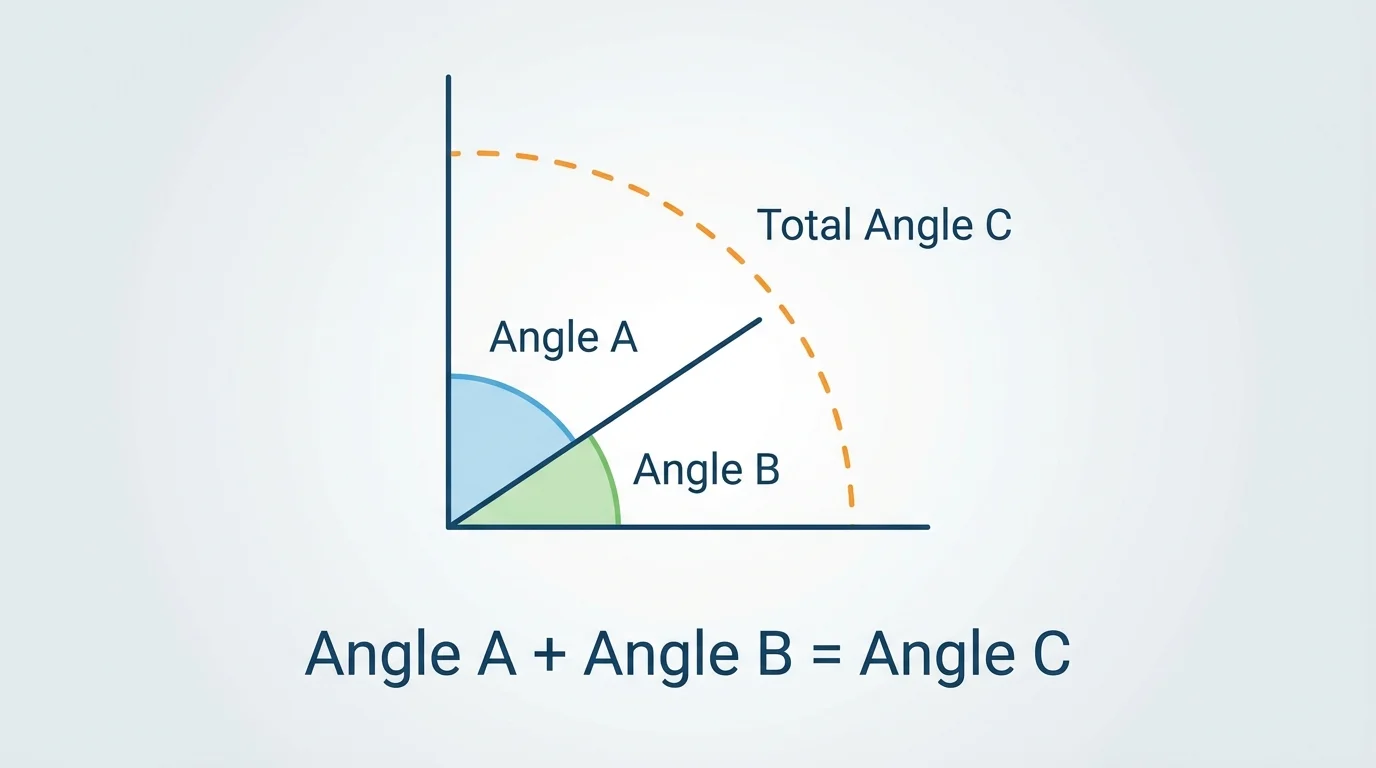
This is a part-part-whole idea. The two small angles are the parts. The large angle is the whole. When the parts do not overlap, we can add them to get the whole.
For example, if an angle is split into three parts that measure \(10^\circ\), \(15^\circ\), and \(35^\circ\), then the whole angle measures \(10^\circ + 15^\circ + 35^\circ = 60^\circ\).
This idea also works in reverse. If you know the whole angle and one part, you can subtract to find the missing part.
Part plus part equals whole
When angle pieces fit together exactly once, the measures add. If a whole angle is made of parts \(a\), \(b\), and \(c\), then the total angle measure is \(a + b + c\). If one part is missing, subtraction helps you find it.
Later, when you look back at [Figure 2], notice that the interior ray splits one angle into two new angles. Nothing overlaps, so addition makes sense.
Sometimes a diagram shows several small angles and asks for the measure of the whole angle. In that case, add the known parts.
Solved example 1
A large angle is split into two non-overlapping angles that measure \(32^\circ\) and \(18^\circ\). Find the whole angle.
Step 1: Identify the parts.
The two parts are \(32^\circ\) and \(18^\circ\).
Step 2: Add the parts.
\(32^\circ + 18^\circ = 50^\circ\)
Step 3: State the answer.
The whole angle measures \(50^\circ\).
Answer: \(50^\circ\)
You can also add more than two parts. Just be sure every small angle belongs to the whole angle and that the parts do not overlap.
If a whole angle is split into angles of \(12^\circ\), \(23^\circ\), and \(19^\circ\), then the whole angle is \(12^\circ + 23^\circ + 19^\circ = 54^\circ\).
Solved example 2
An angle is split into three parts measuring \(14^\circ\), \(27^\circ\), and \(31^\circ\). Find the total angle measure.
Step 1: Write the addition sentence.
\(14^\circ + 27^\circ + 31^\circ\)
Step 2: Add the first two measures.
\(14^\circ + 27^\circ = 41^\circ\)
Step 3: Add the third measure.
\(41^\circ + 31^\circ = 72^\circ\)
Answer: \(72^\circ\)
When reading a diagram, be careful not to add angles that are not part of the same whole angle. Always look at how the rays are arranged.
Other times, you know the whole angle and one part, and you must find the missing part. This is a subtraction problem because you subtract the known part from the whole to find what is missing.
If the whole angle measures \(80^\circ\) and one part measures \(35^\circ\), then the missing part is \(80^\circ - 35^\circ = 45^\circ\).
Solved example 3
A whole angle measures \(95^\circ\). One part measures \(40^\circ\). Find the other part.
Step 1: Start with the whole angle.
The whole is \(95^\circ\).
Step 2: Subtract the known part.
\(95^\circ - 40^\circ = 55^\circ\)
Step 3: State the missing angle.
The missing part measures \(55^\circ\).
Answer: \(55^\circ\)
Subtraction also works when there are more parts. For instance, if the whole angle is \(100^\circ\) and two known parts are \(25^\circ\) and \(30^\circ\), first add the known parts: \(25^\circ + 30^\circ = 55^\circ\). Then subtract from the whole: \(100^\circ - 55^\circ = 45^\circ\).
[Figure 3] Sometimes, instead of a blank, we use a variable such as \(x\) to stand for an unknown angle measure. An equation helps us write the relationship clearly.
Suppose a \(90^\circ\) angle is split into two parts. One part is \(35^\circ\), and the other part is \(x\). Since the parts make the whole, we write \(35^\circ + x = 90^\circ\).
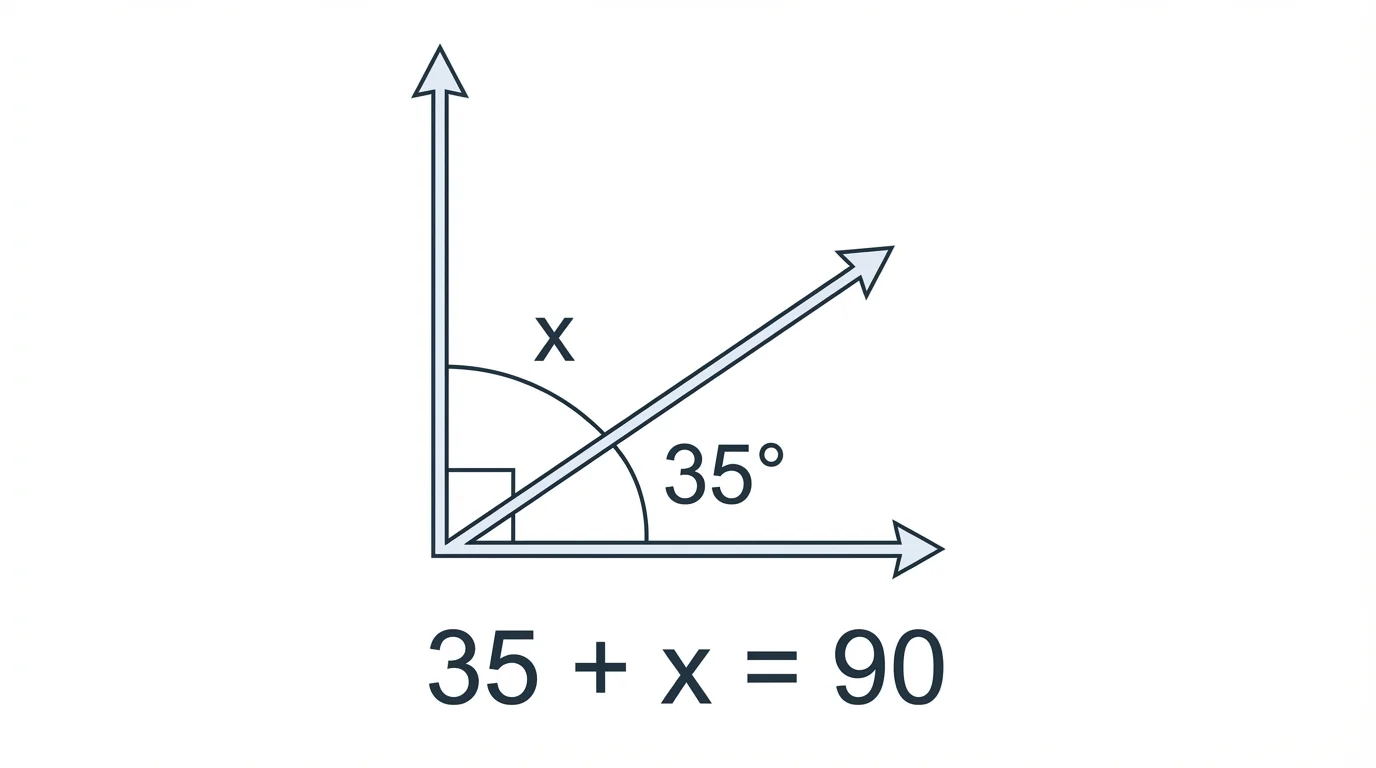
To solve, subtract \(35^\circ\) from \(90^\circ\): \(x = 90^\circ - 35^\circ = 55^\circ\). So the missing angle is \(55^\circ\).
This works because the total of the parts must equal the whole angle. The equation keeps the part-part-whole relationship organized.
Solved example 4
A \(120^\circ\) angle is split into two non-overlapping angles. One angle measures \(48^\circ\). The other measures \(x\). Find \(x\).
Step 1: Write an equation.
\(48^\circ + x = 120^\circ\)
Step 2: Subtract \(48^\circ\) from both sides.
\(x = 120^\circ - 48^\circ\)
Step 3: Compute the difference.
\(x = 72^\circ\)
Answer: \[x = 72^\circ\]
You can write equations with more than one known part too. If a \(110^\circ\) angle is split into \(20^\circ\), \(x\), and \(30^\circ\), then \(20^\circ + x + 30^\circ = 110^\circ\). Add the known parts first: \(50^\circ + x = 110^\circ\). Then solve: \(x = 60^\circ\).
When you return to [Figure 3], you can see how the diagram and the equation tell the same story: parts combine to make the whole.
Some angle measures are especially helpful to know. These can act like landmarks when solving angle problems.
| Angle Type | Measure | What It Means |
|---|---|---|
| Right angle | \(90^\circ\) | A square corner |
| Straight angle | \(180^\circ\) | A straight line |
| Full turn | \(360^\circ\) | One complete turn |
Table 1. Common angle measures that help students estimate and solve angle problems.
If a right angle is divided into two parts measuring \(20^\circ\) and \(70^\circ\), the total is \(90^\circ\). If a straight angle is split into \(125^\circ\) and \(55^\circ\), the total is \(180^\circ\).
Remember that addition joins amounts and subtraction finds what is left or missing. Angle problems use those same operations, but the amounts are measured in degrees.
These special angles are useful for checking if an answer makes sense. For example, if two parts of a right angle add to more than \(90^\circ\), something is wrong.
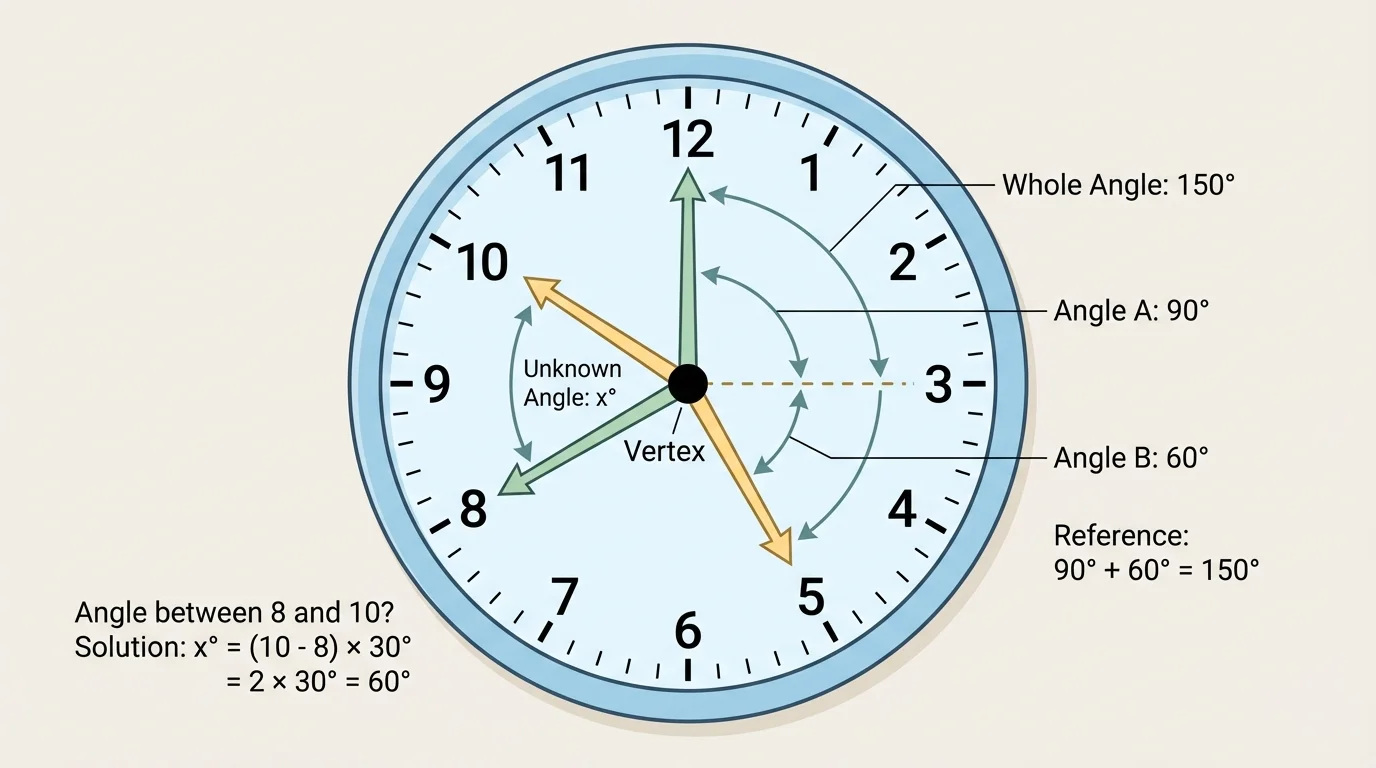
[Figure 4] Angles appear in daily life, and clocks are one familiar example. The center of the clock is the vertex, and the hands form angles as they move. Doors, scissors, folding books, and turning bikes also create angles.
Suppose a door opens first by \(30^\circ\) and then opens another \(20^\circ\). The total opening is \(30^\circ + 20^\circ = 50^\circ\).
Now think about a bicycle rider turning on a path. If the rider turns a total of \(90^\circ\) but has already turned \(55^\circ\), then the amount left to turn is \(90^\circ - 55^\circ = 35^\circ\).
Solved example 5
A clock hand moves from one mark to another in two steps. The first turn is \(40^\circ\). The total turn is \(100^\circ\). Find the second turn.
Step 1: Use subtraction because the whole is known.
\(100^\circ - 40^\circ\)
Step 2: Subtract.
\(100^\circ - 40^\circ = 60^\circ\)
Answer: \(60^\circ\)
Sports use angle ideas too. A basketball pass can bounce off the floor at one angle and head toward a teammate at another. Builders and designers use angle measures when making corners, ramps, and roofs.
Looking again at [Figure 4], you can connect the picture to the math: each movement of the hands creates parts of a turn, and those parts can be added or subtracted.
A full turn around a circle is \(360^\circ\). That means four right angles make a full turn because \(4 \times 90^\circ = 360^\circ\).
Real-world angle problems often sound like movement problems: turning, opening, swinging, rotating, or pointing. These words are clues that angle measure may be involved.
One common mistake is adding angle measures that do not belong to the same whole angle. Another mistake is forgetting that the angle parts must be non-overlapping.
It is also easy to confuse the size of an angle with the length of its rays. Long rays do not mean a larger angle. The amount of turn is what matters.
When solving for an unknown, make sure the equation matches the diagram. If the whole angle is known, subtraction is often needed. If all the parts are known and the whole is missing, addition is often needed.
Whenever an angle is split into smaller non-overlapping angles, you can think, parts make the whole. This simple idea helps with diagrams, equations, and real-life turns.
If the parts are \(a\) and \(b\), then the whole angle is \(a + b\). If the whole is \(c\) and one part is \(a\), then the missing part is \(c - a\). These relationships are the heart of angle addition and subtraction.
As your math work becomes more advanced, you will keep using this same idea in larger geometry problems. Understanding it now gives you a strong start.
