Have you ever noticed that some things grow in a way that feels predictable? A video game score might go up by the same amount each turn, or the number of jumping jacks you do each round might increase in a steady way. Mathematics studies these regular changes with patterns. When we compare two patterns at the same time, we can discover surprising relationships, such as one pattern always being double another.
Patterns help us describe change. If a number pattern starts at a certain number and follows a rule, we can predict what comes next. When two patterns are built side by side, we can compare the numbers in the same places. Those matching numbers are called corresponding terms. Looking at corresponding terms helps us answer questions like: Is one pattern always greater? Are the terms equal? Does one pattern grow twice as fast?
These ideas connect to many parts of mathematics. They also prepare you for algebra, where rules and relationships are written more generally. Instead of only listing numbers, we begin to see structure.
You already know how to follow rules such as add, subtract, multiply, and divide. A numerical pattern uses one of these ideas again and again in order.
A numerical pattern is a list of numbers that follows a rule. The rule tells how to move from one term to the next. The first number is often called the starting number. For example, if the rule is to add \(3\) and the starting number is \(0\), the pattern is \(0, 3, 6, 9, 12, ...\).
Rule means the instruction used to create a pattern. Starting number is the first number in the pattern. Ordered pair is a pair of numbers written as \((x, y)\), where order matters. Coordinate plane is a graph with a horizontal axis and a vertical axis used to plot ordered pairs.
When we compare two patterns, we match the first term of one pattern with the first term of the other, the second with the second, and so on. We do not mix positions. If one pattern is \(2, 5, 8, 11\) and the other is \(4, 7, 10, 13\), then \(2\) matches \(4\), \(5\) matches \(7\), and \(8\) matches \(10\).
Let us use the main example. The first rule is add \(3\) starting at \(0\). The second rule is add \(6\) starting at \(0\). As [Figure 1] shows, it helps to list both patterns side by side so we can compare matching positions clearly.
First pattern: start at \(0\), then keep adding \(3\): \(0, 3, 6, 9, 12, 15, ...\)
Second pattern: start at \(0\), then keep adding \(6\): \(0, 6, 12, 18, 24, 30, ...\)
Now compare the corresponding terms:
| Term number | Pattern A | Pattern B |
|---|---|---|
| \(1\) | \(0\) | \(0\) |
| \(2\) | \(3\) | \(6\) |
| \(3\) | \(6\) | \(12\) |
| \(4\) | \(9\) | \(18\) |
| \(5\) | \(12\) | \(24\) |
Table 1. Corresponding terms in two patterns built from adding \(3\) and adding \(6\), both starting at \(0\).
We can see that each term in Pattern B is twice the matching term in Pattern A. For example, \(6 = 2 \times 3\), \(12 = 2 \times 6\), and \(24 = 2 \times 12\).
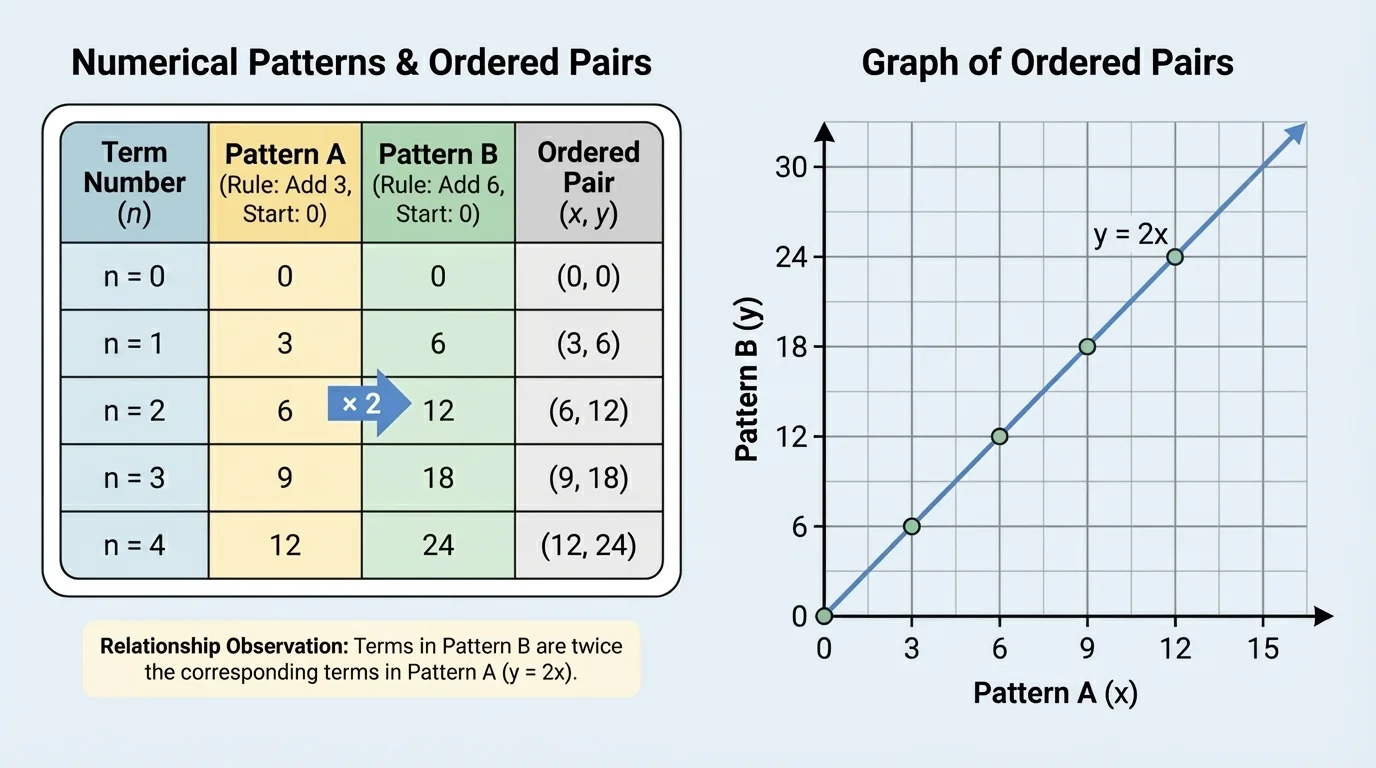
This happens because each time Pattern A goes up by \(3\), Pattern B goes up by \(6\). Since \(6\) is twice \(3\), the second pattern keeps growing at double the amount. Also, both patterns start at \(0\), so the doubling relationship begins right away and continues every step.
Why matching positions matter
To compare two patterns fairly, you must compare terms in the same position. The second term in one pattern matches the second term in the other pattern, not the third or fourth. This is what makes the relationship meaningful.
Later, when we look at graphs, the same matching idea still matters. The point \((3, 6)\) means that when the first pattern has value \(3\), the second pattern has value \(6\). This links the two sequences together.
A relationship is the way two sets of numbers connect. Sometimes one pattern is always greater than the other. Sometimes one pattern is a multiple of the other. Sometimes the difference between the terms stays the same.
Here are some common relationships you might notice:
To identify a relationship, compare several pairs of corresponding terms. If the same pattern keeps happening, you may have found the rule connecting them.
Some relationships are easier to spot in a table, while others become clearer on a graph. Mathematicians often switch between lists, tables, and graphs to understand the same pattern in different ways.
An ordered pair is written as \((x, y)\). The first number is the \(x\)-coordinate, and the second number is the \(y\)-coordinate. When we use two patterns, we usually take the term from the first pattern as \(x\) and the matching term from the second pattern as \(y\).
Using the main example, the corresponding terms give these ordered pairs:
\((0, 0), (3, 6), (6, 12), (9, 18), (12, 24), (15, 30)\)
Notice how each pair keeps the same order: first Pattern A, then Pattern B. If we switched the order, we would get different points.
As [Figure 2] illustrates, a coordinate plane has a horizontal axis called the \(x\)-axis and a vertical axis called the \(y\)-axis. In this lesson, the first pattern gives the \(x\)-value and the second pattern gives the \(y\)-value.
To graph \((3, 6)\), move \(3\) units to the right on the \(x\)-axis and then \(6\) units up on the \(y\)-axis. To graph \((9, 18)\), move \(9\) units right and \(18\) units up.
When all the points are plotted, they lie on a line through the origin. This matches the relationship that the second pattern is always twice the first, which can be written as \(y = 2x\).
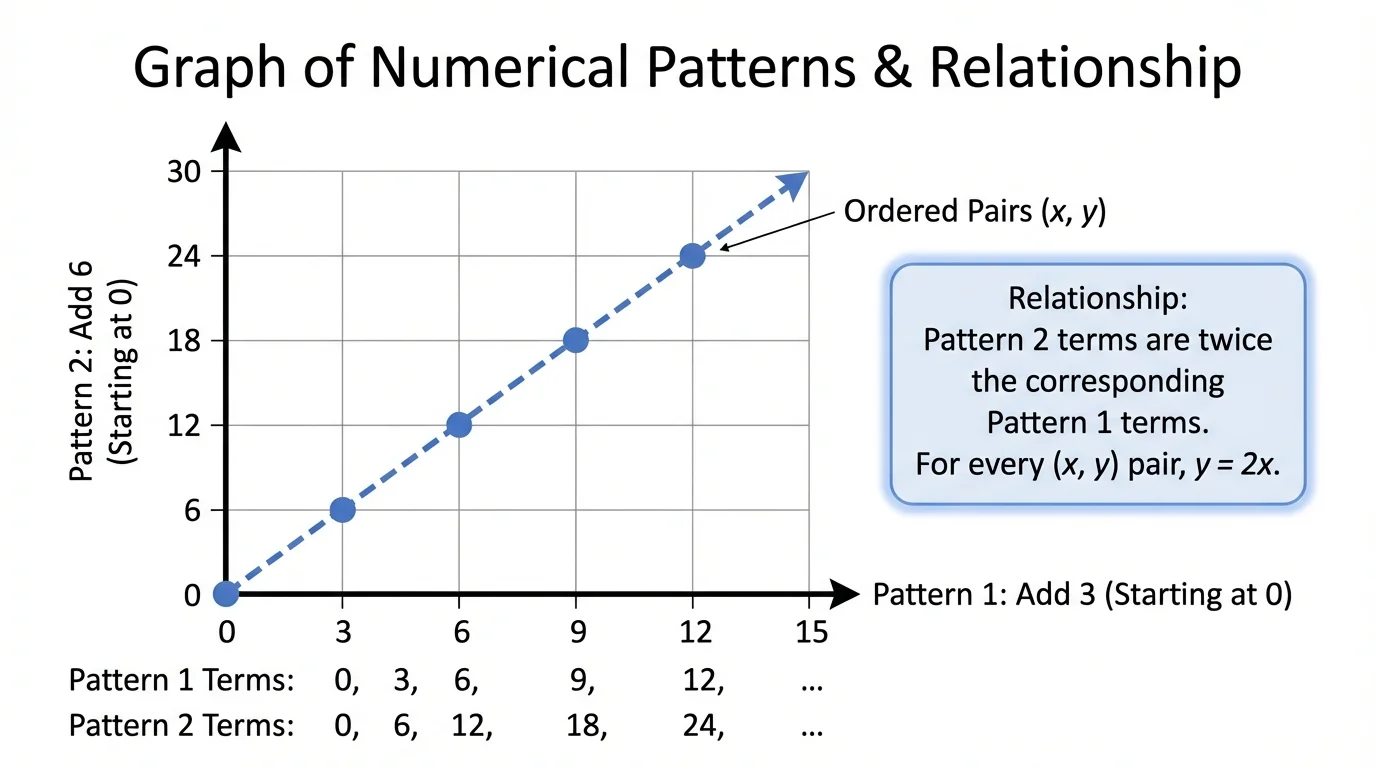
If the points line up neatly, that often means the two patterns have a regular relationship. In the main example, every point follows the rule \(y = 2x\). Looking back at [Figure 1], you can see the same doubling pattern in the table of terms.
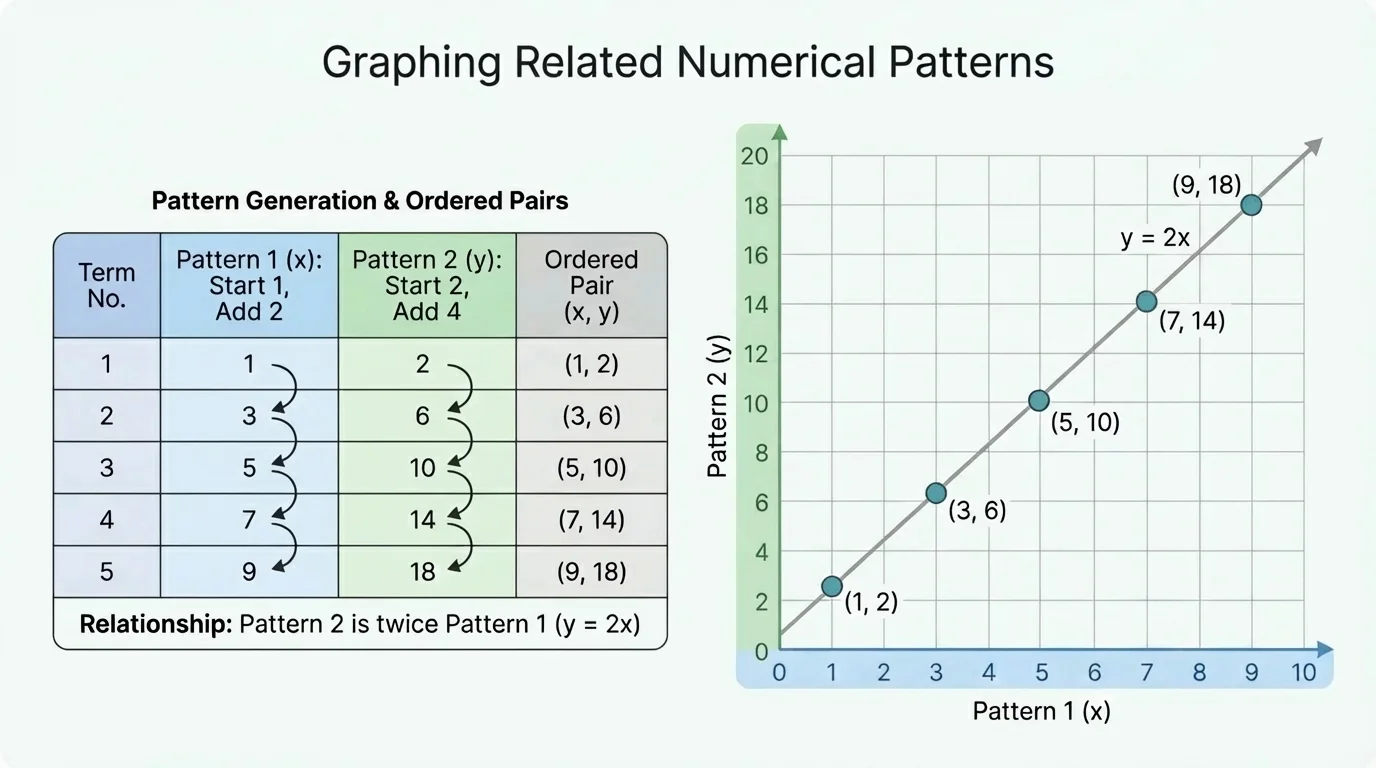
As [Figure 3] later reinforces, some pattern relationships are obvious from the numbers, and some become clearer when we write ordered pairs or make a graph. Now let us solve several examples step by step.
Worked Example 1
Generate two patterns. Pattern A starts at \(1\) and follows the rule "add \(2\)." Pattern B starts at \(2\) and follows the rule "add \(4\)." Find the first five terms and describe the relationship.
Step 1: Generate Pattern A.
Start at \(1\): \(1, 3, 5, 7, 9\)
Step 2: Generate Pattern B.
Start at \(2\): \(2, 6, 10, 14, 18\)
Step 3: Compare corresponding terms.
\(2 = 2 \times 1\), \(6 = 2 \times 3\), \(10 = 2 \times 5\), \(14 = 2 \times 7\), \(18 = 2 \times 9\)
The relationship is that Pattern B is always twice Pattern A.
Because both the starting number and the amount added are doubled, every matching term also doubles. This is similar to the main example, even though the starting numbers are not \(0\).
Worked Example 2
Pattern A starts at \(4\) and follows the rule "add \(3\)." Pattern B starts at \(9\) and follows the rule "add \(3\)." Find the first four terms, make ordered pairs, and describe the relationship.
Step 1: Generate both patterns.
Pattern A: \(4, 7, 10, 13\)
Pattern B: \(9, 12, 15, 18\)
Step 2: Write ordered pairs.
\((4, 9), (7, 12), (10, 15), (13, 18)\)
Step 3: Compare corresponding terms.
Each term in Pattern B is \(5\) more than the matching term in Pattern A, because \(9 - 4 = 5\), \(12 - 7 = 5\), \(15 - 10 = 5\), and \(18 - 13 = 5\).
The relationship is not a doubling relationship. Instead, Pattern B is always \(5\) greater than Pattern A.
This example is important because not all related patterns are multiplication relationships. Sometimes the connection is a constant difference.
Worked Example 3
Pattern A starts at \(2\) and follows the rule "add \(5\)." Pattern B starts at \(6\) and follows the rule "add \(15\)." Find the first four terms and describe the relationship.
Step 1: Generate Pattern A.
\(2, 7, 12, 17\)
Step 2: Generate Pattern B.
\(6, 21, 36, 51\)
Step 3: Compare corresponding terms.
\(6 = 3 \times 2\), \(21 = 3 \times 7\), \(36 = 3 \times 12\), \(51 = 3 \times 17\)
The relationship is that Pattern B is always three times Pattern A.
Since the starting number \(6\) is three times \(2\), and the amount added \(15\) is three times \(5\), the same triple relationship stays true for every term.
Here is a helpful comparison of different pattern pairs.
| Pattern A | Pattern B | Relationship |
|---|---|---|
| \(0, 3, 6, 9\) | \(0, 6, 12, 18\) | Pattern B is twice Pattern A |
| \(1, 3, 5, 7\) | \(2, 6, 10, 14\) | Pattern B is twice Pattern A |
| \(4, 7, 10, 13\) | \(9, 12, 15, 18\) | Pattern B is \(5\) more |
| \(2, 7, 12, 17\) | \(6, 21, 36, 51\) | Pattern B is three times Pattern A |
Table 2. Examples of several kinds of relationships between corresponding terms.
When you compare patterns, ask two questions: How do the patterns grow? and How do matching terms compare? The answer to both questions can help you see the relationship.
Patterns appear in everyday life. Suppose one student saves \(\$3\) each week and another saves \(\$6\) each week. If both start with \(\$0\), then after the same number of weeks their savings form the patterns \(0, 3, 6, 9, ...\) and \(0, 6, 12, 18, ...\). The second student always has twice as much money.
In sports training, one runner might add \(1\) lap each week while another adds \(2\) laps each week. If they both start at \(0\) extra laps, the second runner's number of extra laps is always twice the first runner's. This is the same structure as the main example.
Even in games, if one action earns \(5\) points and another earns \(10\) points, score patterns can show a doubling relationship. If those scores are graphed as ordered pairs, the points line up just like the earlier graphs. That is why [Figure 2] remains useful beyond one example.
One common mistake is comparing the wrong terms. For example, if you compare the second term of one pattern with the third term of another, the relationship may seem wrong.
Another mistake is forgetting the starting number. A pattern does not begin with the first added number unless the rule says so. If the starting number is \(4\) and the rule is add \(3\), the first term is \(4\), not \(7\).
A third mistake is reversing ordered pairs. The pair \((3, 6)\) is not the same as \((6, 3)\). On a graph, those are different points in different places.
"A pattern is not just a list of numbers. It is a rule you can trust."
Also be careful when reading a graph. The horizontal coordinate is read first, and the vertical coordinate is read second. This matches the order in an ordered pair.
Let us return to the example with add \(3\) from \(0\) and add \(6\) from \(0\). Why is the second sequence always twice the first?
Start with the first terms: \(0\) and \(0\). They are equal, and \(0\) is also twice \(0\). Now each time the first pattern increases by \(3\), the second pattern increases by \(6\). Since \(6 = 2 \times 3\), the second pattern adds double the amount every time.
So after one step, the first pattern is \(3\) and the second is \(6\). After two steps, the first is \(6\) and the second is \(12\). After three steps, the first is \(9\) and the second is \(18\). The doubling keeps going because both the start and the growth follow the same double relationship.
You can think of it this way: if Pattern A is built by adding one group of \(3\) each time, then Pattern B is built by adding two groups of \(3\) each time. That is why every matching value in Pattern B is twice the value in Pattern A. Such doubling relationships create points that line up in a steady way.
