Why can the digit \(5\) mean \(5\), \(50\), \(500\), or even \(0.5\)? That seems strange at first, but it is one of the most powerful ideas in our number system. A digit is small, but its place gives it power. Once you understand this pattern, big numbers and decimals start to make much more sense.
Our number system is called a place value system. That means the value of a digit depends on where it is placed. The digit \(7\) does not always mean seven ones. In \(7\), it means \(7\) ones. In \(70\), it means \(7\) tens. In \(700\), it means \(7\) hundreds.
This is useful everywhere: reading population numbers, measuring distances, understanding prices, and working with decimals. If a scoreboard says \(3{,}245\) points over a season, each digit has a different job. The \(3\) means \(3\) thousands, the \(2\) means \(2\) hundreds, the \(4\) means \(4\) tens, and the \(5\) means \(5\) ones.
You already know basic place names such as ones, tens, and hundreds. The new idea here is the relationship between places: moving one place left makes the value \(10\) times greater, and moving one place right makes the value \(\dfrac{1}{10}\) as much.
It is important to tell the difference between a digit and a digit's value. A digit is one symbol from \(0\) through \(9\). Its value depends on its place in the number.
The places in a number follow a repeating pattern, as shown in [Figure 1]. Starting from the right, we have ones, tens, hundreds, thousands, ten thousands, and so on. Every time you move one place to the left, the value becomes \(10\) times as much. Every time you move one place to the right, the value becomes \(\dfrac{1}{10}\) as much.
Here is the pattern with simple examples:
\(1\) one \(= 1\)
\(1\) ten \(= 10\)
\(1\) hundred \(= 100\)
\(1\) thousand \(= 1{,}000\)
Notice what happens each time:
\[10 = 10 \times 1\]
\[100 = 10 \times 10\]
\[1{,}000 = 10 \times 100\]
So if a digit moves from the ones place to the tens place, its value becomes \(10\) times greater. If it moves from the hundreds place to the tens place, its value becomes \(\dfrac{1}{10}\) as much.
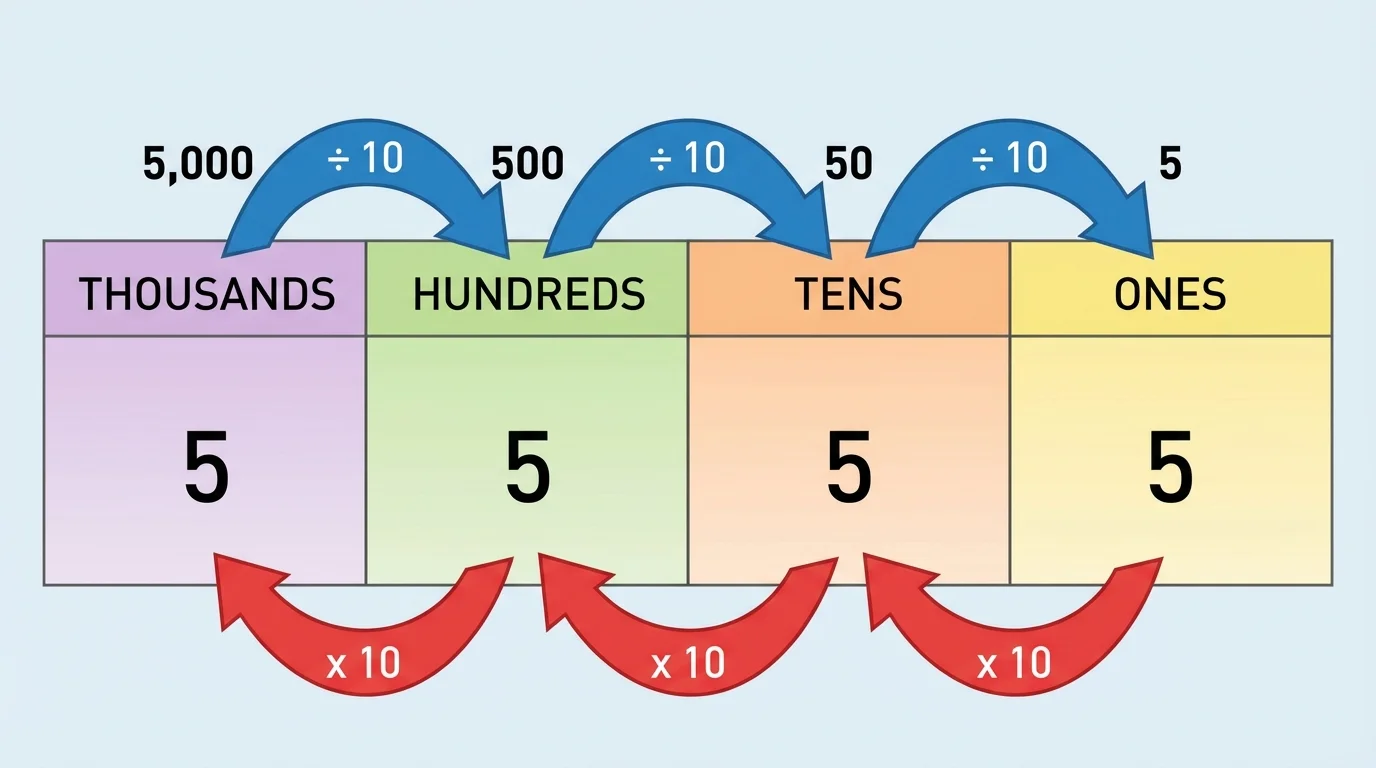
You can think of each place as a larger box. A ones box holds single units. A tens box groups \(10\) ones. A hundreds box groups \(10\) tens, which is \(100\) ones. This is why base-ten blocks are often used to teach place value: one long rod stands for \(10\) cubes, and one flat square stands for \(100\) cubes.
Place value means the value a digit has because of its position in a number. Value is how much the digit is worth in that place. A digit can stay the same while its value changes.
The rule works in both directions. Moving left means multiply by \(10\). Moving right means divide by \(10\). Those two ideas are really the same pattern viewed from opposite directions.
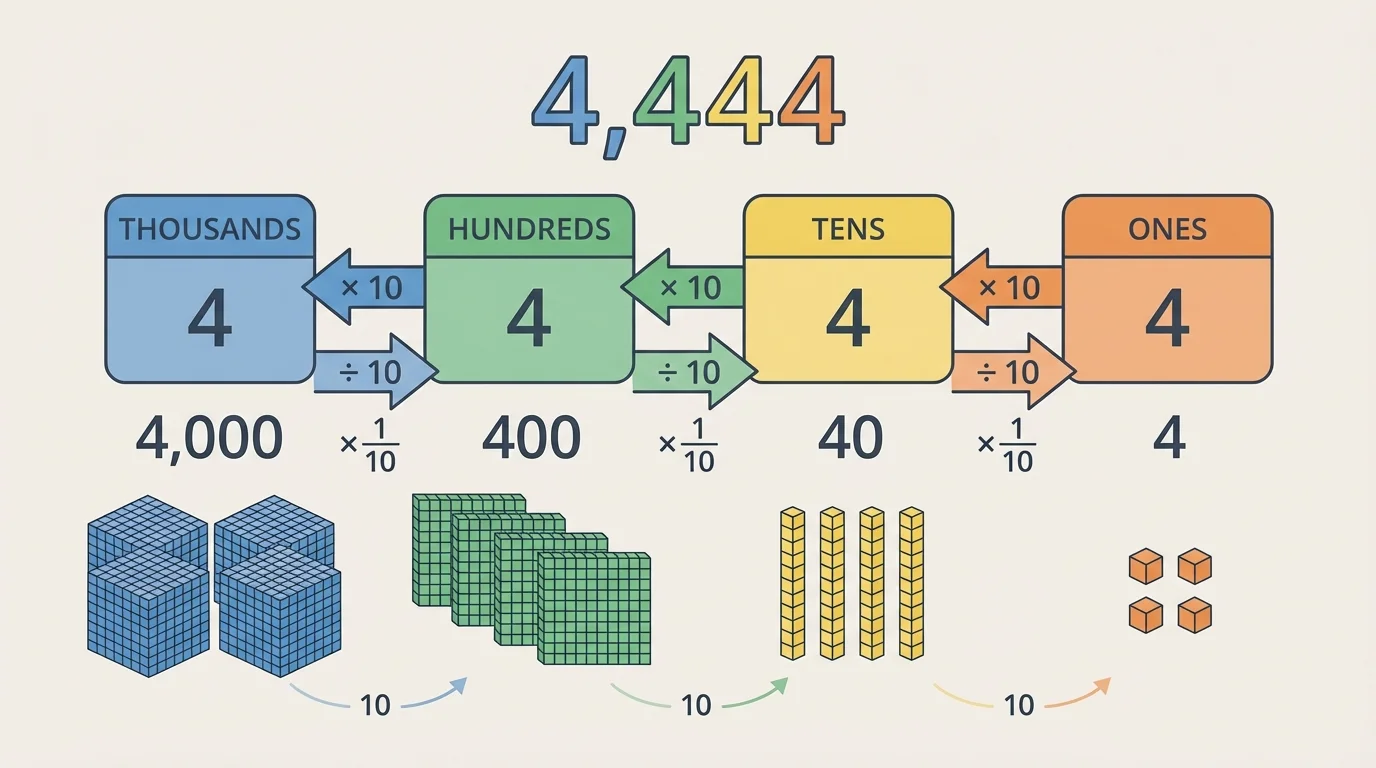
Look at the number \(4{,}444\). This number is especially useful because the same digit appears in every place, and [Figure 2] makes the changing values easy to see. Even though every digit is \(4\), the values are different because the places are different.
In \(4{,}444\):
We can write the number in expanded form:
\[4{,}444 = 4{,}000 + 400 + 40 + 4\]
This shows clearly that the same digit can have very different values. The \(4\) in the thousands place is \(10\) times the \(4\) in the hundreds place. The \(4\) in the hundreds place is \(10\) times the \(4\) in the tens place. The pattern continues all the way across.
Here is another example. In \(8{,}305\), the digit \(8\) means \(8{,}000\), the digit \(3\) means \(300\), the digit \(0\) means \(0\) tens, and the digit \(5\) means \(5\) ones. Even \(0\) is important because it holds a place so the other digits keep their correct values.
The big idea of this lesson can be stated very precisely: in a multi-digit number, a digit in one place represents \(10\) times as much as it represents in the place to its right, and \(\dfrac{1}{10}\) of what it represents in the place to its left.
Suppose the digit \(6\) is in the tens place. Its value is \(60\). If the same digit \(6\) is one place to the right, in the ones place, its value is \(6\). Compare them:
\[60 = 10 \times 6\]
So the \(6\) in the tens place is \(10\) times the value of the \(6\) in the ones place.
Now compare the \(6\) in the tens place to the \(6\) in the hundreds place, which is \(600\):
\[60 = \frac{1}{10} \times 600\]
So the \(6\) in the tens place is \(\dfrac{1}{10}\) of the value of the \(6\) in the hundreds place.
| Place | Value of digit \(6\) | Relationship |
|---|---|---|
| Hundreds | \(600\) | \(10\) times tens |
| Tens | \(60\) | \(10\) times ones |
| Ones | \(6\) | \(\dfrac{1}{10}\) of tens |
Table 1. Comparison of the value of the digit \(6\) in different places.
Notice that we are comparing the same digit in different positions. The number symbol stays the same, but the amount it stands for changes with place.
The left-right rule
Each move one place left makes a digit's value \(10\) times greater. Each move one place right makes a digit's value \(\dfrac{1}{10}\) as great. Two moves left means \(10 \times 10 = 100\) times greater. Two moves right means \(\dfrac{1}{10} \times \dfrac{1}{10} = \dfrac{1}{100}\) as great.
This means you can compare places that are more than one step apart. For example, the value of a digit in the thousands place is \(100\) times the value of the same digit in the tens place, because moving from tens to thousands is two places left.
Worked Example 1
In the number \(3{,}572\), how much is the digit \(5\) worth?
Step 1: Identify the place of the digit.
In \(3{,}572\), the digit \(5\) is in the hundreds place.
Step 2: Find its value.
A \(5\) in the hundreds place means \(5\) hundreds.
\(5\) hundreds \(= 500\).
The value of the digit \(5\) is \(500\).
When you answer a place value question, always ask: What place is the digit in? That tells you its value.
Worked Example 2
Compare the value of the digit \(7\) in \(7{,}000\) and \(700\).
Step 1: State the two values.
In \(7{,}000\), the digit \(7\) has value \(7{,}000\).
In \(700\), the digit \(7\) has value \(700\).
Step 2: Compare using multiplication.
\(7{,}000 \div 700 = 10\).
Step 3: Write the relationship.
The \(7\) in \(7{,}000\) is \(10\) times the value of the \(7\) in \(700\).
The correct comparison is \(7{,}000 = 10 \times 700\).
This matches the rule we saw earlier and also connects back to the pattern in [Figure 1], where each move left multiplies value by \(10\).
Worked Example 3
In the number \(9{,}909\), compare the value of the leftmost \(9\) to the rightmost \(9\).
Step 1: Find the value of each \(9\).
The leftmost \(9\) is in the thousands place, so its value is \(9{,}000\).
The rightmost \(9\) is in the ones place, so its value is \(9\).
Step 2: Compare the two values.
\(9{,}000 \div 9 = 1{,}000\).
Step 3: State the relationship.
The leftmost \(9\) is \(1{,}000\) times the value of the rightmost \(9\).
The comparison is \(9{,}000 = 1{,}000 \times 9\).
Since the two digits are three places apart, the value changes by \(10 \times 10 \times 10 = 1{,}000\).
Worked Example 4
What is the value of the digit \(2\) in \(0.24\), and how does it compare to the digit \(2\) in \(2.4\)?
Step 1: Find each value.
In \(0.24\), the digit \(2\) is in the tenths place, so its value is \(0.2\).
In \(2.4\), the digit \(2\) is in the ones place, so its value is \(2\).
Step 2: Compare them.
\(2 \div 0.2 = 10\).
Step 3: Write the relationship.
The \(2\) in \(2.4\) is \(10\) times the value of the \(2\) in \(0.24\).
The values are \(2\) and \(0.2\), and the larger is \(10\) times the smaller.
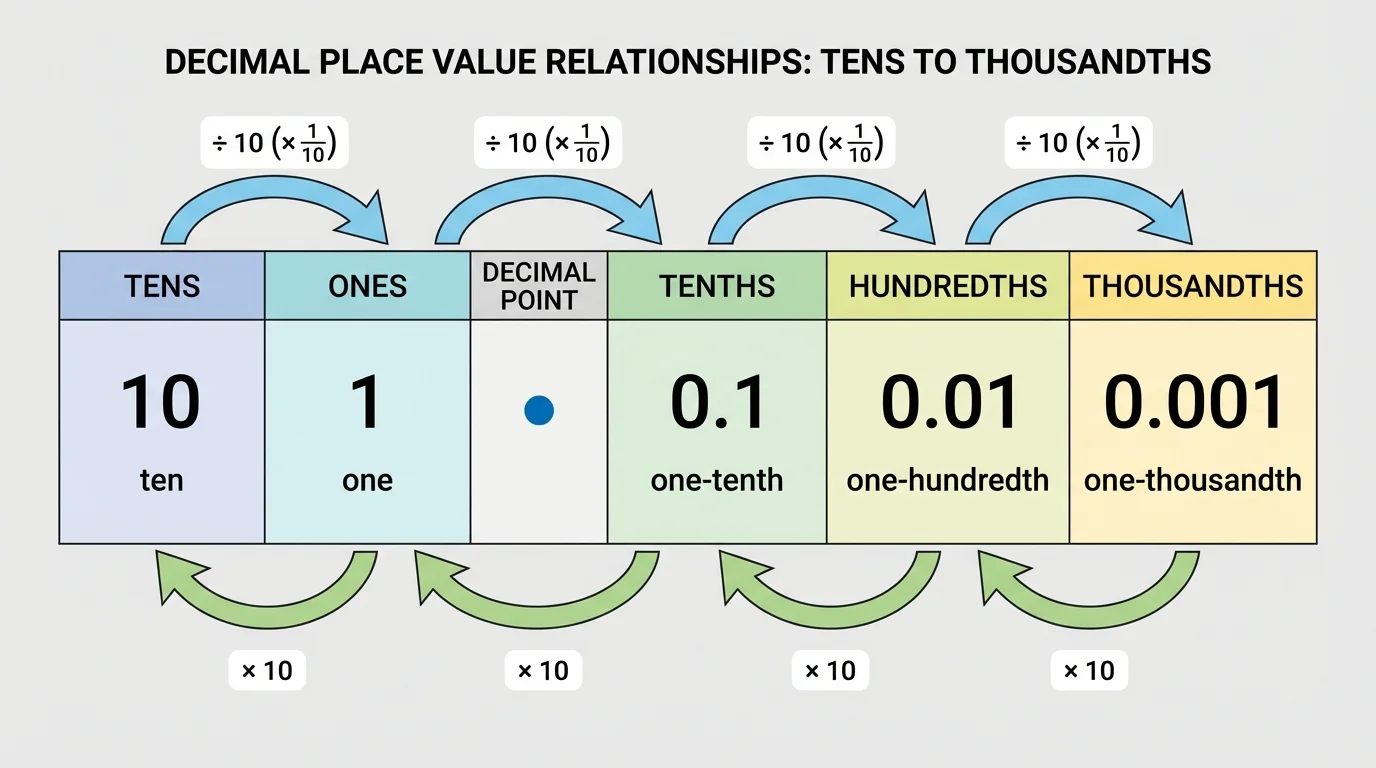
Place value does not stop at the ones place. It continues to the right with decimals. The same pattern continues in [Figure 3]: each place to the right is worth \(\dfrac{1}{10}\) of the place to its left. After ones come tenths, hundredths, thousandths, and so on.
Here are some decimal place values:
\(1\) one \(= 1\)
\(1\) tenth \(= 0.1\)
\(1\) hundredth \(= 0.01\)
\(1\) thousandth \(= 0.001\)
Notice the pattern:
\[0.1 = \frac{1}{10} \times 1\]
\[0.01 = \frac{1}{10} \times 0.1\]
\[0.001 = \frac{1}{10} \times 0.01\]
So a digit in the ones place is \(10\) times the value of the same digit in the tenths place. A digit in the tenths place is \(10\) times the value of the same digit in the hundredths place.
For example, compare the digit \(3\) in \(3\), \(0.3\), and \(0.03\):
Each time the digit moves one place right, its value becomes \(\dfrac{1}{10}\) as much. This is exactly the same place value rule used for whole numbers. The chart in [Figure 3] shows that the pattern crosses the decimal point smoothly.
The decimal point is not a wall that stops place value. It is just a marker between ones and tenths, and the same \(10\)-times pattern continues on both sides.
That is why understanding whole-number place value helps you understand decimals, too.
Place value is not just for worksheets. It helps in many real situations. In money, the difference between \(2\) dollars and \(0.2\) dollars is huge. One is ten times the other. In measurements, \(4\) meters, \(0.4\) meters, and \(0.04\) meters all use the same digit, but the actual lengths are very different.
Suppose a stadium holds \(50{,}000\) people. The digit \(5\) in that number means \(50{,}000\), not \(5\). A weather report might say a town received \(0.5\) inches of rain. That same digit \(5\) now means \(5\) tenths. Place value helps us read numbers correctly in science, sports, business, and everyday life.
When stores list prices like $4.50, the \(4\) means \(4\) ones of dollars, the \(5\) means \(5\) tenths of a dollar, and the final \(0\) means \(0\) hundredths of a dollar. Understanding each place helps you know exactly how much something costs.
One common mistake is naming the digit instead of naming its value. For example, in \(6{,}482\), if someone asks for the value of the digit \(8\), the answer is not just \(8\). The value is \(80\), because the digit is in the tens place.
Another mistake is forgetting that zero holds places. In \(4{,}005\), the two zeros show that there are no hundreds and no tens. Without those zeros, the number would change.
A third mistake is mixing up \(10\) times and \(10\) more. If one value is \(50\) and another is \(5\), then \(50\) is \(10\) times as much as \(5\). It is not just \(10\) more. In fact, \(50\) is \(45\) more than \(5\), but \(10\) times as much.
"A digit's place tells its value."
This short rule can help you check your thinking whenever you read or compare numbers.
Good number sense grows when you look for patterns. The structure of our number system is built on groups of \(10\). Because of that, every place has a simple relationship to the places next to it. The same idea works for whole numbers and decimals.
When you see a number, try breaking it apart. In \(6{,}381\), think of \(6{,}000 + 300 + 80 + 1\). In \(0.681\), think of \(6\) tenths, \(8\) hundredths, and \(1\) thousandth. This kind of thinking makes comparing values much easier.
The example in [Figure 2] with repeated digits is especially useful because it reminds us that a digit does not carry a fixed value by itself. Its position decides whether it means thousands, hundreds, tens, ones, tenths, or hundredths.
