Have you ever tried to pack a box with building blocks, toy cubes, or small packages? If every cube fits neatly with no spaces left over and no cubes overlapping, you can measure exactly how much space the box holds. That idea leads to one of the most important measurements for solid objects: volume.
Volume helps us answer questions about space. How many cubes fit in a storage bin? How much room is inside a gift box? How many small blocks can be stacked to build a tower? When we measure volume, we are measuring the amount of space inside a solid object.
Unlike length, which measures how long something is, or area, which measures the surface of a flat shape, volume measures space in three dimensions: length, width, and height. That is why volume belongs to solid figures, not flat shapes.
Remember: A flat rectangle has area, measured in square units such as square centimeters or square inches. A solid figure has volume, measured in cubic units such as cubic centimeters, cubic inches, or cubic units.
A fish tank, a shoebox, and a stack of toy cubes are all examples of solid figures. They take up space in the world, and that space can be measured.
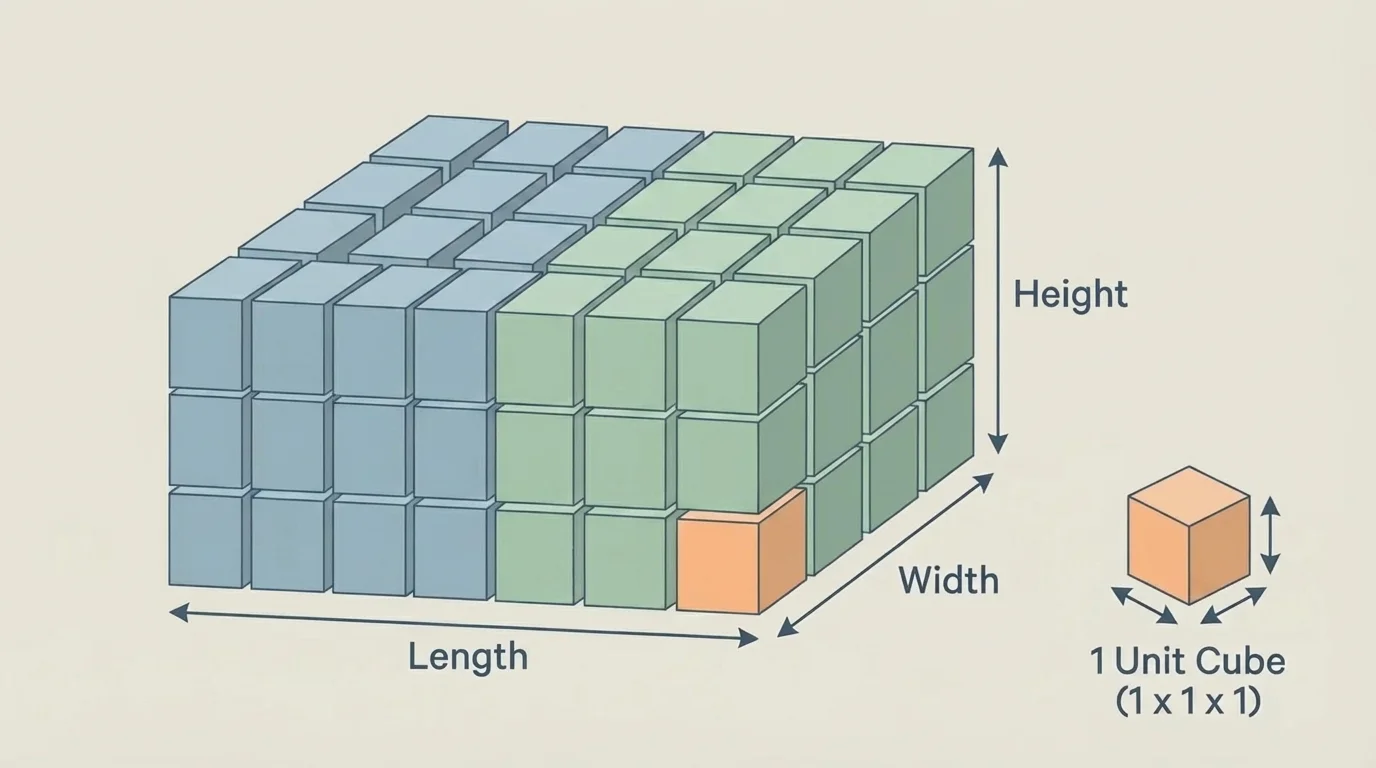
[Figure 1] shows that a solid figure is a shape that has length, width, and height. A unit cube is a cube that measures \(1\) unit long, \(1\) unit wide, and \(1\) unit high. Since each edge is \(1\) unit, one unit cube fills exactly one cubic unit of space.
Volume is the amount of space inside a solid figure.
Cubic unit is the volume of a cube that measures \(1 \times 1 \times 1\) unit.
If a solid figure can be packed without gaps or overlaps using \(n\) unit cubes, then the volume of the figure is \(n\) cubic units.
The words without gaps or overlaps are very important. No gaps means the cubes fill the space completely. No overlaps means cubes do not share the same space. If either of those happens, the measurement would not be accurate.
Suppose a small solid is made from exactly \(7\) unit cubes. If those cubes fit together with no spaces and no overlap, then the volume is \(7\) cubic units. It does not matter whether the solid is tall, narrow, wide, or shaped like steps. If it uses \(7\) unit cubes, it has volume \(7\) cubic units.
This idea gives us a way to measure volume by counting cubes. That is similar to finding area by counting square units, but now we count cubes because the figure is three-dimensional.
[Figure 2] shows one of the clearest ways to understand volume: building a solid with cubes. A rectangular prism is made from equal-size unit cubes arranged in rows and layers. Counting one cube at a time works, but larger solids are easier to count by noticing structure.
For example, imagine a solid with \(4\) cubes in the bottom layer and \(3\) layers total. Instead of counting all the cubes one by one, you can count by layers: \(4 + 4 + 4 = 12\). So the volume is \(12\) cubic units.
We can also think in rows and columns. If a layer has \(2\) rows with \(2\) cubes in each row, then each layer has \(2 \times 2 = 4\) cubes. If there are \(3\) layers, the whole solid has \(4 \times 3 = 12\) cubes.
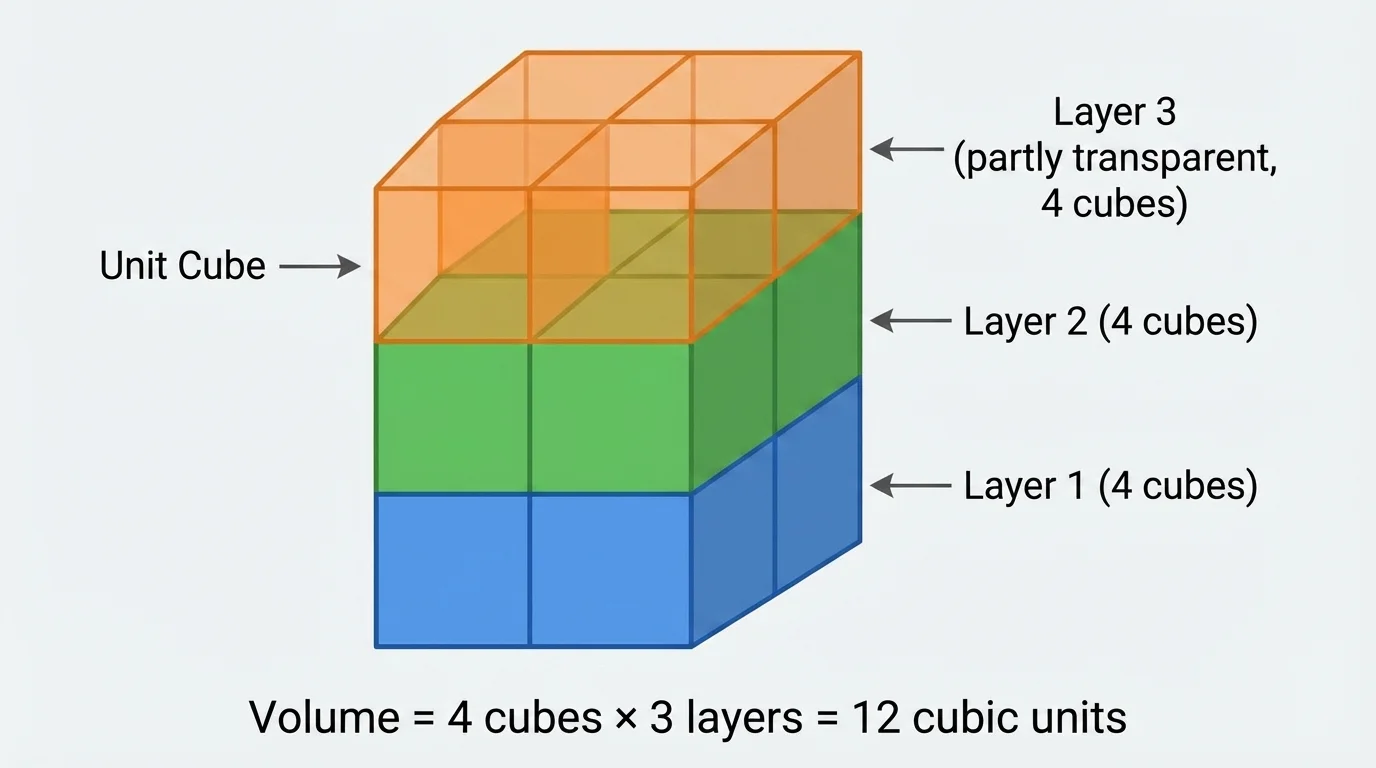
This shows why volume is connected to multiplication. Multiplication is a fast way to count equal groups of cubes.
A cube puzzle or a stack of building blocks can teach the same volume ideas used by architects, movers, and engineers. They all need to know how much space an object takes up.
Whenever unit cubes fit exactly into a solid, counting the cubes tells the volume. If there are \(n\) cubes, the volume is \(n\) cubic units.
A rectangular prism is a box-shaped solid. It is one of the easiest solids for understanding volume because its cubes can be arranged in equal rows, equal columns, and equal layers.
If a rectangular prism is \(l\) units long, \(w\) units wide, and \(h\) units high, then the number of unit cubes in one layer is \(l \times w\). Since there are \(h\) layers, the total number of cubes is
\[V = l \times w \times h\]
Here, \(V\) stands for volume. This formula works because each unit cube fills exactly one cubic unit of space.
Suppose a prism is \(5\) units long, \(2\) units wide, and \(3\) units high. Then its volume is \(5 \times 2 \times 3 = 30\). That means \(30\) unit cubes would fill it exactly, so the volume is \(30\) cubic units.
| Length | Width | Height | Volume |
|---|---|---|---|
| \(2\) | \(3\) | \(4\) | \(2 \times 3 \times 4 = 24\) |
| \(5\) | \(2\) | \(3\) | \(5 \times 2 \times 3 = 30\) |
| \(1\) | \(6\) | \(2\) | \(1 \times 6 \times 2 = 12\) |
| \(4\) | \(4\) | \(2\) | \(4 \times 4 \times 2 = 32\) |
Table 1. Volumes of rectangular prisms found by multiplying length, width, and height.
Notice that volume is always measured in cubic units because we are counting cubes, not squares or line segments.
Let's work through several examples carefully.
Worked example 1
A solid figure is made from \(9\) unit cubes. What is its volume?
Step 1: Recall the meaning of volume.
If a solid can be packed without gaps or overlaps using \(n\) unit cubes, then its volume is \(n\) cubic units.
Step 2: Identify \(n\).
Here, \(n = 9\).
Step 3: State the volume.
Since there are \(9\) unit cubes, the volume is \(9\) cubic units.
Answer: \[V = 9 \textrm{ cubic units}\]
This example is simple, but it is the basic idea behind all volume measurement with unit cubes.
Worked example 2
A rectangular prism has \(3\) cubes in each layer and \(4\) layers. Find the volume.
Step 1: Count cubes by layers.
Each layer has \(3\) cubes, and there are \(4\) equal layers.
Step 2: Multiply.
\(3 \times 4 = 12\)
Step 3: Write the unit.
The prism contains \(12\) unit cubes, so its volume is \(12\) cubic units.
Answer: \[V = 12 \textrm{ cubic units}\]
Counting by layers is much faster than counting one cube at a time.
Worked example 3
A rectangular prism is \(4\) units long, \(2\) units wide, and \(3\) units high. Find its volume.
Step 1: Use the formula for volume.
\(V = l \times w \times h\)
Step 2: Substitute the dimensions.
\(V = 4 \times 2 \times 3\)
Step 3: Multiply.
First, \(4 \times 2 = 8\). Then \(8 \times 3 = 24\).
Step 4: State the result with units.
The prism has a volume of \(24\) cubic units.
Answer: \[V = 24 \textrm{ cubic units}\]
Whether you count the \(24\) cubes directly or use multiplication, the result is the same.
Worked example 4
A solid is built from two parts. One part has volume \(8\) cubic units, and the other part has volume \(5\) cubic units. What is the total volume?
Step 1: Add the volumes of the parts.
\(8 + 5 = 13\)
Step 2: Write the unit.
The total volume is \(13\) cubic units.
Answer: \[V = 13 \textrm{ cubic units}\]
This shows that volume can also be found by adding smaller volumes together.
[Figure 3] shows that not every solid figure is one perfect box. Some solids are made by joining two rectangular prisms together. An L-shaped solid can be split into two simpler parts. This lets us find the volume of each part and then add the results.
For example, suppose one part has dimensions \(2 \times 3 \times 2\). Its volume is \(2 \times 3 \times 2 = 12\) cubic units. The second part has dimensions \(1 \times 3 \times 2\). Its volume is \(1 \times 3 \times 2 = 6\) cubic units. The total volume is \(12 + 6 = 18\) cubic units.
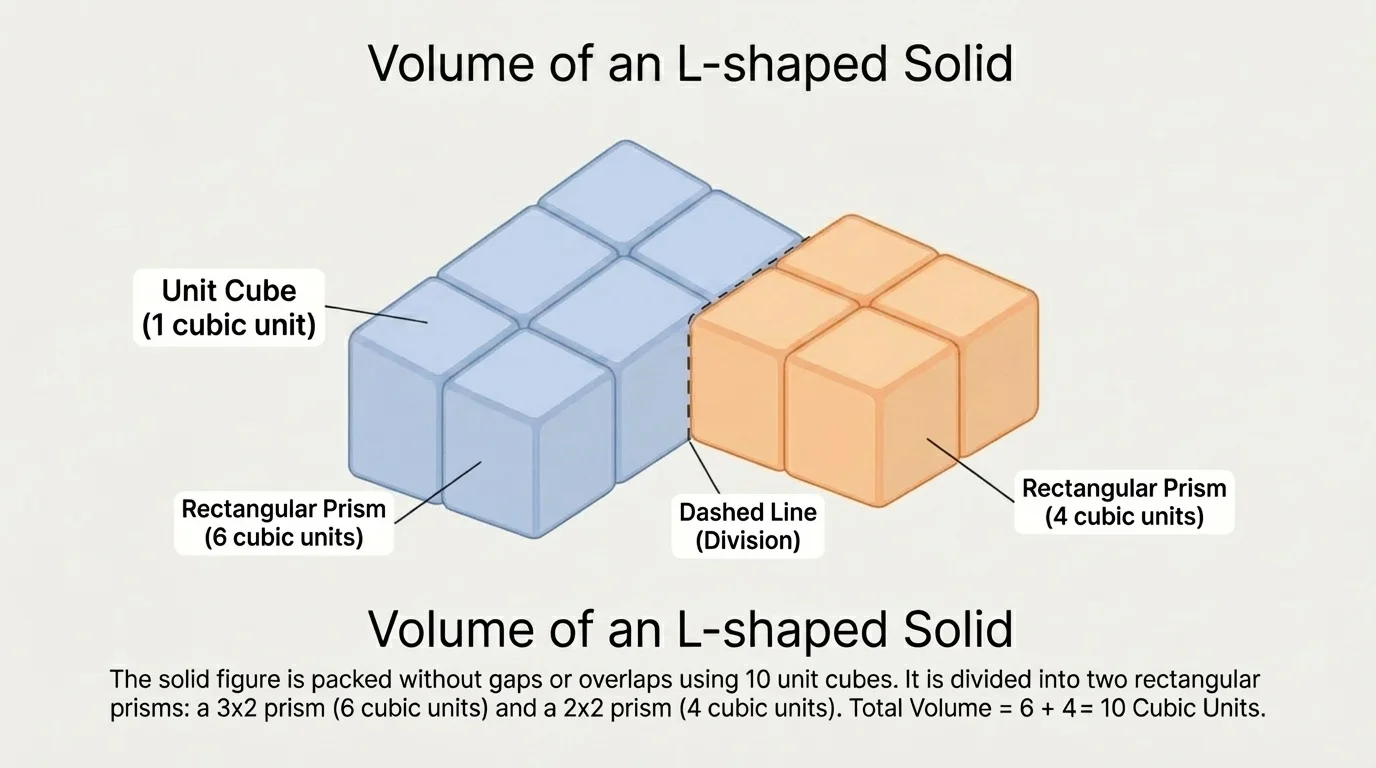
This works because the total space inside the solid is the sum of the spaces inside the parts. As long as the parts do not overlap, adding their volumes gives the whole volume.
Volume connects to addition and multiplication. Multiplication helps when cubes are arranged in equal rows and layers. Addition helps when a solid is made of smaller parts. Both methods are really counting unit cubes in organized ways.
Later, when students study more complex solids, this idea of breaking shapes into parts remains very important. The same thinking starts here with unit cubes.
Volume is not just a classroom idea. It helps in everyday life. A moving box needs enough space for books. A toy chest needs enough room for blocks. A refrigerator shelf must fit containers of different sizes.
Suppose a storage crate can hold \(20\) unit-sized packages with no gaps. Then the crate has a volume of \(20\) cubic units in that unit system. If each package is the same size, the number of packages that fit tells how much space is inside.
Workers who ship products think about volume when packing trucks. Builders think about volume when planning concrete or filling large containers. Even a stack of cubes in a game or puzzle uses the same idea of equal layers to make counting faster and more accurate.
Some huge warehouses use robots to place boxes in neat rows so space is not wasted. The better the packing, the more of the storage space is used.
When people choose a lunchbox, aquarium, or storage bin, they are really asking, "How much space is inside?" That is a volume question.
One common mistake is confusing square units with cubic units. Area is measured in square units because it covers a flat surface. Volume is measured in cubic units because it fills space.
Another mistake is counting cubes that leave empty spaces between them. Remember the definition: the figure must be packed without gaps or overlaps. If there are gaps, the cubes do not fill all the space. If there are overlaps, some space is counted more than once.
A third mistake is forgetting that rearranging the same cubes does not change the total volume. If you take \(10\) unit cubes and build a tall tower, the volume is \(10\) cubic units. If you use the same \(10\) cubes to build a short wall, the volume is still \(10\) cubic units. The shape changes, but the number of cubes does not. That is the same idea shown earlier with tightly packed cubes in [Figure 1].
| Measurement | What It Measures | Units |
|---|---|---|
| Length | Distance in one dimension | units |
| Area | Space on a flat surface | square units |
| Volume | Space inside a solid figure | cubic units |
Table 2. Comparison of length, area, and volume.
Keep asking yourself: "Am I measuring a line, a flat surface, or a solid space?" That question helps you choose the correct kind of unit.
The heart of this topic is simple and powerful: if a solid figure can be packed with exactly \(n\) unit cubes, and those cubes fit with no gaps or overlaps, then the figure has volume \(n\) cubic units.
From that single idea, we can count cubes one by one, organize them into layers, multiply dimensions for rectangular prisms, or add volumes of smaller parts. All of these methods are different ways of counting the cubes that fill the space.
Volume is really a story about space and structure. The more clearly we see how cubes fill a solid, the better we understand why the number of cubes tells the volume.
