Two school clubs meet on different schedules. One meets every \(4\) days, and the other meets every \(6\) days. When will they meet on the same day again? Or suppose you have \(36\) stickers and \(8\) stamps, and you want to sort both into equal-sized groups with no leftovers. Questions like these are really number puzzles, and they lead to three powerful ideas: factors, greatest common factors, and least common multiples.
These ideas are not just about arithmetic rules. They help you organize objects, compare number patterns, and rewrite expressions in smarter ways. They also help you notice structure inside numbers. Once you see that structure, many problems become easier.
When two numbers share factors, they have something in common in the way they can be split into equal groups. When two numbers share multiples, they line up again in a repeating pattern. And when a sum has a common factor, the distributive property lets you rewrite it in a cleaner form.
In Grade \(6\) mathematics, an important goal is to work fluently with numbers and to understand how numbers are connected. Finding a greatest common factor helps with grouping. Finding a least common multiple helps with repeated events. Using the distributive property helps you express a sum as a product.
A whole number is \(0, 1, 2, 3, ...\). A number is a factor of another number if it divides that number with no remainder. A number is a multiple of another number if it can be made by multiplying that number by a whole number.
If \(3\) divides \(12\), then \(3\) is a factor of \(12\). If \(12 = 3 \times 4\), then \(12\) is a multiple of \(3\) and also a multiple of \(4\). These two ideas are connected, but they are not the same.
A factor is a whole number that divides another whole number exactly. For example, the factors of \(12\) are \(1, 2, 3, 4, 6, 12\). Each one divides \(12\) with no remainder.
A multiple is the result of multiplying a number by a whole number. The multiples of \(5\) include \(0, 5, 10, 15, 20, 25, ...\). They go on forever because you can keep multiplying by larger whole numbers.
One useful difference is this: a number has only a limited number of factors, but it has infinitely many multiples. For example, \(10\) has factors \(1, 2, 5, 10\), but its multiples continue forever: \(10, 20, 30, 40, ...\).
Common factors are factors shared by two or more numbers. The greatest common factor is the largest factor they share.
Common multiples are multiples shared by two or more numbers. The least common multiple is the smallest positive multiple they share.
You can often begin by listing factors or multiples. This is a good method when the numbers are not too large, especially for numbers less than or equal to \(100\).
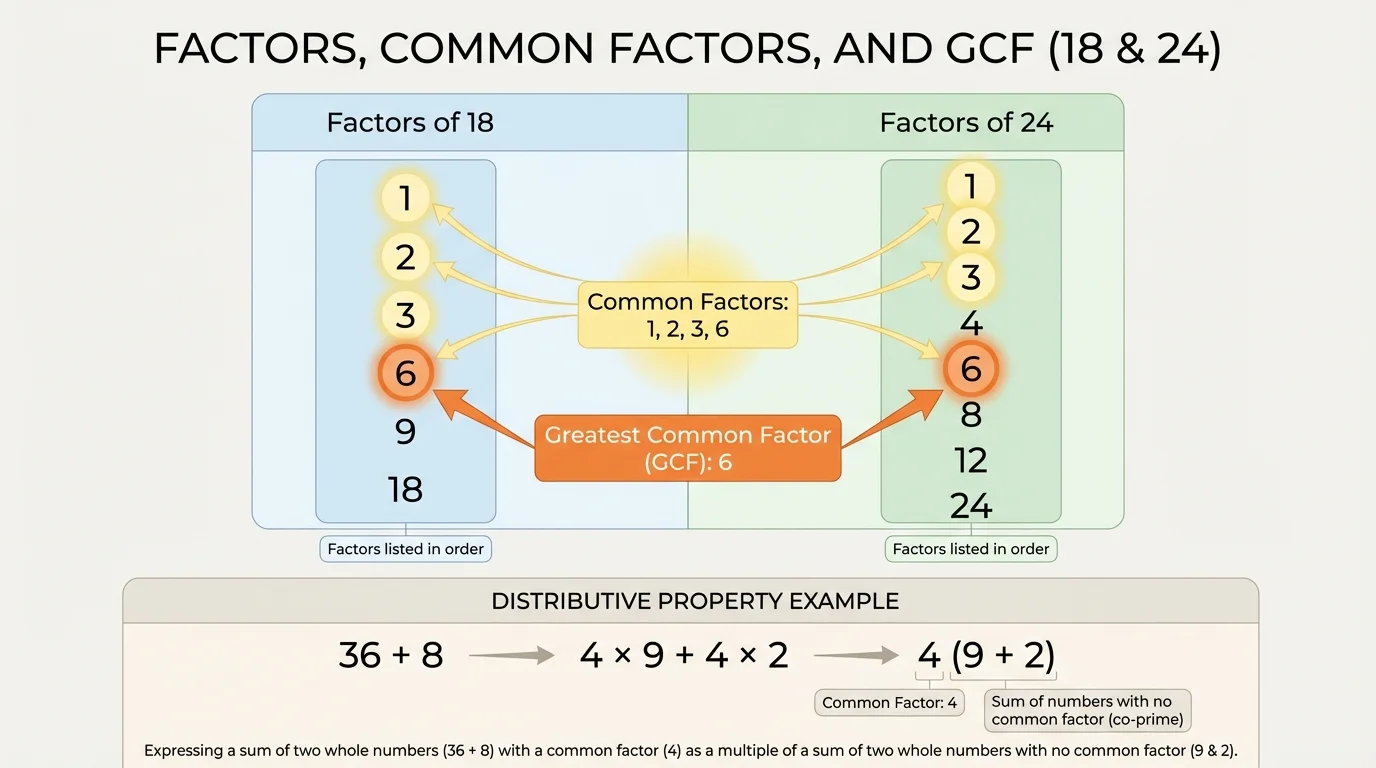
[Figure 1] shows how to find the greatest common factor by first listing the factors of each number and then looking for the numbers that appear in both lists. The overlap of the two factor lists reveals the common factors, and the greatest one is the answer.
For example, consider \(18\) and \(24\). The factors of \(18\) are \(1, 2, 3, 6, 9, 18\). The factors of \(24\) are \(1, 2, 3, 4, 6, 8, 12, 24\). The common factors are \(1, 2, 3, 6\), so the greatest common factor is \(6\).
Another useful strategy is to use factor pairs. For \(24\), the factor pairs are \(1 \times 24\), \(2 \times 12\), \(3 \times 8\), and \(4 \times 6\). Listing factor pairs helps you avoid missing factors.
Every pair of whole numbers has at least one common factor: \(1\). If the greatest common factor is \(1\), the numbers are called relatively prime. For example, \(8\) and \(15\) have no common factors other than \(1\), so their greatest common factor is \(1\).
Two numbers can be relatively prime even if neither number is prime. For example, \(8\) and \(9\) are both composite, but their greatest common factor is \(1\).
Knowing the greatest common factor is very helpful when you want to make the largest equal groups, simplify arrangements, or factor a sum using the distributive property.
Sometimes listing all factors is easy, and sometimes a more organized method is better. A prime factorization writes a number as a product of prime numbers. A prime number has exactly two factors: \(1\) and itself.
For example, \(24\) can be written as \(2 \times 2 \times 2 \times 3\), or \(2^3 \times 3\). The number \(18\) can be written as \(2 \times 3 \times 3\), or \(2 \times 3^2\).
To find the greatest common factor using prime factorization, identify the prime factors the numbers share. Then multiply the shared primes using the smallest power that appears in both factorizations. For \(18 = 2 \times 3^2\) and \(24 = 2^3 \times 3\), the shared primes are one \(2\) and one \(3\). So the greatest common factor is \(2 \times 3 = 6\).
Why the prime factor method works
A common factor must be built from primes that both numbers contain. If one number has three \(2\)s and the other has only one \(2\), then a common factor can use only one \(2\). That is why we choose the smaller exponent for each shared prime.
For numbers less than or equal to \(100\), both listing factors and prime factorization are useful methods. It is smart to choose the one that fits the numbers best.
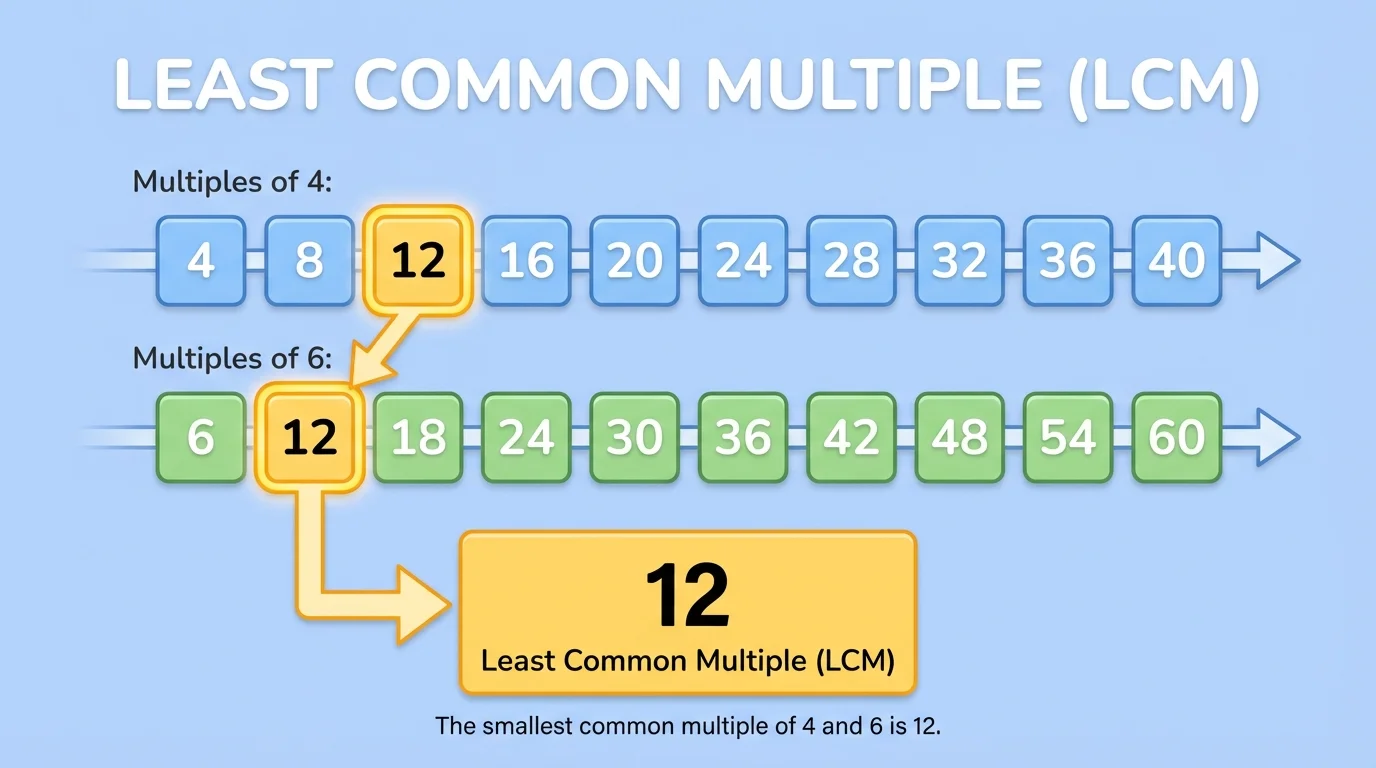
[Figure 2] shows that the least common multiple is the smallest positive number that is a multiple of both numbers. One way to find it is to list multiples of each number until the first shared multiple appears.
For example, for \(4\) and \(6\), list multiples of \(4\): \(4, 8, 12, 16, 20, ...\). List multiples of \(6\): \(6, 12, 18, 24, ...\). The first common multiple is \(12\), so the least common multiple is \(12\).
You can also use prime factorization to find the least common multiple. This time, use every prime factor needed to build both numbers, taking the greatest power of each prime that appears. For \(4 = 2^2\) and \(6 = 2 \times 3\), take \(2^2\) and \(3\). Then \(2^2 \times 3 = 12\), so the least common multiple is \(12\).
Notice the difference from finding the greatest common factor. For GCF, you use only the shared prime factors with the smaller exponents. For LCM, you use all primes needed, with the larger exponents.
Because this standard focuses on whole numbers up to \(12\) for least common multiple, many LCM problems can be solved quickly by listing multiples. Still, the prime factor method builds stronger number sense.
[Figure 3] illustrates how the distributive property works with equal groups. The distributive property says that multiplying a number by a sum gives the same result as multiplying the number by each addend. In symbols, \(a(b + c) = ab + ac\). We can also use this idea backward. If two addends have a common factor, we can factor out that common factor.
To rewrite a sum this way, find the greatest common factor of the two numbers. Then divide each addend by that factor and place the results inside parentheses.
For example, in \(36 + 8\), the greatest common factor of \(36\) and \(8\) is \(4\). Since \(36 = 4 \times 9\) and \(8 = 4 \times 2\), we can write
\[36 + 8 = 4(9 + 2)\]
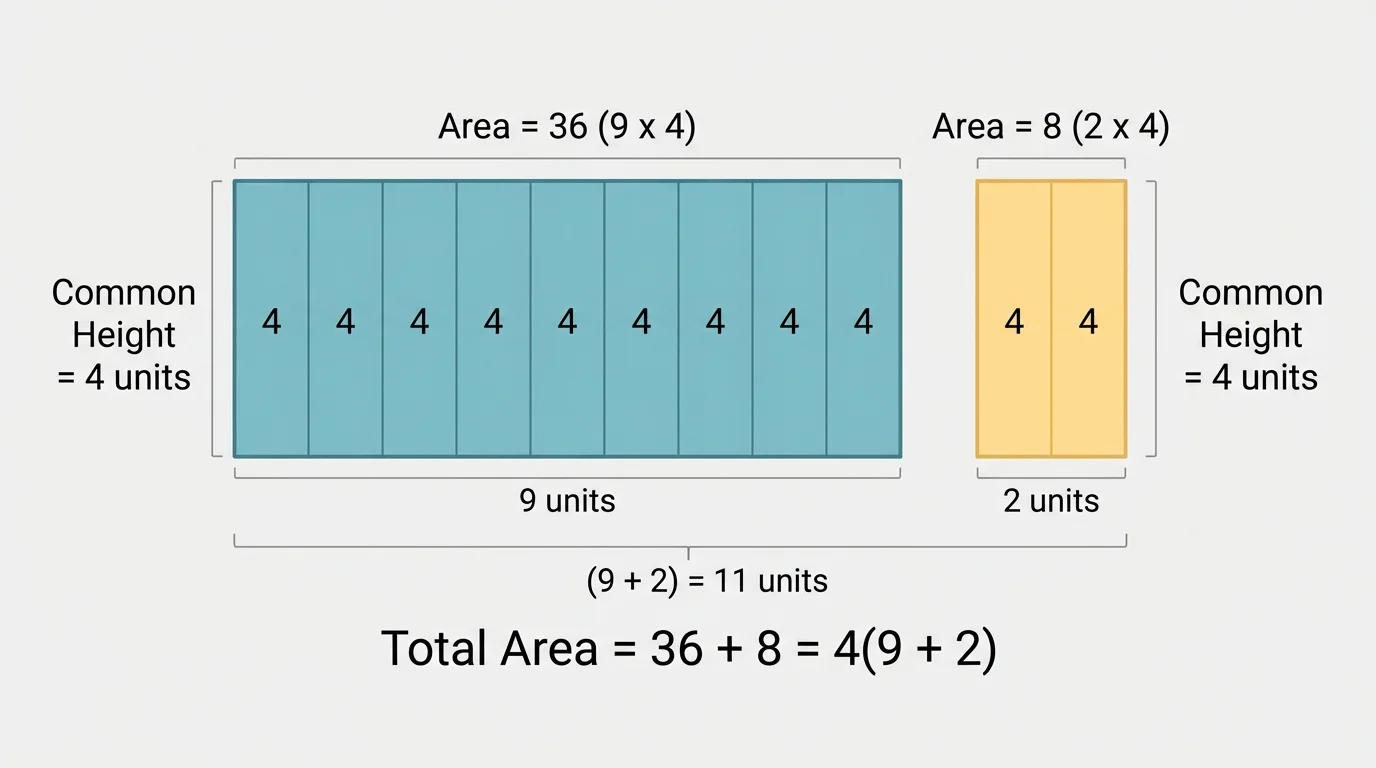
This form is useful because it shows the shared structure in the sum. Instead of seeing two separate numbers, you now see one common factor and a simpler sum inside parentheses.
Later in algebra, students use this idea often. But it begins with ordinary whole numbers. Factoring out the GCF is really using number sense and the distributive property together.
Let's work through several examples carefully.
Worked example 1: Find the greatest common factor of \(20\) and \(30\)
Step 1: List the factors of each number.
Factors of \(20\): \(1, 2, 4, 5, 10, 20\)
Factors of \(30\): \(1, 2, 3, 5, 6, 10, 15, 30\)
Step 2: Identify the common factors.
The common factors are \(1, 2, 5, 10\).
Step 3: Choose the greatest common factor.
The greatest common factor is \(10\).
So, \[\operatorname{GCF}(20, 30) = 10\]
This means \(20\) and \(30\) can both be divided into groups of \(10\) with no leftovers.
Worked example 2: Find the least common multiple of \(3\) and \(8\)
Step 1: List multiples of each number.
Multiples of \(3\): \(3, 6, 9, 12, 15, 18, 21, 24, ...\)
Multiples of \(8\): \(8, 16, 24, 32, ...\)
Step 2: Find the first common multiple.
The first number in both lists is \(24\).
Step 3: State the answer.
The least common multiple is \(24\).
So, \[\operatorname{LCM}(3, 8) = 24\]
As we saw earlier with the aligned multiple lists in [Figure 2], the least common multiple is always the first shared multiple, not just any shared multiple.
Worked example 3: Rewrite \(36 + 8\) using the distributive property
Step 1: Find the greatest common factor of \(36\) and \(8\).
Factors of \(36\): \(1, 2, 3, 4, 6, 9, 12, 18, 36\)
Factors of \(8\): \(1, 2, 4, 8\)
The greatest common factor is \(4\).
Step 2: Rewrite each addend as a multiple of \(4\).
\(36 = 4 \times 9\) and \(8 = 4 \times 2\)
Step 3: Factor out the common factor.
\(36 + 8 = 4 \times 9 + 4 \times 2 = 4(9 + 2)\)
So, \[36 + 8 = 4(9 + 2)\]
The grouping model helps show why this works: both parts are built from equal groups of \(4\).
Worked example 4: Rewrite \(27 + 45\) using the distributive property
Step 1: Find the greatest common factor.
Factors of \(27\): \(1, 3, 9, 27\)
Factors of \(45\): \(1, 3, 5, 9, 15, 45\)
The greatest common factor is \(9\).
Step 2: Divide each addend by \(9\).
\(27 \div 9 = 3\) and \(45 \div 9 = 5\)
Step 3: Write the expression in factored form.
\(27 + 45 = 9(3 + 5)\)
So, \[27 + 45 = 9(3 + 5)\]
You can check by distributing: \(9(3 + 5) = 9 \times 3 + 9 \times 5 = 27 + 45\). The expression is unchanged; it is simply written in a different form.
Greatest common factor and least common multiple appear in everyday situations more often than you might expect.
Suppose a teacher has \(24\) pencils and \(36\) erasers and wants to make identical supply packs with no leftovers. The greatest common factor of \(24\) and \(36\) is \(12\). So the teacher can make \(12\) equal packs. Each pack gets \(2\) pencils and \(3\) erasers.
Suppose two traffic lights change in repeating patterns, one every \(4\) seconds and one every \(6\) seconds. They will change together every \(12\) seconds because \(12\) is the least common multiple of \(4\) and \(6\). This is the same pattern we saw in [Figure 2], where repeating lists meet at the first shared multiple.
Musicians also think about repeated patterns. If one beat pattern repeats every \(3\) counts and another repeats every \(4\) counts, both patterns line up again after \(12\) counts. That is an LCM idea.
Arrays and area models connect to the distributive property. If a mural has sections of \(36\) tiles and \(8\) tiles, and both sections can be grouped into rows of \(4\), then the total can be written as \(4(9 + 2)\). The picture of equal groups in [Figure 3] is the same structure, just shown visually.
One common mistake is mixing up factors and multiples. Remember: factors divide a number, while multiples are made by multiplying. Factors are smaller than or equal to the number. Multiples are usually larger than or equal to the number.
Another common mistake is stopping too soon when listing multiples. For example, if you compare \(4\) and \(6\), you must keep listing until you find the first number that appears in both lists.
Students also sometimes choose a common factor instead of the greatest common factor. For \(18\) and \(24\), \(3\) is a common factor, but it is not the greatest one. The greatest common factor is \(6\), which is clear from the overlap chart in [Figure 1].
When using the distributive property backward, make sure the factor you pull out divides both addends. For instance, in \(14 + 21\), you can factor out \(7\) because \(14 = 7 \times 2\) and \(21 = 7 \times 3\). That gives \(7(2 + 3)\).
"Good number sense means seeing structure, not just doing steps."
That idea fits this topic perfectly. GCF, LCM, and factoring sums are all about seeing hidden structure in numbers.
When you look for common factors, you are asking, "How can these numbers be split in the same way?" When you look for common multiples, you are asking, "When do these number patterns meet again?" When you factor a sum, you are asking, "What do these addends have in common?"
These questions help numbers make sense. They also prepare you for algebra, where expressions are often rewritten to show structure. Even with simple whole numbers, the habit of looking for structure is powerful.
By learning to find greatest common factors, least common multiples, and common factors in sums, you build skills that connect arithmetic, patterns, and algebraic thinking.
