When weather apps say there is a chance of rain, or a sports analyst talks about a team making the playoffs and winning the division, they are describing events inside a larger set of possibilities. Probability becomes much clearer when you can name exactly which outcomes belong to an event. That idea is the foundation of this topic: an event is not just a sentence in words, but a set of outcomes selected from all possible outcomes.
In probability, a single result of an experiment is called an outcome. The complete set of all possible outcomes is the sample space. An event is any subset of the sample space.
Outcome means one possible result of a chance process.
Sample space means the set of all possible outcomes, often written as \(S\).
Event means any collection of outcomes from the sample space.
If you roll one standard die, the sample space is \(S = \{1,2,3,4,5,6\}\). Each number is an outcome. An event might be "rolling an even number," which is the subset \(\{2,4,6\}\). Another event might be "rolling a number greater than 4," which is \(\{5,6\}\).
This set-based view matters because probability rules are really rules about subsets. Once you know which outcomes belong to an event, you can reason carefully about overlap, combinations, and probabilities.
Often, you do not list outcomes one by one at first. Instead, you describe an event by a characteristic shared by its outcomes. For example, if a card is drawn from a standard deck, the event "draw a heart" includes all cards whose suit is hearts. If a student survey records grade level, club membership, and sports participation, the event "students in grade \(11\)" includes all outcomes with that category.
These characteristic-based descriptions are especially useful when the sample space is large. For a deck of \(52\) cards, writing every heart individually is possible, but saying "all cards in the hearts suit" is faster and clearer. For data sets, categories often define events naturally: "students who play soccer," "patients under age \(18\)," or "days with temperature above \(30^\circ\)."
Events as subsets by category
An event can be described by any property that separates some outcomes from others. The key question is always: which outcomes satisfy this condition? If they do, they belong to the event; if they do not, they stay outside it.
Suppose a school survey records whether a student is in band, athletics, both, or neither. Then the event "student is in band" is the set of all survey outcomes labeled band. The event "student is in athletics" is another subset. These subsets may overlap if some students are in both groups.
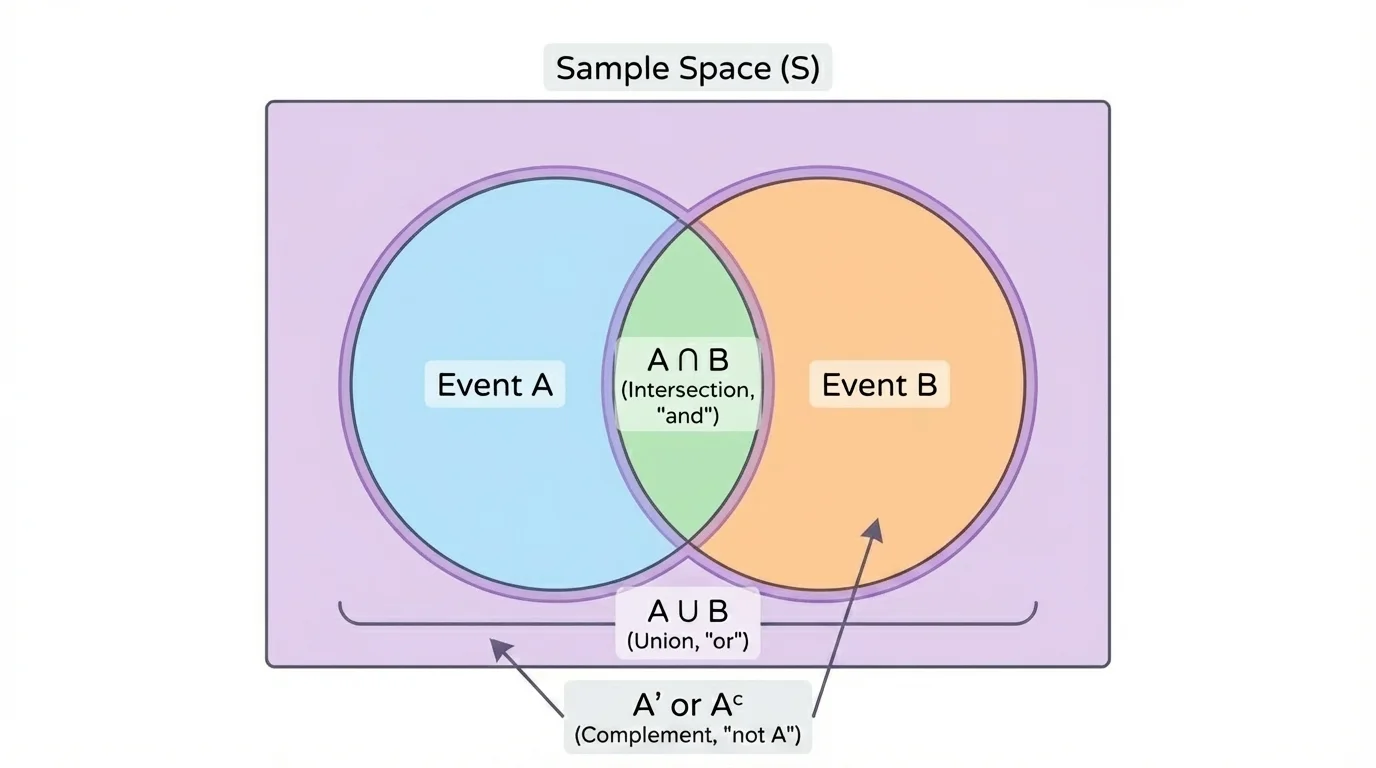
Set diagrams help visualize how events combine, as [Figure 1] shows. In probability language, the words or, and, and not correspond to special operations on sets.
The union of events \(A\) and \(B\), written \(A \cup B\), means outcomes in \(A\) or in \(B\) or in both. The word "or" in probability is usually inclusive, not exclusive. So if an outcome belongs to both events, it still belongs to \(A \cup B\).
The intersection of \(A\) and \(B\), written \(A \cap B\), means outcomes in both \(A\) and \(B\). This matches the word "and."
The complement of an event \(A\), written \(A^c\), means all outcomes in the sample space that are not in \(A\). This matches the word "not."
If \(S = \{1,2,3,4,5,6\}\), let \(A = \{2,4,6\}\) and \(B = \{4,5,6\}\). Then:
\(A \cup B = \{2,4,5,6\}\), because those outcomes are in \(A\) or \(B\).
\(A \cap B = \{4,6\}\), because those outcomes are in both events.
\(A^c = \{1,3,5\}\), because those outcomes are not in \(A\).
A common mistake is to think "or" means one event happens but not the other. In probability, "or" includes overlap unless the problem clearly says otherwise.
It is important to translate smoothly between words and symbols. If event \(A\) is "the selected student is a senior" and event \(B\) is "the selected student is in theater," then:
Sometimes event descriptions combine more than one operation. For example, \((A \cup B)^c\) means "not in \(A\) or \(B\)," so it includes outcomes in neither event. Also, \(A \cap B^c\) means "in \(A\) and not in \(B\)."
Being able to read these expressions accurately is essential in later topics such as conditional probability, independence, and probability rules.
Small sample spaces are useful because you can see exactly how events are built from outcomes. The grouped die outcomes are easy to compare visually, as [Figure 2] illustrates.
Worked example
A fair die is rolled once. Let \(S = \{1,2,3,4,5,6\}\). Define:
\(A\): rolling an even number
\(B\): rolling a prime number
\(C\): rolling a number greater than \(3\)
Describe each event and find \(A \cup B\), \(A \cap C\), and \(B^c\).
Step 1: List each event as a subset of \(S\).
Even numbers are \(2,4,6\), so \(A = \{2,4,6\}\).
Prime numbers on a die are \(2,3,5\), so \(B = \{2,3,5\}\).
Numbers greater than \(3\) are \(4,5,6\), so \(C = \{4,5,6\}\).
Step 2: Find the union \(A \cup B\).
Combine all outcomes in \(A\) or \(B\): \(\{2,4,6\} \cup \{2,3,5\} = \{2,3,4,5,6\}\).
Step 3: Find the intersection \(A \cap C\).
Look for outcomes in both sets: \(\{2,4,6\} \cap \{4,5,6\} = \{4,6\}\).
Step 4: Find the complement \(B^c\).
Take all outcomes in \(S\) that are not in \(B\): \(\{1,2,3,4,5,6\} \setminus \{2,3,5\} = \{1,4,6\}\).
The completed results are \(A \cup B = \{2,3,4,5,6\}\), \(A \cap C = \{4,6\}\), and \(B^c = \{1,4,6\}\).
This example shows that one outcome can belong to multiple events. For instance, \(2\) is both even and prime, so it belongs to both \(A\) and \(B\).
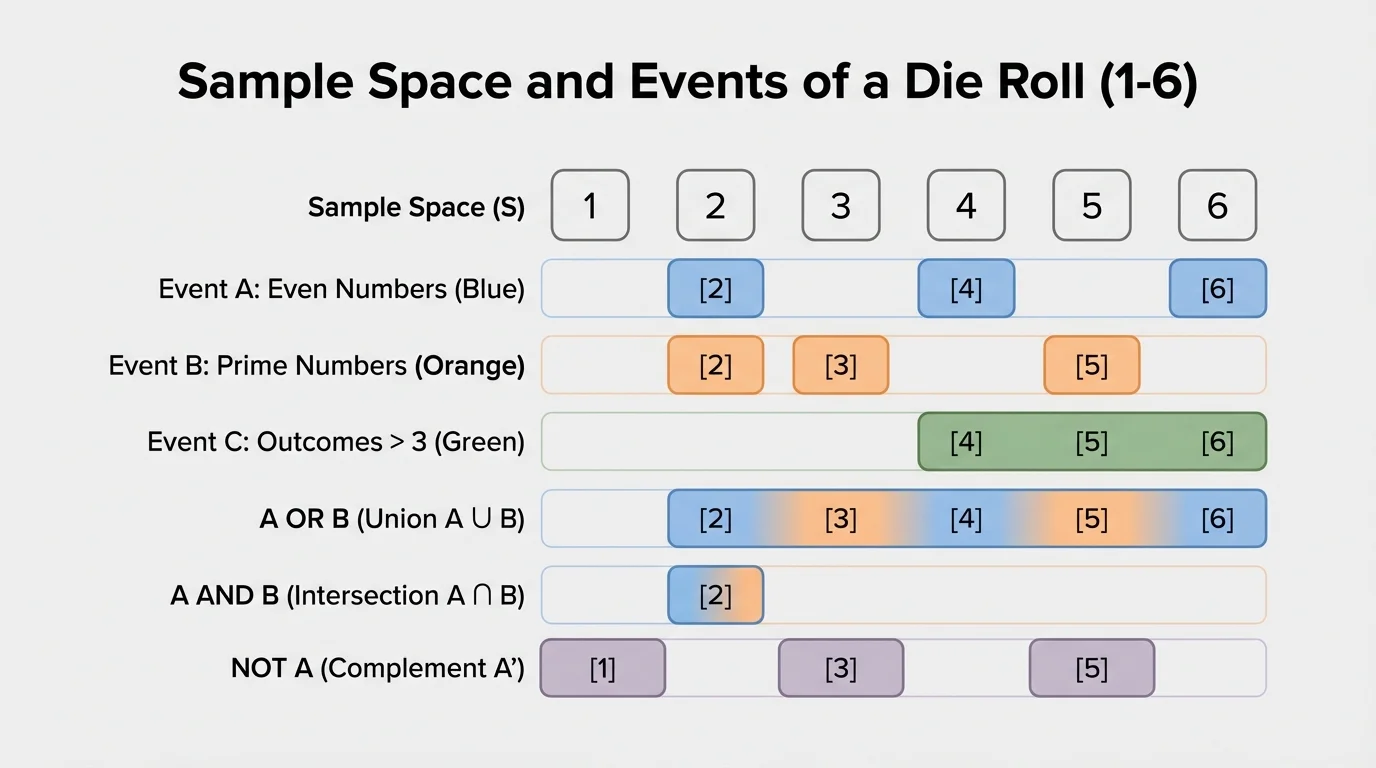
That overlap becomes important later when calculating probabilities, because outcomes in the intersection should not be counted twice.
[Figure 3] Card problems are excellent for event descriptions because cards can be grouped in several different ways at once. The overlap between categories is especially clear where color and face-card status intersect.
Worked example
One card is drawn from a standard \(52\)-card deck. Let:
\(R\): drawing a red card
\(F\): drawing a face card
\(H\): drawing a heart
Describe \(R \cap F\), \(R \cup H\), and \(F^c\).
Step 1: Identify each basic event.
\(R\) includes all hearts and diamonds, so it contains \(26\) cards.
\(F\) includes jacks, queens, and kings of all suits, so it contains \(12\) cards.
\(H\) includes all \(13\) hearts.
Step 2: Interpret \(R \cap F\).
This means red and face card. So the event is the set of red face cards: jack, queen, and king of hearts, and jack, queen, and king of diamonds. There are \(6\) such cards.
Step 3: Interpret \(R \cup H\).
This means red or heart or both. Since every heart is already red, \(H\) is a subset of \(R\). Therefore, \(R \cup H = R\).
Step 4: Interpret \(F^c\).
This means not a face card. Since there are \(12\) face cards in the deck, \(F^c\) contains the other \(52 - 12 = 40\) cards.
So \(R \cap F\) is the event "red face card," \(R \cup H\) is just the event "red card," and \(F^c\) is the event "not a face card."
This example also shows a subset relationship: every heart is red, so \(H \subseteq R\). When one event is contained inside another, their union is the larger event.
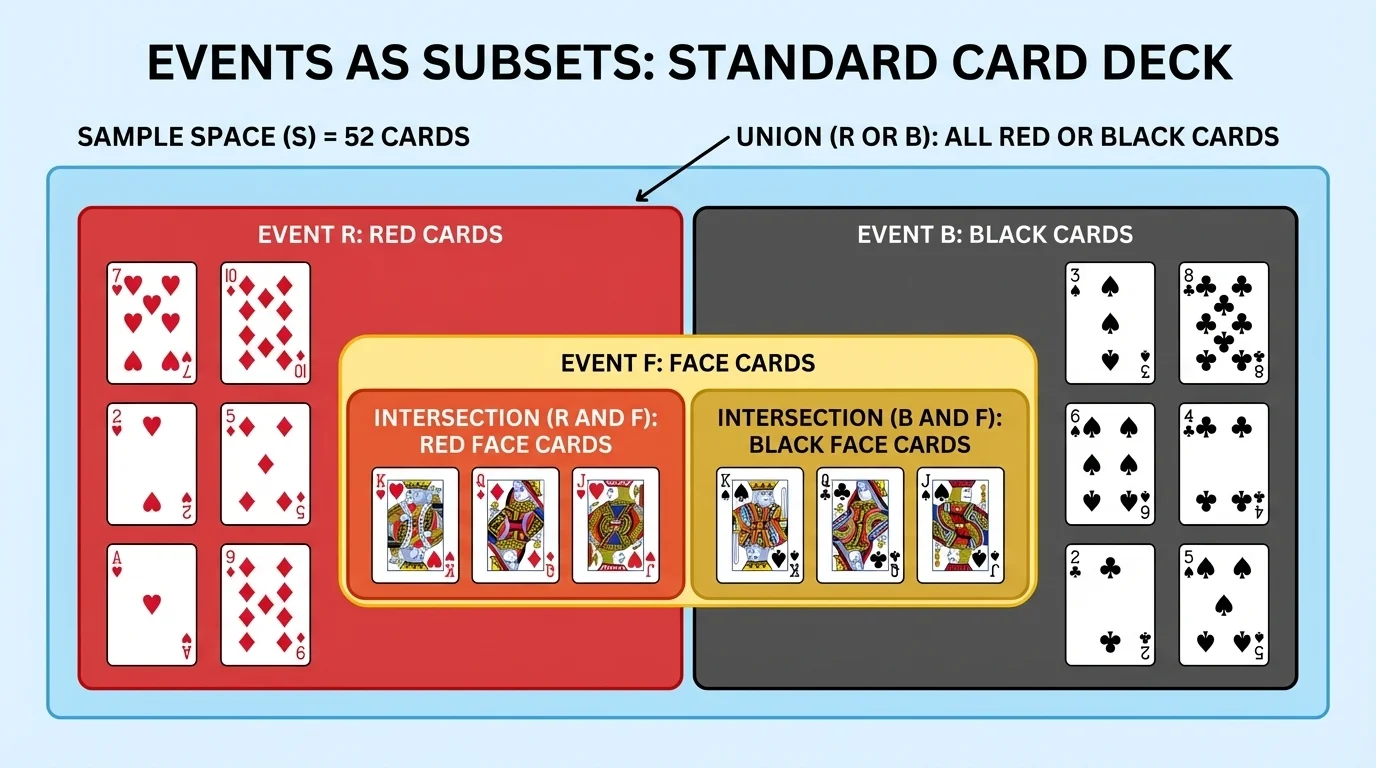
Later, when working with probabilities, the subset idea explains why \(P(R \cup H) = P(R)\): adding hearts adds nothing new beyond the red cards already included.
Probability is not only about coins, dice, and cards. It is also about interpreting data. In surveys or data tables, each recorded case is an outcome, and events are built from categories such as grade level, club membership, or course enrollment.
Worked example
A survey of students records whether each student participates in robotics and whether each student plays a sport. Let:
\(A\): the selected student is in robotics
\(B\): the selected student plays a sport
Suppose the survey results are:
Describe the events \(A\), \(B\), \(A \cap B\), \(A \cup B\), and \(B^c\).
Step 1: Identify the categories.
Students in robotics are the robotics-only group plus the both group, so event \(A\) contains \(12 + 18 = 30\) students.
Students who play a sport are the sport-only group plus the both group, so event \(B\) contains \(25 + 18 = 43\) students.
Step 2: Describe the intersection.
\(A \cap B\) means students in robotics and a sport. That is exactly the both group, which has \(18\) students.
Step 3: Describe the union.
\(A \cup B\) means students in robotics or a sport or both. That includes robotics only, sport only, and both: \(12 + 25 + 18 = 55\) students.
Step 4: Describe the complement.
\(B^c\) means students not in a sport. That includes robotics only and neither: \(12 + 15 = 27\) students.
The events are built directly from data categories, which is exactly how probability helps interpret real-world information.
In data analysis, this kind of event description is crucial before talking about conditional probability. For example, if you later ask for the probability that a student is in robotics given that the student plays a sport, you must first know which outcomes belong to each event.
[Figure 4] Some event pairs overlap, some do not, and some are contained inside others. These relationships become clearer when you compare overlapping, nested, and non-overlapping events.
Two events are mutually exclusive if they have no outcomes in common. In symbols, \(A \cap B = \varnothing\), where \(\varnothing\) is the empty set. For example, on one die roll, the event "roll an even number" and the event "roll an odd number" are mutually exclusive.
By contrast, "roll an even number" and "roll a number greater than \(3\)" are not mutually exclusive, because \(4\) and \(6\) belong to both events.
If every outcome in event \(A\) is also in event \(B\), then \(A\) is a subset of \(B\), written \(A \subseteq B\). The hearts-and-red-cards example showed this idea: \(H \subseteq R\).
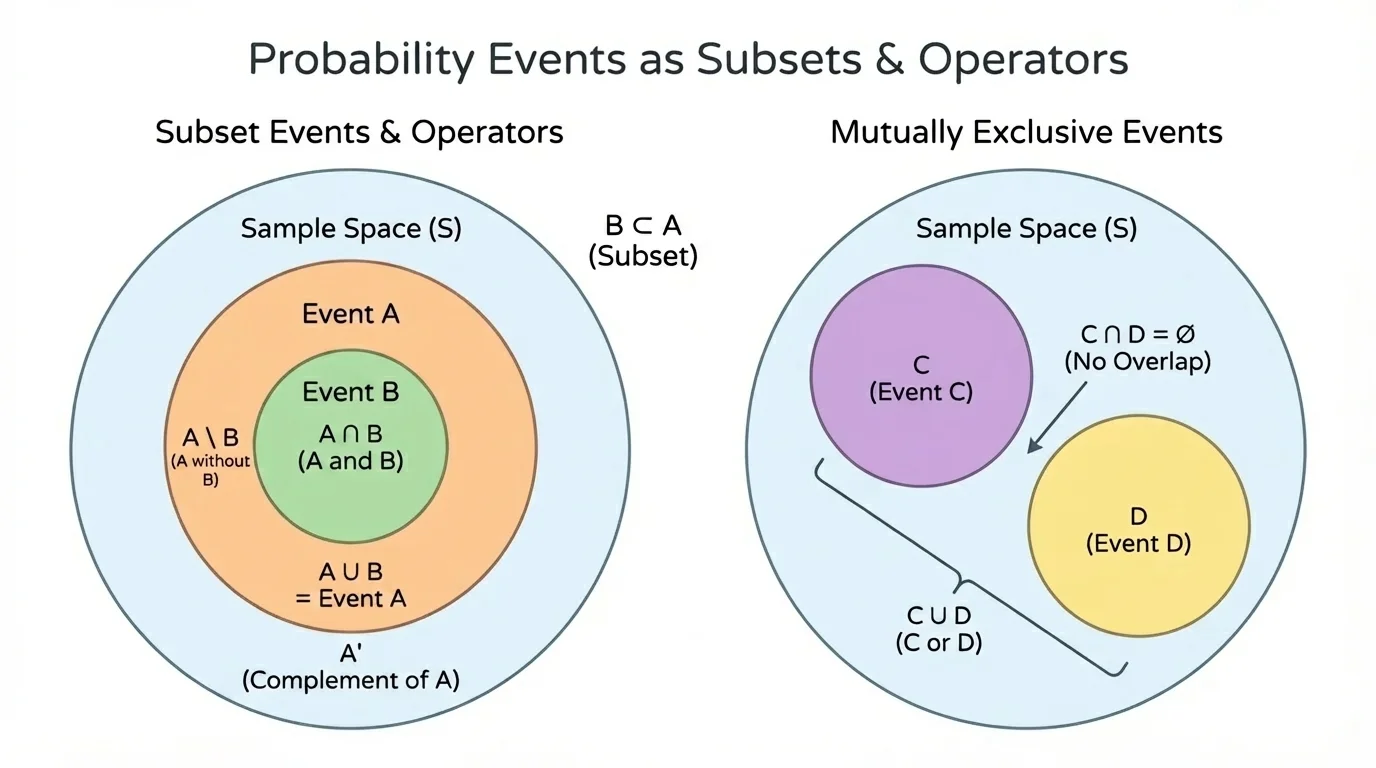
These relationships matter because they affect how events combine. If events are mutually exclusive, their union contains no overlap. If one event is a subset of another, then the smaller one adds no new outcomes to the union.
Returning to [Figure 1], the shaded overlap region is exactly the part you must pay attention to whenever events are not mutually exclusive.
Airline overbooking, medical screening, and online recommendation systems all depend on careful event definitions. Analysts must decide exactly which outcomes count as "success," "risk," or "match" before any useful probability model can be built.
A subtle but important point is that mutually exclusive does not mean independent. If two events cannot happen together, then knowing one occurred completely changes whether the other can occur. That idea belongs more fully to conditional probability, but it starts with accurate event descriptions.
Once an event is clearly defined as a subset of the sample space, probability measures how large that subset is compared with the whole sample space.
For equally likely outcomes, the probability of an event \(A\) is:
\[P(A) = \frac{n(A)}{n(S)}\]
If a die is rolled and \(A = \{2,4,6\}\), then \(P(A) = \dfrac{3}{6} = \dfrac{1}{2}\).
If \(B = \{2,3,5\}\), then \(P(B) = \dfrac{3}{6} = \dfrac{1}{2}\), and \(P(A \cap B) = \dfrac{1}{6}\) because only the outcome \(2\) is both even and prime.
This is why event descriptions come first. You cannot find probabilities for "or," "and," or "not" unless you know exactly which outcomes belong to the union, intersection, or complement.
In medicine, an event might be "patient tests positive," "patient has the disease," or "patient tests positive and has the disease." In weather forecasting, events might be "temperature below freezing," "rain occurs," or "not windy." In sports analytics, events include "team wins at home," "player scores at least \(20\) points," or "team wins and player scores at least \(20\) points."
These event descriptions allow analysts to compare categories in meaningful ways. For example, a public health researcher may study the event "vaccinated and infected" versus "vaccinated and not infected." A school administrator may compare "students taking calculus" and "students in science club." A business may classify purchases by events such as "bought online," "used a coupon," and "bought online and used a coupon."
In each case, the event is a subset chosen by characteristics of outcomes. The language may sound different across fields, but the structure is the same: define the sample space, define the event, and then study how events overlap or combine.
Set notation from earlier math courses is extremely useful here. A sample space is a set, and events are subsets. The ideas of union, intersection, complement, and subset are the same set operations you have already seen, now applied to chance processes and data.
Precise event descriptions also support clear communication. If someone says "the probability of athletes" or "the chance of red or face cards," that wording is incomplete until the sample space is understood. Are we choosing from one classroom, one school, one deck, or all survey respondents? Probability always depends on the set of possible outcomes being considered.
That is why the best habit in probability is to identify the sample space first, then define events carefully, and only then perform calculations or interpretations.
