A doctor studies a scan of the human body one thin slice at a time. An architect checks cutaway drawings of a building. A package designer thinks about flat faces and cross sections when creating boxes. All of these use the same geometric idea: a flat cut through a solid can reveal a completely different shape than you might expect. A three-dimensional object can hide many two-dimensional figures inside it.
When we cut a loaf of bread, each slice is a flat shape. When a carpenter cuts through a wooden block, the cut surface is flat too. Geometry describes these flat results as plane sections. Understanding these sections helps us connect the world of solids, like boxes and pyramids, to the world of flat figures, like rectangles, squares, and triangles.
This topic is about describing the two-dimensional figures that result from slicing three-dimensional figures, especially right rectangular prisms and right rectangular pyramids. The main question is simple: if a flat plane cuts through a solid, what flat shape appears where the cut happens?
You already know many two-dimensional figures, such as squares, rectangles, and triangles. You also know some three-dimensional figures, such as prisms and pyramids. This lesson connects those ideas by showing how a flat shape can appear inside a solid when it is sliced.
As [Figure 1] suggests, a useful way to think about this is to imagine the solid staying still while an invisible sheet of paper moves through it. Wherever that sheet passes through the solid, the outline of the cut is a two-dimensional figure.
A plane section is the flat shape formed when a plane cuts through a solid figure. Another common name for this is a cross section. Even though the solid is three-dimensional, the section itself is two-dimensional because it lies in a flat plane.
A plane in geometry is a flat surface that extends in all directions. In real life, no sheet of paper goes on forever, but the idea helps us describe slicing precisely. The plane may cut straight across, up and down, or at a slant.
When identifying a plane section, we do not name the whole solid. We name the flat figure created by the cut. For example, if a plane cuts a prism and the cut surface has four right angles with opposite sides equal, the section is a rectangle.
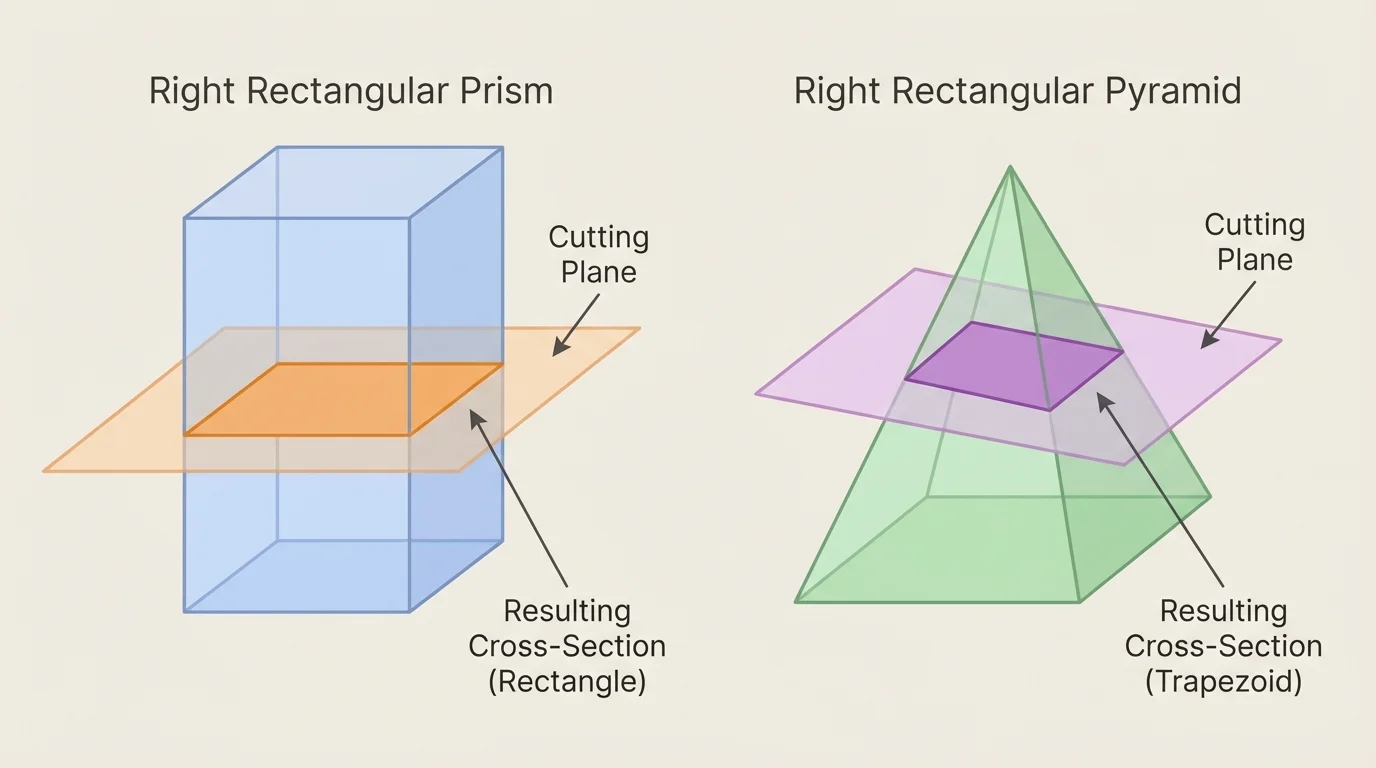
It is important to separate a face from a cross section. A face is part of the original outside surface of the solid. A cross section is created by slicing through the inside of the solid. Sometimes a cross section has the same shape as a face, but it is still formed by the cut, not by the original outer surface.
Cross section is the two-dimensional figure formed where a plane slices through a three-dimensional figure.
Right rectangular prism is a prism whose bases are rectangles and whose side edges are perpendicular to the bases.
Right rectangular pyramid is a pyramid with a rectangular base and an apex directly above the base so that the height meets the base at a right angle.
In many school problems, you are asked to describe the section without measuring exact side lengths. That means you focus on the type of figure: triangle, rectangle, square, and sometimes other polygons.
A right rectangular prism is shaped like a box. Because its faces are rectangles, many slices through it create rectangles too. But the exact result depends on the direction of the cut.
As [Figure 2] illustrates, if the plane is parallel to the base of the prism, the cross section has the same shape as the base. Since the base is a rectangle, the section is a rectangle. If the base happens to be a square, then that special rectangle is a square.
If the plane cuts straight down, perpendicular to the base, the section is often also a rectangle. For example, slicing a cereal box from top to bottom in a straight vertical cut gives a rectangular section.
A slanted cut through a right rectangular prism can still produce a rectangle. This surprises many students. Even though the cut is diagonal across the top face, the cut can meet the side faces in a way that forms four right angles in the section.
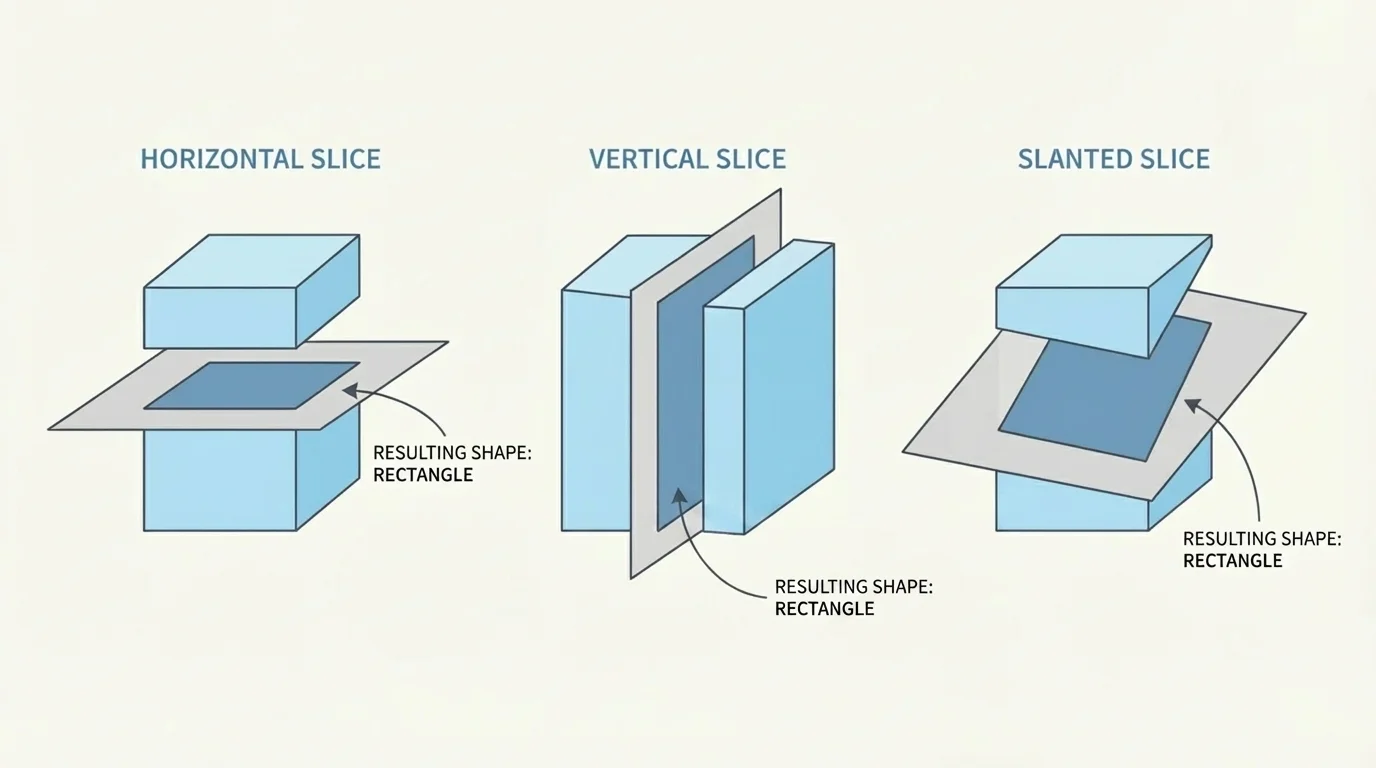
To decide what shape appears, ask: how many sides does the cut outline have, and what are their relationships? In the prism situations emphasized here, the most common answers are rectangles and squares. A square is really a special rectangle with all sides equal.
Suppose a right rectangular prism has dimensions of length \(8\), width \(5\), and height \(4\). A horizontal slice halfway up is parallel to the base, so the section is a rectangle with side lengths \(8\) and \(5\). If the base were \(6 \times 6\), that same kind of slice would give a square section.
Medical imaging machines often create pictures by combining many thin cross sections. Looking at one slice at a time helps doctors understand the shape of organs and bones inside the body.
Later, when you compare solids, remember the box-like structure of a prism. The straight edges and rectangular faces strongly influence the kinds of sections a prism can produce.
A right rectangular pyramid has one rectangular base and triangular faces that meet at one top point called the apex. The most important slices to study are those parallel to the base and those that pass through the apex.
As [Figure 3] shows, if the plane is parallel to the base, the section is similar in shape to the base. Since the base is a rectangle, the section is a smaller rectangle. If the base is actually a square, then the cross section is a smaller square.
If the plane passes through the apex and cuts down through the pyramid, the section is usually a triangle. This happens because the slice reaches the top point and two edges of the pyramid, creating three sides in the cut figure.
A slice through the apex can create different kinds of triangles depending on where the plane passes. Some may be isosceles triangles, and some may have different side lengths, but they are still triangles because the cut outline has three sides.
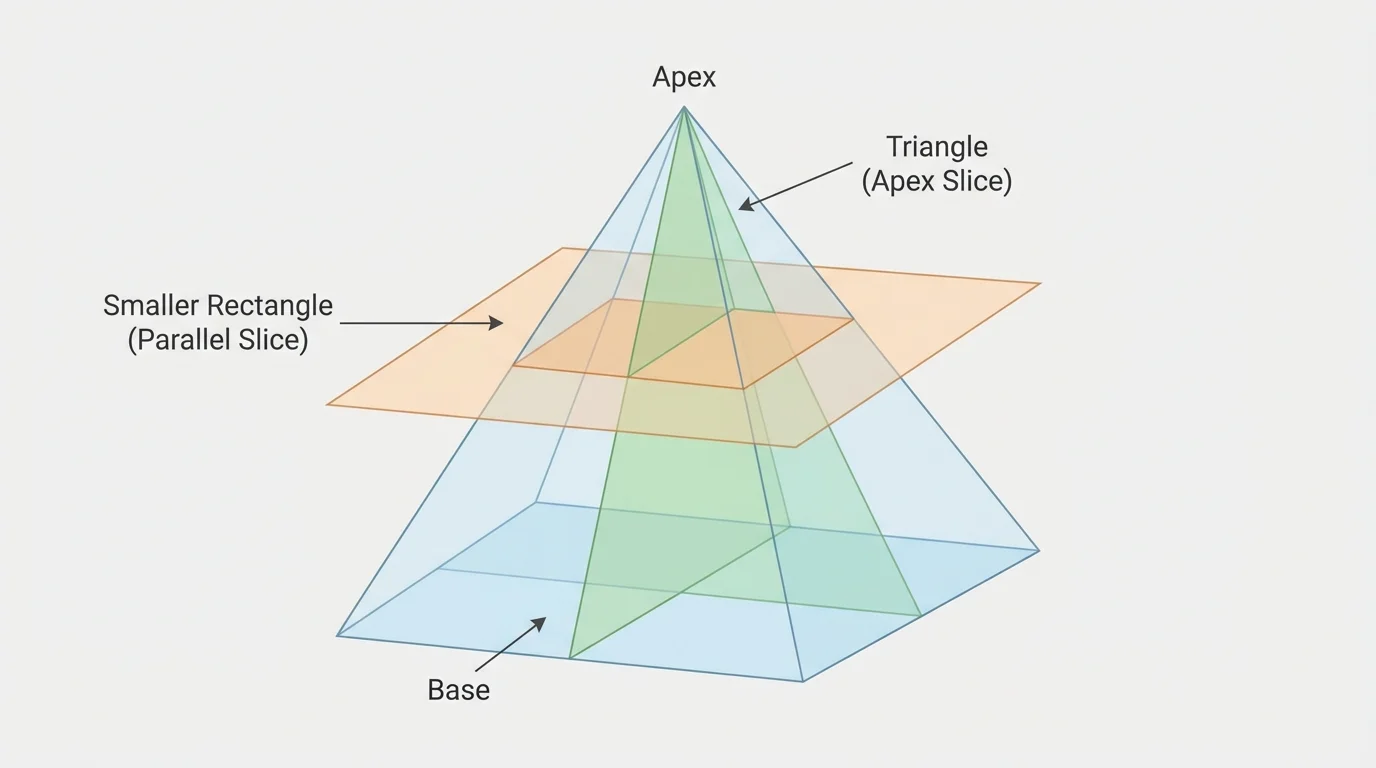
If the plane does not pass through the apex and is not parallel to the base, the section can still be a polygon, but in this lesson the main focus is on recognizing the important common results: rectangles or squares for slices parallel to the base, and triangles for slices through the apex.
Think about a pyramid-shaped roof. A cut made straight across the roof, parallel to the bottom, gives a smaller rectangular shape. A cut made from the top point downward through the middle gives a triangular shape. That is why architects and builders often use sections when planning structures.
This pyramid example helps show a major difference from a prism: because all the side faces meet at one point, slices through that point often create triangles.
The orientation of the plane matters just as much as the solid being cut. A plane parallel to a base behaves differently from a plane perpendicular to a base or a slanted plane. The same solid can give different cross sections depending on the slice direction.
As [Figure 4] shows, for a right rectangular prism, many common slices produce rectangles. For a right rectangular pyramid, a slice parallel to the base gives a rectangle, but a slice through the apex gives a triangle. So when you answer a question, do not just name a shape from memory. Use the direction and location of the cut.
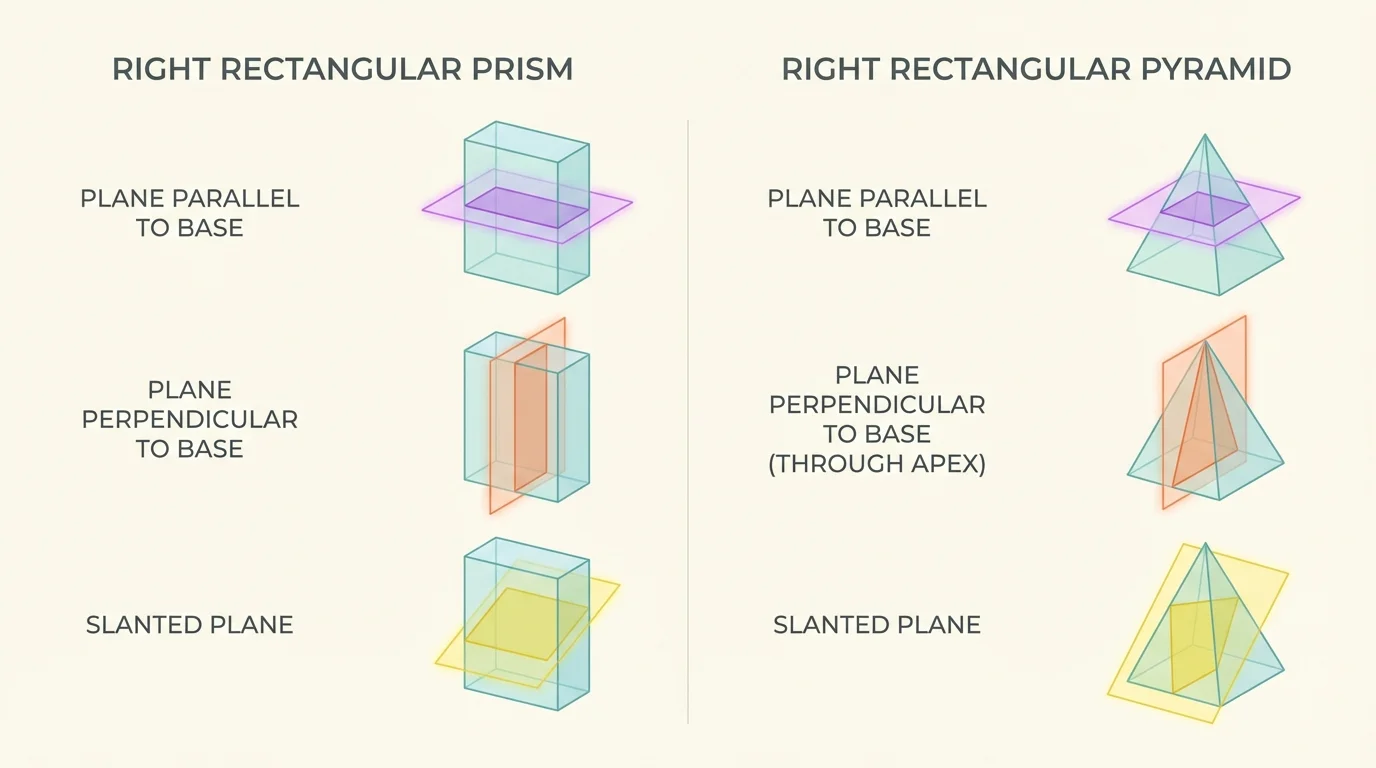
A good strategy is to visualize where the plane enters and leaves the solid. Count the boundary lines of the cut surface. If the slice touches the apex of a pyramid, that is a clue that the section may be a triangle. If the slice stays parallel to a rectangular base, that is a clue that the section may be a rectangle or square.
Why matching the base matters
When a plane is parallel to the base of a prism or pyramid, the section keeps the same general shape as the base. That is why a rectangular base leads to a rectangular section. The size may change, but the shape type stays the same.
This is also why you should pay attention to special cases. A square is a rectangle with equal sides. So if a problem says the base is a square, then a slice parallel to the base gives a square, not just any rectangle.
Now let's use careful reasoning to identify plane sections from descriptions.
Worked example 1
A right rectangular prism is sliced by a plane parallel to its base. Describe the cross section.
Step 1: Identify the base shape.
The base of a right rectangular prism is a rectangle.
Step 2: Use the slice direction.
A plane parallel to the base creates a section with the same shape as the base.
Step 3: State the result.
The cross section is a rectangle.
Answer: The section is a rectangle.
This example uses one of the most important rules in the topic: a slice parallel to the base copies the base's shape type.
Worked example 2
A right rectangular pyramid is sliced by a plane that passes through the apex and cuts through the base. Describe the cross section.
Step 1: Notice that the slice includes the apex.
The apex is a single top point where the triangular faces meet.
Step 2: Think about the boundary of the cut.
The plane meets the pyramid in a shape that has the apex as one vertex and extends down to the base.
Step 3: Name the figure.
A section through the apex of a pyramid is commonly a triangle.
Answer: The section is a triangle.
The apex is the key clue here. As seen earlier in [Figure 3], slices through that point usually create triangular sections.
Worked example 3
A right rectangular prism has a square base. It is sliced by a plane parallel to the base. Describe the cross section.
Step 1: Identify the special base.
The base is not just any rectangle; it is a square.
Step 2: Apply the parallel-slice idea.
A section parallel to the base has the same shape as the base.
Step 3: State the exact shape.
The cross section is a square.
Answer: The section is a square.
This example shows why using the most precise name matters. Since every square is a rectangle but not every rectangle is a square, square is the better description.
Worked example 4
A right rectangular pyramid is sliced by a plane parallel to its rectangular base. Describe the cross section.
Step 1: Identify the base shape.
The base is a rectangle.
Step 2: Use the rule for parallel slices.
A plane parallel to the base creates a section with the same shape type as the base.
Step 3: Name the figure.
The cross section is a smaller rectangle.
Answer: The section is a rectangle.
When solving these problems, there is often no lengthy calculation. The challenge is geometric reasoning: seeing how the cut meets the faces and edges of the solid.
Cross sections appear in many careers and technologies. Engineers use them to understand the inside of bridges, machine parts, and beams. Doctors use scans that show many thin cross sections of the body. Designers of packaging think about how cuts through boxes and containers reveal shape and structure.
Geologists study layers of Earth by looking at cross-sectional drawings. Builders use sectional views to show what is inside a wall or roof. In all of these cases, the geometry idea is the same as the one we use for prisms and pyramids: a three-dimensional object can be understood by examining two-dimensional slices.
This comparison connects directly to these real situations because professionals must choose the direction of a cut carefully. A different cutting plane can reveal a different shape and a different kind of information.
One common mistake is naming the solid instead of the section. If a prism is sliced, the answer is not "prism." The answer should be the two-dimensional figure formed by the cut, such as rectangle or square.
Another mistake is forgetting that the direction of the plane matters. A prism and a pyramid do not always produce the same kind of section. A slice parallel to the base and a slice through the apex of a pyramid give different results.
A third mistake is giving a less precise name when a more precise one is possible. If the section is a square, say "square" rather than only "rectangle." The more exact geometric description is usually the better answer.
"A change in viewpoint can reveal a new shape hidden inside the old one."
Geometry becomes much clearer when you picture the cut, the path of the plane, and the outline left behind. With practice, you start to see flat figures hidden inside solid ones.
