Two different roads on a map can cross at exactly one place, never meet at all, or turn out to be the very same road. Pairs of linear equations behave in a very similar way. When you solve two linear equations in two variables, you are often finding the one point that both equations share. That point can represent where two paths cross, where two pricing plans cost the same amount, or whether lines built from coordinate pairs ever meet.
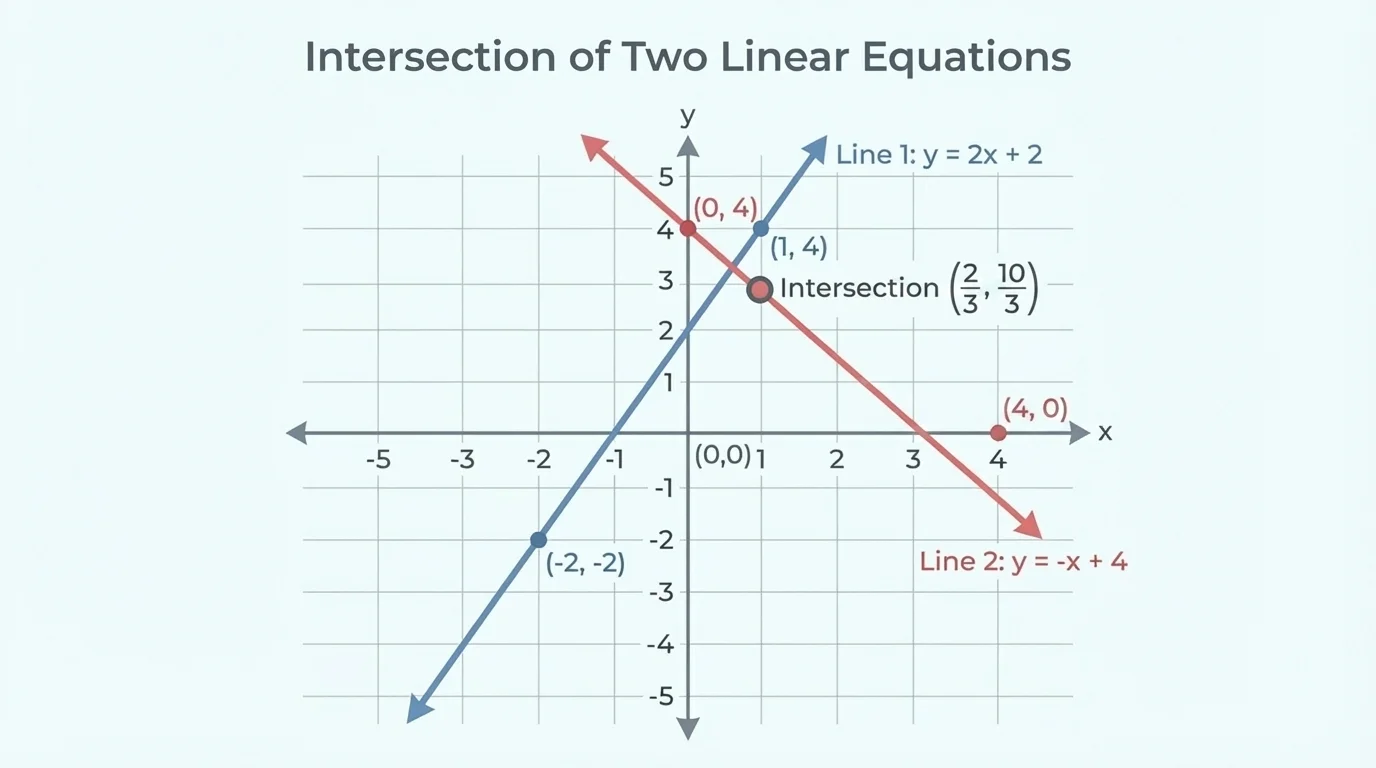
A system of linear equations is a set of two or more equations that use the same variables. In this lesson, we focus on two linear equations in two variables, usually written with variables like \(x\) and \(y\). A solution to the system is an ordered pair \((x, y)\) that makes both equations true at the same time, as [Figure 1] shows with two lines crossing at one shared point.
Because linear equations graph as straight lines, solving a pair of them often means finding where the two lines intersect. If they cross once, there is one solution. If they are parallel, there is no solution. If they are actually the same line, there are infinitely many solutions.
Linear equation is an equation whose graph is a straight line.
Solution is a value or ordered pair that makes an equation true.
Intersection is the point where two graphs cross.
You may already know that a single equation like \(y = 2x + 1\) has many solutions. For example, if \(x = 0\), then \(y = 1\), and if \(x = 3\), then \(y = 7\). But when a second equation is added, the possibilities usually narrow down. Now the ordered pair must satisfy two conditions at once.
A variable is a letter that stands for a number. In a two-variable linear equation, both variables work together to describe all the points on a line. A slope tells how steep a line is, and the y-intercept tells where the line crosses the \(y\)-axis.
Many linear equations are written in slope-intercept form:
\(y = mx + b\)
Here, \(m\) is the slope and \(b\) is the \(y\)-intercept. This form is especially useful for graphing and comparing lines.
Another useful form is standard form:
\(Ax + By = C\)
This form is often convenient when solving by elimination.
Recall how to find slope from two points:
\[m = \frac{y_2 - y_1}{x_2 - x_1}\]
You also need to remember that an ordered pair solves an equation only if substituting both coordinates makes the equation true.
These forms describe the same kind of relationship: a straight line. Different forms are useful in different situations, and switching between them can make a problem much easier.
Sometimes a system is given directly, but other times you must build it from a description. This is where algebra becomes a modeling tool. If one equation describes one condition and a second equation describes another condition, then the solution satisfies both conditions at once.
Suppose a school sells adult tickets and student tickets for a play. Let \(a\) be the number of adult tickets and \(s\) be the number of student tickets. If \(120\) tickets were sold total, then one equation is \(a + s = 120\). If adult tickets cost \(\$8\) and student tickets cost \(\$5\), and the total money collected was \(\$780\), then the second equation is \(8a + 5s = 780\). Together these equations form a system.
Coordinate information can also create equations. If you know two points on a line, you can find the slope, write the line equation, and then compare it to another line. This is exactly what happens when you are asked whether the line through one pair of points intersects the line through another pair.
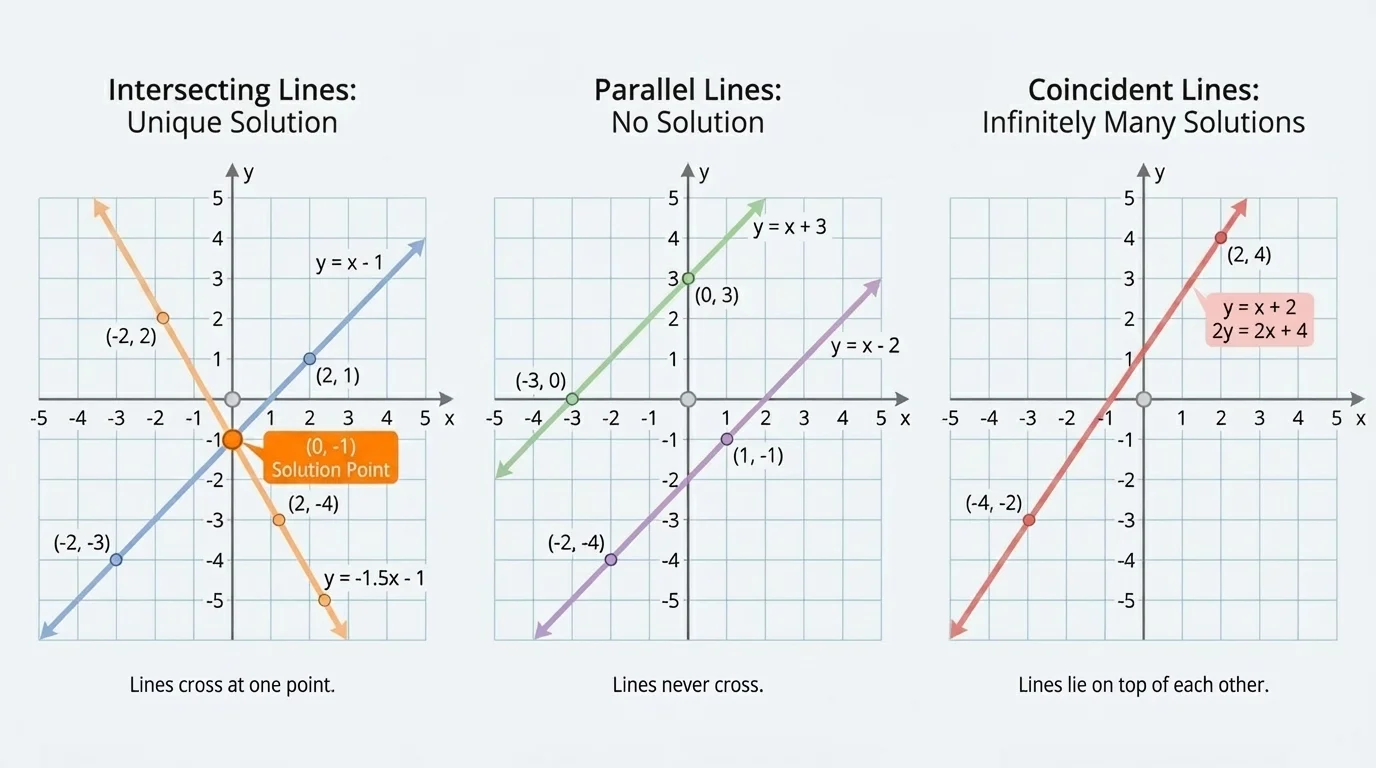
Graphing is the most visual method. You graph both lines on the same coordinate plane and look for their intersection. The three possible outcomes, shown in [Figure 2], are one intersection, no intersection, or lines that lie on top of each other.
If two lines have different slopes, they usually intersect once. If they have the same slope but different \(y\)-intercepts, they are parallel and never meet. If they have the same slope and the same \(y\)-intercept, they are the same line.
Worked example: solve by graphing
Solve the system \(y = x + 1\) and \(y = -x + 5\).
Step 1: Graph each equation.
The line \(y = x + 1\) has slope \(1\) and \(y\)-intercept \(1\). The line \(y = -x + 5\) has slope \(-1\) and \(y\)-intercept \(5\).
Step 2: Find the intersection.
On the graph, the lines meet at \((2, 3)\).
Step 3: Check the point in both equations.
For \(y = x + 1\), substituting \(x = 2\) gives \(y = 3\). For \(y = -x + 5\), substituting \(x = 2\) gives \(y = 3\).
The solution is \((2, 3)\)
Graphing is powerful because it makes the meaning of the solution clear. However, graphs can be hard to read exactly if the intersection is not at a neat point. For that reason, algebraic methods are often more precise.
In the substitution method, you solve one equation for one variable and then replace that variable in the other equation. This turns two equations into one equation with one variable.
How substitution works
If one equation already says something like \(y = 3x - 4\), then every place you see \(y\) in the other equation can be replaced with \(3x - 4\). You are using the fact that both expressions represent the same value of \(y\).
Substitution is often easiest when one equation is already solved for \(x\) or \(y\), or when one variable has a coefficient of \(1\) or \(-1\).
Worked example: solve by substitution
Solve the system \(y = 2x + 3\) and \(x + y = 12\).
Step 1: Substitute \(2x + 3\) for \(y\) in the second equation.
\(x + y = 12\) becomes \(x + (2x + 3) = 12\).
Step 2: Solve for \(x\).
Combine like terms: \(3x + 3 = 12\).
Subtract \(3\): \(3x = 9\).
Divide by \(3\): \(x = 3\).
Step 3: Find \(y\).
Substitute \(x = 3\) into \(y = 2x + 3\): \(y = 2(3) + 3 = 9\).
Step 4: Check.
In \(x + y = 12\), substituting \(x = 3\) and \(y = 9\) gives \(3 + 9 = 12\), which is true.
The solution is \((3, 9)\)
Substitution also helps when comparing lines from coordinate data. Once you write each line as \(y = mx + b\), you can set the two expressions for \(y\) equal to each other.
The elimination method removes one variable by adding or subtracting the equations. This works best when the coefficients of one variable are opposites or can be made opposites by multiplying.
Worked example: solve by elimination
Solve the system \(2x + y = 11\) and \(3x - y = 4\).
Step 1: Add the equations to eliminate \(y\).
\((2x + y) + (3x - y) = 11 + 4\)
This simplifies to \(5x = 15\).
Step 2: Solve for \(x\).
\(x = 3\).
Step 3: Substitute into one original equation.
Use \(2x + y = 11\): \(2(3) + y = 11\), so \(6 + y = 11\), and \(y = 5\).
Step 4: Check.
In \(3x - y = 4\), substituting \(x = 3\) and \(y = 5\) gives \(9 - 5 = 4\), which is true.
The solution is \((3, 5)\)
Sometimes elimination takes one extra step. For example, with \(2x + 3y = 13\) and \(4x - 3y = 5\), adding the equations eliminates \(y\) right away. But if the coefficients are not opposites, you may multiply one or both equations first.
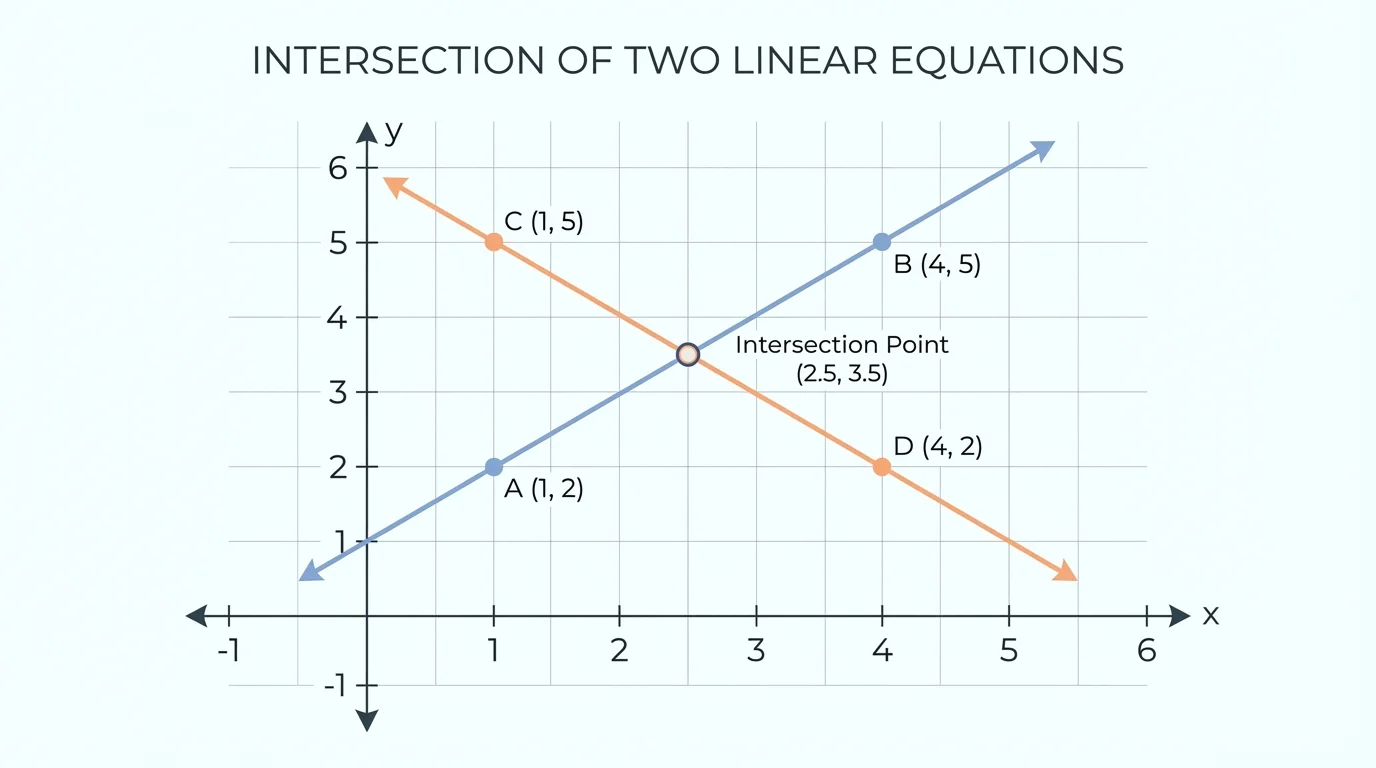
One of the most important grade-level applications is deciding whether the line through one pair of points intersects the line through another pair. This idea appears in coordinate geometry and in real-world problems involving paths and trends. As [Figure 3] illustrates, two points determine exactly one line, so each pair of points gives you enough information to build an equation.
To decide whether the two lines intersect, you can use this plan:
Step 1: Find the slope of each line.
Step 2: Compare the slopes.
Step 3: If the slopes are different, the lines intersect once.
Step 4: If the slopes are the same, check whether the lines are actually the same line or parallel lines.
Worked example: determine whether two lines intersect
Line \(L_1\) passes through \((1, 2)\) and \((3, 6)\). Line \(L_2\) passes through \((0, 5)\) and \((2, 3)\). Determine whether the lines intersect.
Step 1: Find the slope of \(L_1\).
\(m_1 = \dfrac{6 - 2}{3 - 1} = \dfrac{4}{2} = 2\).
Step 2: Find the slope of \(L_2\).
\(m_2 = \dfrac{3 - 5}{2 - 0} = \dfrac{-2}{2} = -1\).
Step 3: Compare the slopes.
Since \(2 \ne -1\), the lines are not parallel.
Step 4: Conclude.
Because the slopes are different, the lines intersect at exactly one point.
The lines do intersect.
If you need the exact point of intersection, write equations for both lines and solve the system. For \(L_1\), use slope \(2\) and point \((1, 2)\): \(y = 2x\). For \(L_2\), use slope \(-1\) and point \((0, 5)\): \(y = -x + 5\). Solving \(y = 2x\) and \(y = -x + 5\) gives \(2x = -x + 5\), so \(3x = 5\), \(x = \dfrac{5}{3}\), and \(y = \dfrac{10}{3}\).
This exact coordinate matches the graph of crossing lines, and later you can connect it back to graphing ideas, just as in [Figure 1], where one shared point represents a single solution.
Not every system has one solution. Some have none, and some have infinitely many. These cases are important because they tell you how the two equations are related.
| Type of system | What the lines do | What it means |
|---|---|---|
| One solution | The lines intersect once | One ordered pair satisfies both equations |
| No solution | The lines are parallel | No ordered pair satisfies both equations |
| Infinitely many solutions | The lines are the same line | Every point on the line satisfies both equations |
Table 1. The three possible outcomes when solving a pair of linear equations.
For example, the system \(y = 3x + 2\) and \(y = 3x - 1\) has no solution because the slopes are both \(3\), but the \(y\)-intercepts are different. The system \(2x + y = 8\) and \(4x + 2y = 16\) has infinitely many solutions because the second equation is just the first equation multiplied by \(2\).
Engineers and computer programs often check whether lines or paths intersect when designing roads, animation, navigation systems, and even video games. The same algebra you use in class helps make those systems work correctly.
If elimination leads to a statement like \(0 = 5\), the system has no solution. If it leads to a true statement like \(0 = 0\), the equations represent the same line, so there are infinitely many solutions.
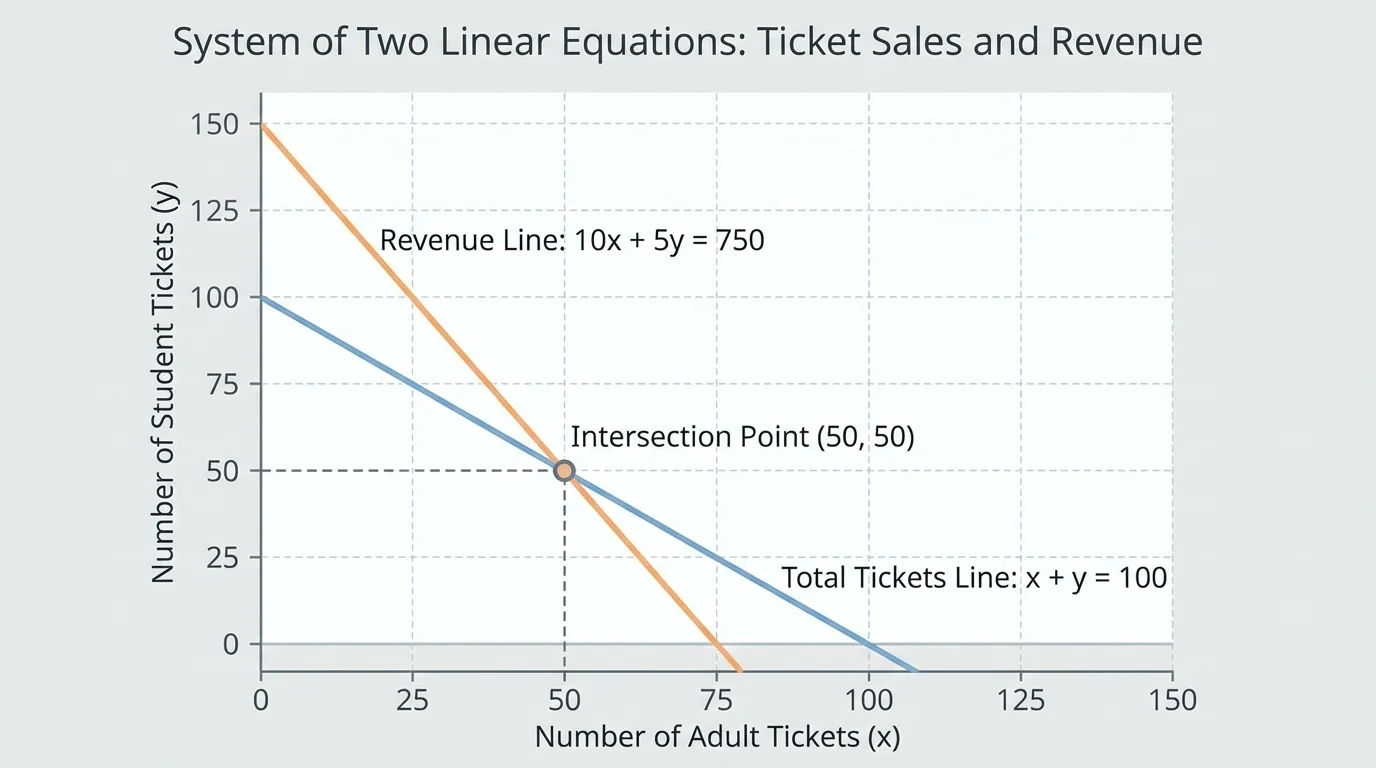
Systems of equations can answer questions that one equation alone cannot. In a ticket-sales problem, one equation might represent the total number of tickets and another might represent the total amount of money collected. Their intersection gives the combination that satisfies both conditions on a graph of possible ticket counts.
They can also compare two pricing plans. For instance, suppose one taxi company charges a starting fee plus a cost per mile, and another company uses a different fee and rate. The point where the two equations are equal tells where the costs match.
Worked example: ticket sales
At a school concert, adult tickets cost \(\$8\) and student tickets cost \(\$5\). A total of \(120\) tickets were sold, and the total revenue was \(\$780\). How many of each type were sold?
Step 1: Define variables.
Let \(a\) be adult tickets and \(s\) be student tickets.
Step 2: Write the system.
Total tickets: \(a + s = 120\).
Total revenue: \(8a + 5s = 780\).
Step 3: Use substitution.
From \(a + s = 120\), solve for \(s\): \(s = 120 - a\).
Substitute into the revenue equation: \(8a + 5(120 - a) = 780\).
Step 4: Solve.
\(8a + 600 - 5a = 780\)
\(3a + 600 = 780\)
\(3a = 180\)
\(a = 60\)
Step 5: Find \(s\).
\(s = 120 - 60 = 60\).
The solution is \[ (a, s) = (60, 60) \]
So the school sold 60 adult tickets and 60 student tickets.
Notice that in the graphing view from [Figure 4], this solution appears exactly where the total-tickets line and the revenue line cross.
A very common mistake is to solve correctly for one variable but forget to find the other. Another is making an arithmetic error while substituting or combining like terms. Students also sometimes think that equal slopes always mean the lines are the same, but equal slopes can also mean the lines are parallel and never meet.
Always check your solution in both original equations. If your ordered pair does not make both equations true, it is not the solution to the system.
A reliable checking strategy
After solving, substitute the ordered pair into each original equation separately. If both equations are true, your answer is correct. If one fails, go back and look for an error in arithmetic, sign changes, or substitution.
When using coordinates, checking slopes first can save time. If the slopes are different, the lines intersect once, so you know there will be a single solution. If the slopes are the same, compare the equations more closely to decide whether there are no solutions or infinitely many.
"The solution to a system is the point that tells the truth for both equations at the same time."
This idea is the heart of every method in the lesson. Whether you graph, substitute, eliminate, or compare slopes, you are asking the same question: which ordered pair, if any, works for both equations?
