If a bridge support is off by just a few degrees, the entire structure can twist or collapse. The precise angles and distances that keep buildings, roads, and devices stable are not guesses—they come from geometric theorems that can be proved, not just believed.
This lesson focuses on three powerful and frequently used theorems about lines and angles: vertical angles, angles formed when a transversal intersects parallel lines, and the perpendicular bisector of a segment. These are core tools for more advanced geometry, coordinate proofs, and even computer graphics.
Before proving the theorems, recall some basic ideas.
To follow the proofs, you should already know what a point, line, line segment, ray, angle, and parallel and perpendicular lines are, and how to name angles with three letters like \(\angle ABC\).
A line extends forever in two opposite directions. A line segment has two endpoints. A ray has one endpoint and extends forever in one direction.
An angle is formed by two rays with a common endpoint (the vertex). Angle measure is usually in degrees.
Key types of angles we will use:
Two angles or segments are congruent if they have exactly the same measure. For angles we often write, for example, \(m\angle 1 = m\angle 2\) to mean their measures are equal.
When two lines intersect, they form four angles, as shown in [Figure 1]. Pairs of angles that are opposite each other at the intersection are called vertical angles. They share the same vertex but have no common sides.
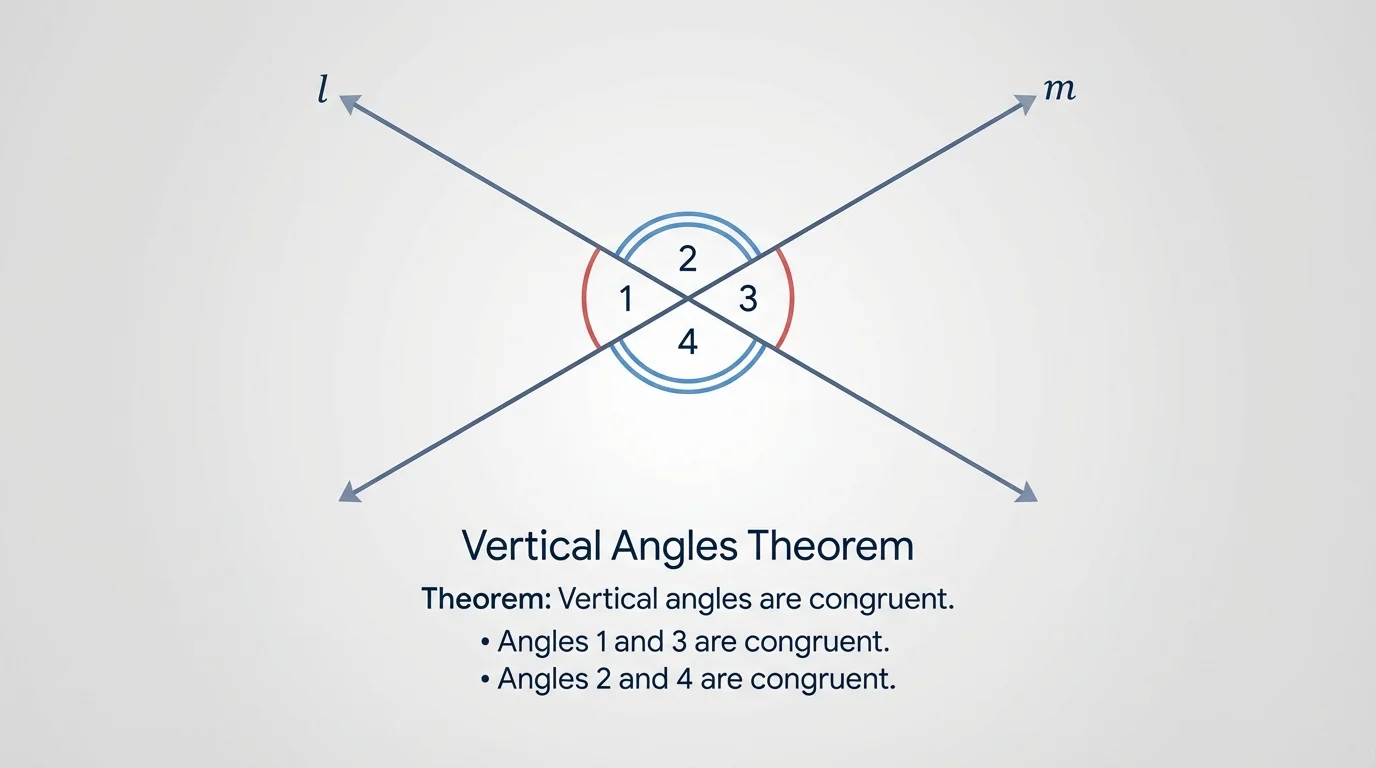
For example, if lines \(\ell_1\) and \(\ell_2\) intersect, we can label the four angles \(\angle 1, \angle 2, \angle 3, \angle 4\). Then:
Vertical angles are the non-adjacent angles formed when two lines intersect. Each pair of vertical angles shares only a vertex, not a side.
Linear pair is a pair of adjacent angles whose non-common sides form a straight line; their measures sum to \(180^{\circ}\).
The theorem we want to prove:
When two lines intersect, vertical angles are congruent.
We will prove this using the fact that angles in a linear pair are supplementary.
Proof (vertical angles are congruent)
Let two lines intersect to form \(\angle 1, \angle 2, \angle 3, \angle 4\) as in [Figure 1]. Consider \(\angle 1\) and \(\angle 3\), which are vertical angles.
Since both sums equal \(180^{\circ}\), we have:
\(m\angle 1 + m\angle 2 = m\angle 2 + m\angle 3\).
Subtract \(m\angle 2\) from both sides (using the subtraction property of equality):
\(m\angle 1 = m\angle 3\).
Therefore, \(\angle 1\) and \(\angle 3\) are congruent. The same reasoning shows that \(\angle 2\) and \(\angle 4\) are congruent.
Example 1: Using vertical angles to find an unknown angle
Two lines intersect. One of the vertical angles has measure \(\angle AOB = (4x + 10)^{\circ}\) and its vertical angle has measure \(\angle COD = (7x - 5)^{\circ}\). Find \(x\) and the measure of each angle.
Step 1: Use the vertical angle theorem
Since \(\angle AOB\) and \(\angle COD\) are vertical angles, they are congruent. So:
\(4x + 10 = 7x - 5\).
Step 2: Solve the equation
Subtract \(4x\) from both sides:
\(10 = 3x - 5\).
Add \(5\) to both sides:
\(15 = 3x\).
Divide both sides by \(3\):
\(x = 5\).
Step 3: Find the angle measures
Substitute \(x = 5\) into either expression. Using \(4x + 10\):
\(4(5) + 10 = 20 + 10 = 30^{\circ}\).
So each of the vertical angles measures \(30^{\circ}\).
Each angle in the other vertical pair is supplementary to \(30^{\circ}\), so they measure \(150^{\circ}\).
Now we look at what happens when a line (called a transversal) crosses two parallel lines. This is one of the most important configurations in all of geometry.
A transversal is a line that intersects two or more other lines at distinct points.
Consider two parallel lines \(\ell_1\) and \(\ell_2\) cut by transversal \(t\). Eight angles are formed. We classify them by position:
The key results we will prove:
The relationships among the eight angles are easier to see in a structured way.
| Angle type | Position description | Relationship (when lines are parallel) |
|---|---|---|
| Alternate interior | Interior, opposite sides of transversal | Congruent |
| Corresponding | Same relative position at each intersection | Congruent |
| Same-side interior | Interior, same side of transversal | Supplementary |
| Vertical | Opposite at intersection | Congruent |
| Linear pair | Adjacent, form line | Supplementary |
Table 1. Angle relationships when a transversal crosses parallel lines.
We now prove that when a transversal intersects two parallel lines, alternate interior angles are congruent.
Statement of the theorem:
If line \(t\) is a transversal of parallel lines \(\ell_1\) and \(\ell_2\), then each pair of alternate interior angles is congruent.
Idea of the proof: Use the fact that a straight line measures \(180^{\circ}\) and that interior angles on the same side of the transversal are supplementary to connect the alternate interior angles.
Proof (alternate interior angles theorem)
Let \(\ell_1 \parallel \ell_2\), and transversal \(t\) intersect them at points \(P\) and \(Q\). Label the interior angles so that \(\angle 3\) is on \(\ell_1\) and \(\angle 6\) is the alternate interior angle on \(\ell_2\), as in [Figure 2].
One common proof route is:
The final conclusion is \(m\angle 3 = m\angle 6\), so alternate interior angles are congruent.
Example 2: Finding an angle using alternate interior angles
Two parallel lines are cut by a transversal. One of the alternate interior angles measures \((5x + 15)^{\circ}\) and the other measures \((2x + 51)^{\circ}\). Find \(x\) and each angle measure.
Step 1: Use the alternate interior angles theorem
Since the lines are parallel, alternate interior angles are congruent:
\(5x + 15 = 2x + 51\).
Step 2: Solve for \(x\)
Subtract \(2x\) from both sides:
\(3x + 15 = 51\).
Subtract \(15\) from both sides:
\(3x = 36\).
Divide by \(3\): \(x = 12\).
Step 3: Find the angle measures
Substitute \(x = 12\) into one expression, say \(5x + 15\):
\(5(12) + 15 = 60 + 15 = 75^{\circ}\).
So each of the alternate interior angles measures \(75^{\circ}\).
Now we turn to corresponding angles. These are angles in the same "corner" position at each intersection of the transversal with the parallel lines. For example, angle 1 (upper-left at the first intersection) and angle 5 (upper-left at the second intersection) in [Figure 2] are corresponding.
The theorem:
If a transversal intersects two parallel lines, then each pair of corresponding angles is congruent.
Proof idea: Corresponding angles can be linked to alternate interior angles and vertical angles, which we already know about.
Proof (one approach)
Combining equalities:
\(m\angle 1 = m\angle 3 = m\angle 6 = m\angle 5\).
So \(m\angle 1 = m\angle 5\) and the angles are congruent. The same idea works for any pair of corresponding angles.
Example 3: Solving using corresponding and supplementary angles
A transversal crosses two parallel lines. A corresponding angle measures \((3y - 10)^{\circ}\). Another angle that forms a linear pair with its corresponding angle measures \((2y + 40)^{\circ}\). Find \(y\) and both angles.
Step 1: Use the linear pair relationship
The two given angles form a linear pair, so they are supplementary:
\((3y - 10) + (2y + 40) = 180\).
Step 2: Solve for \(y\)
Combine like terms:
\(5y + 30 = 180\).
Subtract \(30\): \(5y = 150\).
Divide by \(5\): \(y = 30\).
Step 3: Find the angle measures
Substitute \(y = 30\) into \(3y - 10\):
\(3(30) - 10 = 90 - 10 = 80^{\circ}\).
The other angle is:
\(2(30) + 40 = 60 + 40 = 100^{\circ}\).
Check: \(80^{\circ} + 100^{\circ} = 180^{\circ}\), so they are indeed supplementary.
If we look at a different corresponding position, it will also measure \(80^{\circ}\) because corresponding angles are congruent when lines are parallel.
Next we explore the relationship between a segment, its perpendicular bisector, and distances to the endpoints. This is key in constructions and in understanding circles and involves right angles and equal lengths.
Definitions:
The theorem has two directions:
Together, these tell us that the points on the perpendicular bisector of \(\overline{AB}\) are exactly the points that are equidistant from \(A\) and \(B\).
Proof (direction 1: point on perpendicular bisector ⇒ equidistant)
Let \(\overline{AB}\) be a segment with midpoint \(M\). Let line \(\ell\) be the perpendicular bisector of \(\overline{AB}\), so \(M\) is on \(\ell\) and \(\ell \perp \overline{AB}\). Take any point \(P\) on \(\ell\), as in [Figure 3]. We must show \(PA = PB\).
By the hypotenuse-leg (HL) congruence theorem for right triangles, \(\triangle PAM \cong \triangle PBM\). Therefore, corresponding sides \(PA\) and \(PB\) are congruent, so \(PA = PB\).
Proof (direction 2: equidistant from endpoints ⇒ on perpendicular bisector)
Now assume a point \(P\) is such that \(PA = PB\). We want to prove that \(P\) lies on the perpendicular bisector of \(\overline{AB}\).
This proves that the set of all points equidistant from \(A\) and \(B\) is precisely the perpendicular bisector of \(\overline{AB}\), as the diagram in [Figure 3] suggests.
Example 4: Using the perpendicular bisector theorem
Segment \(\overline{AB}\) has endpoints \(A(2, 1)\) and \(B(8, 1)\). A point \(P(x, y)\) is equidistant from \(A\) and \(B\). Describe the line on which \(P\) must lie.
Step 1: Find the midpoint and direction of the perpendicular bisector
The midpoint of \(\overline{AB}\) is:
\(M\left(\dfrac{2 + 8}{2}, \dfrac{1 + 1}{2}\right) = M(5, 1)\).
Segment \(\overline{AB}\) is horizontal (both \(y\)-coordinates are 1), so its perpendicular direction is vertical.
Step 2: Write the equation of the perpendicular bisector
A vertical line through \(x = 5\) passes through the midpoint and is perpendicular to \(\overline{AB}\). So the perpendicular bisector is the line:
\(x = 5\).
By the perpendicular bisector theorem, any point \(P\) equidistant from \(A\) and \(B\) lies on the line \(x = 5\).
The following problems combine vertical angles, alternate interior and corresponding angles, and the perpendicular bisector.
Example 5: Mixing vertical and alternate interior angles
Two parallel lines are cut by a transversal. At the top intersection, an angle on the left side of the transversal measures \((2x + 20)^{\circ}\). At the bottom intersection, the angle on the right side of the transversal that forms a vertical pair with the alternate interior angle corresponding to the first has measure \((5x - 10)^{\circ}\). Find \(x\) and all distinct angle measures.
Step 1: Understand the relationships
The first angle is some angle \(\angle A\). Its alternate interior angle is congruent (lines are parallel). Call that \(\angle B\). The given angle at the bottom intersection is vertical to \(\angle B\), so it is also congruent to \(\angle B\), and thus congruent to \(\angle A\).
So the two expressions \(2x + 20\) and \(5x - 10\) represent congruent angles.
Step 2: Set up and solve the equation
\(2x + 20 = 5x - 10\).
Subtract \(2x\): \(20 = 3x - 10\).
Add \(10\): \(30 = 3x\).
Divide by \(3\): \(x = 10\).
Step 3: Find the angle measure
Substitute \(x = 10\) into \(2x + 20\):
\(2(10) + 20 = 20 + 20 = 40^{\circ}\).
So the acute angles in the figure all measure \(40^{\circ}\). Their supplementary angles each measure \(140^{\circ}\).
Example 6: Using the perpendicular bisector with angle information
Segment \(\overline{AB}\) has endpoints such that its perpendicular bisector is line \(m\). A point \(P\) lies on line \(m\). Another point \(Q\) does not lie on line \(m\). At \(Q\), the two segments \(QA\) and \(QB\) form an angle of \(50^{\circ}\). At \(P\), the two segments \(PA\) and \(PB\) form an angle of \(2x^{\circ}\). It is known that \(PA = PB\) and \(QA \neq QB\). If \(\angle APB\) is supplementary to \(\angle AQB\), find \(x\).
Step 1: Use the fact that \(P\) is on the perpendicular bisector
Because \(P\) is on the perpendicular bisector, \(PA = PB\) (given) and \(\angle APB\) is an isosceles vertex angle. The specific measure will come from the supplementary relationship.
Step 2: Use supplementary angles
Since \(\angle APB\) and \(\angle AQB\) are supplementary:
\(2x + 50 = 180\).
Step 3: Solve for \(x\)
Subtract \(50\): \(2x = 130\).
Divide by \(2\): \(x = 65\).
Then \(\angle APB = 2x = 130^{\circ}\), and \(\angle AQB = 50^{\circ}\), confirming the supplementary relationship.
Example 7: Coordinate geometry and perpendicular bisector
Points \(A(1, 4)\) and \(B(7, -2)\) are the endpoints of a segment. Find an equation of the perpendicular bisector of \(\overline{AB}\), and explain why any point on that line is equidistant from \(A\) and \(B\).
Step 1: Find the midpoint of \(\overline{AB}\)
Midpoint \(M\):
\(M\left(\dfrac{1 + 7}{2}, \dfrac{4 + (-2)}{2}\right) = M(4, 1)\).
Step 2: Find the slope of \(\overline{AB}\)
Slope of \(\overline{AB}\):
\(m_{AB} = \dfrac{-2 - 4}{7 - 1} = \dfrac{-6}{6} = -1\).
A line perpendicular to \(\overline{AB}\) will have slope \(1\) (the negative reciprocal of \(-1\)).
Step 3: Write the equation of the perpendicular bisector
Use point-slope form with point \(M(4, 1)\) and slope \(1\):
\(y - 1 = 1(x - 4)\).
Simplify: \(y - 1 = x - 4\) so \(y = x - 3\).
By the perpendicular bisector theorem, any point on the line \(y = x - 3\) is equidistant from \(A\) and \(B\). Conversely, any point equidistant from \(A\) and \(B\) must lie on this line.
These line and angle theorems are not just abstract ideas—they are built into many technologies and designs you depend on every day.
In classical geometric constructions using only a compass and straightedge, constructing a perpendicular bisector is one of the first moves, and it is the key to drawing circles that pass through chosen points and to building regular polygons.
