GPS systems, computer animations, and engineering blueprints all depend on a surprisingly simple question: if you know two points, how do you locate a point partway between them with exact precision? Geometry answers that question beautifully. When a point divides a segment in a given ratio, its coordinates are not guessed from a picture; they can be found exactly with algebra.
Suppose two points are given, and you want the point that lies between them so that one part of the segment is, for example, twice as long as the other. This is one of the most useful ideas in coordinate geometry because it connects shape, distance, and algebraic expressions. It also helps prove geometric statements using coordinates rather than relying only on diagrams.
Before working with ratios on segments, it helps to remember a few basic ideas. A point in the coordinate plane is written as an ordered pair, such as \(3, -2\). A line segment is the part of a line between two endpoints. If the endpoints are \(x_1, y_1\) and \(x_2, y_2\), moving from the first point to the second changes the \(x\)-coordinate by \(x_2 - x_1\) and the \(y\)-coordinate by \(y_2 - y_1\).
The midpoint of the segment joining \(A(x_1, y_1)\) and \(B(x_2, y_2)\) is \(\left(\dfrac{x_1+x_2}{2}, \dfrac{y_1+y_2}{2}\right)\). A midpoint is really a special ratio case: it divides the segment in the ratio \(1:1\).
Another key idea is a directed line segment. A directed segment has an order. The segment from \(A\) to \(B\) is not treated the same as the segment from \(B\) to \(A\) when ratios are described. That order tells us which side of the partition is first and which is second.
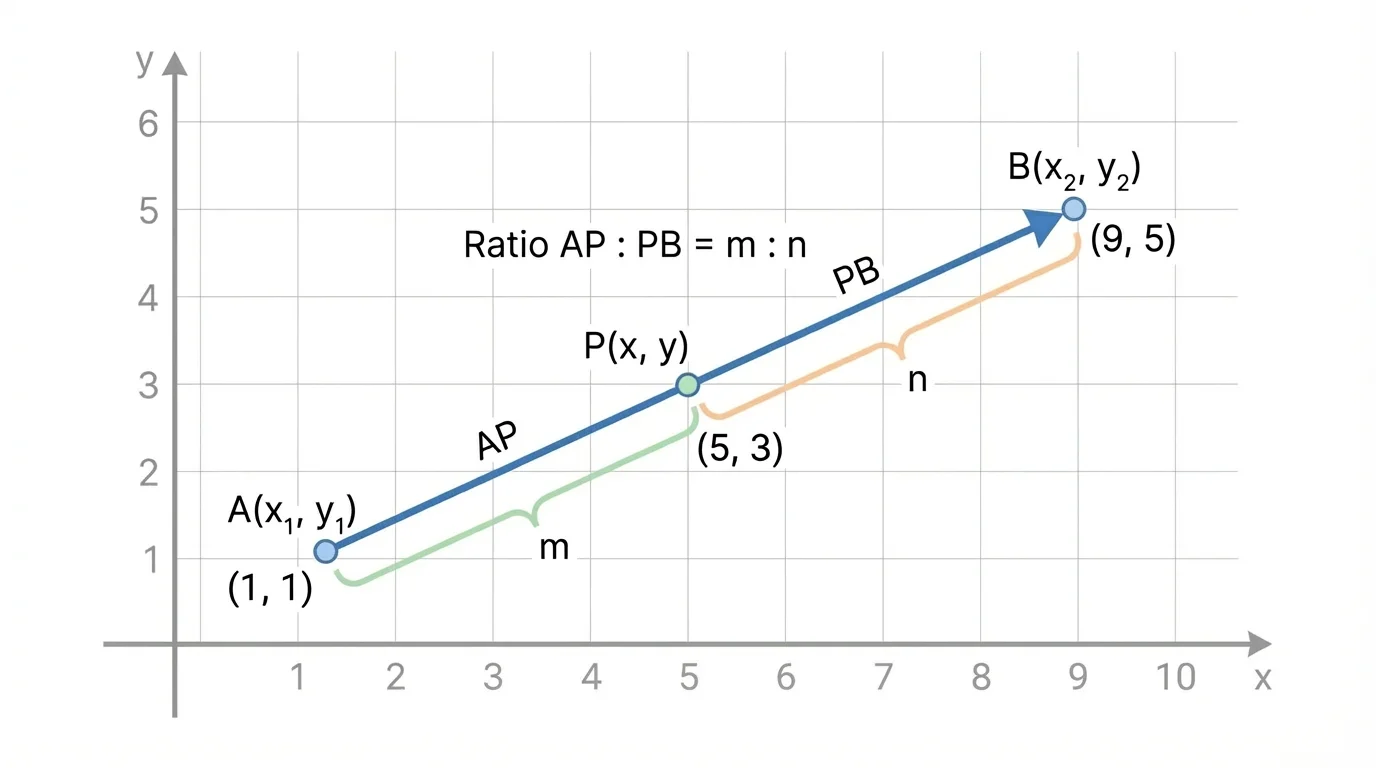
Let \(A(x_1, y_1)\) and \(B(x_2, y_2)\) be two points. Suppose point \(P\) lies on the directed segment from \(A\) to \(B\) and divides it in the ratio \(m:n\), meaning \(AP:PB = m:n\). As [Figure 1] shows, the ratio tells us how the whole segment is split into two parts, and because the segment is directed, the order \(A \to B\) matters.
If \(P\) is between \(A\) and \(B\), then this is called internal division. We can find the coordinates of \(P\) by thinking of the movement from \(A\) to \(B\). The point \(P\) is a fraction of the way from \(A\) to \(B\), and that fraction is determined by the ratio.
Since \(AP:PB = m:n\), the whole segment is split into \(m+n\) equal ratio parts. That means \(P\) is \(\dfrac{m}{m+n}\) of the way from \(A\) to \(B\). So we add that fraction of the horizontal and vertical changes:
\[P = \left(x_1 + \frac{m}{m+n}(x_2-x_1),\; y_1 + \frac{m}{m+n}(y_2-y_1)\right)\]
This expression simplifies to the more commonly used section formula:
\[P = \left(\frac{nx_1 + mx_2}{m+n},\; \frac{ny_1 + my_2}{m+n}\right)\]
This formula is sensible in an important way: the coordinate of \(P\) is built from both endpoints. It is not just an average unless the ratio is \(1:1\).
Notice the pattern carefully. If the ratio is \(m:n\), then the coordinate of \(A\) is multiplied by \(n\), and the coordinate of \(B\) is multiplied by \(m\). Students often expect the same letter to stay with the same point, but the weights are attached in the opposite way because the point is pulled according to the length of the segment on the other side.
Partitioning a segment means dividing a segment into parts according to a specified ratio. For a directed segment from \(A\) to \(B\), if \(P\) partitions the segment in the ratio \(m:n\), then \(AP:PB = m:n\).
You can also think of this as a weighted average. The coordinates of \(P\) are a blend of the endpoint coordinates. If the two parts of the ratio are more nearly equal, then \(P\) is closer to the midpoint. If one part of the ratio is much larger than the other, then \(P\) shifts accordingly.
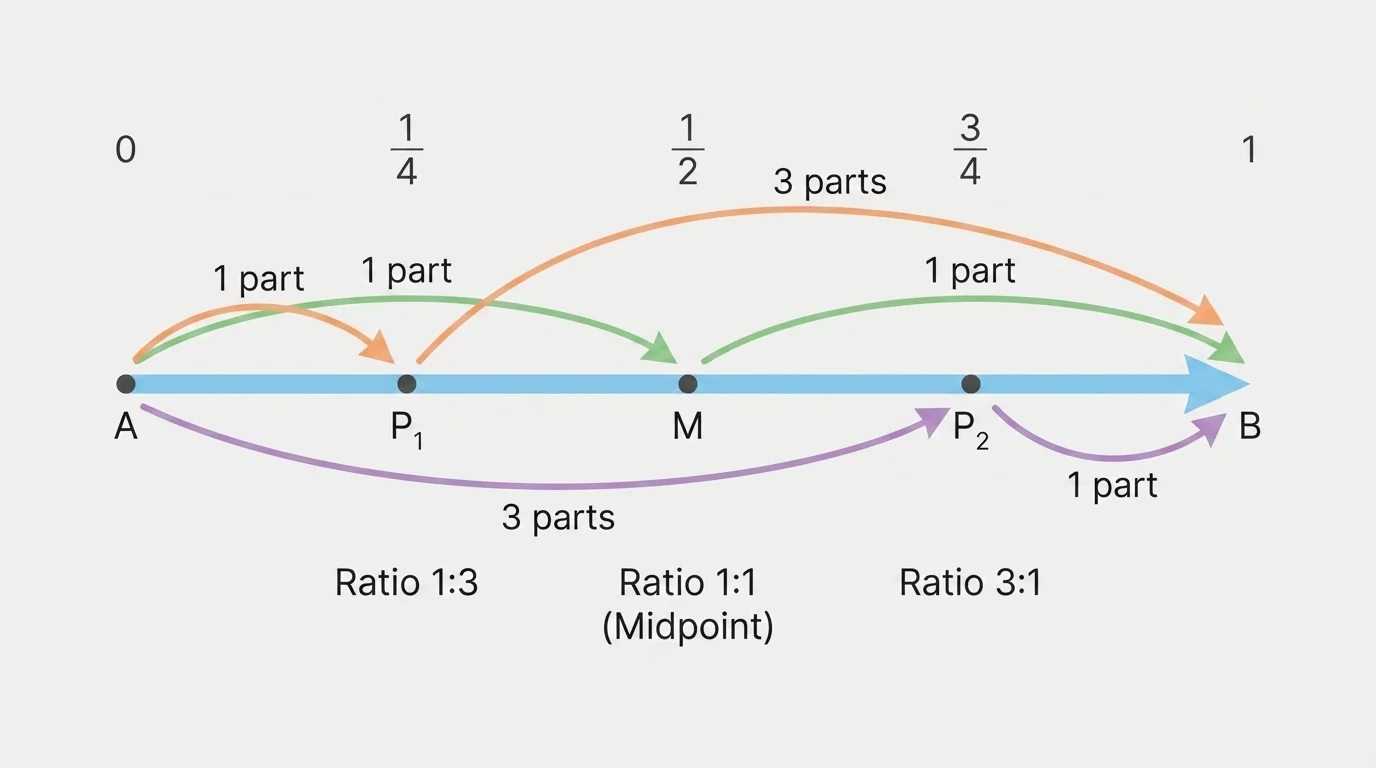
A useful way to understand the section formula is to notice how the point moves as the ratio changes. As [Figure 2] illustrates, if \(AP:PB = 1:1\), the point is exactly the midpoint. If \(AP:PB = 1:3\), then \(P\) is much closer to \(A\), because the segment from \(P\) to \(B\) is three times as long as the segment from \(A\) to \(P\).
If \(AP:PB = 3:1\), then \(P\) is much closer to \(B\). That gives you a strong mental check. Before finishing any calculation, ask: does the point lie where the ratio says it should lie? A correct formula answer should also make geometric sense.
For example, if \(A(0,0)\) and \(B(8,0)\), then a \(1:3\) ratio gives \(P\) at \(x = 2\), while a \(3:1\) ratio gives \(P\) at \(x = 6\). The ratio changes the location in a predictable way.
This idea is closely related to interpolation in technology. When software needs a point between two known positions, it often computes a weighted average. In geometry class, that weighted average becomes a precise coordinate formula.
Computer graphics often create smooth motion by calculating intermediate points between known positions. The same coordinate idea used to partition a segment also helps place objects accurately between frames.
Later, when you study vectors or analytic geometry in more depth, this same pattern appears again. That is one reason this topic is more than a single formula: it is a model for how algebra describes location.
Find the point \(P\) that divides the directed segment from \(A(2,3)\) to \(B(10,7)\) in the ratio \(1:3\).
Worked example 1
Step 1: Identify the values.
Here, \(x_1 = 2\), \(y_1 = 3\), \(x_2 = 10\), \(y_2 = 7\), \(m = 1\), and \(n = 3\).
Step 2: Use the section formula.
\(P = \left(\dfrac{nx_1 + mx_2}{m+n}, \dfrac{ny_1 + my_2}{m+n}\right)\)
Substitute the values: \(P = \left(\dfrac{3(2) + 1(10)}{1+3}, \dfrac{3(3) + 1(7)}{1+3}\right)\).
Step 3: Simplify.
\(P = \left(\dfrac{6+10}{4}, \dfrac{9+7}{4}\right) = \left(\dfrac{16}{4}, \dfrac{16}{4}\right) = \left(4,4\right)\)
\(P = \left(4,4\right)\)
This answer is reasonable because a \(1:3\) ratio places \(P\) closer to \(A\) than to \(B\), and \( (4,4) \) is indeed closer to \( (2,3) \) than to \( (10,7) \).
Notice that the result is not the midpoint. The midpoint would be \(\left(6,5\right)\), but the ratio \(1:3\) places the point earlier along the directed segment from \(A\) to \(B\).
Find the point that divides the directed segment from \(A(-4,6)\) to \(B(8,-2)\) in the ratio \(2:5\).
Worked example 2
Step 1: Record the data.
\(x_1 = -4\), \(y_1 = 6\), \(x_2 = 8\), \(y_2 = -2\), \(m = 2\), and \(n = 5\).
Step 2: Substitute into the formula.
\(P = \left(\dfrac{5(-4) + 2(8)}{2+5}, \dfrac{5(6) + 2(-2)}{2+5}\right)\)
Step 3: Compute each coordinate carefully.
\(x = \dfrac{-20 + 16}{7} = \dfrac{-4}{7}\)
\(y = \dfrac{30 - 4}{7} = \dfrac{26}{7}\)
\[P = \left(-\frac{4}{7}, \frac{26}{7}\right)\]
The point lies between the endpoints, and because \(2:5\) means the first part is shorter than the second, the point is closer to \(A\), which matches the result.
Examples with negative coordinates are especially good for checking whether you really understand the formula rather than relying on intuition from only the first quadrant.
Coordinate geometry often asks you to prove a geometric fact algebraically. Suppose \(A(1,5)\) and \(B(9,-3)\). Show that the point that divides \(\overrightarrow{AB}\) in the ratio \(1:1\) is the midpoint of \(AB\).
Worked example 3
Step 1: Use the section formula with \(m = 1\) and \(n = 1\).
\(P = \left(\dfrac{1(1) + 1(9)}{2}, \dfrac{1(5) + 1(-3)}{2}\right)\)
Step 2: Simplify.
\(P = \left(\dfrac{10}{2}, \dfrac{2}{2}\right) = \left(5,1\right)\)
Step 3: Compare with the midpoint formula.
The midpoint of \(AB\) is \(\left(\dfrac{1+9}{2}, \dfrac{5+(-3)}{2}\right) = (5,1)\).
\(P = \left(5,1\right)\)
Because both methods give the same point, dividing a segment in the ratio \(1:1\) does produce the midpoint.
This is a small algebraic proof, but it shows an important theme of coordinate geometry: geometric relationships can be verified by equations.
Why the coordinates are weighted
The section formula is a weighted average of the endpoints. The larger the weight attached to an endpoint's coordinate, the more influence that endpoint has on the location of the point. This is why a ratio changes the position smoothly along the segment instead of jumping unpredictably.
That weighted-average idea is the bridge between geometry and algebra. The point is not found by measuring with a ruler; it is determined by the endpoint coordinates and the ratio alone.
Sometimes the ratio describes a point on the same line as \(A\) and \(B\), but not between them. As [Figure 3] shows, this is called external division. In that case, the point lies outside the segment, even though it is still on the line through the two points.
For external division, the formula changes slightly because the point is beyond one endpoint. If \(P\) divides the line through \(A(x_1,y_1)\) and \(B(x_2,y_2)\) externally in the ratio \(m:n\), then
\[P = \left(\frac{nx_1 - mx_2}{n-m},\; \frac{ny_1 - my_2}{n-m}\right)\]
This formula is useful when directed lengths are treated with signs. In more advanced work, direction can be encoded using positive and negative values, which is why the idea of a directed segment matters so much.
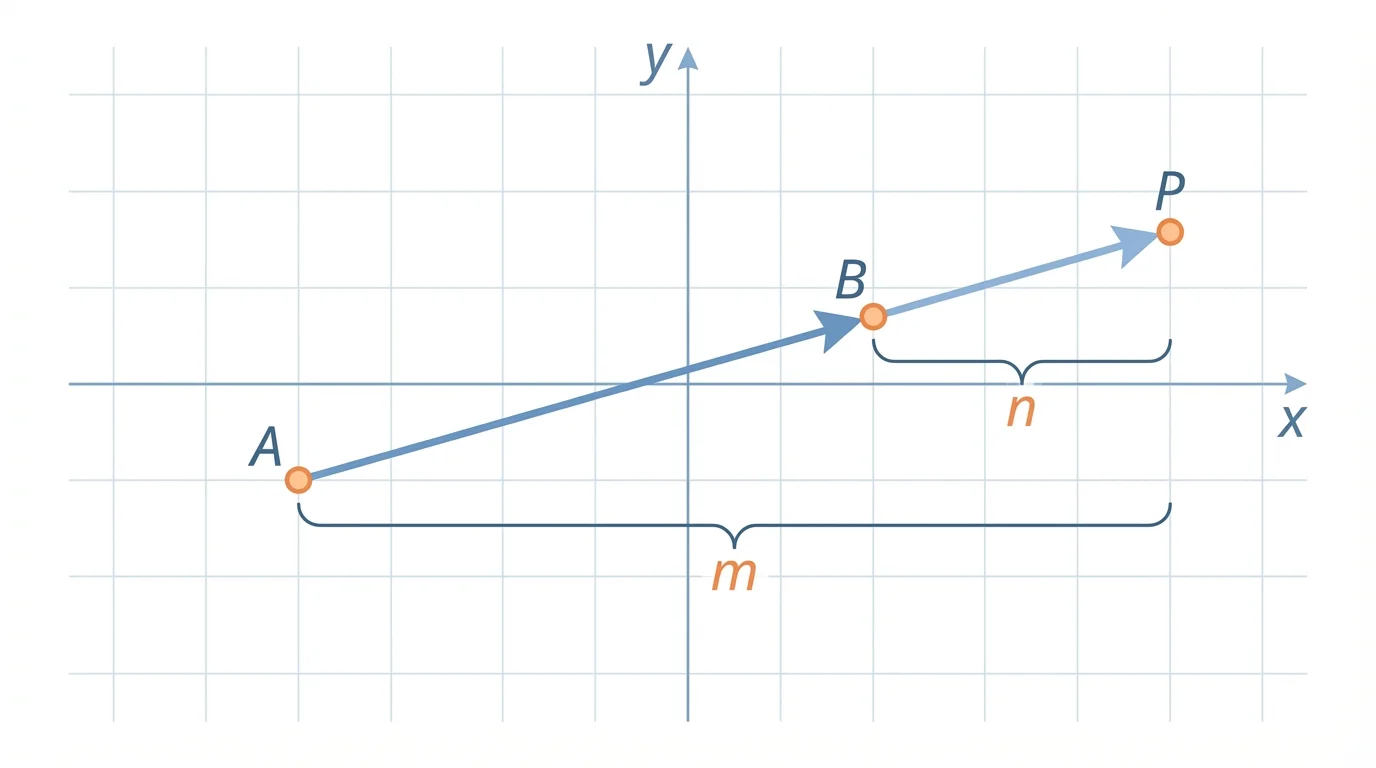
For example, let \(A(1,1)\) and \(B(5,3)\), and suppose \(P\) divides the line externally in the ratio \(1:2\). Then
\(P = \left(\dfrac{2(1) - 1(5)}{2-1}, \dfrac{2(1) - 1(3)}{2-1}\right) = (-3,-1)\)
That point is on the same line but outside the segment. A point beyond an endpoint requires subtraction rather than addition in the formula.
One common mistake is reversing the ratio. If the problem says the point divides the directed segment from \(A\) to \(B\) in the ratio \(2:3\), that means \(AP:PB = 2:3\), not \(3:2\). Reading carefully matters.
Another common mistake is mixing up the endpoint order. On a directed segment, changing from \(A \to B\) to \(B \to A\) changes the interpretation of the ratio. Geometry is not just about the numbers; the order carries meaning.
A third mistake is forgetting to check whether the answer lies where it should. If the point is supposed to divide the segment internally, the coordinates should usually fall between the coordinates of the endpoints in a way consistent with the line. For a horizontal segment from \(x = 2\) to \(x = 10\), an internal division point should not have \(x = 15\).
| Situation | What to expect | Quick check |
|---|---|---|
| Ratio \(1:1\) | Midpoint | Same result as midpoint formula |
| Ratio \(1:3\) | Point closer to first endpoint | First part shorter, second part longer |
| Ratio \(3:1\) | Point closer to second endpoint | First part longer, second part shorter |
| External division | Point outside the segment | Coordinate may lie beyond an endpoint |
Table 1. Quick checks for whether a partition point is reasonable.
The geometric picture in [Figure 2] helps with these checks. Ratios are not just symbols in a formula; they control position along a line in a very visual way.
Partitioning a segment by ratio appears in many fields. In surveying and map design, a location might need to be marked at a specified fraction of the way between two known points. In architecture and engineering, support points and design features are often placed proportionally along beams or edges. In computer graphics, intermediate points are calculated to place moving objects smoothly or build shapes from known vertices.
Medical imaging and robotics also use similar ideas. If a robot arm moves from one coordinate to another, software may calculate intermediate positions using weighted averages. If a medical scan identifies two reference points, a proportional point between them can be located precisely. Those applications are more sophisticated than a classroom exercise, but the underlying mathematics is the same.
"Algebra is the language through which geometry becomes exact."
That is why this topic belongs in coordinate geometry: it turns a visual relationship into a formula that can be proved, checked, and used in practical settings.
