What happens when \(2\) teddy bears get \(3\) more friends? Now there are more to count. What happens when \(5\) cookies are on a plate and \(1\) is eaten? Now there are fewer. That is what we do in math when we add and subtract, as [Figure 1] shows.
Addition means putting together or adding to. Subtraction means taking away. In simple math stories, we look at what we start with, what changes, and what we have at the end.
If we have \(3\) apples and get \(2\) more apples, we add: \(3 + 2 = 5\). If we have \(5\) blocks and take away \(2\) blocks, we subtract: \(5 - 2 = 3\).
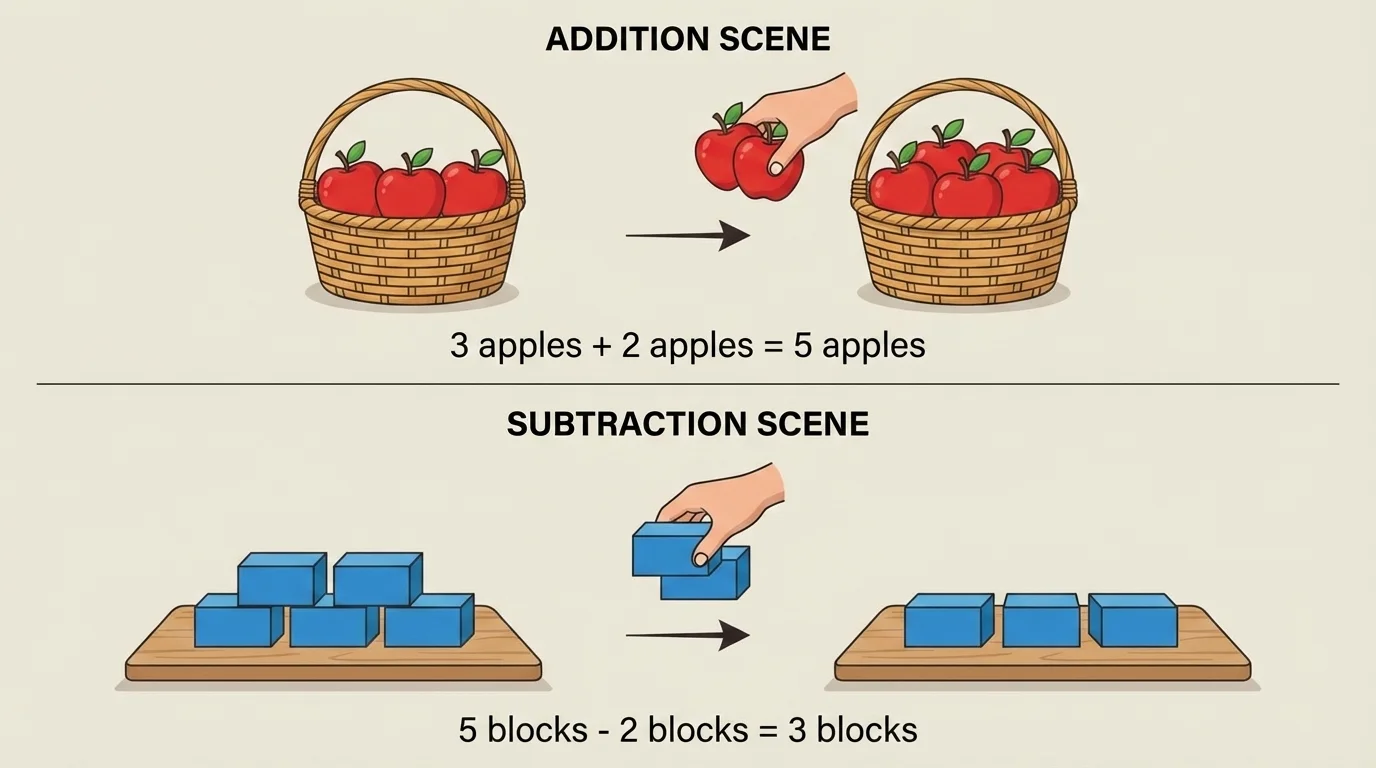
When we add, the group gets bigger. When we subtract, the group gets smaller. We work with totals up to \(10\), like \(1 + 4 = 5\), \(2 + 3 = 5\), \(6 - 1 = 5\), and \(8 - 3 = 5\).
Sum is the answer when we add. Difference is the answer when we subtract.
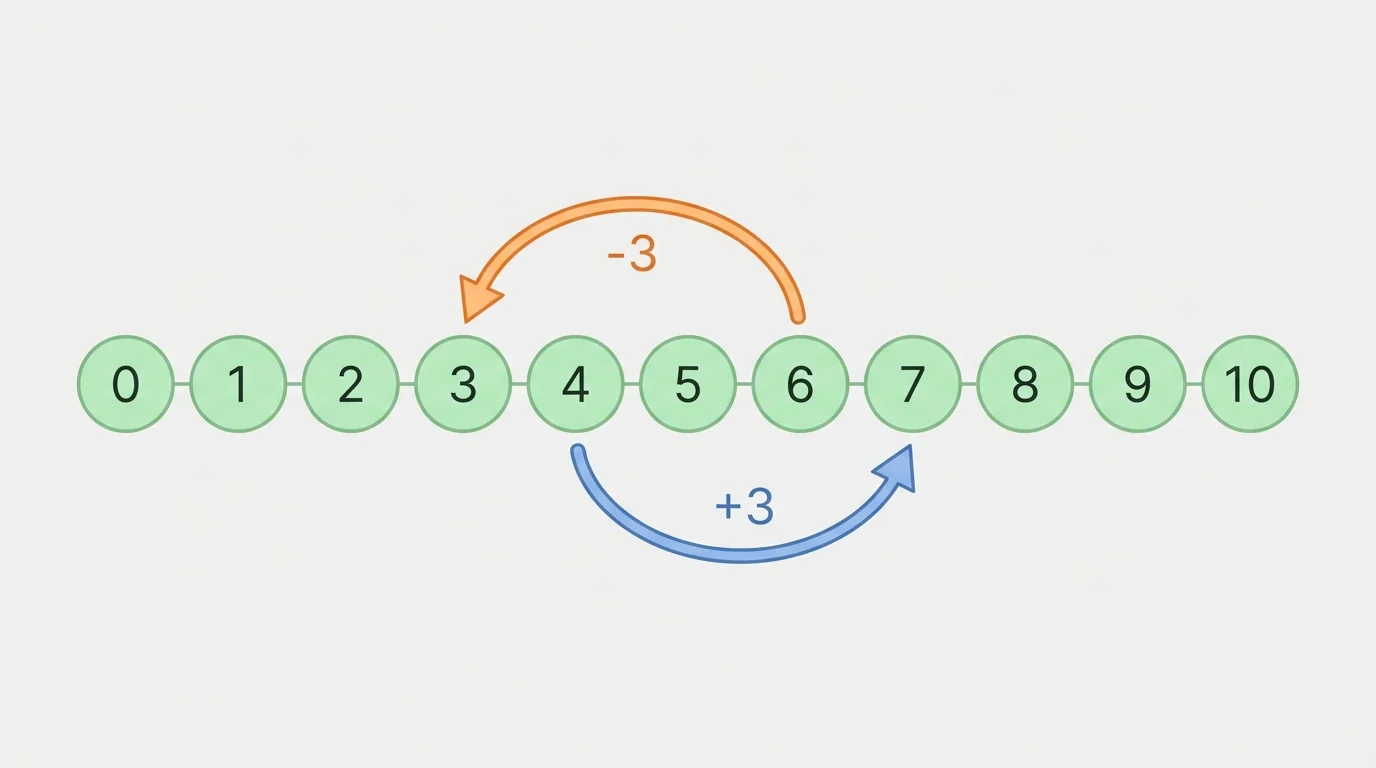
A simple story can help us see the math, as [Figure 2] helps show on a number path. "There are \(4\) ducks. \(1\) more duck comes." The math is \(4 + 1 = 5\). "There are \(5\) ducks. \(2\) swim away." The math is \(5 - 2 = 3\).
We can count to solve problems. For addition, we can count on. For subtraction, we can count back. A number path helps us move forward for addition and backward for subtraction.
Start with the first number. Then move or count the second number. For \(4 + 3\), start at \(4\) and count on: \(5, 6, 7\). So \(4 + 3 = 7\). For \(6 - 3\), start at \(6\) and count back: \(5, 4, 3\). So \(6 - 3 = 3\).
You can also use fingers, toys, cubes, or pictures. If you see \(2\) balls and then \(2\) more balls, you can count all: \(1, 2, 3, 4\). That means \(2 + 2 = 4\).
Counting in order helps a lot: \(0, 1, 2, 3, 4, 5, 6, 7, 8, 9, 10\). We use these numbers to find how many there are.
Sometimes we know the whole group first and then take some away. If there are \(7\) birds and \(1\) flies away, we count back one step: \(7 - 1 = 6\). Counting back is like taking one little hop backward on the number path from [Figure 2].
Let's solve some small number stories step by step.
Worked example 1
There are \(2\) toy cars. \(3\) more toy cars come. How many toy cars are there now?
Step 1: Find the starting number.
The story starts with \(2\) toy cars.
Step 2: See what happens.
\(3\) more come, so we add.
Step 3: Count on.
Start at \(2\): \(3, 4, 5\).
The sum is \(2 + 3 = 5\).
This answer means there are \(5\) toy cars now.
Worked example 2
There are \(5\) bananas. \(2\) bananas are taken away. How many bananas are left?
Step 1: Find the starting number.
The story starts with \(5\) bananas.
Step 2: See what happens.
\(2\) are taken away, so we subtract.
Step 3: Count back.
Start at \(5\): \(4, 3\).
The difference is \(5 - 2 = 3\).
This answer means \(3\) bananas are left.
Worked example 3
\(4\) birds sit on a fence. \(1\) more bird comes. How many birds are there?
Step 1: Start with the first number.
We have \(4\) birds.
Step 2: Add the new bird.
One more means add \(1\).
Step 3: Count on one step.
After \(4\) comes \(5\).
The sum is \(4 + 1 = 5\).
This kind of quick addition helps with small changes, like adding \(1\), \(2\), \(3\), \(4\), or \(5\).
Many games use adding and subtracting. When you pick up pieces, your total gets bigger. When you give some away, your total gets smaller.
We can also subtract with very small numbers, as [Figure 3] shows in everyday counting scenes. If \(3\) frogs are on a log and \(1\) jumps off, then \(3 - 1 = 2\). If \(2\) kittens are sleeping and \(2\) run away, then \(2 - 2 = 0\). Zero means none are left.
Math is all around us. We can see little number stories during snack time, playtime, and cleanup time.
At snack time, you might have \(3\) crackers and get \(2\) more. That is \(3 + 2 = 5\). At cleanup time, there may be \(6\) blocks in a box, and \(1\) block is taken out. That is \(6 - 1 = 5\).
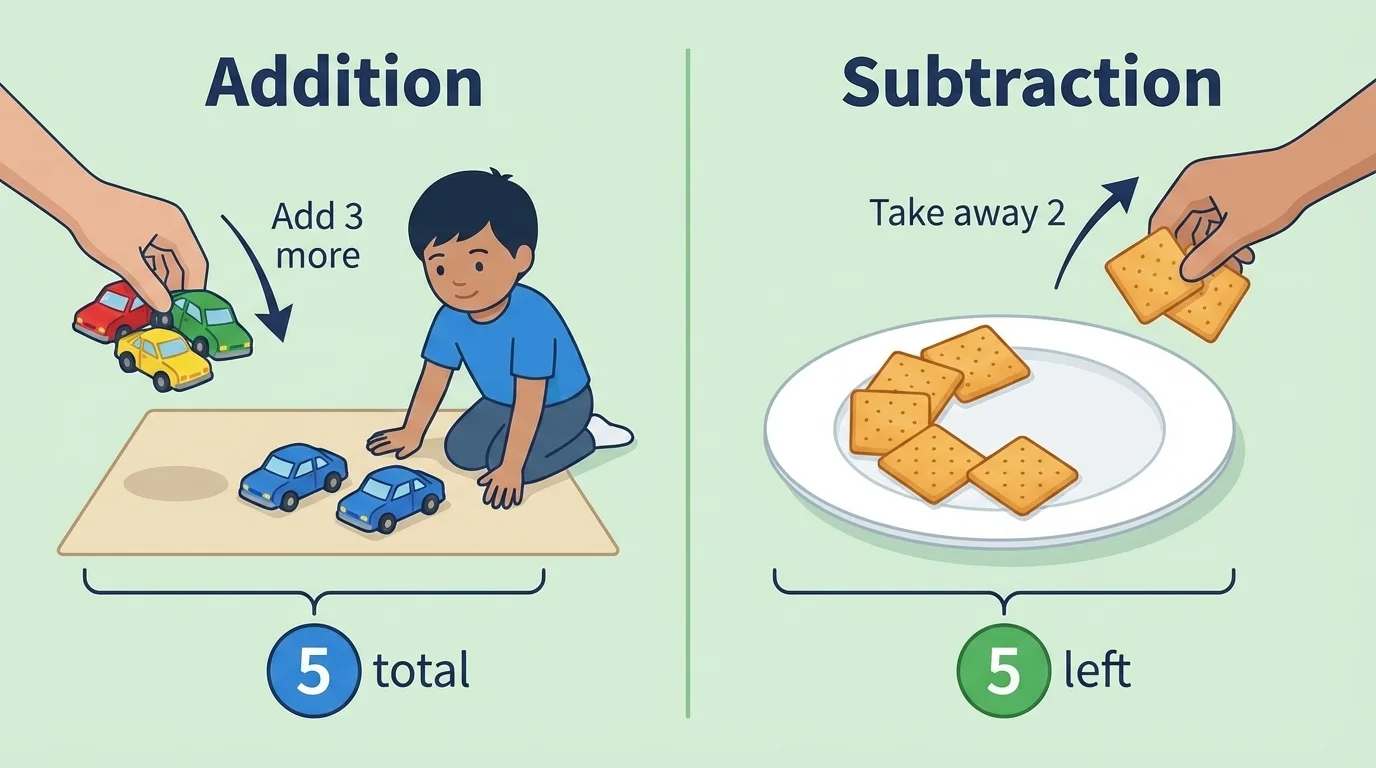
On the playground, \(5\) children are at the slide. Then \(2\) more come. Now there are \(7\): \(5 + 2 = 7\). If \(7\) children are playing and \(3\) go home, then \(7 - 3 = 4\).
These stories help us match words to math. Words like more, come, and join often mean add. Words like take away, left, and go away often mean subtract. We can use the real-life counting idea from [Figure 3] when we solve our own little stories.
Addition and subtraction are connected. If \(2 + 3 = 5\), then \(5 - 3 = 2\) and \(5 - 2 = 3\). The same numbers can make a small family of facts.
If your answer does not make sense, count the objects again. For addition, the answer should be bigger or the same only when adding \(0\). For subtraction, the answer should be smaller or the same only when subtracting \(0\).
