The United States declared political independence in 1776, but its cultural identity took much longer to develop. Long before film, streaming, or social media, Americans argued about freedom, religion, race, ambition, nature, and power through poems, speeches, essays, memoirs, and novels. Those arguments did not stay in the past. They still shape debates today about who belongs, what success means, and whether American ideals match American reality.
To study foundational American literature is to read the country thinking out loud. Some writers celebrate possibility; others expose hypocrisy. Some speak in confident public voices, while others turn inward and question everything. Together, these works form a record of a nation inventing itself and criticizing itself at the same time.
Foundational American literature includes major works from the eighteenth, nineteenth, and early twentieth centuries that have had lasting influence on American culture, language, values, and literary tradition. These texts matter not because they all agree with one another, but because they establish the major questions American writers keep returning to: What is freedom? What is the self? What do democracy and equality actually require? How should individuals relate to society, nature, and history?
These works are also challenging because they are deeply connected to historical moments. Reading them well means doing more than following the plot. It means noticing diction, tone, structure, symbolism, and point of view while also considering the world in which the text was written. A slave narrative, a transcendentalist essay, and a modernist poem all ask readers to think differently about language and truth.
Theme is a central idea or insight explored in a literary work, such as freedom, identity, ambition, or isolation.
Historical context is the social, political, and cultural background that helps explain a text's meaning.
Author's purpose is the reason a writer creates a text, such as to persuade, criticize, reflect, entertain, or reveal injustice.
When you compare works from the same period, you can see how writers respond to similar pressures in very different ways. Two authors living in the same century may confront the same subject, such as democracy or death, but one may celebrate it while another questions it. That tension is one of the most important features of American literature.
It helps to think of American literature as a developing conversation across three broad periods, as [Figure 1] shows. The eighteenth century is shaped by revolution, religion, public virtue, and the creation of a new national identity. The nineteenth century expands into debates about slavery, reform, westward growth, individualism, industrialization, and the meaning of democracy. The early twentieth century reflects modernization, urban life, war, immigration, racial conflict, and disillusionment.
Each period has distinct styles. Eighteenth-century writing often values clarity, reason, moral instruction, and civic purpose. Nineteenth-century literature becomes more varied and experimental, ranging from transcendentalism to realism, from tightly compressed lyric poetry to sprawling novels. Early-twentieth-century writing often becomes sharper, leaner, and more fractured, reflecting a world that feels faster and less stable.
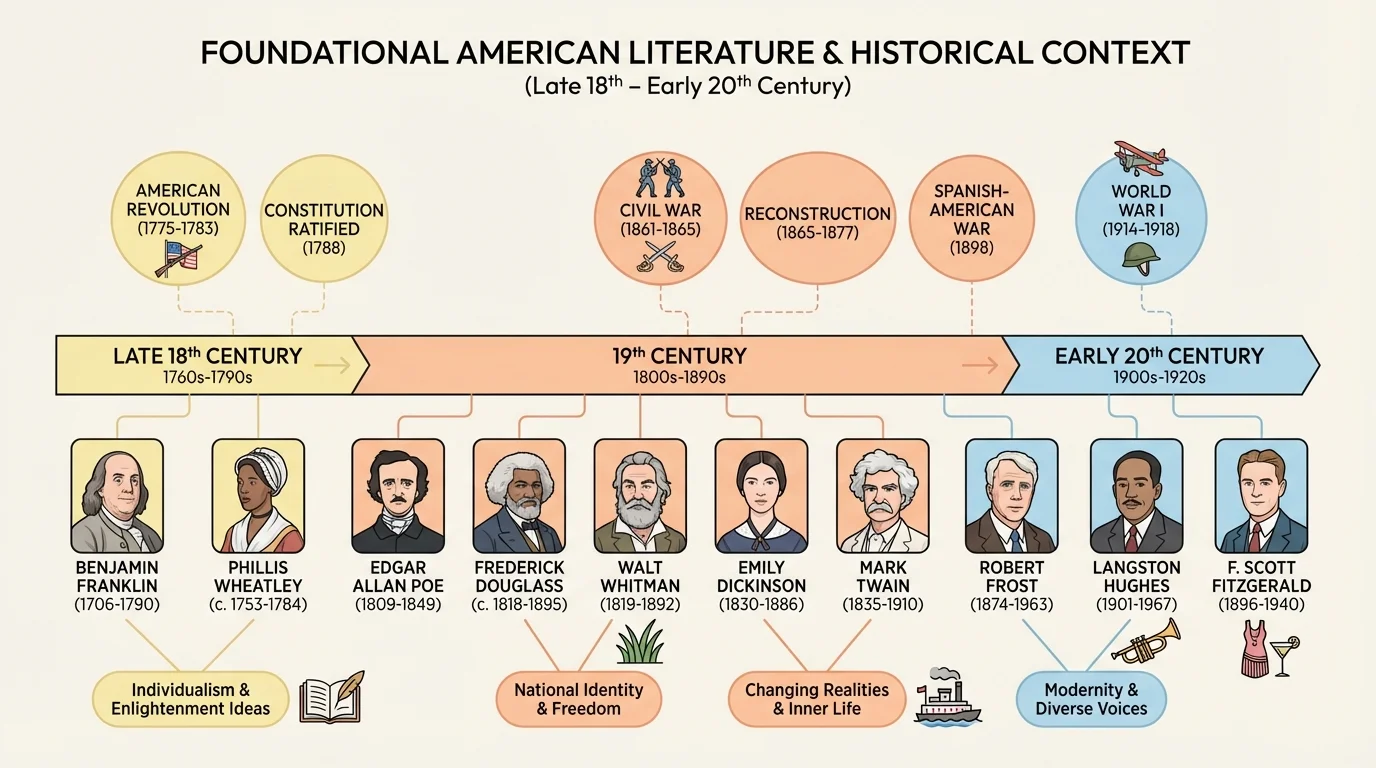
The periods are useful, but they are not rigid boxes. Writers overlap, borrow from older traditions, and challenge the expectations of their age. Still, the historical sequence matters because literature changes as the nation changes. A poem written in a revolutionary culture sounds different from one written after the Civil War or during the Jazz Age.
As you read across time, ask two questions again and again: What is this writer saying about America? and How does the writer's form help communicate that idea? Those questions connect close reading to larger interpretation.
One of the earliest major American writers is Benjamin Franklin, and his work helps establish a lasting image of the self-made individual, as [Figure 2] illustrates. In The Autobiography, Franklin presents himself as disciplined, practical, self-improving, and devoted to public usefulness. He turns his own life into a model, suggesting that character can be built through effort, planning, and habit.
Franklin's writing reflects Enlightenment values: reason, order, improvement, and confidence in human ability. He often sounds worldly and persuasive. Yet his work is not just private reflection. It is also a statement about what kind of nation America might become: energetic, rational, industrious, and socially mobile.
Phillis Wheatley offers a different but equally important early voice. Enslaved and brought from Africa to America as a child, Wheatley became a published poet whose work combines religious language, classical references, and sharp awareness of liberty and human dignity. Her poems often appear formal and controlled, but that formal style should not hide the complexity of her position. She writes within a culture that praises freedom while allowing slavery.
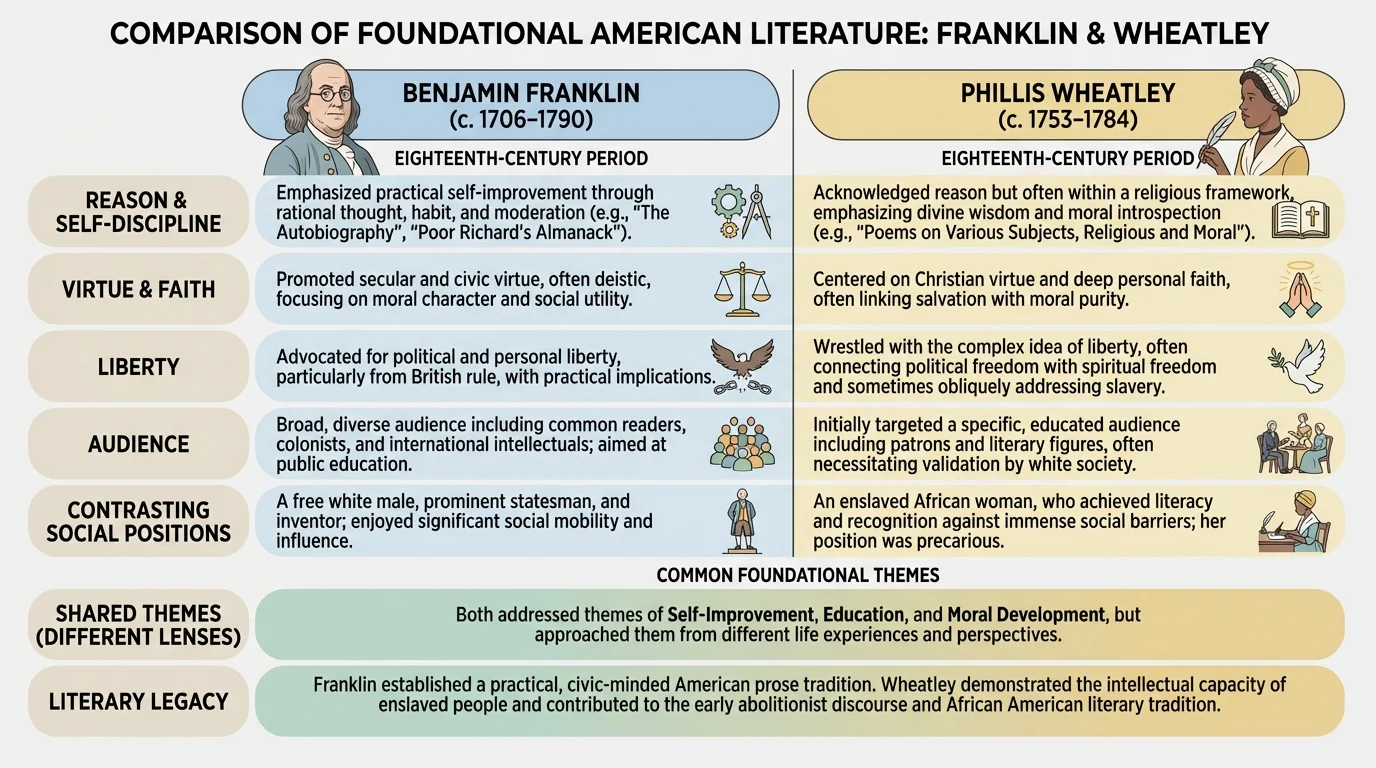
Reading Franklin beside Wheatley reveals how one period can contain very different experiences of America. Franklin emphasizes self-construction through effort. Wheatley writes from within a system that denies basic freedom, so her treatment of spiritual equality and liberty carries a different force. Both writers engage with virtue and human potential, but they do so from radically unequal positions.
Another early American current is the influence of Puritan writing, especially in earlier colonial texts such as Jonathan Edwards's sermons or Anne Bradstreet's poetry. Puritan literature often focuses on sin, grace, divine judgment, and the struggle to understand God's will. Even when later writers move away from Puritan theology, the seriousness of moral self-examination remains part of the American literary tradition.
Comparing two eighteenth-century texts
The Autobiography by Benjamin Franklin and selected poems by Phillis Wheatley both address human potential, but they treat it differently.
Step 1: Identify the shared topic.
Both works consider what gives a person worth and what enables growth.
Step 2: Notice the difference in perspective.
Franklin focuses on self-discipline and public success. Wheatley emphasizes spiritual value, moral intelligence, and the contradiction between Christian ideals and social injustice.
Step 3: Evaluate the meaning of that difference.
The comparison shows that early American literature is not one unified voice. It includes aspiration, but also exclusion and tension.
That comparison matters because it prevents oversimplified history. The eighteenth century is not only a story of national beginnings. It is also a period in which ideals of liberty coexist with inequality. Foundational literature often becomes most powerful exactly where those contradictions are visible.
The nineteenth century is one of the richest and most conflicted periods in American literature, as [Figure 3] makes clear. The nation expands geographically, industrially, and politically, but it also becomes more divided over slavery, class, gender, and power. Writers respond in many forms: speeches, slave narratives, essays, poems, short stories, and novels.
A major intellectual movement of the period is transcendentalism, associated especially with Ralph Waldo Emerson and Henry David Thoreau. Emerson's essay Self-Reliance argues that individuals should trust their own insight rather than blindly conform to social expectations. Thoreau, in Walden and Civil Disobedience, explores simplicity, nature, conscience, and resistance to unjust government. These works value the individual, but not in a shallow way. They ask readers to live deliberately and morally.
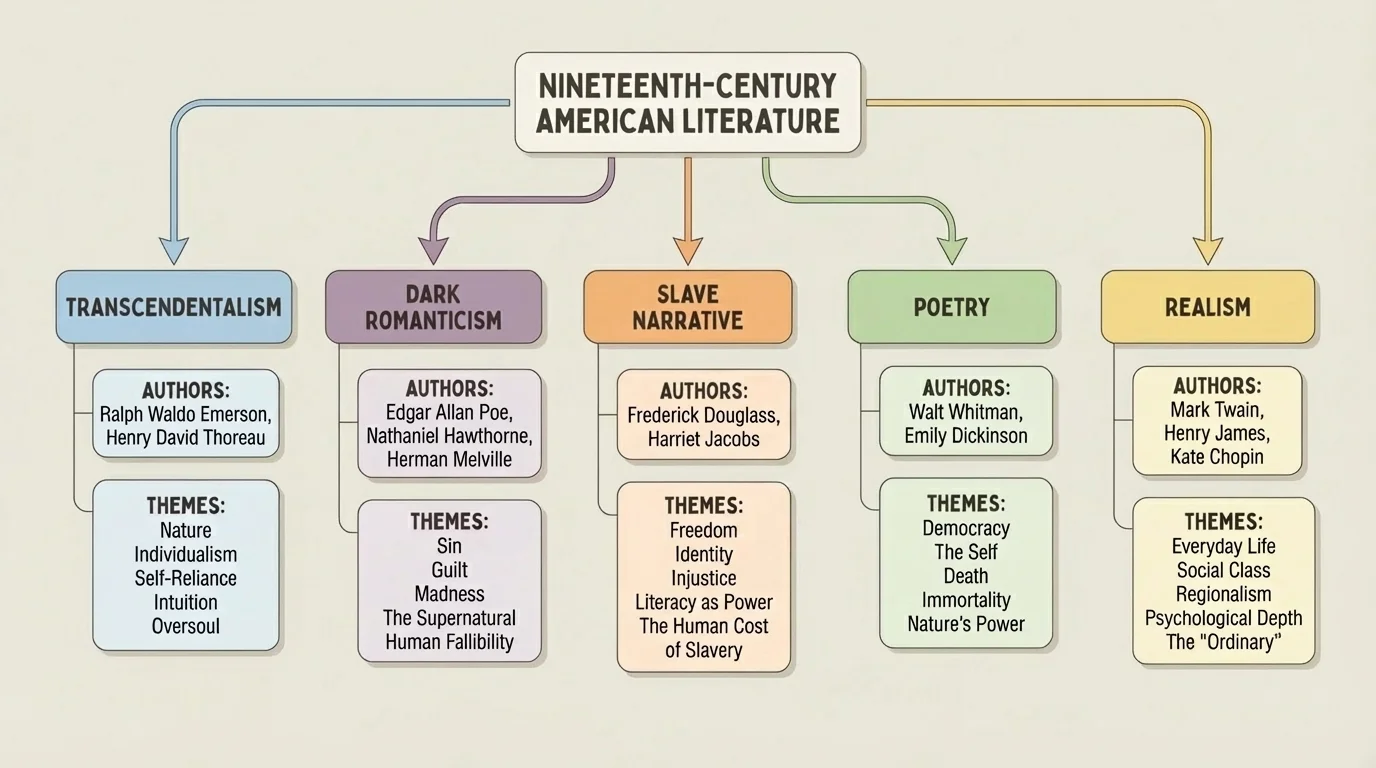
At the same time, darker strands of nineteenth-century literature challenge optimism. Edgar Allan Poe explores obsession, madness, guilt, and psychological instability. Nathaniel Hawthorne examines sin, secrecy, and the burden of moral judgment in works such as The Scarlet Letter. Herman Melville's Moby-Dick turns a whaling voyage into a vast meditation on knowledge, fate, power, and human obsession. These writers often suggest that the human mind is not transparent or fully under control.
Frederick Douglass's Narrative of the Life of Frederick Douglass, an American Slave is one of the most powerful works in American literature because it joins personal testimony to political argument. It is a slave narrative, but it is also a sophisticated work of rhetoric, self-formation, and moral indictment. Douglass shows how slavery damages both the enslaved and the society that permits it. He also presents literacy as a path to consciousness and resistance.
Walt Whitman and Emily Dickinson, two of the greatest American poets, transform poetry in very different ways. Whitman's Leaves of Grass uses long, expansive lines and a public, inclusive voice. He celebrates the body, democracy, labor, sexuality, and the multiplicity of the self. Dickinson, by contrast, writes short, compressed poems marked by dashes, slant rhyme, and intense inwardness. She explores death, faith, consciousness, and the limits of language. Both are original, but they sound almost like opposites.
Later in the century, Mark Twain's The Adventures of Huckleberry Finn uses humor, vernacular speech, and satire to question racism, hypocrisy, and so-called civilization. The novel is often read as an example of American realism because it pays close attention to speech, social behavior, and everyday life. Yet it is also morally complex. Huck's struggle over whether to help Jim exposes the gap between social law and human conscience.
Herman Melville's Moby-Dick was not widely recognized as a masterpiece when it first appeared. Its reputation grew much later, showing that literary importance can change across time as readers and critics reinterpret a work.
This century shows why historical context matters so much. The same nation that produces democratic idealism also produces slavery and civil war. The same culture that celebrates progress also generates anxiety, alienation, and doubt. Nineteenth-century literature does not hide those contradictions; it dramatizes them.
By the early twentieth century, the United States is more urban, industrial, and globally connected, and literature reflects both excitement and strain, as [Figure 4] suggests. Writers confront war, class divisions, racial injustice, mechanization, and the uneasy promise of modern life. The old confidence that progress automatically leads to moral improvement begins to weaken.
Stephen Crane, though active at the turn of the century, helps open this period with works that emphasize vulnerability, conflict, and indifferent social forces. In The Red Badge of Courage, he explores fear, courage, and the psychological experience of war rather than simply glorifying battle.
Robert Frost often seems plain and accessible at first, but poems such as Mending Wall and Stopping by Woods on a Snowy Evening reveal tension beneath their surface simplicity. Frost uses rural settings to ask difficult questions about boundaries, duty, isolation, and desire.
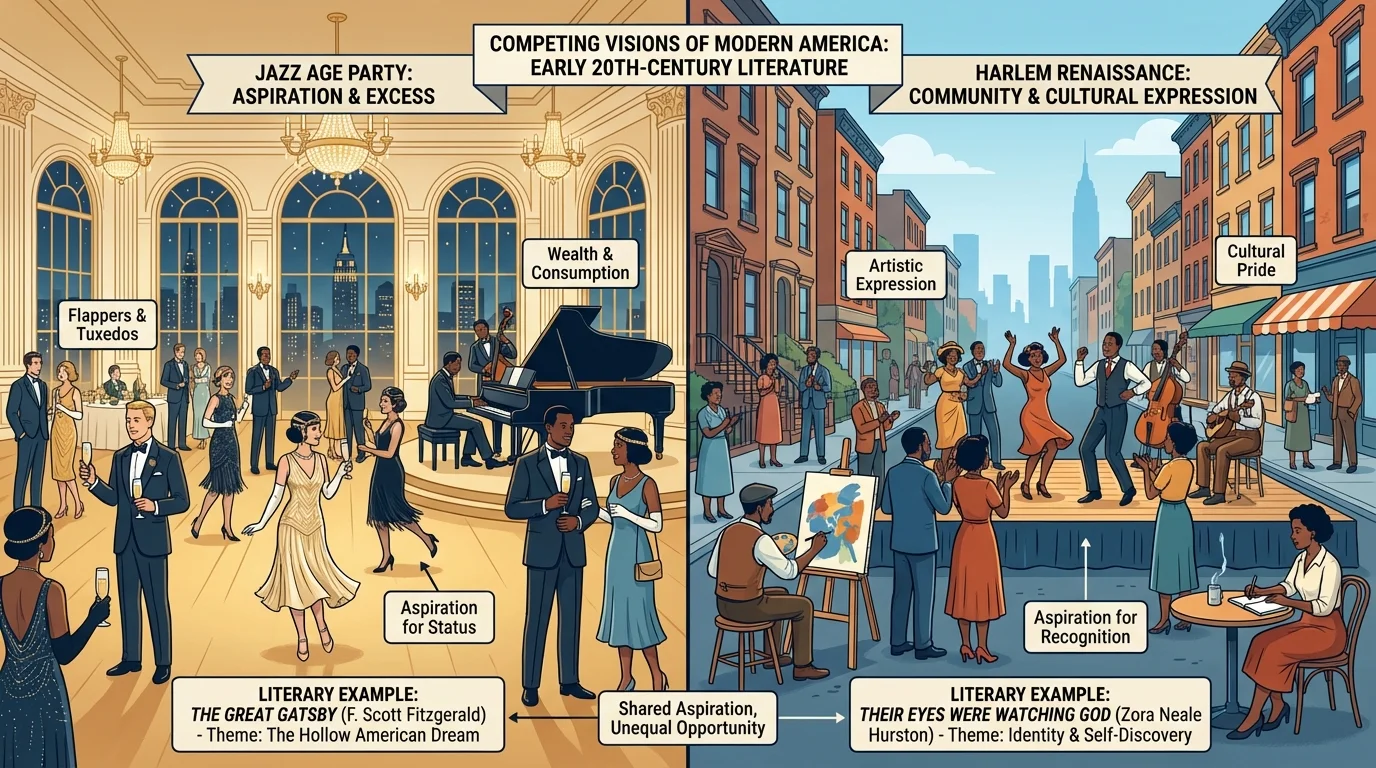
Langston Hughes, a central figure of the Harlem Renaissance, writes with musical energy, political force, and deep attention to Black experience in America. In poems such as I, Too and The Negro Speaks of Rivers, Hughes insists on dignity, memory, endurance, and belonging. His poetry answers exclusion not by asking permission, but by asserting presence.
F. Scott Fitzgerald's The Great Gatsby examines wealth, desire, illusion, and the corruption of the American Dream. The novel's glittering parties and elegant surfaces hide emptiness, carelessness, and moral failure. Fitzgerald does not simply describe luxury; he exposes its hollowness when ambition is detached from responsibility and truth.
Early-twentieth-century writers often focus on the distance between appearance and reality. That concern connects Fitzgerald and Hughes in an unexpected way. Both deal with national promises, but Fitzgerald shows a dream deformed by money and status, while Hughes insists that the promise of America must include those whom the nation has marginalized.
"I, too, sing America."
— Langston Hughes
This line is brief, but its effect is enormous. It claims inclusion, artistic authority, and national identity in just a few words. Foundational literature often works like that: it compresses a historical struggle into language that remains memorable across generations.
One of the strongest ways to interpret literature is to compare texts from the same historical period because comparison helps reveal both shared concerns and striking differences in treatment. A useful comparison does not just list similarities. It asks how two or more authors approach the same theme through different voices, structures, assumptions, and purposes.
[Figure 5] Consider Walt Whitman and Emily Dickinson. Both write in the nineteenth century and both are deeply interested in the self, death, and the mysteries of experience. Yet Whitman's poetic style is expansive, public, and overflowing. He often sounds as if he is speaking to the entire nation. Dickinson's style is compressed, private, and elliptical. She often sounds as if she is recording a moment of consciousness too intense or strange to state directly.
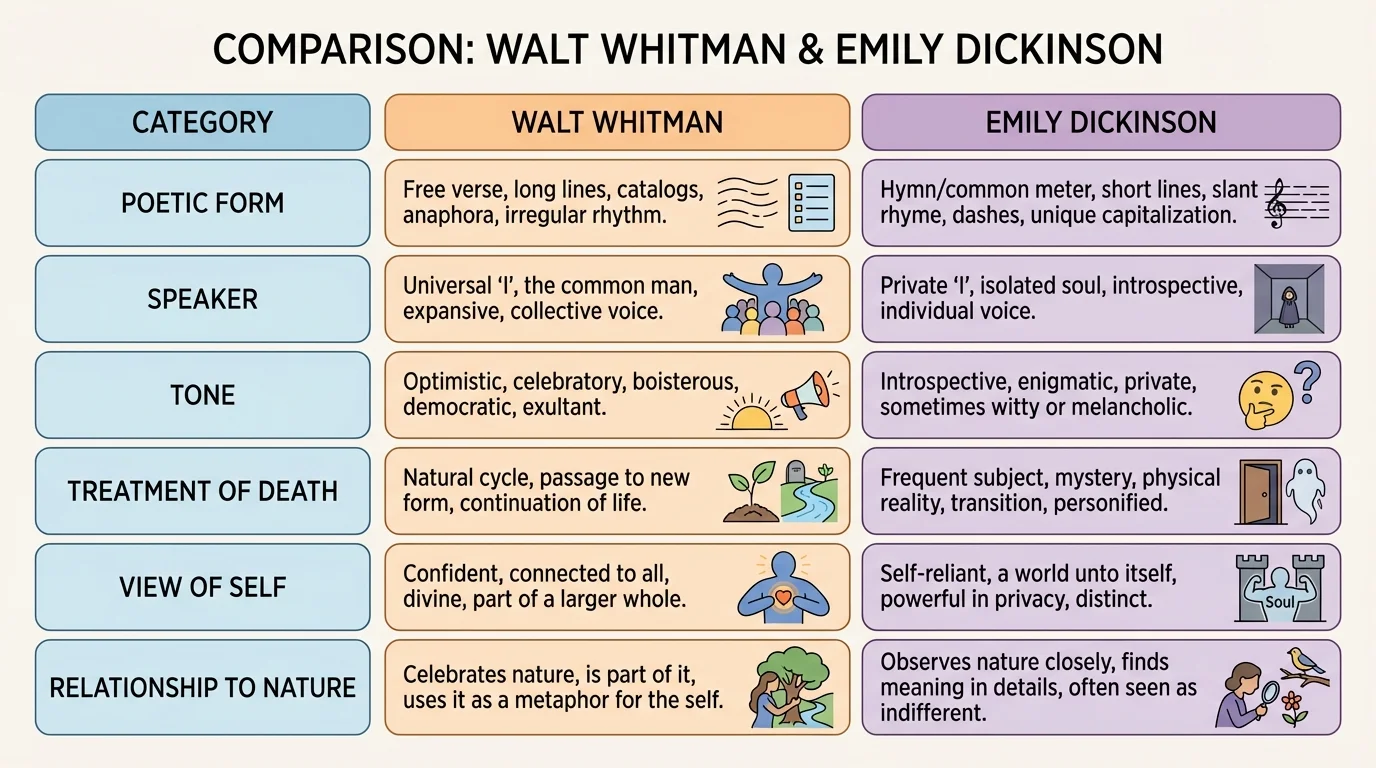
That difference in style shapes theme. Whitman tends to treat the self as multiple, energetic, and connected to others. Dickinson often presents the self as sharply observant but solitary, testing the edges of faith and language. Both confront death, but Whitman may absorb it into a larger cycle of life, while Dickinson often lingers in uncertainty, suspense, or eerie precision. Comparing them reveals that a shared topic does not lead to a shared meaning.
Another strong comparison is Frederick Douglass and Mark Twain. Both address American hypocrisy and the failure of moral systems, though in very different genres. Douglass writes from direct experience of slavery and uses autobiography to expose cruelty and assert humanity. Twain uses fiction and satire to reveal the absurdity and violence of racist social norms. Douglass is urgent and openly argumentative; Twain often works indirectly, letting irony expose what society refuses to admit.
Franklin and Wheatley also form a revealing same-period comparison, as we saw earlier in [Figure 2]. Both engage ideas of virtue and human possibility in the eighteenth century, but Franklin writes from confidence in mobility and self-fashioning, while Wheatley writes from within a system that limits freedom. The contrast demonstrates that themes gain meaning through social position and historical circumstance.
In the early twentieth century, Hughes and Fitzgerald can be paired around the topic of the American dream. Fitzgerald shows aspiration becoming illusion in a culture shaped by wealth and spectacle. Hughes reclaims national promise for Black Americans excluded from full citizenship and recognition. Both texts are about desire and belonging, but one emphasizes decay behind glamour while the other asserts justice and future possibility.
| Period | Texts Compared | Shared Theme or Topic | Key Difference |
|---|---|---|---|
| Eighteenth century | The Autobiography and Wheatley's poems | Human potential, virtue, freedom | Self-improvement versus liberty under oppression |
| Nineteenth century | Douglass and Twain | American hypocrisy, morality, race | Autobiographical testimony versus satirical fiction |
| Nineteenth century | Whitman and Dickinson | Self, death, consciousness | Expansive public style versus compressed inward style |
| Early twentieth century | Hughes and Fitzgerald | Dream, identity, belonging | Demand for inclusion versus critique of empty wealth |
Table 1. Comparisons of foundational American texts from the same period that address similar themes.
Comparison is not only about what texts say. It is also about how they say it. A poem, memoir, sermon, and novel may all address freedom, but each genre shapes the reader's experience differently. Paying attention to those formal choices makes your interpretation sharper and more convincing.
Strong literary interpretation depends on reading actively. Start with close reading: notice unusual word choice, repeated images, shifts in tone, contradictions, and structural patterns. If a writer repeats a word like "liberty," "self," or "dream," ask whether the repetition confirms a clear value or exposes tension.
Next, identify tone, the writer's or speaker's attitude toward the subject. Franklin often sounds practical and confident. Douglass can sound controlled but morally forceful. Dickinson may sound skeptical, playful, startled, or unsettling within just a few lines. Tone matters because two texts may discuss the same idea while guiding readers to very different judgments.
How to connect evidence to interpretation
A strong interpretation moves from observation to meaning. First notice a detail, such as Whitman's long lines or Dickinson's dashes. Then ask what effect that detail creates. Finally, connect that effect to a larger theme. Literary analysis becomes convincing when it explains how specific textual choices produce meaning.
Also consider symbolism. In many foundational works, physical objects carry abstract meaning. The scarlet letter in Hawthorne's novel becomes more than cloth; it represents shame, identity, and shifting community judgment. Gatsby's green light is not just a distant lamp; it represents desire, illusion, and the persistence of longing.
Another key strategy is to analyze point of view. Who speaks, and from what position? Douglass's first-person narration creates authority through lived experience. Twain's use of Huck Finn's voice allows the novel to reveal social prejudice from inside ordinary speech. Dickinson's speakers often feel intensely private, while Whitman's speaker reaches outward and tries to contain multitudes.
Historical context should deepen interpretation, not replace it. Saying that Douglass wrote during slavery is only the beginning. The real question is how that context shapes his rhetorical urgency, his treatment of literacy, and his representation of violence and agency. Context becomes useful when it helps explain textual choices.
From earlier literary study, remember that analysis requires evidence. A theme is not just a topic word like "freedom" or "death." It is a claim about what the text suggests regarding that topic.
Finally, evaluate complexity rather than forcing simple conclusions. Foundational texts often resist easy answers. Emerson praises self-reliance, but complete individual independence can also become isolating. Whitman celebrates democracy, but Douglass exposes the nation's betrayal of democratic ideals. Fitzgerald presents glamour and emptiness at once. Great literature often becomes great because it holds contradiction without dissolving it.
These works continue to matter because later American writing grows out of them. Hughes speaks back to exclusion in ways that echo and revise earlier national ideals. Modern debates about opportunity still sound haunted by Franklin's self-made model and Fitzgerald's critique of ambition. Questions about race, voice, belonging, and truth remain shaped by Wheatley, Douglass, Twain, and many others.
They also matter because they train readers to think historically and critically. Foundational American literature is not a museum of dead texts. It is a living archive of arguments about power, conscience, and identity. When you read these authors closely, you are not just learning what Americans once believed. You are examining how language can defend ideals, challenge injustice, and reveal the distance between myth and reality.
Even now, when public life moves fast and information is constant, these texts ask for a different kind of attention: slower, more exact, more reflective. That is one reason they remain foundational. They do not merely tell us what happened. They show how a culture imagines itself, and how writers push back when that imagination becomes false.
