Have you ever tried to build a new toy or play a new game just by looking at the pictures, and it didn't quite work? Then you read the directions, and suddenly everything made sense. 📘 That is exactly how words and pictures work together in informational texts.
An informational text is writing that gives you facts and teaches you about real things. It does not tell a made-up story. It helps you learn about the world.
You see informational texts all around you, such as:
These texts often include special pictures and text features that help you, such as titles, headings, bold words, and different kinds of illustrations.
In informational texts, the words and the pictures are like teammates on a sports team. They both try to help you understand the main ideas.
The words usually tell you:
The pictures (illustrations) can be:
These pictures usually help you see:
When you use both words and pictures together, you understand the text more deeply than if you only read the words or only look at the pictures.
Different kinds of illustrations give you different kinds of information. Let's explore some of the most common ones you will see in informational texts. 📚
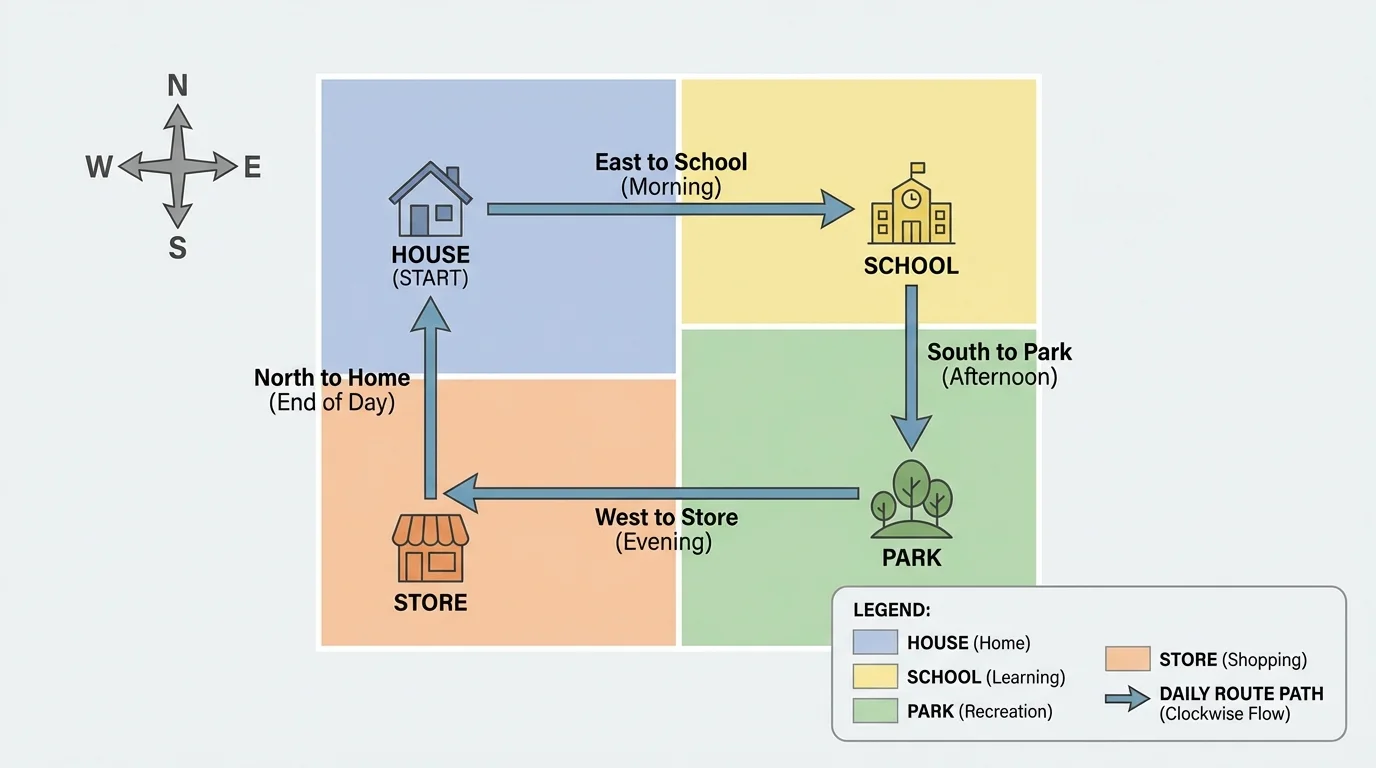
A map shows places from above, like you are a bird looking down. A map can help you answer "where" and sometimes "how" questions, as shown in [Figure 1].
Important parts of a map often include:
When you read a text about a place, the map helps you see:
For example, if the text says, "The school is north of the park," you can look at the compass rose and see which direction is north to find the school.
Later, when you think back to maps, you can remember how the simple town map in [Figure 1] helped show a route and directions with just a few clear symbols.
A photograph is a real picture taken with a camera. In informational texts, photographs help you see what something actually looks like in real life.
Photographs can help you answer:
Always read the caption under a photograph. The caption is a short sentence or two that explains what is happening in the picture. It connects the photo to the words in the text.
A diagram is a special kind of drawing that shows parts of something or steps in a process. A plant diagram, like the one in [Figure 2], can help you see how all the parts work together.
Diagrams often have:
Diagrams are very helpful for answering "how" and "why" questions, such as:
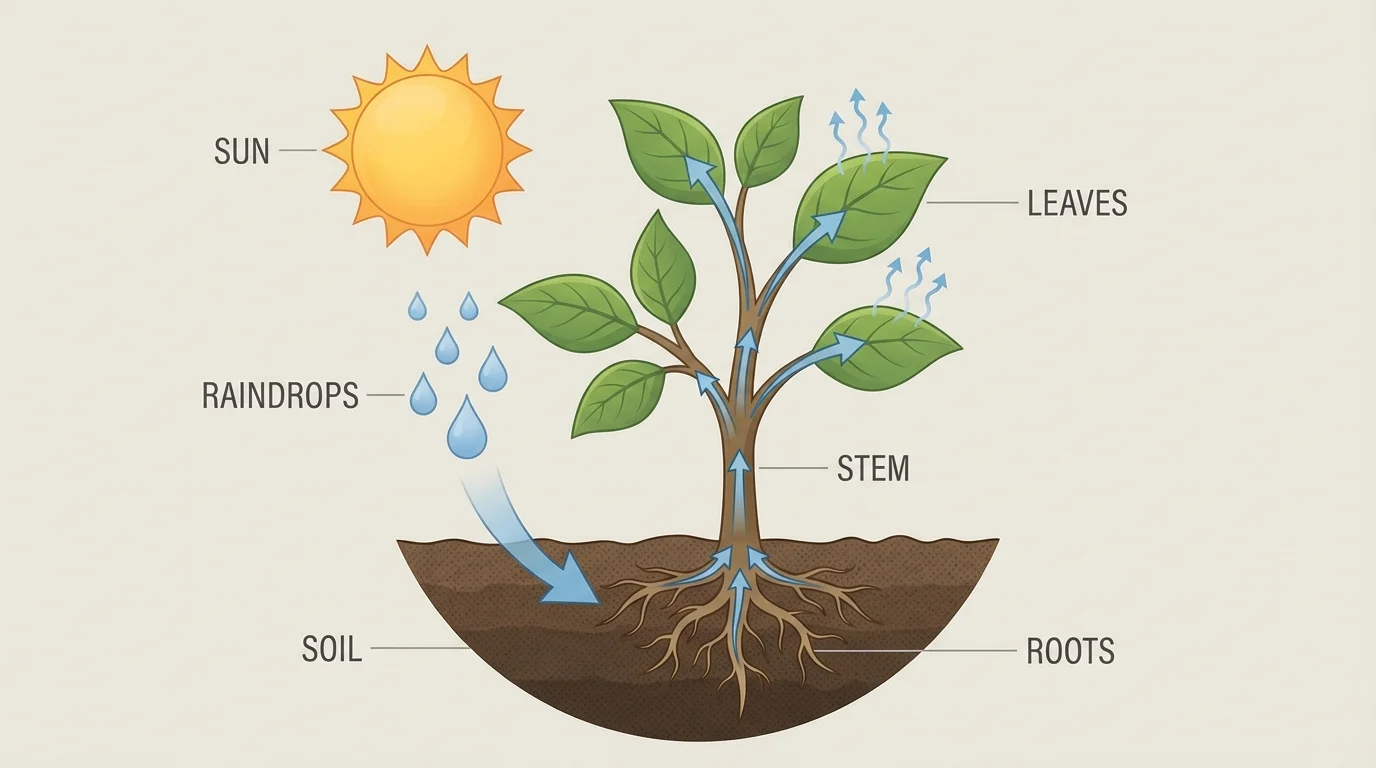
When you remember the plant picture in [Figure 2], you can think about how diagrams make invisible things (like water moving inside the plant) easier to understand.
A chart or graph helps you compare information, such as numbers or amounts. For example, a chart might show how many books each student in a class read this month.
Charts and graphs can help you answer:
Even though charts may have numbers like \(5\) or \(10\), you do not always have to do hard math. You mainly need to notice which bars or lines are taller, shorter, higher, or lower.
To really understand an informational text, you should use both the words and the illustrations together. Here is how they can help answer different kinds of questions:
| Question Word | Words Can Tell You… | Illustrations Can Show You… |
|---|---|---|
| Where? | Names of places, like "near the river" or "in Africa." | Exact position on a map or photo of the place. |
| When? | Times and dates, like "at night" or "in winter." | Clues like snow, sunshine, or darkness. |
| Why? | Reasons and causes, like "because" and "so." | Before-and-after pictures that show changes. |
| How? | Step words like "first, next, finally." | Diagrams or arrows showing steps or movement. |
Table 1. How words and illustrations help answer different kinds of questions.
Example: Using a Short Text and a Diagram
Text: "Plants need sunlight and water to live. First, water goes into the soil. Then the roots soak up the water. Next, the water travels up the stem to the leaves."
Step 1: Use the words.
The words tell you what plants need (sunlight and water) and how the water moves (soil → roots → stem → leaves).
Step 2: Use the diagram.
A diagram like the plant in [Figure 2] might show arrows from the soil to the roots, up the stem, and to the leaves, plus a sun shining on the plant.
Step 3: Put them together.
Now you can explain: "Plants get water from the soil through their roots, and the water moves up the stem to the leaves. They also need sunlight from above."
The words and the diagram worked together to answer the "how" question.
When you practice this, you become better at explaining key events in the text: where, when, why, and how they happen.
Using this strategy will make you a more powerful reader who really understands what you read.
You do not only use this skill in school. You use it in many parts of your life, such as:
Any time you match pictures and words to understand something in real life, you are using this same reading skill.
Sometimes readers get confused because they do not use the text and illustrations together correctly. Here are some common mistakes and how to fix them.
Remember that pictures and words work together. If you use only one, you might miss important information.
Mistake 1: Only looking at the pictures.
Some readers look only at pictures and guess what the text says. This can be wrong, especially if the picture is just one small part of the story.
Fix: Always read the words and then look back at the pictures. Check that your ideas match both.
Mistake 2: Skipping the captions.
Captions often tell you exactly who is in a photograph, where it is, or what is happening. If you skip them, you may miss key facts.
Fix: Read every caption you see. Treat it like a tiny piece of the text.
Mistake 3: Ignoring maps and diagrams.
Some readers think maps and diagrams are "extra" and skip them. But, as the town map in [Figure 1] and the plant diagram in [Figure 2] show, these illustrations can explain things the words cannot show as clearly.
Fix: Always stop and study any map or diagram. Ask yourself, "What new information does this give me?"
Mistake 4: Not matching details.
Sometimes the picture and the words both give details, but the reader does not connect them. For example, a text might say "the north part of town," but the reader never checks which part is north on the map.
Fix: When you see a direction, number, or name in the words, look for that same detail in the picture.
Let's put everything together with a short story and a map. Imagine you read this passage and follow the trip on a simple neighborhood map.
Text: "Mia leaves her house and walks east to the school. After school, she walks south to the park to play. Then she walks west to the store. Finally, she walks north back to her house."
Example: Answering Questions with the Map and Text
Step 1: "Where does Mia start?"
The text says she leaves her house. On the map in [Figure 3], you find the house symbol. That is the starting place.
Step 2: "When does she go to the park?"
The text says, "After school, she walks south to the park." So she goes to the park after school but before the store.
Step 3: "How does she get from the school to the park?"
The text uses the word "south." On the map, you look at the compass rose and see that south points down. From the school, she walks down (south) to the park.
Step 4: "Why does she end up back at the house?"
The last sentence says, "Finally, she walks north back to her house." The word "finally" shows this is the last step. The map shows the last arrow going north to the house.
By putting the text and map together, you can clearly explain where Mia goes, when she goes there, and how she travels each part of her trip.
"Reading is more than looking at words; it is making meaning from everything on the page."
— Unknown Teacher
Some authors plan their maps, photos, and diagrams first and write the words later, because they know pictures can make complex ideas much easier to understand.
