Every day, your brain quickly sorts information. When a friend tells you about a movie, when a teacher reads a passage aloud, or when you look at a chart in science, you do not remember every single word or detail. Instead, you figure out what matters most. That skill is called summarizing, and a summary is one of the most useful tools for school and for life.
Summarizing helps you learn from many kinds of information. Sometimes the information is oral communication, such as a class discussion, a speech, or a read-aloud. Sometimes it is visual, such as a map, diagram, photograph, or video. Sometimes it is quantitative, which means it includes numbers, amounts, or data. Strong learners can listen, watch, and read across all these formats and then explain the most important ideas clearly.
A summary is useful because it helps you focus on the main point of the message. If someone tells a long story about recycling at school, the summary is not every example, joke, or repeated point. The summary is the main message and the key details that support it. This makes it easier to remember information, share it with others, and use it in a discussion.
In class discussions, summaries help everyone stay organized. If one student summarizes a video and another student adds information from a chart, a summary can connect both ideas. Summaries also show respect for the speaker or source because they present the information fairly and accurately instead of twisting it or changing it.
Summary is a short explanation of the most important ideas from a source.
Main idea is the most important point the source is mostly about.
Key details are the important facts, examples, or reasons that support the main idea.
When you summarize, you are not trying to copy the source. You are trying to understand it. That means you choose what matters most and say it in your own words. A strong summary is shorter than the original source, but it still keeps the meaning accurate.
A good summary keeps the main idea and a few key details, as [Figure 1] shows with one big idea supported by a small number of important points. If a passage is mostly about how a school garden helps students learn science, the summary should say that the garden teaches students by letting them observe plants, insects, and weather in real life.
The summary should also include only the most important support. For the garden example, useful details might include that students measure plant growth, record weather changes, and study pollinators. Tiny details, such as the exact color of one student's gloves, do not belong unless they are important to the message.

Another important part of summarizing is deciding what to leave out. Repeated ideas, side comments, and personal reactions usually do not belong. If the speaker says, "I think gardens are awesome," that may show opinion, but it may not be part of the central message. A summary should focus more on information than on extra chatter.
Summaries are also usually objective. That means they report the source fairly without adding your own opinion. Instead of saying, "The video was boring but it talked about weather," a stronger summary is, "The video explains how warm and cold air masses affect storms."
Professional reporters, scientists, and historians summarize information all the time. They often study long interviews, detailed notes, and data charts, then share the most important ideas in a much shorter form.
Even when a source is interesting or exciting, your job in a summary is to stay accurate. You are like a careful guide leading someone else to the main points.
When a text is read aloud, you cannot always look back at every sentence, so careful listening matters. First, listen for the topic. Ask yourself, "What is this mostly about?" Then listen for clues that show importance, such as repeated ideas, cause-and-effect relationships, and words like first, because, most importantly, or as a result.
You can also make quick notes while listening. These notes should not be full sentences copied word for word. Instead, write short phrases such as "wolves returned," "elk numbers changed," and "plants grew back." Later, those notes can help you build a short summary.
Example: Summarizing a read-aloud passage
A teacher reads a paragraph about sea turtles. The paragraph explains that sea turtles hatch on beaches, many babies do not survive, and the ones that do survive may travel long distances in the ocean before returning to nest.
Step 1: Find the main idea.
The passage is mostly about the life journey of sea turtles from hatching to adulthood.
Step 2: Pick the key details.
Important details are that sea turtles hatch on beaches, many young turtles face danger, and adults may return later to nest.
Step 3: Put the ideas in your own words.
A strong summary is: Sea turtles begin life on beaches, many do not survive when they are young, and those that live can travel through the ocean before coming back to nest.
Notice that the summary is much shorter than the original passage, but it still includes the most important information in order. That order matters, especially when a source explains steps, events, or changes over time.
If a text read aloud includes a problem and a solution, your summary should include both. If it compares two things, your summary should include the main comparison. The structure of the source helps determine the structure of the summary.
Not all spoken information comes from a read-aloud. You may need to summarize a guest speaker, a classmate's presentation, a podcast clip, or a group discussion. In these situations, strong listening means paying attention not only to facts but also to the speaker's purpose. Is the speaker explaining, persuading, warning, or reporting?
During a discussion, summarizing can help the group move forward. For example, one student might say, "We have heard two main ideas so far: school lunches should be healthier, and students want more choices." That summary helps organize the conversation and shows careful, collaborative listening.
How collaboration improves summaries
When students discuss a source together, each person may notice something different. One student may catch the main idea, another may remember a key example, and another may notice the speaker's reason or evidence. By listening to each other and building on ideas, the group can create a more complete and accurate summary.
When summarizing a speaker, it is helpful to pay attention to repeated phrases, changes in tone, and signal words. If a speaker says, "The most important reason is..." that is a clue. If a speaker tells a long personal story, ask whether the story supports a larger point. If it does, include the larger point in the summary rather than every part of the story.
You should also be ready to summarize what others say before adding your own thoughts. This is a strong discussion move. For example: "I heard Maya say that the article shows bees are important because they pollinate crops." That sentence shows that you listened before responding.
Visual sources communicate ideas without relying only on sentences. A poster, video, photograph, diagram, or graph can all send important messages. To summarize a visual source, look for patterns, labels, important actions, and the overall point the creator wants you to notice, as [Figure 2] illustrates with a graph that can be read for the biggest pattern rather than every small detail.
If you are studying a diagram of the water cycle, the summary should explain the main process: water evaporates, forms clouds, and returns as precipitation. You do not need to list every arrow unless it is important to understanding the cycle.
When you summarize a video, think about both images and spoken words. A video about volcanoes might show lava, ash, and layers of rock while the narrator explains eruption types. A strong summary combines what is seen and what is said.
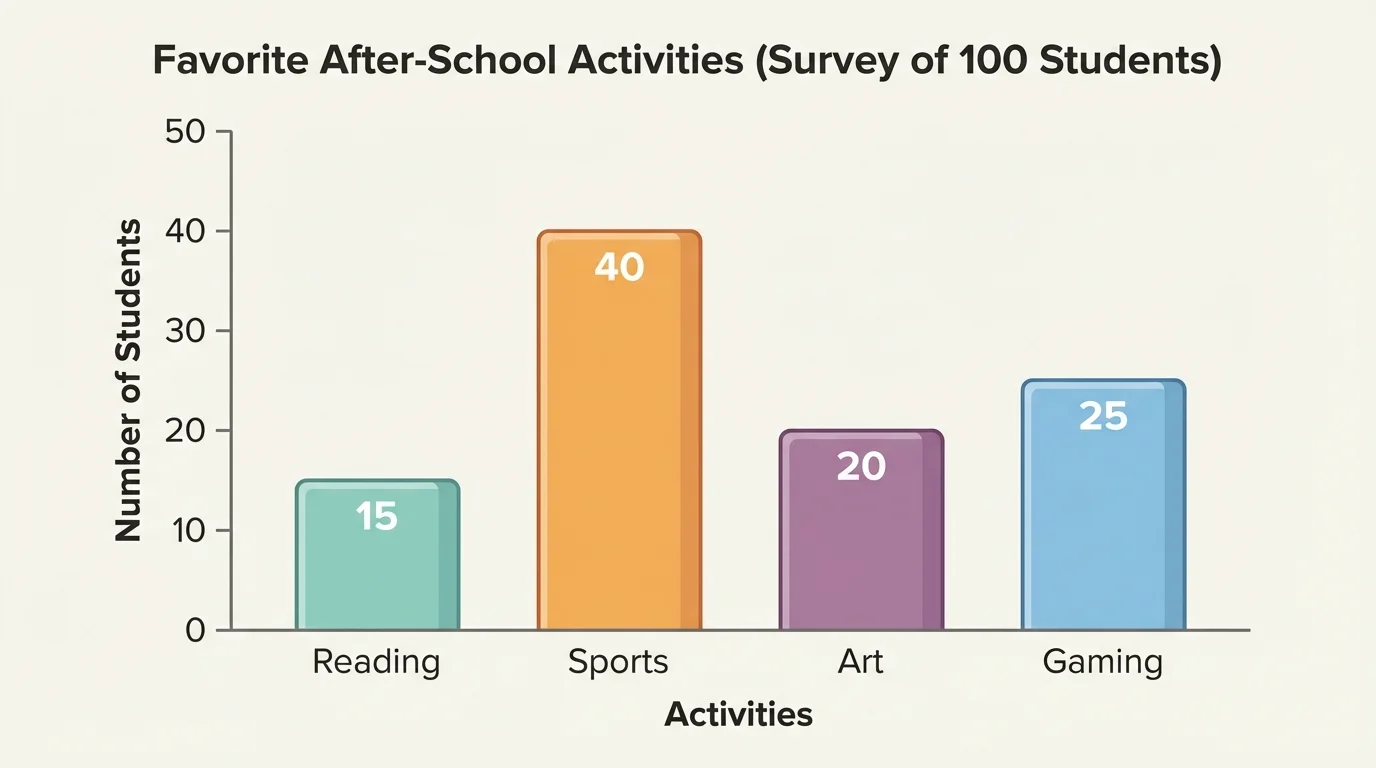
Graphs and charts are visual tools that often show comparisons. If a bar graph shows favorite after-school activities, you should not read every number one by one unless needed. Instead, notice the pattern. Perhaps sports is the highest category and reading is the lowest. That pattern belongs in a summary because it tells the main message of the data.
As we see again in [Figure 2], the title and labels matter. A graph without careful reading can be misunderstood. Before summarizing, check what the axes, categories, and scale actually show.
Quantitative information includes numbers, measurements, counts, and data. You may find it in tables, graphs, surveys, science experiments, or news reports. Summarizing quantitative information does not mean listing every number. It means explaining what the numbers show.
Suppose a table shows the number of books read by four classes in one month. Class A read \(48\) books, Class B read \(52\), Class C read \(51\), and Class D read \(79\). A weak summary would repeat all four numbers with no explanation. A stronger summary would say that all classes read many books, but Class D read far more than the others.
| Source type | What to notice | What belongs in the summary |
|---|---|---|
| Bar graph | Highest, lowest, and patterns | Main comparison or trend |
| Table | Important numbers and categories | What the numbers suggest |
| Survey results | Most common and least common responses | Overall result |
| Experiment data | Change over time or difference between groups | Main outcome |
Table 1. What to focus on when summarizing different kinds of quantitative sources.
Sometimes the numbers show change. For example, if a plant grows from \(8\) centimeters to \(14\) centimeters in two weeks, the summary should explain that the plant increased in height. The exact amounts may matter, but the big idea is the growth over time.
Example: Summarizing data
A chart shows that a school recycling drive collected \(120\) cans on Monday, \(145\) on Tuesday, \(160\) on Wednesday, and \(210\) on Thursday.
Step 1: Look for the pattern.
The number of cans collected rises each day.
Step 2: Decide the main point.
The number of cans collected increases as the week continues.
Step 3: Write the summary.
A strong summary is: The school collected more cans each day of the recycling drive, with the highest total on Thursday.
This kind of summary is clear because it turns several numbers into one main idea. That is what good summarizing does.
Sometimes the most powerful understanding comes from more than one source. You might hear a news report, study a chart, and watch a short video about the same topic. Then your task is to combine those pieces into one clear explanation, as [Figure 3] shows by bringing spoken, visual, and numerical information together into a single summary.
To do this, first ask what all the sources have in common. For example, imagine you hear a report about drought, see a map of dry areas, and read a table showing lower crop production. The shared idea might be that drought reduces available water and affects farming. That shared idea should be the center of your summary.
Then add one or two details from different formats. You might mention that the speaker explains less rainfall, the map shows the dry region, and the table shows crops decreasing. This makes the summary stronger because it uses evidence from several kinds of sources.
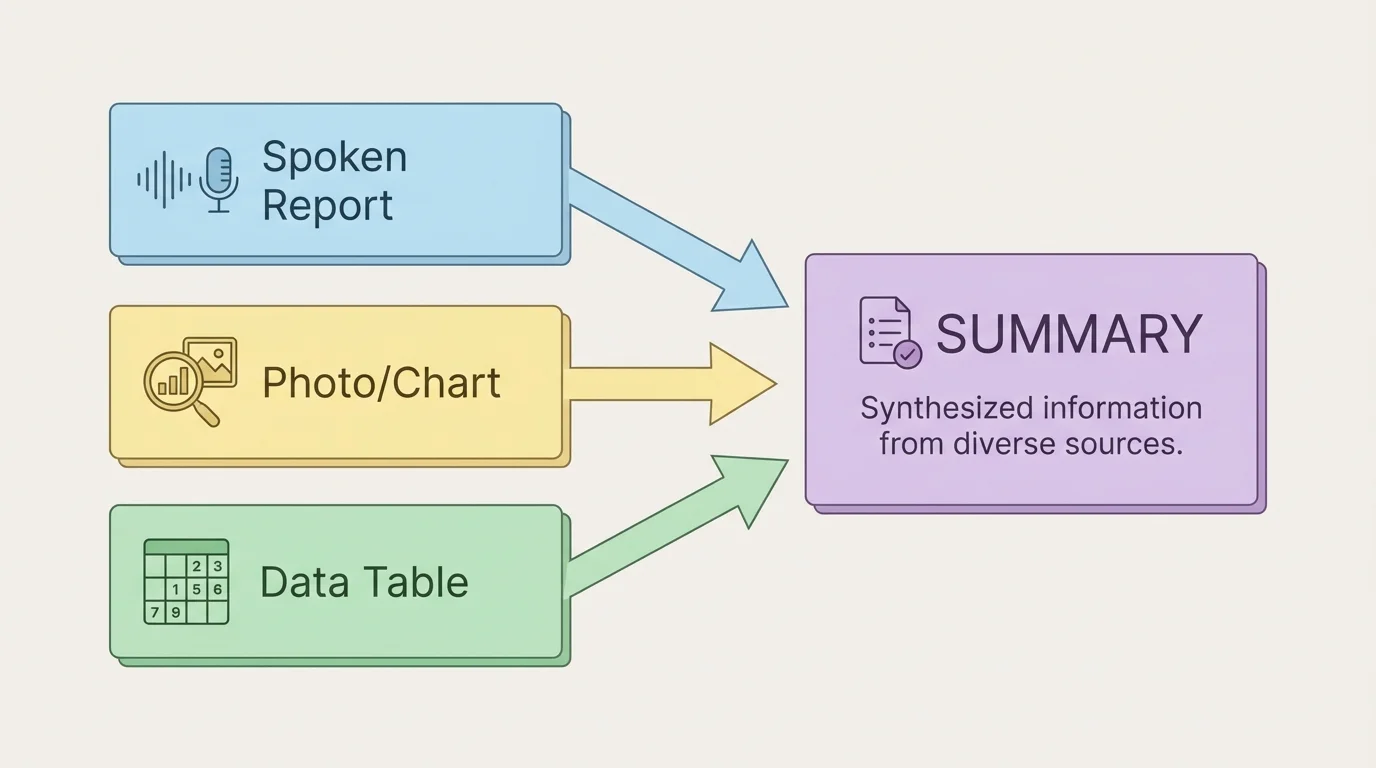
When sources do not match perfectly, summarize carefully. You may need to say that one source emphasizes one part of the topic while another source emphasizes something else. That is still a valid summary as long as it stays accurate.
Later, when you speak in a discussion, [Figure 3] remains useful as a model: gather the strongest idea from each format, then combine the ideas into one organized statement. This helps listeners understand the topic without hearing every single detail from every source.
A strong summary can be spoken or written. In both cases, the language should be clear, organized, and accurate. Helpful sequence words include first, next, also, for example, and finally. These words guide the listener or reader through the ideas.
It also helps to name the source type. You might say, "The article explains...," "The graph shows...," or "The speaker argues...." This tells your audience where the information came from. In discussions, it also helps classmates follow your thinking.
Example: Combining formats into one oral summary
A class studies a short article about plastic waste, watches a video of ocean animals affected by trash, and looks at a chart showing how much waste is recycled.
Step 1: Find the common idea.
All three sources show that plastic waste harms the environment.
Step 2: Choose one important detail from each source.
The article explains that plastic lasts a long time, the video shows animals affected by trash, and the chart shows that only part of the waste is recycled.
Step 3: State the summary clearly.
A strong oral summary is: The sources show that plastic waste is a serious environmental problem because it stays in nature for a long time, harms ocean animals, and is not all recycled.
Notice that the summary sounds natural. It is not a list of random facts. It has one clear main idea with supporting details.
When speaking, use an even pace and a clear voice. When writing, check punctuation and spelling. In both forms, reread or rethink the summary by asking, "Does this match the source? Did I include the main point? Did I leave out the unimportant parts?"
One common mistake is turning a summary into a retelling. A retelling may include too many details, side events, or exact lines from the source. To fix this, go back and cut anything that does not support the main idea.
Another mistake is adding opinions. For example, "The speaker's idea was weird" is not part of a summary. Instead, focus on what the speaker said. Save your opinion for a response or discussion after the summary is complete.
Good listeners and readers ask themselves questions while learning: What is the topic? What is the main idea? Which details really matter? Those same questions support strong summarizing.
A third mistake is missing information from one format. A student might summarize the spoken part of a video but forget the chart that appears on the screen. To fix this, pause and check every source or format before finishing your summary.
Finally, some summaries are too vague. Saying, "It was about animals," is not enough if the source is really about how animals adapt to winter. Be specific enough to show understanding, but brief enough to stay focused.
"The shortest way to tell a lot is to choose what matters most."
That idea is at the center of summarizing. Whether the source is read aloud, shown on a screen, spoken in a discussion, or presented through numbers, your job is to find the message that matters most and express it clearly for others.
