A single word can change meaning significantly. If a writer says, "The storm was bad," you know almost nothing. But if the writer says, "The thunderstorm brought strong winds, heavy rain, and flash flooding," the picture becomes much clearer. Informative writing depends on this kind of sharp word choice. When you explain a topic, your job is not just to say something. Your job is to help readers understand it accurately.
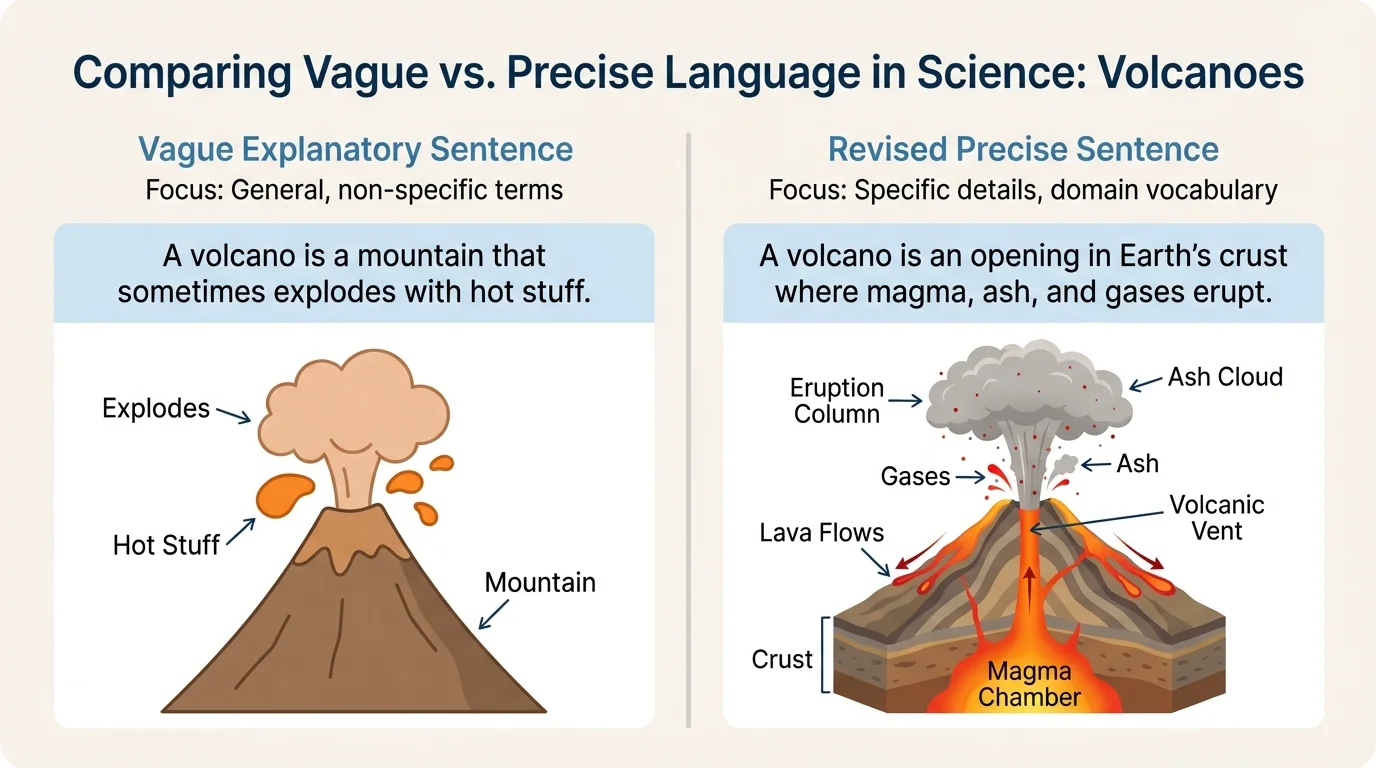
Precise language helps readers form a clear mental picture, as [Figure 1] shows through the difference between a vague sentence and a detailed one. In informative and explanatory writing, readers need facts, clear explanations, and exact terms. If the language is too general, the information becomes unclear. If the language is exact, the explanation becomes stronger.
Think about reading directions for building a skateboard ramp, caring for a pet, or staying safe during a wildfire. Vague instructions could be confusing or even dangerous. Precise language tells exactly what happened, how something works, or why it matters. It also makes a writer sound more trustworthy and knowledgeable.
Strong explanatory writing often answers questions such as what exactly?, how specifically?, and which kind? The more clearly a writer answers those questions, the easier it is for the reader to follow the topic.
Precise language means choosing words that are exact, specific, and accurate.
Domain-specific vocabulary means words and phrases used mainly in a certain subject, field, or area of knowledge.
Informative/explanatory writing is writing that teaches, clarifies, or explains a topic using organized ideas and relevant details.
These ideas work together. A writer may know a topic well, but if the word choice is weak, the explanation will also be weak. Good writing depends not only on having information, but also on choosing the language that delivers that information clearly.
When writers use precise language, they avoid words that are fuzzy, overused, or too broad. Instead of saying "thing," they might say "device," "tool," "organism," or "artifact," depending on the topic. Instead of saying "nice," they might say "helpful," "effective," "durable," or "detailed."
Precision is closely connected to specificity. Specificity means giving exact details rather than staying general. Compare these examples:
Vague: "Plants need stuff to grow."
Precise: "Plants need sunlight, water, carbon dioxide, and nutrients from soil to grow."
The second sentence teaches much more. It names the exact needs of plants instead of using the unclear word "stuff."
Precision also requires accuracy. A sentence can sound fancy but still be wrong. For example, saying "Magma is lava that cools underground" is inaccurate. A more accurate explanation is that magma is molten rock beneath Earth's surface, while lava is molten rock that has reached the surface. Good informative writing must be both exact and correct.
Some of the most misunderstood ideas in science and history come from words being used loosely. A tiny change in wording can change the meaning of an entire explanation.
Precise language does not always mean long words. Sometimes the clearest word is short. The goal is not to impress readers with complicated wording. The goal is to communicate exactly what you mean.
Every school subject has special terms. These words help experts and students discuss ideas efficiently and accurately. A science book uses vocabulary that differs from the language used in a history essay or a computer science guide.
Domain-specific vocabulary includes words such as photosynthesis in science, legislature in government, algorithm in technology, and tempo in music. These terms carry precise meanings within their subjects. If a writer replaces them with general words, important meaning may be lost.
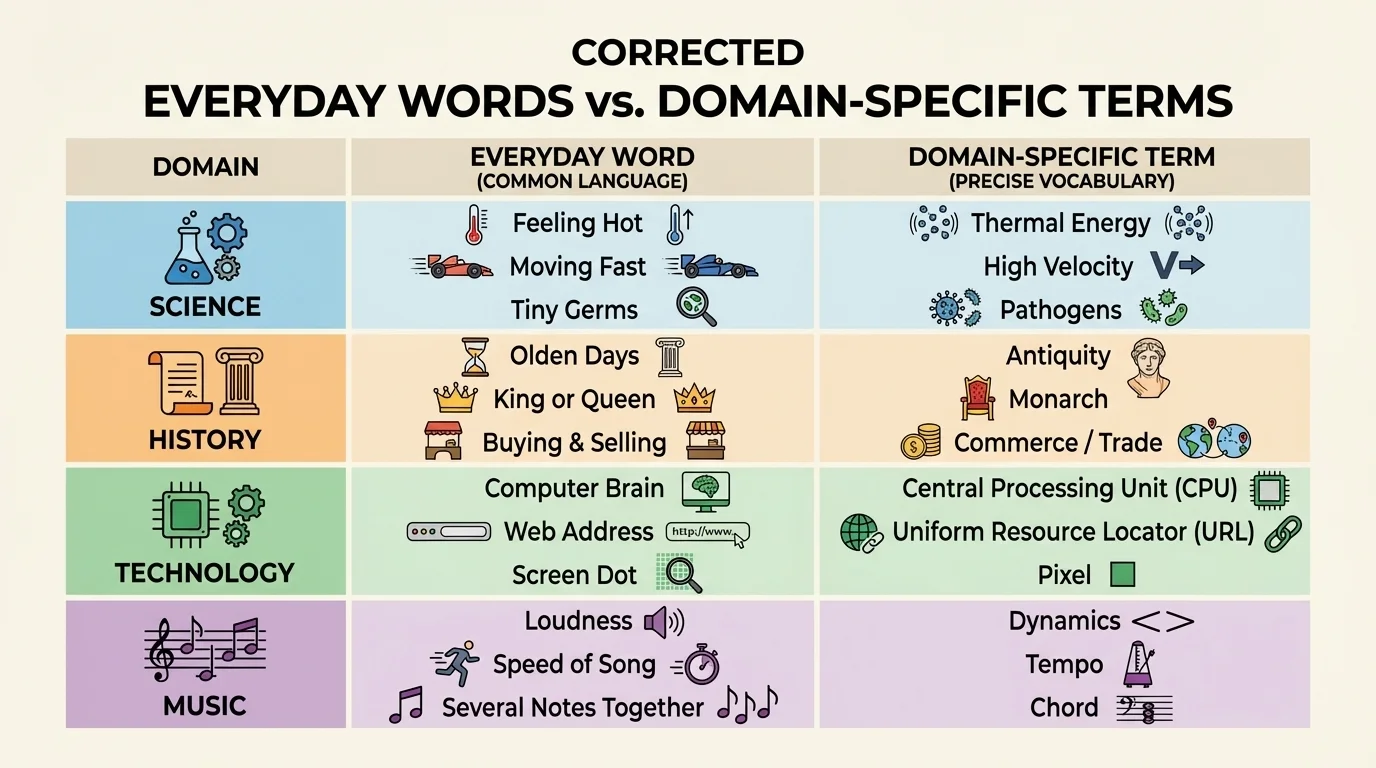
[Figure 2] For example, a writer could say, "The plant makes food." That is partly understandable, but a more informative sentence would be, "Through photosynthesis, the plant converts light energy into chemical energy." The second sentence uses the correct science term and explains the process more accurately.
Writers use domain-specific vocabulary because it saves time and adds clarity. Imagine trying to explain government without words like "citizen," "election," or "legislature." You would need many extra sentences just to say what one exact term can say.
| Subject | General Word | Domain-Specific Word | Why It Is Better |
|---|---|---|---|
| Science | making food | photosynthesis | Names the exact biological process |
| History | government group | legislature | Identifies a specific branch or lawmaking body |
| Technology | step-by-step procedure | algorithm | Describes a defined set of instructions |
| Music | musical speed | tempo | Gives the accepted music term |
Table 1. Comparison of general words and more precise domain-specific terms in different subjects.
As writing becomes more advanced, choosing the right subject vocabulary becomes even more important. It helps a reader understand not just the topic, but the exact way people in that field talk about it.
Writers do not always need the most technical word possible. They need the word that best fits the purpose, subject, and audience. Sometimes a general word is fine. Sometimes a more specific word is necessary. The skill is knowing which choice helps the reader most.
Suppose you are writing about weather for younger students. You might first say "storm," then later explain "thunderstorm" or "hurricane," depending on the topic. If you are writing a science report, those exact weather terms are important because each one has a different meaning.
Here is a useful pattern for choosing words:
General word: animal
More specific word: mammal
Most precise word for a certain case: bottlenose dolphin
Each step adds more information. The best level depends on what the reader needs to know. If the topic is ocean ecosystems, "bottlenose dolphin" may be the strongest choice. If the topic is broader, "mammal" may be enough.
Choosing among general, specific, and technical words is not about making writing sound complicated. It is about matching the word to the information. A broad topic may need broad terms at first, while deeper explanation often needs more precise and technical vocabulary.
Good writers also choose strong verbs. Compare "The volcano did something to the land" with "The volcano deposited ash across the valley." The verb "deposited" explains the action much more clearly than "did something." Strong nouns and verbs usually improve informative writing faster than simply adding more adjectives.
There is one important warning: precise writing should still be easy to understand. If a writer fills a paragraph with difficult terms and never explains them, readers may get lost. This is called jargon when technical language becomes hard for non-experts to understand.
Jargon is not always bad. In the right setting, experts need it. Doctors, engineers, historians, and computer scientists all use specialized language. But when writing for a wider audience, a writer should introduce technical terms carefully and define them when necessary.
For example: "Erosion is the gradual movement of rock and soil from one place to another." In that sentence, the domain-specific term is introduced and explained. Readers learn the word and understand it at the same time.
A helpful method is to use the term, give a short definition, and then continue using the term correctly. This keeps the writing formal and informative without becoming confusing.
Example: Defining a technical term clearly
Weak version: "The city improved its infrastructure."
Step 1: Identify the unclear term.
"Infrastructure" may be unfamiliar to some readers.
Step 2: Add a clear explanation.
Improved version: "The city improved its infrastructure by repairing and expanding roads, bridges, and water systems."
Step 3: Use the term again if needed.
Once readers understand the term, the writer can continue discussing infrastructure more efficiently.
This kind of explanation respects the reader. It teaches without talking down to the audience.
Precise language becomes even more powerful when it works with good organization. Informative writing usually introduces a topic, develops ideas with facts and examples, and uses transitions to connect points. Clear word choice supports each part of that structure.
Precise nouns identify the topic clearly. Precise verbs explain actions or processes. Precise adjectives and adverbs add details only when they truly help the reader. Transitions such as "for example," "in contrast," "as a result," and "because" show how ideas connect.
Suppose you are explaining how a bicycle moves. You could write, "The bike goes because things happen." That sentence is far too vague. A stronger version would be: "When the rider pushes the pedals, the chain turns the gears, causing the rear wheel to rotate." This explanation names the parts and shows the sequence of action.
Notice how exact nouns such as "pedals," "chain," "gears," and "rear wheel" create a clearer explanation. The sentence also uses the transition idea of cause and effect with the word "causing." Informative writing improves when the writer names parts, steps, relationships, and results.
As with the sentence comparison in [Figure 1], stronger explanations often come from replacing weak words with exact ones. A precise sentence does more than sound better. It teaches better.
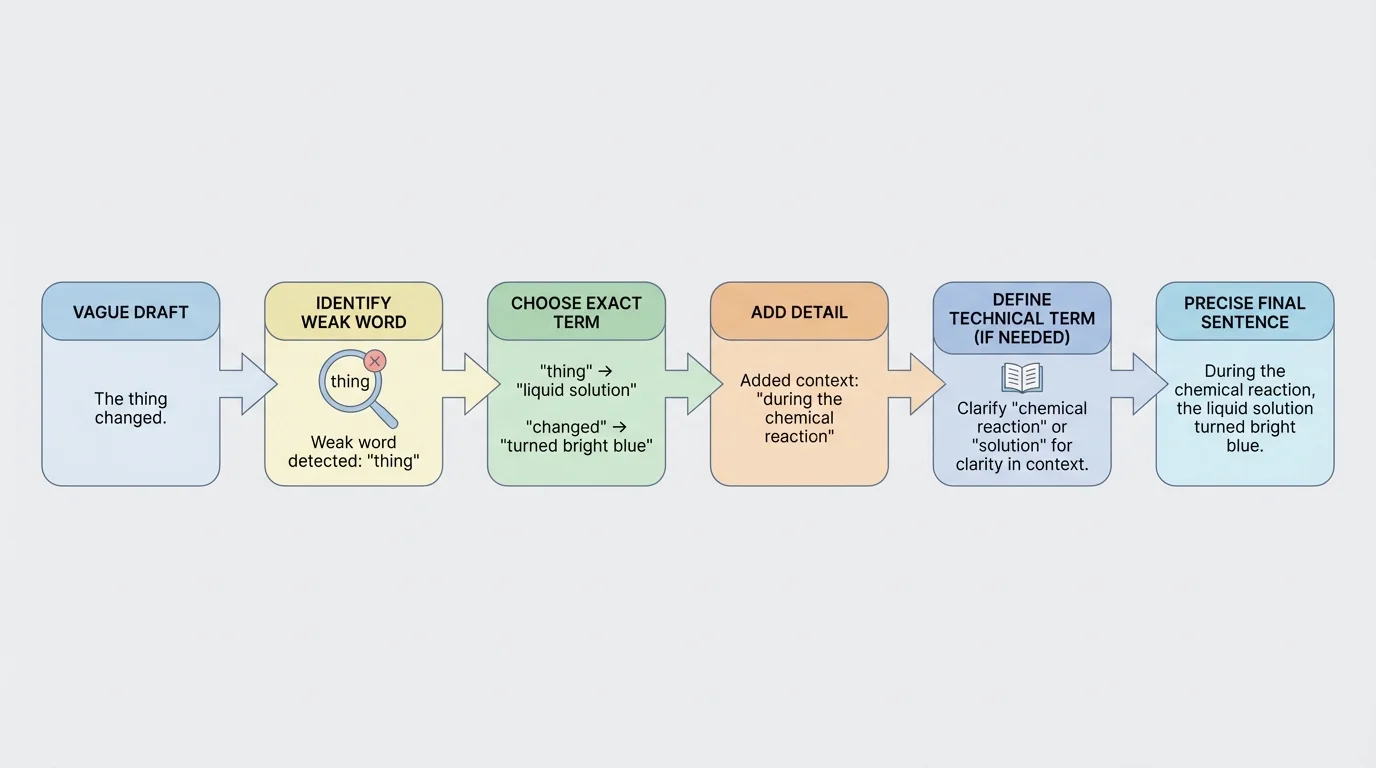
Revision is where many strong explanations are built, and [Figure 3] presents revision as a clear sequence of choices instead of random editing. First drafts often contain broad words because the writer is getting ideas down quickly. During revision, the writer sharpens those ideas.
One useful strategy is to circle vague words such as "thing," "stuff," "good," "bad," "a lot," "nice," or "went." Then ask: What exact noun, verb, or detail would be clearer here?
Another strategy is to check whether each important subject term is used correctly. If you are writing about earthquakes, do you mean "magnitude" or "intensity"? If you are writing about government, do you mean "law" or "policy"? Similar words may have different meanings.
Writers should also listen for repetition. If every sentence uses the same basic verbs such as "is," "does," or "has," the explanation may feel flat. Replacing those with more exact verbs often makes the writing more informative. For example, "The river has an effect on the land" becomes "The river erodes the land."
Reading aloud can help. If a sentence sounds unclear when spoken, it may need more precise wording. Reading aloud also helps a writer hear whether the tone sounds formal enough for explanatory writing.
Formal writing does not mean stiff or robotic writing. It means using correct grammar, accurate word choice, and a respectful tone instead of slang, text-message language, or overly casual expressions.
Later in the revision process, writers often return to the same kind of check shown in [Figure 3]: identify weak wording, choose exact terms, add needed detail, and explain any technical language. This habit turns rough drafts into clear explanations.
Different subjects require different kinds of precision. The skill stays the same, but the vocabulary changes.
Science example: "Water disappears when heated" is understandable, but "Liquid water evaporates into water vapor when heated" is more scientific and accurate. The writer uses exact terms for the process and the state change.
History example: "People were mad about taxes" is informal and vague. A stronger sentence is: "Many colonists protested British taxation because they believed they were being taxed without representation." This revision adds the historical group, the cause, and the political idea involved.
Technology example: "The app figures out what to show you" becomes "The app uses an algorithm to recommend videos based on your viewing history." The second sentence explains the process and uses a correct technical term.
Everyday informative writing example: "The recipe changes the eggs" becomes "Whisking the eggs incorporates air, which helps the pancakes become lighter." Even in cooking, precise language improves explanation.
Model revision set
Draft sentence: "The desert is harsh and plants do special things to live there."
Step 1: Replace vague words.
"Harsh" can become "dry and hot," and "special things" can become "adaptations."
Step 2: Add domain-specific vocabulary.
Use the term "adaptations" because it is the correct science word for traits that help organisms survive.
Step 3: Add specific details.
Revised sentence: "Desert plants survive in hot, dry conditions through adaptations such as waxy coatings, deep roots, and water-storing stems."
This final version is more informative because it names exact conditions and examples. It teaches instead of merely hinting.
One common mistake is using words that are too broad. Another is choosing technical words without really understanding them. A third is using slang in formal explanatory writing. Saying "The experiment was super cool and stuff" weakens the tone and gives almost no information.
Another mistake is confusing precision with complexity. A sentence packed with difficult words is not automatically better. For example, replacing every simple term with a longer one can make writing sound forced. The best writing is clear, accurate, and appropriate for the audience.
Writers should also avoid assuming that readers already know every subject term. If a key word is necessary but may be unfamiliar, define it the first time. That small step can make the whole explanation easier to understand.
Finally, be careful with near-synonyms. Words such as "climate" and "weather," or "speed" and "velocity," may seem similar in casual conversation, but they do not always mean exactly the same thing in academic subjects. Precise writing depends on noticing those differences.
"The difference between the almost right word and the right word is really a large matter."
— Mark Twain
This idea matters in school writing because the right word helps readers learn the right idea. Informative writing is not only about including facts. It is about presenting those facts with language that is exact, meaningful, and understandable.
When you explain a topic, think like a guide. Your reader is following your words to understand something new. If your language is vague, the path becomes confusing. If your language is precise, the path becomes clear.
Use exact nouns to name people, places, events, parts, and processes. Use strong verbs to explain actions and changes. Use domain-specific vocabulary when it helps the reader understand the subject more accurately. Define unfamiliar terms when needed. Revise broad wording into specific, accurate explanation.
Whether you are writing about ecosystems, ancient civilizations, robotics, music, or community issues, precise language helps your ideas sound informed and organized. It turns a basic report into a clear, effective explanation.
