Sunlight leaves the Sun, crosses about 150 million kilometers of nearly empty space, and reaches your face in a little over 8 minutes. That simple fact is remarkable: something is traveling across space and carrying energy to Earth, yet it is not a mechanical wave like an ocean wave or a sound wave, and it does not need a material medium such as air. That "something" is light, and understanding how it moves helps explain rainbows, glasses, cameras, shadows, and even why black shirts get hot in sunlight.
Light is a form of energy called electromagnetic radiation. Electromagnetic radiation includes visible light, but it also includes types of radiation our eyes cannot see, such as radio waves, microwaves, infrared, ultraviolet, X-rays, and gamma rays. These are all part of the same family. They differ mainly in their frequency, which tells how often the wave repeats each second.
The small part of this family that human eyes can detect is called visible light. Visible light includes all the colors from red to violet. Red light has a lower frequency than blue or violet light, while blue and violet have higher frequencies.
Electromagnetic radiation is energy that travels as waves and can move through empty space. Visible light is the part of electromagnetic radiation that human eyes can see. Frequency describes how many wave cycles pass a point each second, and it is related to color in visible light.
It helps to compare light with familiar waves. Sound is a vibration moving through matter such as air, water, or solids. Water waves move through water. But light can travel through outer space, where there is almost no matter. That is one indication that light is not a mechanical wave.
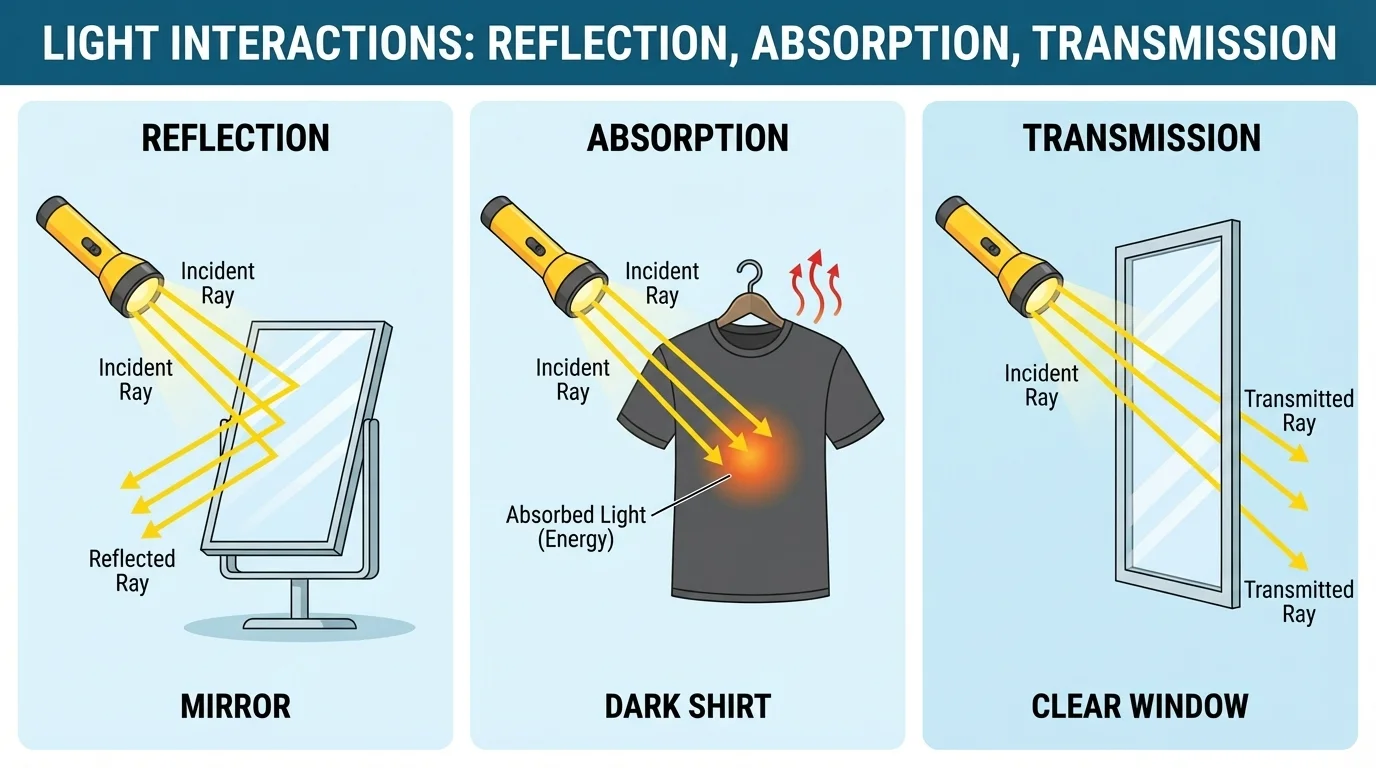
[Figure 1] When light reaches an object, several things can happen. Some light may bounce off the object. This is called reflection. Some light may be absorbed by the material. This is called absorption. Some light may pass through the material. This is called transmission. Which of these happens depends on the kind of material and on the frequency, or color, of the light.
A shiny mirror reflects most of the light that hits it, which is why you can see an image in it. A black asphalt road absorbs much of the sunlight that reaches it, so it gets hot on a summer day. A clean window transmits much of the visible light, allowing you to see through it.
Many materials do more than one of these at the same time. For example, sunglasses transmit some light, absorb some light, and reflect a little. A leaf reflects mostly green light to your eyes, absorbs a lot of red and blue light for photosynthesis, and may transmit a small amount through thin parts of the leaf.
The color of an object depends on which frequencies of visible light it reflects or transmits. A red apple looks red because it reflects red light better than most other visible colors. A blue backpack looks blue because it reflects blue light and absorbs many other colors. A white sheet of paper reflects many visible frequencies, while a black cloth absorbs many visible frequencies.
This is why color is not simply inherent in an object. Color depends on both the object and the light shining on it. Under red light, a blue object may look very dark because there is little or no blue light available for it to reflect.
Some animals see parts of electromagnetic radiation that humans cannot. Bees can detect ultraviolet patterns on flowers, which helps them find nectar.
The same object can behave differently with different kinds of electromagnetic radiation. Ordinary glass transmits visible light well, but it can block much of ultraviolet light. That is another reminder that material and frequency both matter.
In visible light, color is connected to frequency. Lower-frequency visible light appears red, and higher-frequency visible light appears blue or violet. White light, such as sunlight, is a mixture of many visible frequencies together.
Brightness is related to how much light energy reaches your eyes from a source or surface. In a wave model, brighter light can be explained as light with greater intensity, which is connected to the wave's amplitude. For middle school science, the important idea is that brighter light means more energy is arriving each second.
A flashlight on a low setting looks dimmer than the same flashlight on a high setting because less light energy is being sent out. If one lamp gives out twice as much light energy as another, we can say it is about twice as intense. For example, if lamp A sends out an intensity of \(2\) units and lamp B sends out \(4\) units, lamp B is brighter because \(4 = 2 \times 2\).
Color and brightness are different ideas. Two lights can have the same color but different brightness, or the same brightness but different colors. A bright red light and a dim red light have the same color but different intensities.
[Figure 2] A useful way to show the path of light is with rays. A ray is a straight-line model of the direction light travels. In one material, such as air, light usually travels in straight lines. This is why shadows have clear edges and why you need a direct line of sight to see something.
If you shine a flashlight toward a wall, the beam travels straight unless it hits something. Put your hand in the beam, and a shadow forms behind it because your hand blocks the light. The shadow shows that light is not curving around the object in ordinary situations.
You also cannot see around a corner because light from the object does not normally bend around the wall to reach your eyes. This straight-line model is extremely useful in science and engineering.
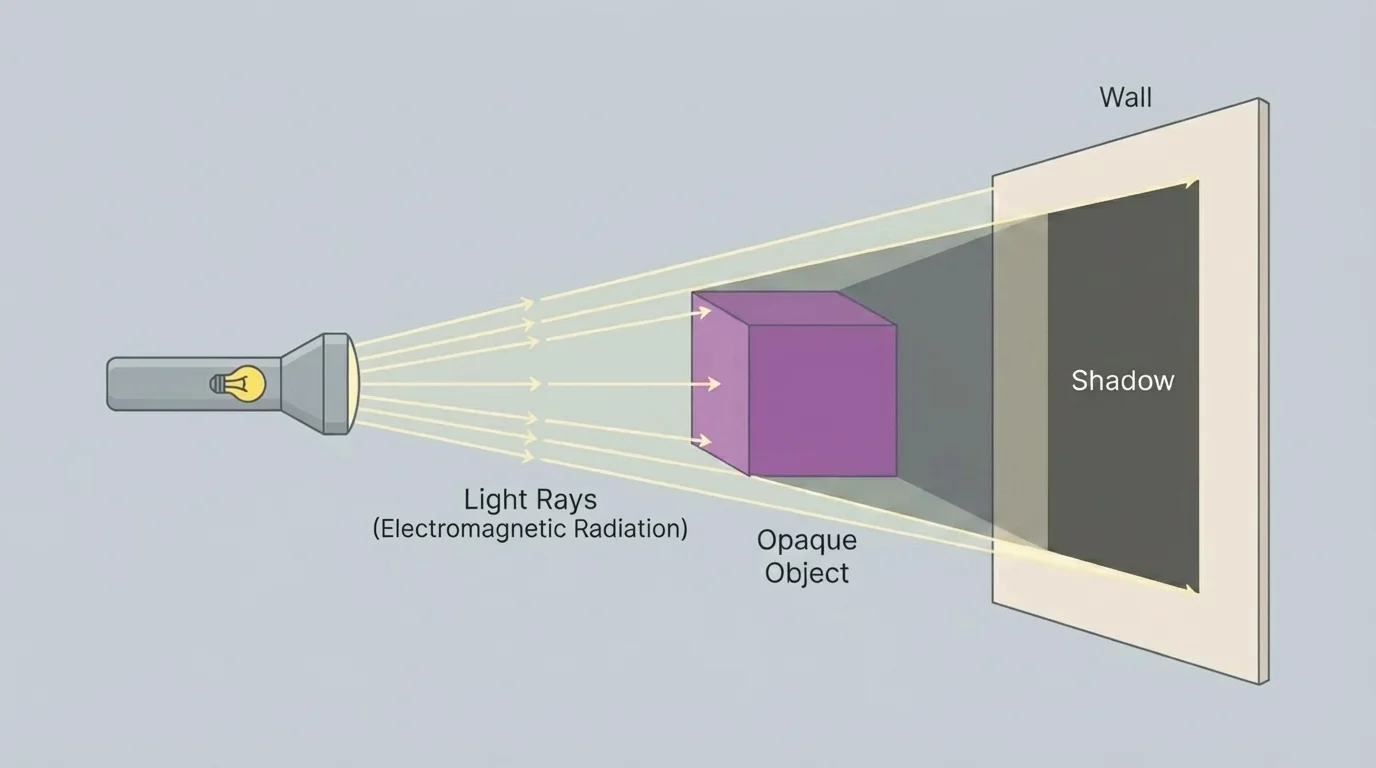
Scientists often draw several rays from a source to show where light goes. Even though light is better described in some situations as a wave, the ray model is still very helpful for tracing paths, especially in mirrors and lenses.
You already know that energy can move from place to place. Light is one way energy transfers from a source, such as the Sun or a lamp, to another object.
Later, when studying optics, students use rays to predict where an image will appear in a mirror or where a lens will focus light. The ray model and the wave model work together: one is good for path tracing, and the other helps explain wave behaviors such as color and refraction.
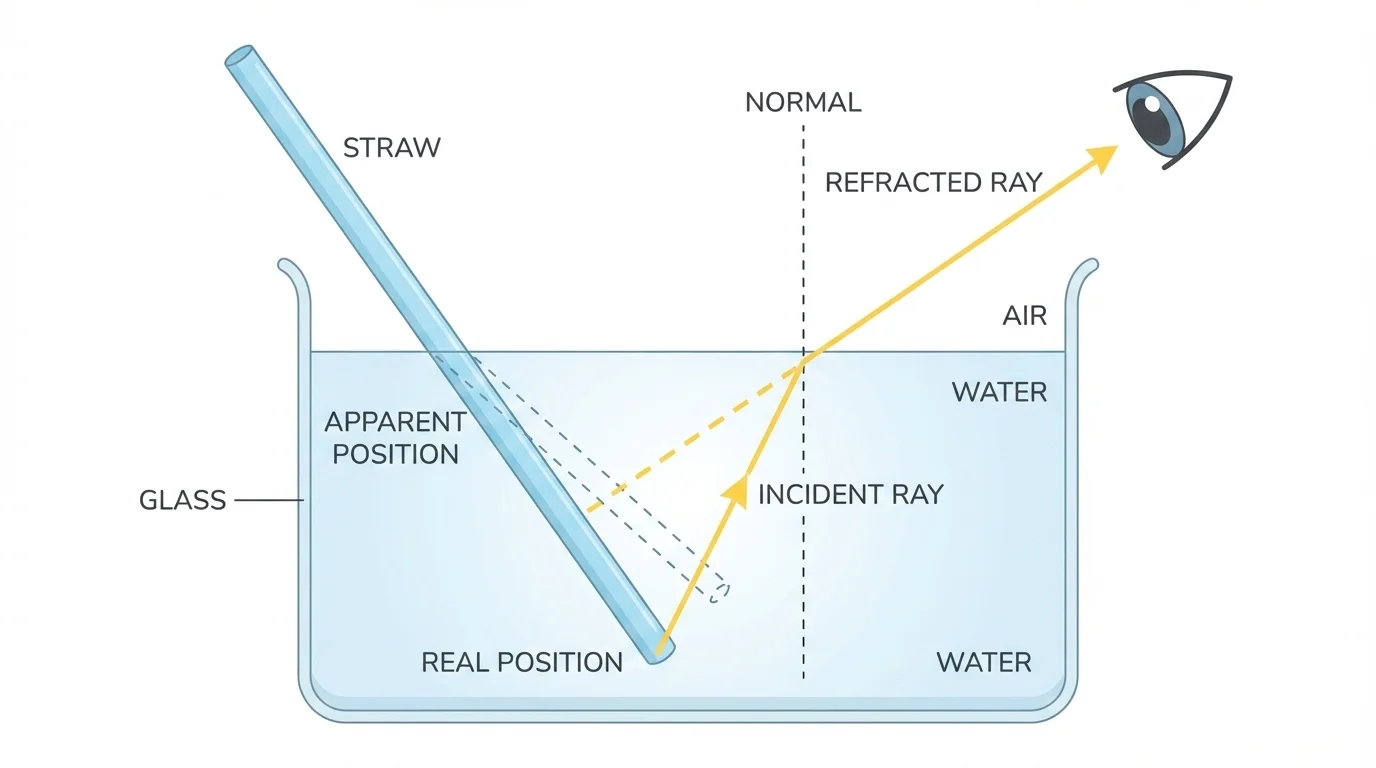
[Figure 3] Light usually travels straight in one medium, but it changes direction at a boundary between transparent materials. This bending is called refraction. You can see it when a straw in a glass of water looks bent or when the bottom of a swimming pool appears closer than it really is.
Refraction happens because light travels at different speeds in different materials. Light moves fastest in empty space. It moves more slowly in materials such as water and glass. When one side of a wave enters the new material before the other side, the path changes direction.
If light goes from air into water, it bends one way. If it goes from water back into air, it bends the other way. The amount of bending depends on the materials and on the frequency of the light.
Here is a simple way to think about it: imagine a line of marching students moving from smooth floor onto sticky carpet at an angle. The side that hits the carpet first slows down first, so the whole line turns. Light behaves in a similar way when its speed changes in a new transparent material.
The bending can be measured by comparing speeds. A simple relationship is \[n = \frac{c}{v}\], where \(n\) is the refractive index of the material, \(c\) is the speed of light in empty space, and \(v\) is the speed of light in the material.
For example, if light travels at about \(3.0 \times 10^8 \textrm{ m/s}\) in space and about \(2.25 \times 10^8 \textrm{ m/s}\) in water, then \[n = \frac{3.0 \times 10^8}{2.25 \times 10^8} \approx 1.33\]. A refractive index of about \(1.33\) helps explain why water bends light noticeably.
Why frequency matters in bending
Different frequencies of light do not always slow down by exactly the same amount in a material. Because of that, red, green, and violet light can bend by slightly different amounts. This is why a prism can spread white light into separate colors.
That frequency-dependent bending is a key reason scientists use a wave model for light. A simple straight-ray picture alone cannot explain why different colors separate in a prism.
[Figure 4] Lenses and prisms use refraction in useful ways. A lens is a shaped transparent object that bends light in a controlled way. A prism is a transparent solid with flat surfaces that bends light, often separating white light into colors.
A convex lens is thicker in the middle than at the edges. It bends incoming rays toward each other and can focus them. Magnifying glasses, cameras, microscopes, and some telescopes use convex lenses. Your eye also contains a lens that helps focus light onto the retina.
A concave lens is thinner in the middle than at the edges. It spreads rays apart. Some eyeglasses use concave lenses to help people who are nearsighted.
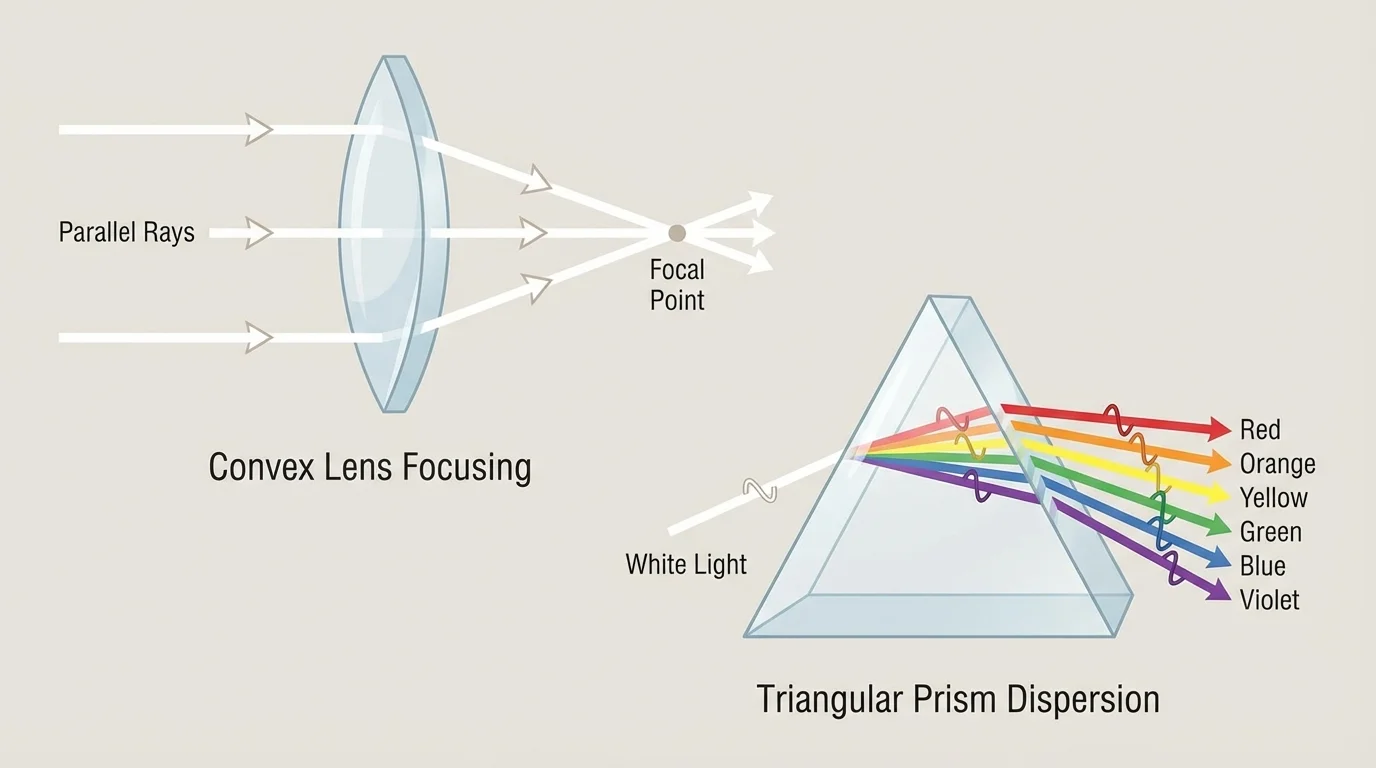
Prisms are famous for producing rainbow-like color bands. White light enters the prism, and different frequencies bend by different amounts. Violet light usually bends more than red light, so the colors spread out. As we saw earlier in [Figure 3], refraction happens at boundaries between materials. A prism simply uses that effect very carefully on several surfaces.
Many technologies depend on precise bending of light. Camera lenses focus images onto a sensor. Microscopes enlarge tiny objects. Telescopes collect and focus light from distant stars. Eyeglasses correct the path of light so an image focuses more clearly in the eye.
Real-world application: why a magnifying glass works
A magnifying glass uses a convex lens to bend light rays from a small object so the eye sees a larger image.
Step 1: Light from the object enters the curved lens.
The curved surfaces cause the rays to change direction by refraction.
Step 2: The rays leave the lens on paths that make the object appear larger.
Your brain interprets the light as coming from a bigger image.
Step 3: Moving the lens changes the effect.
If the object, lens, and eye are at the right distances, the image appears sharp and enlarged.
This same basic idea is used in microscopes and some phone cameras, though those devices often use several lenses together.
Road reflectors, safety gear, and some signs are also designed to send light back efficiently so drivers can see them at night. Reflection and refraction both matter in their design.
A wave model of light explains several important observations. First, it explains color by linking visible colors to different frequencies. Second, it explains brightness in terms of the amount of wave energy arriving. Third, it explains why different colors bend by different amounts in a prism.
This does not mean every detail of light is simple. Light is one of the most interesting topics in science because it behaves in ways that require more than one model to fully describe. At this level, the important point is that the wave model is especially useful for understanding brightness, color, and refraction.
When white light passes through a prism, the wave model helps us understand why the colors spread apart instead of staying together. If all frequencies bent exactly the same amount, the light would not separate into a spectrum.
"We see objects because light from them reaches our eyes."
— A central idea of optics
The wave model also helps explain why light can be added and filtered. For example, a colored filter transmits some frequencies and absorbs others. A red filter mainly transmits red light while reducing many other colors.
Sound waves need matter. If there is no air, no water, and no solid material, sound cannot travel. Water waves need water. But light from the Sun crosses nearly empty space to reach Earth. That means light cannot be a mechanical wave like sound or water waves.
Instead, light is an electromagnetic wave. It is made of changing electric and magnetic fields that can travel through a vacuum. You do not need to memorize all the details of those fields yet. The key idea is that light carries energy without needing a material medium.
This is why astronauts in space can see the Sun but cannot hear it through empty space. The light arrives, but the sound does not. That contrast is one of the clearest ways to understand the difference.
Infrared cameras detect electromagnetic radiation that our eyes cannot see. They are useful for finding heat leaks in buildings, studying wild animals at night, and helping firefighters locate hot spots.
Scientists call light a wave because the wave model explains many observations well. But it is not a water wave, not a sound wave, and not a wave made of moving matter.
Many everyday experiences become clearer once you know how light behaves. Polarized sunglasses reduce reflected glare from water or roads. Windows are made from materials that transmit visible light well. Solar panels absorb light energy and convert some of it into electrical energy. Camera systems use lenses to focus light precisely.
You can observe reflection, absorption, and transmission at home with safe materials. Hold a flashlight near a mirror, a dark cloth, and a clear plastic container. The mirror reflects strongly, the cloth absorbs much of the light, and the clear plastic transmits some light. These simple observations connect directly to the patterns shown earlier in [Figure 1].
You can also place a straw in a glass of water and view it from the side. The straw appears bent because the light from the straw changes direction as it leaves the water and enters the air. That matches the refraction idea shown earlier in [Figure 3].
Even a rainbow relates to these ideas. Tiny water droplets in the air bend, reflect, and separate sunlight. Different colors leave the droplets at slightly different angles, which is why a rainbow shows a spread of colors instead of plain white light.
| Behavior of light | What happens | Example |
|---|---|---|
| Reflection | Light bounces off a surface | Seeing yourself in a mirror |
| Absorption | Light energy is taken in by a material | Black pavement warming in sunlight |
| Transmission | Light passes through a material | Seeing through a window |
| Refraction | Light changes direction between transparent materials | A straw looking bent in water |
Table 1. Main ways light interacts with materials and common examples of each behavior.
Understanding light helps scientists and engineers design better tools for seeing, measuring, communicating, and protecting people. It also reminds us that everyday events, such as seeing color or spotting a shadow, are signs of deep physical rules at work.
