Your phone can receive a message from someone miles away, a weather satellite can detect storms from space, and doctors can use instruments to observe parts of the body that your eyes can never see directly. All of these technologies depend on one powerful idea: information can travel as signals, and instruments can detect those signals even when human senses cannot.
People are good at sensing some things directly. We hear sound, see visible light, feel warmth, and smell chemicals in the air. But the world contains many more signals than our bodies can detect. We cannot directly hear radio waves, see infrared radiation, or feel the tiny electrical signals moving through a computer network. To work with those hidden signals, engineers design tools that act like expanded senses.
These tools are part of instrumentation, the science and technology of measuring, detecting, and analyzing signals. A radio receiver detects radio waves. A television antenna picks up broadcast signals. A cell phone sends and receives signals to nearby towers. A wired computer network carries signals through metal wires or optical fibers. A wireless network sends signals through the air.
In each case, the device does not just detect a signal. It must also turn that signal into a form that is useful. A radio changes a received electromagnetic signal into sound. A screen changes electrical signals into light patterns your eyes can read. A network router reads incoming information and sends it to the right device.
Signal means a change or pattern that carries information from one place to another. A signal can be a sound wave, a light pulse, a radio wave, an electrical change in a wire, or another measurable pattern.
Information transfer is the movement of a message from a source to a receiver using a signal.
Signals can be natural or human-made. Thunder sends sound waves. Stars send light. A heartbeat produces electrical patterns that can be measured by instruments. Human-made systems also create signals: a microphone sends an electrical signal, a Wi-Fi router sends radio signals, and a remote control sends infrared light signals.
A signal must have a pattern. If something changes randomly, it may be noise rather than useful information. For example, when you speak into a microphone, the sound waves from your voice form detailed patterns. The microphone detects those pressure changes and converts them into an electrical signal with a matching pattern. That pattern carries the information needed to reproduce your voice later.
Signals often answer questions such as: How strong is something? When did it change? How often does it repeat? Where did it come from? Instruments are designed to notice these patterns and report them clearly. A smoke detector senses particles in the air. A motion sensor detects changes in infrared radiation. A satellite sensor detects light from Earth at wavelengths your eyes cannot see.
Signals as encoded messages
A signal is useful because it can stand for something else. A flashing light can mean "message received." A sequence of electrical pulses can stand for letters, numbers, pictures, or music. In communication systems, the real challenge is not only sending energy but organizing that energy so it carries meaning.
That is why scientists and engineers think carefully about both the signal itself and the material environment it travels through. A signal moving through air behaves differently from one moving through water, metal wire, or glass fiber.
Many communication signals travel as waves. A wave is a repeating disturbance that transfers energy and information from one place to another. Waves can differ in height, spacing, and repetition rate, and those differences can affect how much information they carry and how devices detect them.
There are two broad groups of waves important here. Mechanical waves need matter to travel, such as sound moving through air. Electromagnetic waves do not need matter and can travel through empty space. Radio waves, microwaves, visible light, infrared, and X-rays are all electromagnetic waves. Communication technologies often use radio waves, microwaves, visible light, or infrared light.
As [Figure 1] shows, three useful wave properties are amplitude, frequency, and wavelength. Amplitude is the size or strength of the wave. Frequency is how many wave cycles pass a point each second. Wavelength is the distance from one crest to the next crest. Higher frequency means shorter wavelength for a wave traveling at the same speed.
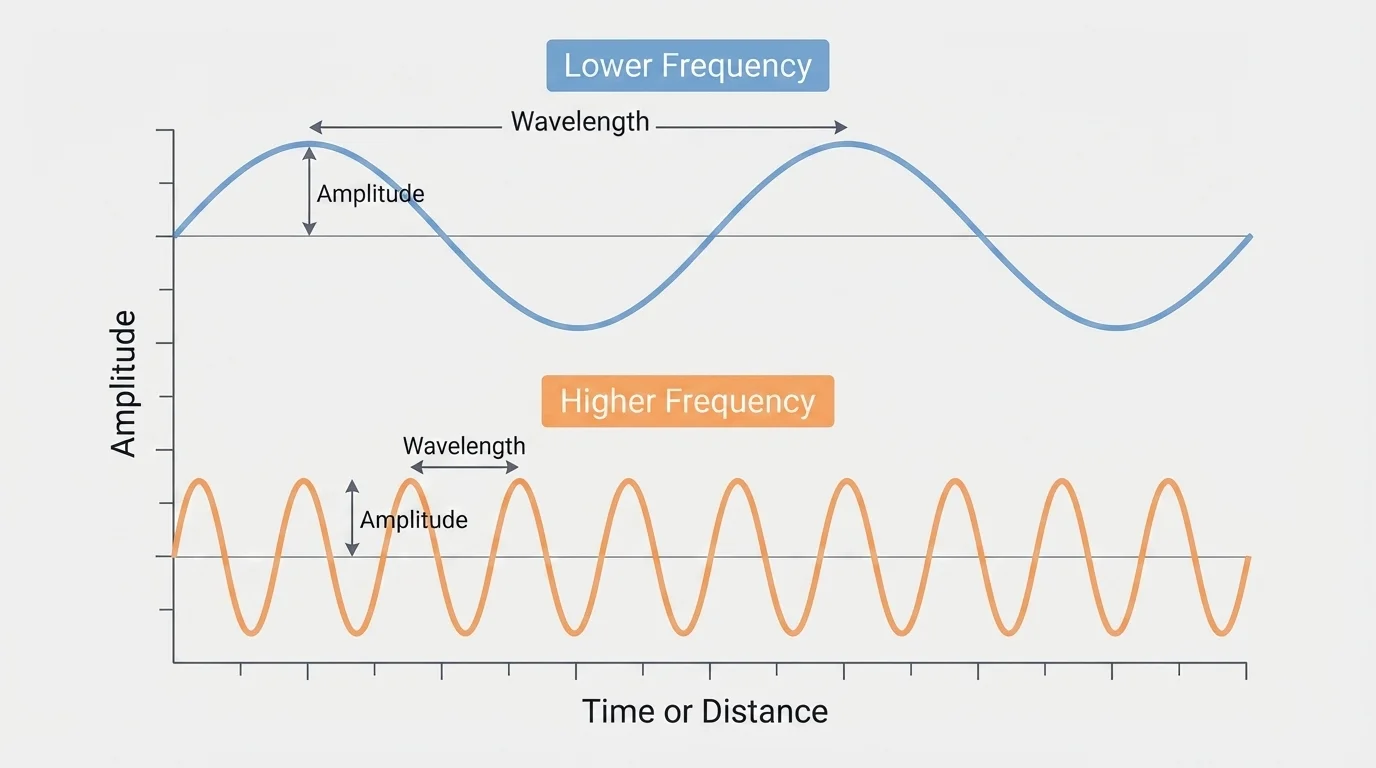
For electromagnetic waves, the wave speed in empty space is about \(3.0 \times 10^8 \textrm{ m/s}\). The basic relationship is:
\[v = f\lambda\]
Here, \(v\) is wave speed, \(f\) is frequency, and \(\lambda\) is wavelength. For example, if a wave travels at \(300 \textrm{ m/s}\) and has a frequency of \(100 \textrm{ Hz}\), then its wavelength is \(\lambda = \dfrac{300}{100} = 3 \textrm{ m}\). This relationship helps engineers choose the right frequencies and antenna sizes for communication devices.
Different parts of the electromagnetic spectrum are useful for different jobs. Radio waves can travel long distances and bend around some obstacles. Microwaves are useful for cell phones and Wi-Fi. Infrared is common in remote controls. Visible light can carry information through fiber-optic systems. Each type is a signal carrier with strengths and limits.
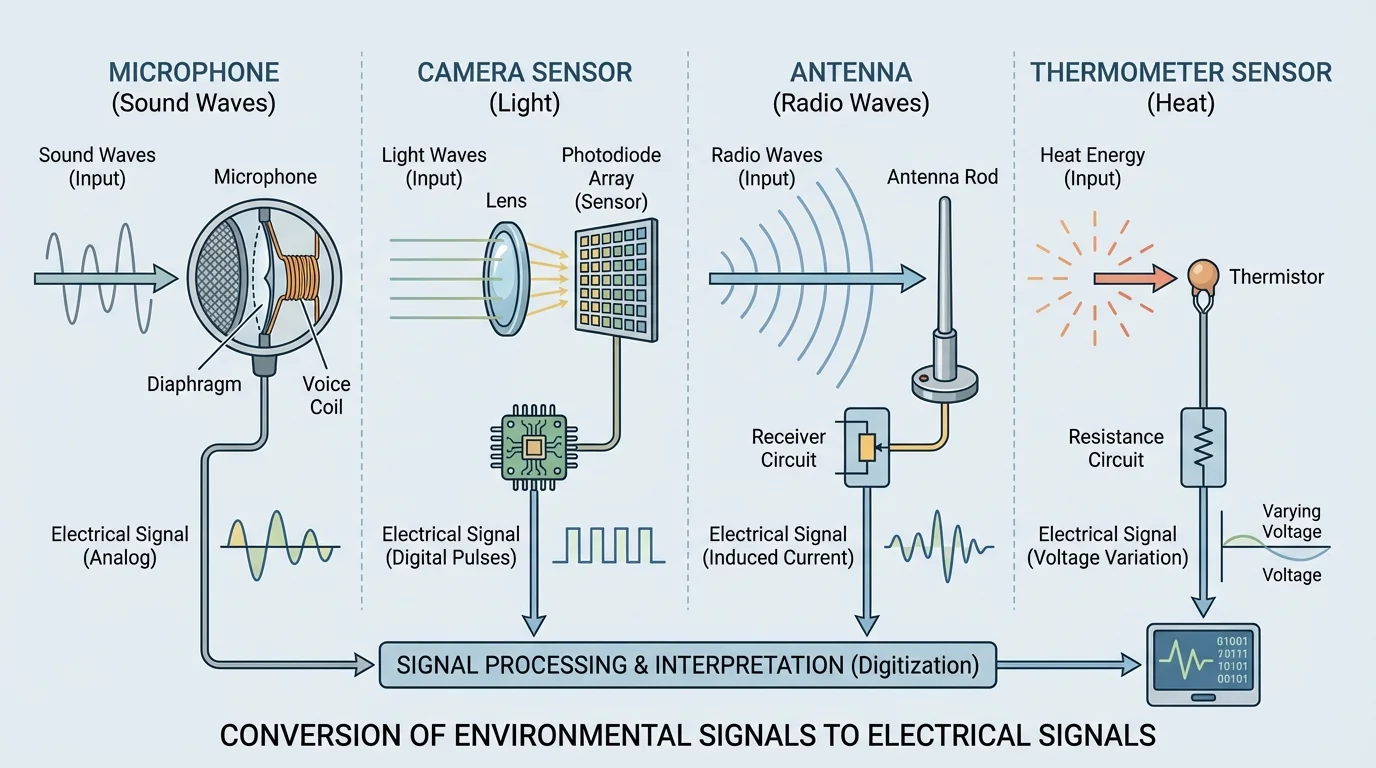
As [Figure 2] shows, many devices detect hidden signals by using a sensor, a part that responds to a physical change and turns it into a measurable output. Different sensors respond to different inputs, but all convert those inputs into signals a device can process.
A microphone detects changing air pressure from sound waves. A camera sensor detects light. An antenna detects electromagnetic waves. A digital thermometer uses a sensor whose electrical properties change with temperature. In every case, the incoming signal interacts with matter inside the device. That interaction causes another change the instrument can measure.
This is why designers must understand both the signal and its interactions with matter. If an antenna is the wrong size, it may not receive a certain frequency well. If a camera sensor is not sensitive to infrared light, it cannot detect that part of the spectrum. If a material absorbs too much signal energy, the signal may weaken before it can be measured.
Think about night-vision cameras. People cannot see infrared radiation directly, but some warm objects give off more infrared than cooler ones. The camera sensor detects infrared radiation and converts it into electrical signals. Then software maps those signals to visible colors on a screen, allowing people to "see" heat patterns.
Medical instruments work in a similar way. An electrocardiogram, often called an ECG, detects small electrical signals from the heart. The body produces the signal, electrodes detect it, and the instrument displays a graph. The graph helps doctors interpret what is happening inside the body without opening it.
Some radio telescopes detect signals that started traveling through space long before humans existed. Instruments on Earth turn these faint radio waves into data that help scientists study stars, galaxies, and black holes.
Even everyday devices use hidden-signal detection. Automatic doors may detect motion with microwaves or infrared. A TV remote sends an infrared signal that your eyes cannot see, but the television sensor can detect it quickly and accurately.
Detecting a signal is only the first step. After detection, a device often amplifies the signal, filters out unwanted parts, and then interprets it. A weak incoming signal may be too small to use at first, so the device makes it stronger. A filter removes unwanted frequencies, helping the device focus on the needed information.
Next, the system must decode the message. In a radio broadcast, the receiver extracts the sound information from the radio wave. In a phone call, the phone changes your voice into electrical or digital form, sends it, and then changes it back into sound at the other end. In a computer network, the receiving device checks the incoming pattern of pulses and decides which bits are \(1\) and which are \(0\).
The full path can be described as source, transmitter, medium, receiver, and output. The source creates information. The transmitter puts that information onto a signal. The medium is the material or space through which the signal travels. The receiver detects the signal. The output presents the information in a useful form.
Real-world example: a voice message on a phone
Step 1: Your voice creates sound waves in air.
Step 2: The phone microphone changes those sound waves into an electrical signal.
Step 3: The phone converts the signal into digital data and sends it by radio waves.
Step 4: A cell tower receives the signal and routes it through a larger network.
Step 5: The receiving phone decodes the data and turns it back into sound.
The listener hears a message that closely matches the original voice because the signal was encoded, transmitted, and decoded carefully.
Every part of this system must work together. If one stage adds too much noise or loses too much information, the final message may be unclear or incomplete.
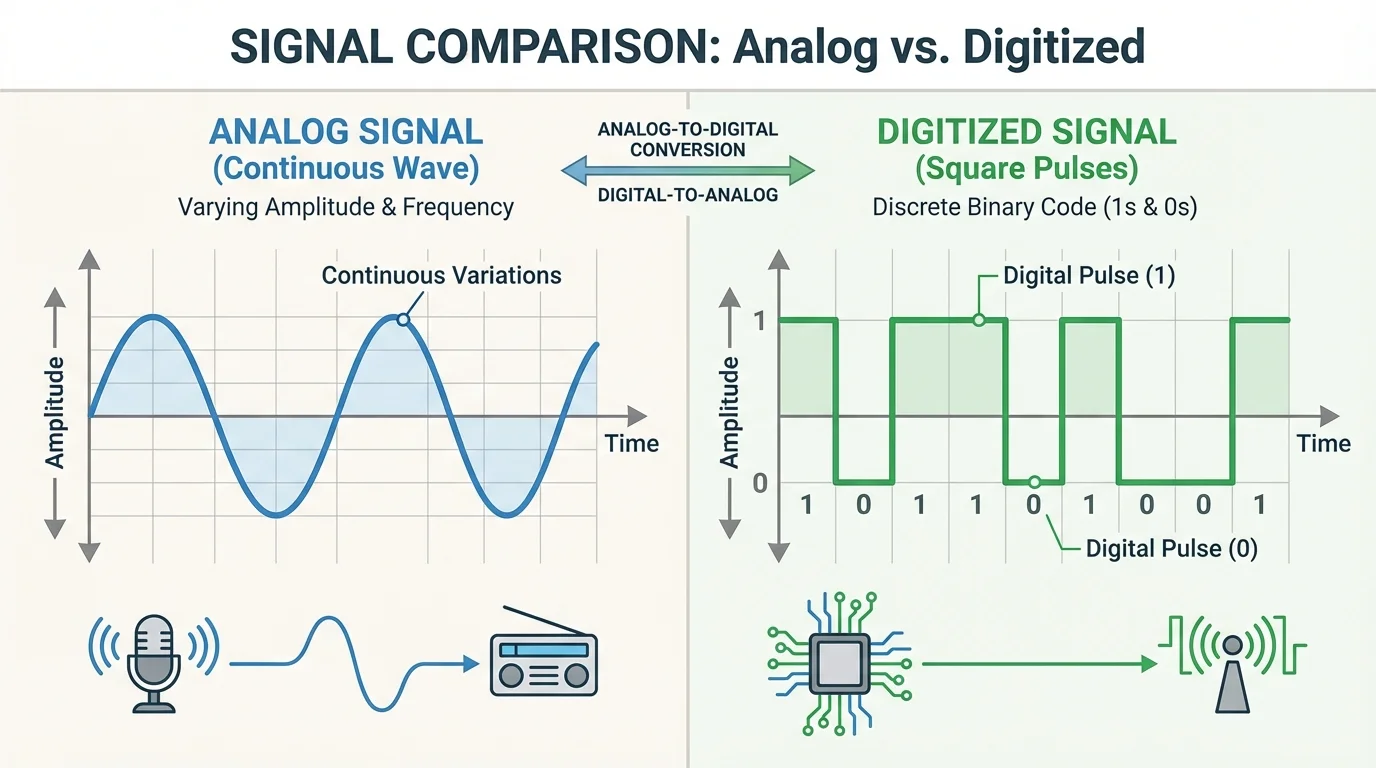
As [Figure 3] illustrates, signals can be analog signals or digital signals. An analog signal changes smoothly and continuously, while a digital signal uses distinct steps or pulses, usually representing values such as \(0\) and \(1\).
An analog signal can closely match a changing natural signal like sound. For many years, radios and telephones often used analog systems. But analog signals can be more easily affected by noise. If static or interference changes the signal a little, the receiver may not know exactly what the original value was.
A digital signal converts information into a sequence of numbers or bits. Because the system only has to decide between a small number of possible states, it can often recover the correct information even if the signal has been slightly disturbed. That is why many modern devices use digitized signals sent as wave pulses.
Suppose a digital system expects a pulse to be either "low" or "high." If noise changes a high pulse a little, the receiver may still recognize it as high. This makes digital communication more reliable over long distances or in noisy environments. Error-checking systems can improve reliability even more by detecting when data was changed during transmission.
Digital information is often stored and sent in bits. A bit has two possible values: \(0\) or \(1\). A small group of bits can represent many patterns. For example, with \(2\) bits, the possible combinations are \(00\), \(01\), \(10\), and \(11\), which gives \(4\) possible codes. With \(3\) bits, there are \(2^3 = 8\) possible codes.
This does not mean analog systems are useless. In fact, the world often begins with analog signals, such as light intensity or sound waves. Devices frequently convert analog signals into digital form because digital systems are easier to copy, store, process, and transmit accurately.
Radio sends information through radio waves. A station changes sound into a signal, places that information onto a carrier wave, and broadcasts it. Receivers tuned to the right frequency pick up the signal and reconstruct the audio.
Television sends both sound and image information. Older systems often used analog methods, while modern systems commonly use digital broadcasting. Digital TV can provide clearer images because it is less affected by small signal distortions than analog TV.
Cell phones communicate by radio waves with nearby towers. The towers connect phones into a larger network so messages can travel great distances. Phones constantly send and receive signals, even when you are not speaking, because they must stay connected to the network.
Wired computer networks send electrical signals through metal wires or light pulses through fiber-optic cables. Fiber optics use light because light can carry large amounts of information very quickly. In a fiber, the light signal reflects inside the material and travels long distances with low energy loss.
Wireless computer networks, such as Wi-Fi, use radio waves to send digital data through the air. The router and the device both contain antennas and electronics that encode and decode signals. That is why your tablet can stream a video without any visible wire connecting it to the network.
Waves transfer energy from place to place, but they can also transfer information when their patterns are organized carefully. Communication technology depends on that same wave behavior.
Other technologies also rely on information transfer by waves. GPS receivers detect signals from satellites. Weather radar sends out radio waves and measures the reflected signals from raindrops. Barcode scanners use light. Seismographs detect vibrations traveling through Earth. The same general idea appears again and again: detect a signal, measure it, and interpret it.
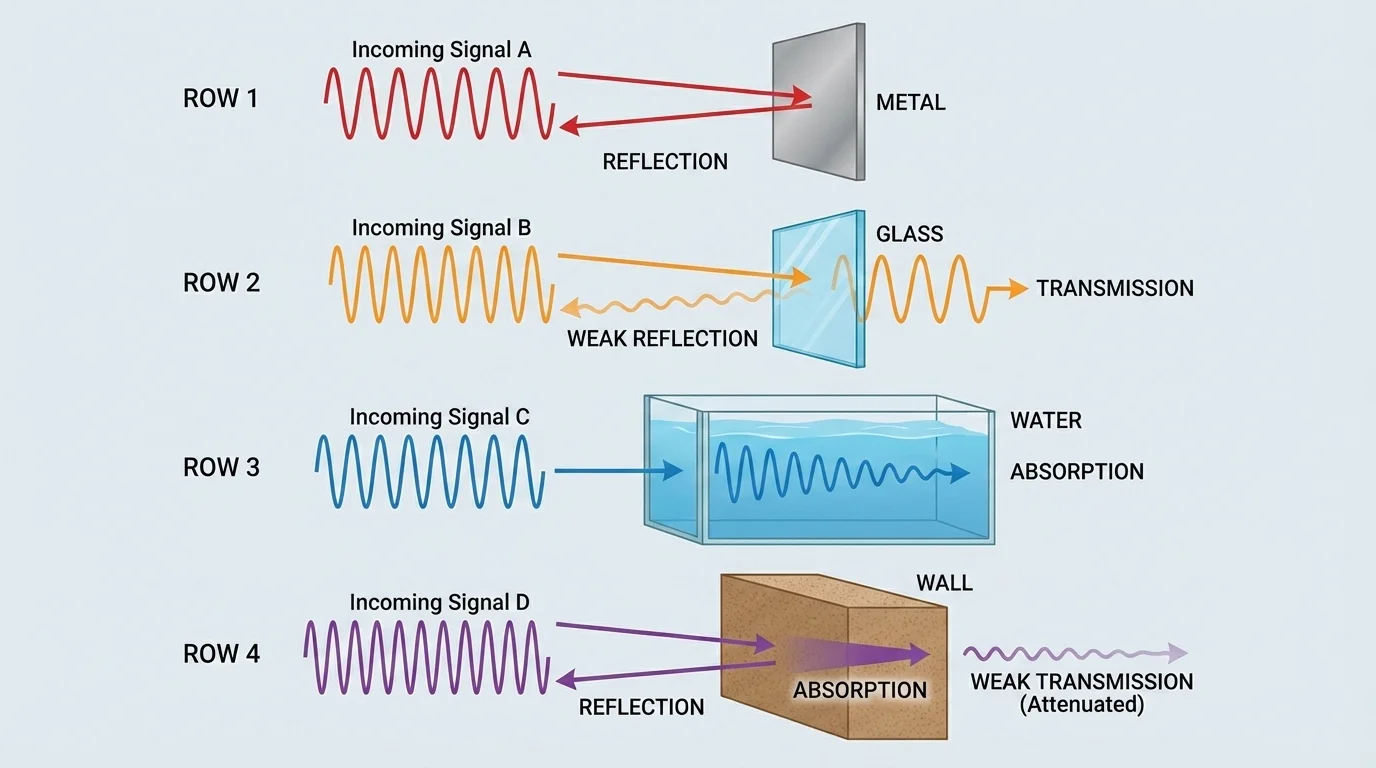
A signal does not travel through every material in the same way. As [Figure 4] shows, a wave can be reflected, absorbed, or transmitted depending on the material it meets. Understanding these interactions is essential for designing reliable devices.
Reflection happens when a wave bounces off a surface. This principle is important in radar systems and mirrors, and internal reflection helps guide light through fiber-optic cables. Absorption happens when a material takes in some of the wave's energy. Thick walls can weaken Wi-Fi signals because they absorb part of the radio energy. Transmission happens when the wave passes through the material. Glass transmits visible light well, which is why windows are transparent.
Different frequencies interact with matter differently. For example, visible light does not pass through a brick wall, but some radio waves can. Water can absorb certain microwave frequencies strongly, which is one reason water-rich materials heat well in microwave ovens. Engineers must choose signal frequencies that fit the job and the environment.
Interference is another challenge. If two signals overlap, they may combine in ways that make the message harder to read. Noise from other electronics can also disturb a signal. Designers reduce these problems by selecting suitable frequencies, shielding equipment, improving materials, and using digital error correction.
These ideas explain common experiences. An elevator with metal walls may weaken phone service. A basement may block wireless signals better than a room near a window. A satellite dish must face a certain direction because it is designed to receive waves arriving from a particular source.
When you send a text, your phone converts letters into digital data. The data is sent as radio signals to a tower, through network equipment, and then to another phone. The message arrives quickly because machines can process digital patterns extremely fast.
When you stream a video, the information is broken into many packets of digital data. These packets travel through wired and wireless networks. If a few packets arrive late, the app may pause briefly while it waits. This is a sign that information transfer depends on timing as well as signal strength.
Remote controls use infrared light. That light is invisible to your eyes, but the TV sensor detects it. This works over short distances and usually requires a direct path, unlike some radio systems that can work through walls.
Weather radar is a powerful example of signal interpretation. The radar sends out waves, which bounce off raindrops and return to the instrument. By measuring the reflected signal, the system can estimate where rain is falling and how intense it is. That helps meteorologists track storms.
Numeric example: finding wavelength
A sound wave travels through air at about \(340 \textrm{ m/s}\). If its frequency is \(170 \textrm{ Hz}\), what is its wavelength?
Step 1: Use the wave equation \(v = f\lambda\).
Step 2: Rearrange to find wavelength: \(\lambda = \dfrac{v}{f}\).
Step 3: Substitute the values: \(\lambda = \dfrac{340}{170} = 2\).
The wavelength is \(2 \textrm{ m}\).
Fiber-optic internet gives another everyday example. Instead of using electrical signals in metal wires, it uses pulses of light in glass fibers. Total internal reflection keeps the light signal inside the cable and allows very fast information transfer over long distances.
Communication systems also depend on timing. If a signal travels at speed \(v\) for time \(t\), the distance is:
\(d = vt\)
For example, if a signal moves at \(300,000 \textrm{ km/s}\) for \(0.002 \textrm{ s}\), then \(d = 300,000 \times 0.002 = 600 \textrm{ km}\). This idea helps scientists estimate distances in systems such as radar and sonar, where travel time reveals how far away an object is.
Data amount also matters. A larger image file contains more bits than a short text message, so it usually takes longer to send unless the connection is very fast. Engineers often talk about data rate, which is how much information can be sent each second.
| Technology | Main signal type | Medium | Example of information |
|---|---|---|---|
| Radio broadcast | Radio wave | Air | Music, speech |
| Television | Radio wave or cable signal | Air or cable | Sound and images |
| Cell phone | Microwave/radio wave | Air | Voice, text, video |
| Ethernet cable | Electrical signal | Metal wire | Digital data |
| Fiber optic | Light pulse | Glass fiber | Digital data |
| Remote control | Infrared light | Air | Commands |
Table 1. Examples of technologies, the signals they use, and the kinds of information they carry.
Looking back at [Figure 3], the difference between smooth analog change and pulse-based digital coding explains why networks built for modern devices can move huge amounts of information accurately. Looking back at [Figure 1], wave properties such as frequency and wavelength help determine which technologies work best for different tasks.
No communication system is perfect. Signals weaken with distance, unwanted noise can interfere, and crowded frequencies can create competition between devices. Designers solve these problems by choosing materials carefully, using amplifiers and filters, reducing interference, and building smart digital systems that can detect mistakes.
Reliability is one major reason digital communication is so important. If a music file is copied digitally many times, each correct copy can stay almost identical to the original. In contrast, repeated copying of analog information often adds more and more noise.
Security also matters. Digital systems can encrypt information so that only the right receiver can read it. This is important for private messages, online banking, medical records, and many other uses of information technology.
Good device design depends on science
Engineers do not choose parts randomly. They use knowledge of wave behavior, materials, energy transfer, and signal processing to make devices that are sensitive enough to detect weak signals, selective enough to ignore unwanted ones, and reliable enough to communicate accurately.
That same scientific understanding allows devices to become smaller, faster, and more powerful over time. A modern smartphone combines functions that once required separate radios, cameras, maps, televisions, clocks, and computers.
As technology advances, more devices are becoming part of connected systems. Smart homes, self-driving vehicles, environmental sensors, and space probes all depend on accurate signal detection and information transfer. In each case, the basic questions remain the same: What is the signal? How does it travel? How does it interact with matter? How will the receiver decode it?
When scientists and engineers answer those questions well, they create technologies that expand human abilities. We can detect storms before they arrive, communicate across oceans, view distant galaxies, and send information around the world in fractions of a second.
The invisible world of signals is one of the main reasons modern life works the way it does. Radios, televisions, phones, and networks may seem ordinary, but behind them is a deep set of ideas about waves, matter, energy, and information.
