Almost every bite of food you eat, every breath of oxygen you take, and much of the energy moving through ecosystems can be traced back to one process: photosynthesis. This is a remarkable fact. Plants, algae, and some bacteria capture energy from sunlight and convert it into a form that living things can use later. In other words, they turn incoming light energy into stored chemical energy.
Photosynthesis is one of the most important energy transformations on Earth. Without it, food webs would collapse, atmospheric oxygen would be far lower, and life as we know it would not exist. For students studying biology, photosynthesis is not just a plant topic. It is a core example of how living systems use matter and energy to survive, grow, and interact with their environment.
When you use a model of photosynthesis, you are not just memorizing a definition. You are tracing how matter moves into and out of an organism and how energy changes form. A good model helps answer several big questions: What goes into the process? What comes out? Where does it happen? And how does light become energy stored in food molecules?
Photosynthesis is the process by which plants, algae, and some bacteria use light energy to produce sugars from carbon dioxide and water, releasing oxygen as a byproduct.
Chemical energy is energy stored in the bonds of molecules. In photosynthesis, that stored energy ends up in sugar molecules such as glucose.
To understand the scope of photosynthesis, it helps to start with the overall equation. This equation is a model of the process, not a description of every molecular event.
\[6\textrm{CO}_2 + 6\textrm{H}_2\textrm{O} + \textrm{light energy} \rightarrow \textrm{C}_6\textrm{H}_{12}\textrm{O}_6 + 6\textrm{O}_2\]
This tells us that carbon dioxide and water are rearranged using light energy to produce glucose and oxygen. The equation is powerful because it tracks both matter and energy in one line. However, the equation alone does not show where the process happens or why light is necessary. That is where a model becomes especially useful.
In the equation above, the atoms are conserved. The carbon, hydrogen, and oxygen atoms on the left side are the same atoms found in new combinations on the right side. Matter is not created from nothing. Instead, matter is reorganized. Energy, however, is transformed. Light energy enters the system and becomes stored as chemical energy in glucose.
Glucose, \(\textrm{C}_6\textrm{H}_{12}\textrm{O}_6\), is an energy-rich molecule. Organisms can later break it down to release usable energy for cellular activities. This means photosynthesis is a way of capturing light energy and storing it in molecules. That stored energy can then move through food chains when animals eat plants or eat other animals that ate plants.
Matter cycles and energy flows are not the same idea. Matter, such as carbon, oxygen, and hydrogen atoms, is reused in living systems. Energy enters, changes form, and eventually leaves as heat. Photosynthesis is one of the clearest examples of this difference.
Because the focus here is on modeling the transformation, you do not need to memorize every biochemical step. What matters most is understanding the big picture: sunlight provides energy, chloroplasts capture that energy, and the plant stores some of it in sugar molecules.
[Figure 1] A systems model of photosynthesis begins with inputs and outputs. The major inputs are light energy, water \(\textrm{H}_2\textrm{O}\), and carbon dioxide \(\textrm{CO}_2\). The major outputs are glucose \(\textrm{C}_6\textrm{H}_{12}\textrm{O}_6\) and oxygen \(\textrm{O}_2\). The model should also show that energy enters as light and leaves stored in the chemical bonds of glucose.
Another important feature of the model is the location of the process. Photosynthesis in plants mainly occurs in leaves, especially inside specialized cell structures called chloroplasts. A complete model therefore includes both the whole-plant scale and the cell scale. At the whole-plant scale, roots absorb water and leaves take in carbon dioxide. At the cell scale, chloroplasts absorb light and drive the conversion.
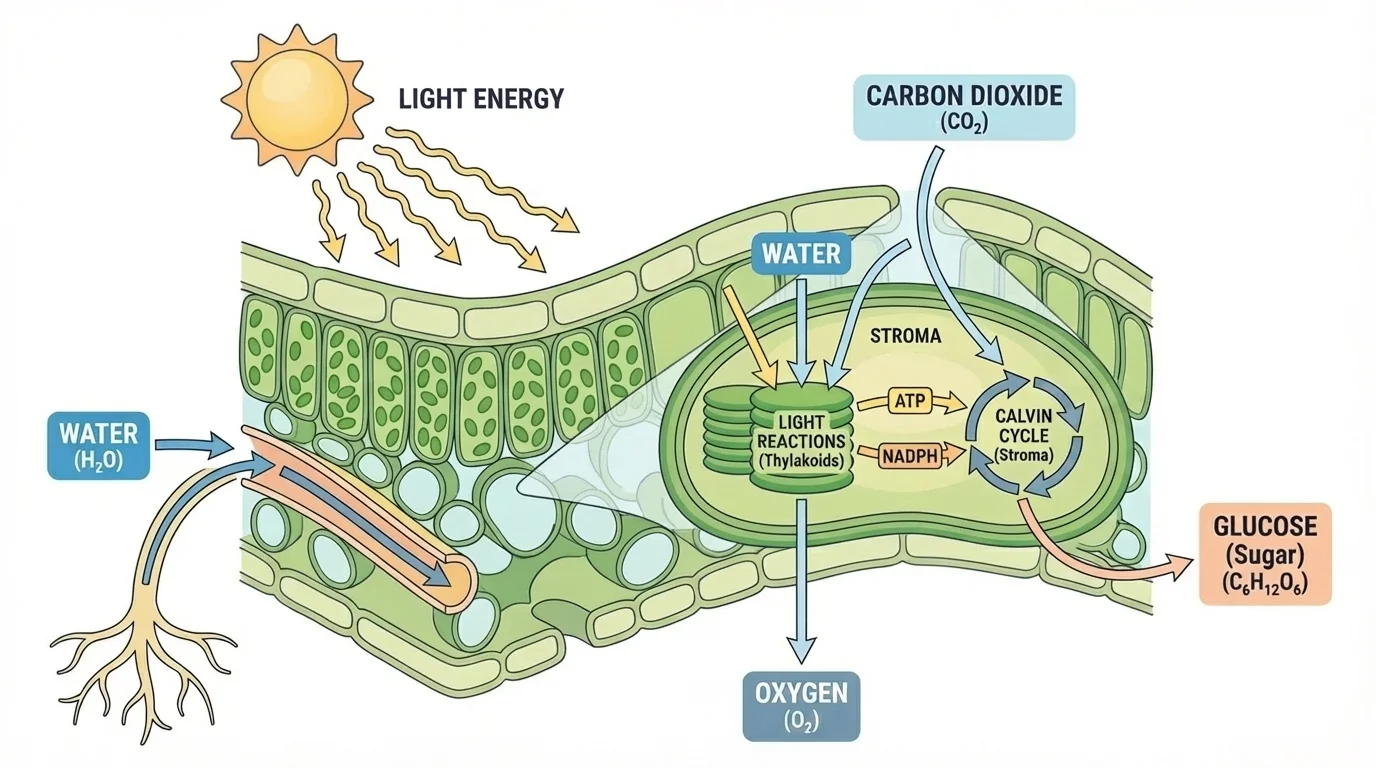
A useful model does not need every molecular detail. It needs the right relationships. For example, arrows can show matter entering and leaving, while labels can show where energy enters and where it becomes stored. This kind of model is especially helpful because it makes clear that light is not a raw material like water or carbon dioxide. Light is the energy source that makes the transformation possible.
What a strong model includes
A strong model of photosynthesis shows three things clearly: the matter flow into and out of the organism, the energy transformation from light to chemical energy, and the structures that make the process possible, especially leaves and chloroplasts.
Later, when you compare photosynthesis with other biological processes, the systems view in [Figure 1] remains useful because it keeps matter and energy separate while showing how both are connected.
The structures inside a leaf support photosynthesis in a highly organized way. Leaves are broad and thin, which helps them absorb sunlight efficiently and exchange gases with the air. Tiny openings called stomata allow carbon dioxide to enter and oxygen to exit. Inside the leaf are many mesophyll cells packed with chloroplasts.
[Figure 2] A chloroplast is an organelle found in plant cells and many algal cells. It contains chlorophyll, the pigment that absorbs light energy. Chlorophyll does not make the plant green just by coincidence; its molecular structure causes it to absorb certain wavelengths of light and reflect green wavelengths, which is why most leaves appear green.
The arrangement of chloroplasts inside leaf cells helps maximize light capture. Water delivered from the roots reaches these cells through vascular tissues, while carbon dioxide diffuses in from the air. The leaf is therefore built as an energy-harvesting surface linked to a transport network.
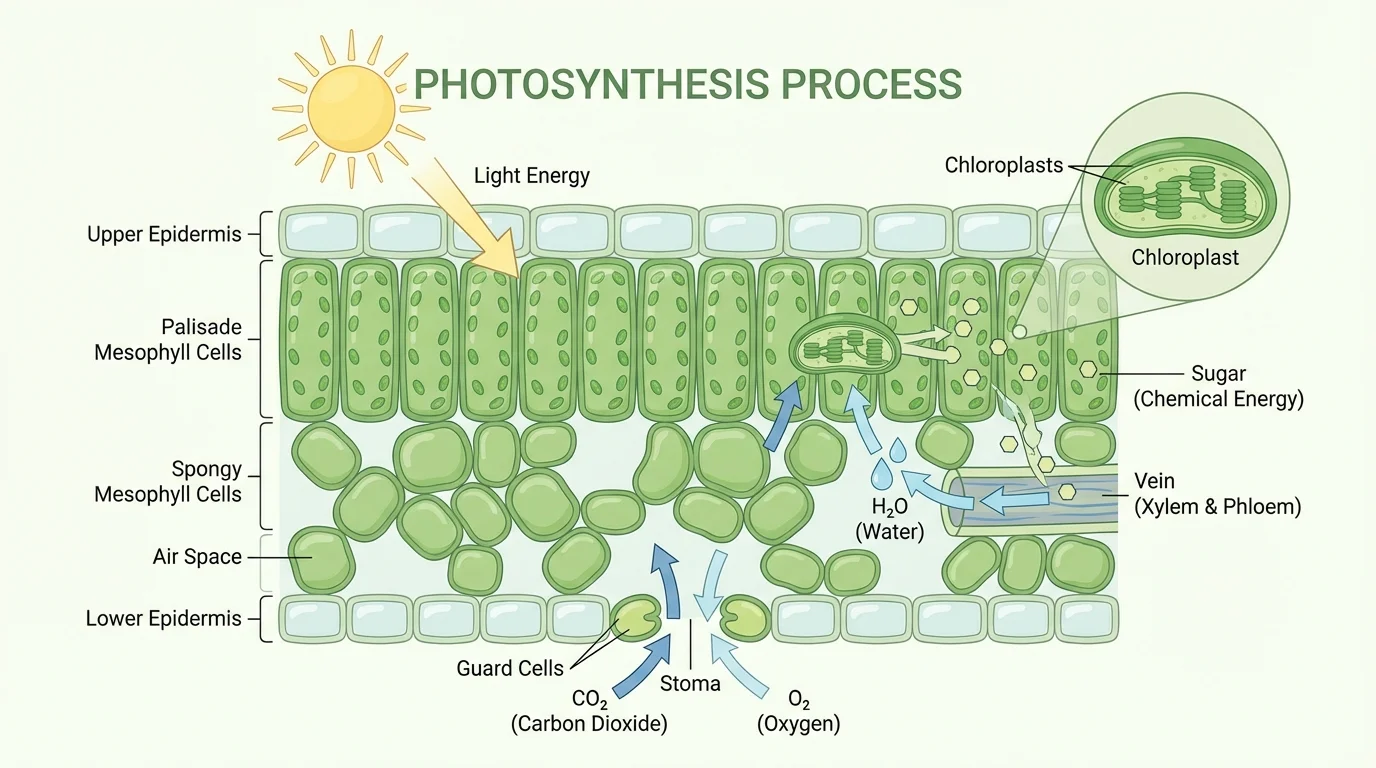
This is a strong example of the relationship between structure and function in biology. The shape of the leaf, the presence of stomata, and the location of chloroplasts all support the same goal: capturing light energy and using it to build energy-rich molecules.
Some ocean ecosystems depend heavily on photosynthetic algae and microscopic plankton rather than large land plants. A large fraction of Earth's oxygen is produced in aquatic environments.
The structural details in [Figure 2] also explain why leaves wilt or photosynthesize poorly when water is limited. The process depends on both the plant's external environment and its internal organization.
[Figure 3] The most important idea in this lesson is the energy transformation. Light energy enters the chloroplast. The chlorophyll absorbs that energy. The plant then uses that captured energy to build glucose from carbon dioxide and water. The energy is not gone; it is now stored in the chemical bonds of the glucose molecule.
An analogy can help here. Sunlight is like an energy source charging a battery, and glucose is like the charged battery. The analogy is not perfect, but it captures the main idea: energy is captured, converted, and stored for later use. When organisms later break down glucose, some of that stored energy becomes available for life processes such as growth, repair, active transport, and movement.
This means that photosynthesis is not mainly about making oxygen, even though oxygen is important. Its central biological role is producing energy-rich organic molecules. Oxygen is a major byproduct, but the long-term storage of energy in sugar is what allows ecosystems to build biomass.
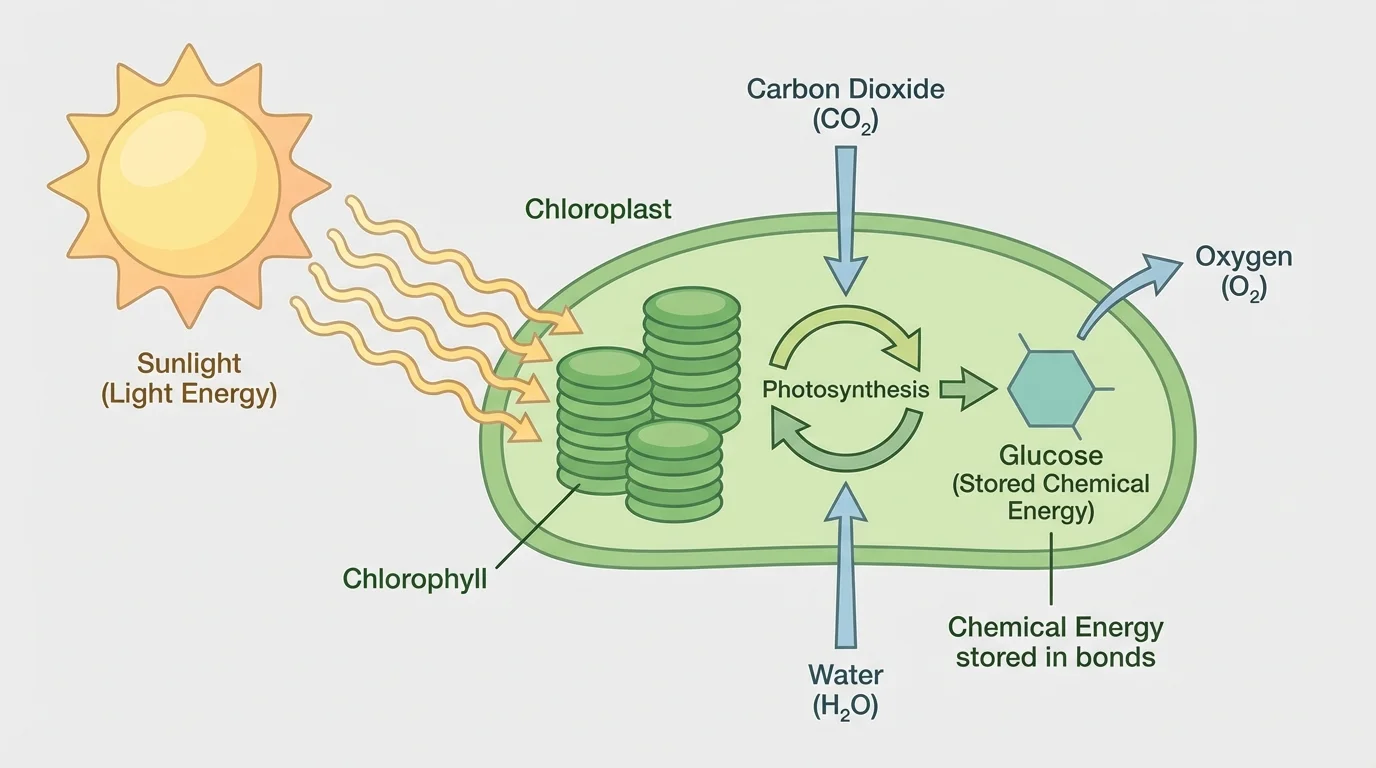
The phrase chemical energy matters because it points to energy stored in bonds. Glucose contains many \(\textrm{C–H}\) and \(\textrm{C–C}\) bonds that can later be rearranged in metabolic reactions. You do not need the detailed biochemical pathway here. What matters is that the product molecule stores more usable energy than the simple input molecules alone.
Energy transformation example
Suppose a plant leaf receives light from the Sun and produces one glucose molecule. A model would not need to calculate every joule of energy, but it should show the direction of the transformation.
Step 1: Identify the incoming energy source.
The incoming energy is light energy from the Sun.
Step 2: Identify the energy-rich product.
The energy-rich product is glucose, \(\textrm{C}_6\textrm{H}_{12}\textrm{O}_6\).
Step 3: State the transformation.
The model shows: light energy \(\rightarrow\) stored chemical energy in glucose.
This is the core energy idea in photosynthesis.
The energy pathway shown in [Figure 3] also explains why photosynthesis supports nearly all food webs. Even meat ultimately traces back to organisms that directly or indirectly used photosynthesis to store solar energy in chemical form.
A scientific model should help you distinguish two different questions: Where does the matter go? And where does the energy go? For matter, the answer comes from the overall equation. Carbon atoms from carbon dioxide become part of glucose. Hydrogen atoms from water also become part of glucose. Oxygen atoms are redistributed, with some ending up in glucose and some released as oxygen gas.
For energy, the answer is different. Light energy enters the system and is transformed into chemical energy. Matter is conserved, but energy changes form. That distinction is central in biology, chemistry, and physics.
You can use the coefficients in the overall equation to interpret the model quantitatively. The equation shows that six carbon dioxide molecules combine with six water molecules to form one glucose molecule and six oxygen molecules.
\[6\textrm{CO}_2 + 6\textrm{H}_2\textrm{O} \rightarrow \textrm{C}_6\textrm{H}_{12}\textrm{O}_6 + 6\textrm{O}_2\]
Using the equation as a model of matter conservation
If a plant uses \(12\) molecules of carbon dioxide and enough water, how many glucose molecules could the model predict?
Step 1: Read the ratio from the equation.
\(6\) molecules of \(\textrm{CO}_2\) produce \(1\) molecule of glucose.
Step 2: Compare the given amount to the ratio.
\(12 \div 6 = 2\)
Step 3: State the model prediction.
\(12\) molecules of \(\textrm{CO}_2\) could produce \(2\) molecules of glucose, assuming enough water and light are available.
This simple ratio does not describe every real-world limitation, but it shows how the equation models conservation of matter.
That example is not about memorizing numbers. It is about seeing that the equation is a compact representation of rearranged atoms. It also reminds us that if any required input is missing, the process cannot continue normally.
[Figure 4] The rate of photosynthesis depends on environmental conditions. Light intensity matters because light supplies the energy that drives the process. Carbon dioxide concentration matters because carbon dioxide provides the carbon atoms used to build glucose. Water availability matters because water is a reactant and also helps maintain plant structure. Temperature matters because photosynthesis depends on enzymes and other biological processes that work best within certain temperature ranges.
If one factor is in short supply, it can limit the overall rate even when the other factors are favorable. For example, a plant under bright light may still photosynthesize slowly if carbon dioxide is scarce or if the plant lacks enough water. This is sometimes called a limiting factor, and it is very useful when interpreting plant growth.
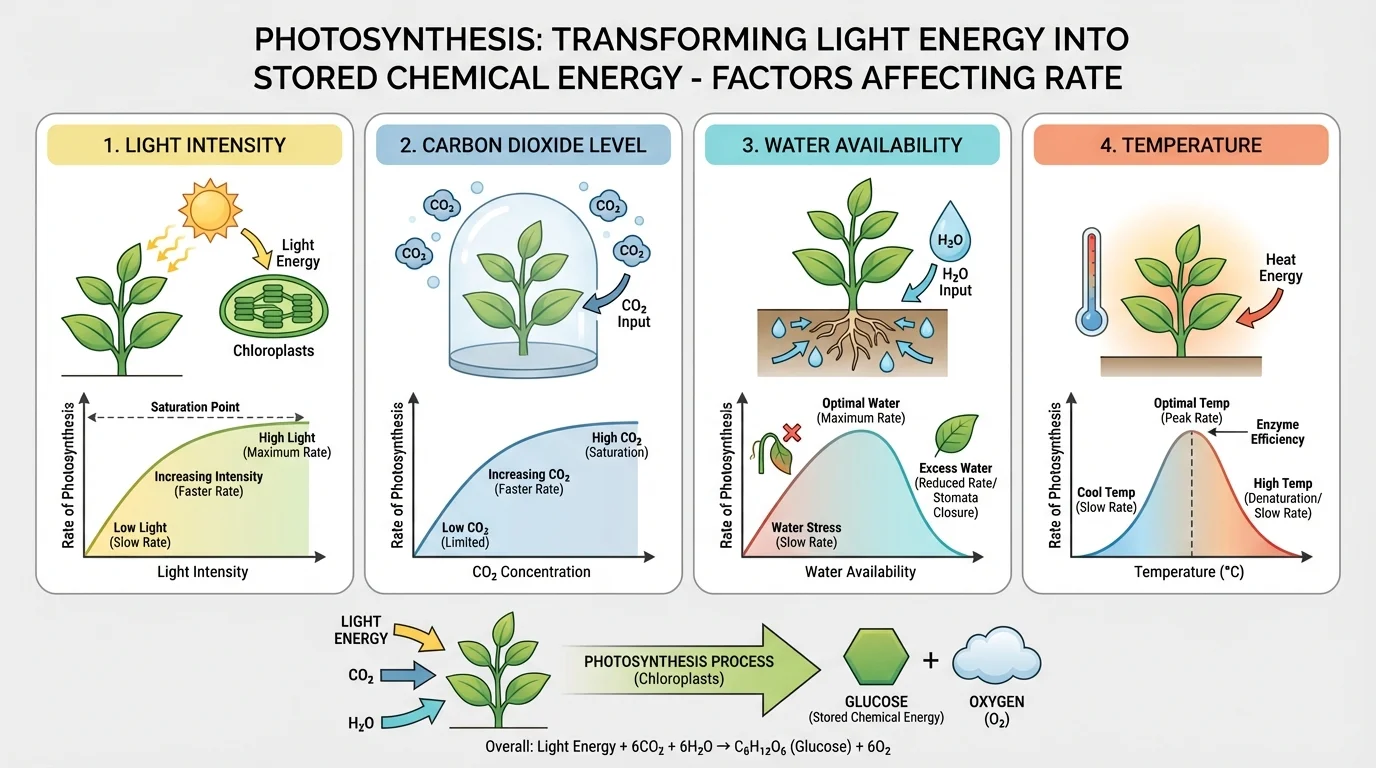
Farmers and greenhouse managers use this knowledge in practical ways. They may increase light exposure, manage irrigation, or adjust carbon dioxide levels in enclosed growing spaces to improve crop production. The science of photosynthesis is therefore directly connected to food systems and resource management.
Real-world application: greenhouse growing
A greenhouse operator notices that plants are receiving strong light but still growing slowly.
Step 1: Check whether light is the limiting factor.
If light is already abundant, increasing it further may not help much.
Step 2: Consider other inputs in the model.
The operator examines carbon dioxide supply, water availability, and temperature.
Step 3: Use the model to guide action.
If carbon dioxide is low, increasing it may raise the rate of photosynthesis more effectively than adding more light.
This is how a biological model supports problem solving in agriculture.
The comparison in [Figure 4] also helps explain seasonal changes. In winter or drought conditions, lower light levels, colder temperatures, or reduced water availability can all reduce photosynthetic activity.
Photosynthesis matters far beyond a single leaf. In ecosystems, it is the main process that introduces usable chemical energy into food webs. Producers such as plants and algae capture solar energy, and consumers depend on that stored energy either directly or indirectly.
Photosynthesis also affects the atmosphere by removing carbon dioxide and releasing oxygen. Although this does not solve climate change by itself, forests, grasslands, wetlands, and oceans all play major roles in the global carbon cycle because photosynthetic organisms move carbon into living tissues.
Another major outcome is biomass production. Wood, fruits, seeds, leaves, and plant oils all exist because plants build organic molecules from carbon dioxide and water. Biofuels also depend on this stored chemical energy. Even fossil fuels represent ancient solar energy originally captured by photosynthetic organisms millions of years ago.
"All flesh is grass."
— Ancient phrase reminding us that food chains begin with producers
This idea may sound poetic, but it is biologically accurate. When a hawk catches a mouse or a human eats bread, the energy involved ultimately traces back to photosynthesis.
One common misconception is that plants get their food from soil. Soil provides minerals and support, but the plant builds most of its food molecules through photosynthesis. Much of a plant's mass comes from carbon dioxide in the air, not from solid material pulled from the ground.
Another misconception is that photosynthesis and respiration are the same process. They are related, but they are not identical. Photosynthesis stores energy in glucose, while cellular respiration releases energy from glucose. In broad terms, the products of one process are closely linked to the reactants of the other, but the energy direction is different.
A third misconception is that only land plants matter. In reality, photosynthetic organisms in lakes, rivers, and oceans are essential to global oxygen production and energy flow. The leaf model is useful, but the core principles apply more broadly across photosynthetic life.
When you return to the system model in [Figure 1], these misconceptions become easier to correct. The model makes clear that food is produced inside the organism from matter taken in and energy captured from light.
| Feature | Photosynthesis | Why it matters |
|---|---|---|
| Energy source | Light from the Sun | Provides the energy for building sugar molecules |
| Main reactants | \(\textrm{CO}_2\) and \(\textrm{H}_2\textrm{O}\) | Supply the atoms used to make glucose |
| Main product | \(\textrm{C}_6\textrm{H}_{12}\textrm{O}_6\) | Stores chemical energy for later use |
| Byproduct | \(\textrm{O}_2\) | Supports aerobic life on Earth |
| Main location in plants | Chloroplasts in leaf cells | Connects cell structure to biological function |
Table 1. Major features of photosynthesis and why each one is important.
Photosynthesis is one of the clearest examples of how organisms use matter and energy to live and grow. A model of this process should therefore do more than list terms. It should reveal relationships: inputs become outputs, light becomes stored chemical energy, and biological structures make the transformation possible.
