A forest looks still from a distance, but it is actually a giant exchange system. Carbon from the air becomes part of leaves, the leaf becomes part of an insect, the insect becomes part of a bird, and eventually those same atoms may return to the soil or atmosphere. At the same time, energy from sunlight enters the system, moves through organisms, and gradually leaves as heat. One of the most powerful ideas in biology is that living systems are built on transfers, not magic: matter is reused, and energy changes form.
An ecosystem includes living organisms and the nonliving environment they interact with. That means plants, animals, fungi, bacteria, water, air, soil, and sunlight all matter. In an ecosystem, atoms do not vanish when an organism dies, and energy does not stay trapped forever in food. Instead, matter cycles through the system while energy flows through it.
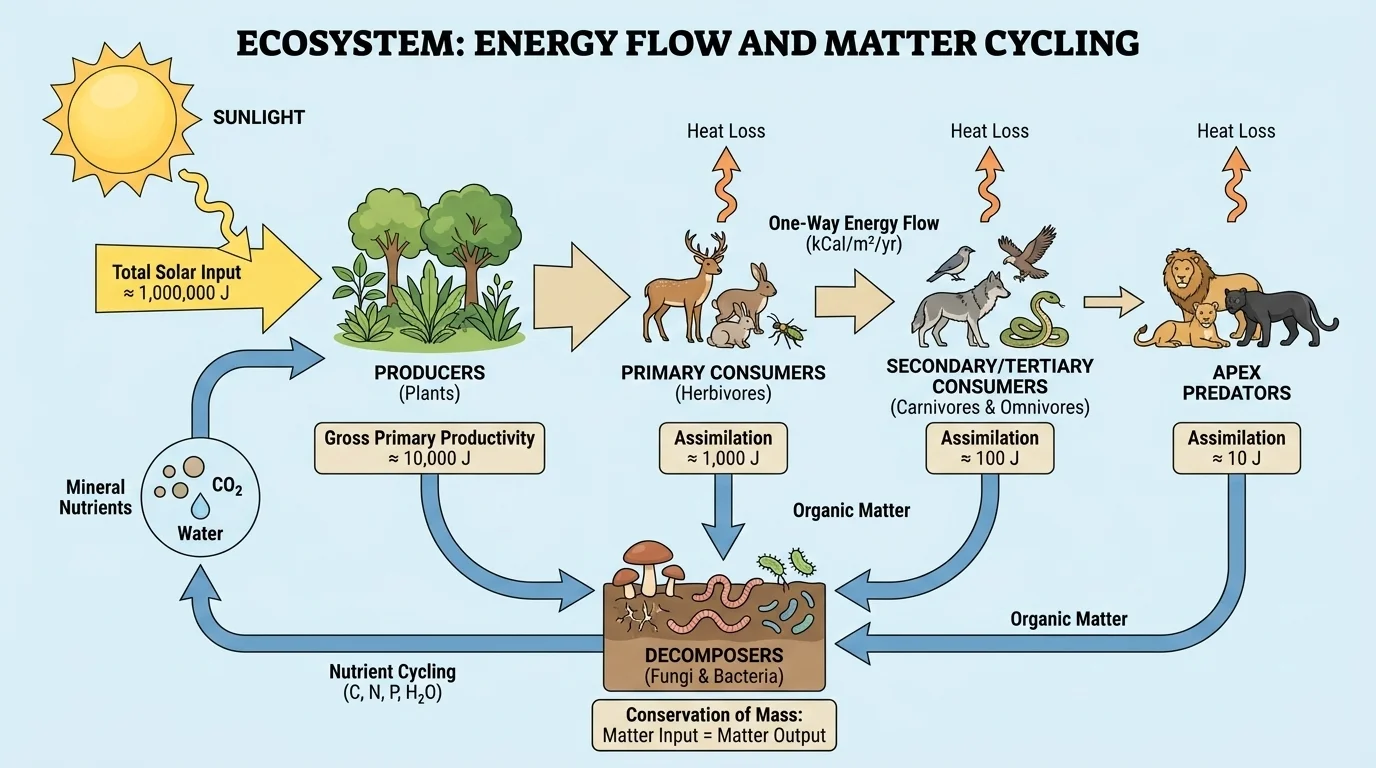
[Figure 1] This distinction is essential. Matter is made of atoms such as carbon, oxygen, hydrogen, and nitrogen. Those atoms can be rearranged into different molecules, but they are conserved. Energy, in contrast, enters most ecosystems as sunlight and moves from organism to organism through feeding relationships. Eventually, much of that energy becomes thermal energy released to the surroundings.
Producers are organisms that make their own food, usually by photosynthesis.
Consumers are organisms that obtain matter and energy by eating other organisms.
Decomposers are organisms that break down dead material and waste, returning matter to the environment.
Trophic level is a feeding position in a food chain or food web.
Because the same atoms can move through many organisms over time, an ecosystem is not just a collection of separate individuals. It is more like a network of exchanges. The carbon atom in your body today may once have been part of a tree, a fish, or a molecule of \(\textrm{CO}_2\) in the air. That is why biologists talk about the cycling of matter.
The movement of energy is different. Organisms use energy for growth, movement, repair, and maintaining internal conditions. With each transfer, some energy becomes less available for biological work because it is released as heat. This is why the one-way pathway of energy in [Figure 1] does not loop back in the same way that matter does.
Most ecosystems depend on photosynthesis, the process by which producers use light energy to build sugars from carbon dioxide and water. A simplified equation is:
\[6\textrm{CO}_2 + 6\textrm{H}_2\textrm{O} \rightarrow \textrm{C}_6\textrm{H}_{12}\textrm{O}_6 + 6\textrm{O}_2\]
This equation shows conservation of matter clearly. Before and after the reaction, the same numbers of carbon, hydrogen, and oxygen atoms are present. The atoms are rearranged into new molecules. Light energy is captured and stored as chemical energy in glucose, \(\textrm{C}_6\textrm{H}_{12}\textrm{O}_6\).
Why this equation matters
Photosynthesis explains how abiotic matter enters the living part of an ecosystem. Carbon in atmospheric \(\textrm{CO}_2\) becomes plant biomass. Water contributes hydrogen and oxygen atoms. The product glucose stores energy in chemical bonds, making it available to the producer and to organisms that eat the producer.
Organisms then use cellular respiration to release that stored energy. A simplified equation is:
\[\textrm{C}_6\textrm{H}_{12}\textrm{O}_6 + 6\textrm{O}_2 \rightarrow 6\textrm{CO}_2 + 6\textrm{H}_2\textrm{O}\]
Again, matter is conserved. The carbon atoms in glucose are not destroyed; they become part of \(\textrm{CO}_2\). The energy stored in glucose is transformed into usable forms for cells, and some is released as heat. Together, photosynthesis and cellular respiration form a major biological connection between matter cycling and energy flow.
If a plant makes \(100\textrm{ g}\) of glucose-containing biomass, that material can become part of leaves, stems, roots, or seeds. If a caterpillar eats some of that plant, part of the matter enters the caterpillar's body, part leaves as waste, and part returns to the atmosphere through respiration. The atoms move; they do not disappear.
[Figure 2] Food chains and food webs show who eats whom in an ecosystem. They also help explain how energy becomes less available at higher feeding levels. The structure of trophic levels reveals why ecosystems usually contain more producers than top predators.
Suppose producers in a grassland capture \(10{,}000\) units of energy from sunlight into chemical energy stored in biomass. If primary consumers receive about \(10\%\) of that stored energy, they would receive:
\[10{,}000 \times 0.10 = 1{,}000\]
If secondary consumers receive about \(10\%\) of the primary consumers' energy, they would receive:
\[1{,}000 \times 0.10 = 100\]
If tertiary consumers receive \(10\%\) of that, they would receive:
\[100 \times 0.10 = 10\]
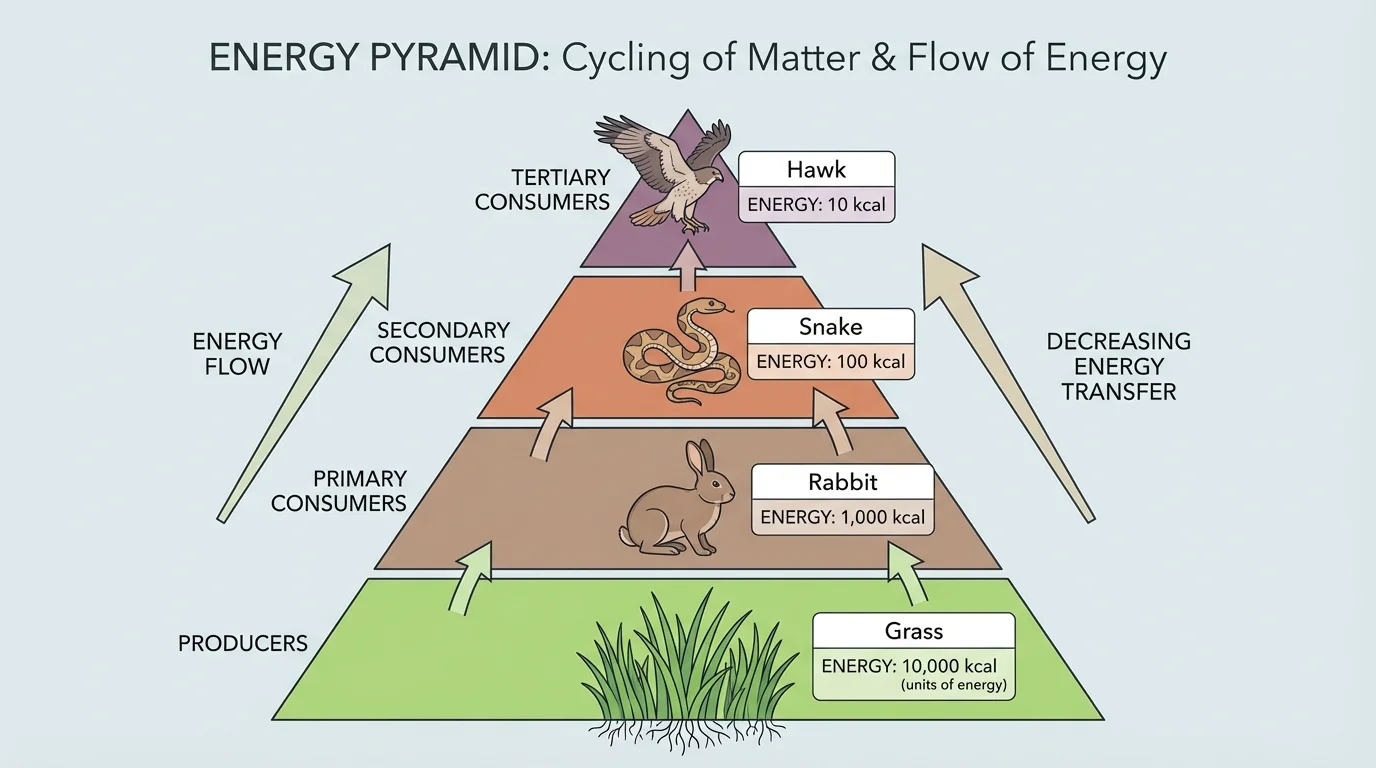
This is not an exact rule for every ecosystem, but it is a useful proportional model. It helps explain why there is far less available energy at higher trophic levels. A hawk can exist only because a much larger amount of energy was first captured by plants and then transferred through lower levels.
Worked example: comparing energy at trophic levels
A wetland ecosystem has \(5{,}000\) units of energy stored in producer biomass. Estimate the energy available to primary consumers and secondary consumers using a \(10\%\) transfer model.
Step 1: Find the primary consumer energy.
\(5{,}000 \times 0.10 = 500\)
Step 2: Find the secondary consumer energy.
\(500 \times 0.10 = 50\)
The model predicts about \(500\) units for primary consumers and \(50\) units for secondary consumers.
Notice what proportional reasoning does here: it allows us to support a biological claim with numbers. The claim is that less energy is available at each higher trophic level. The math representation shows the pattern clearly. The energy pyramid in [Figure 2] matches this idea visually.
Mathematical representations in ecology do not always need advanced algebra. Often, ratios, percentages, and simple comparisons are enough to support a strong claim. This fits the idea that the focus is on proportional reasoning.
Suppose a population of rabbits eats \(200\textrm{ kg}\) of plant material. If \(25\%\) of that matter becomes new rabbit biomass, then the amount added to rabbit bodies is:
\[200 \times 0.25 = 50\textrm{ kg}\]
The remaining \(150\textrm{ kg}\) is not gone. Some leaves as waste, some is broken down during respiration, and some contributes to activities that release matter back to the environment. The key claim is that only a fraction of consumed matter becomes biomass in the next trophic level.
Worked example: proportion of biomass transferred
In a pond, small fish consume \(80\textrm{ kg}\) of algae biomass. If \(15\%\) becomes new fish biomass, how much fish biomass is produced?
Step 1: Convert the percentage to a decimal.
\(15\% = 0.15\)
Step 2: Multiply the total consumed biomass by the proportion transferred.
\(80 \times 0.15 = 12\textrm{ kg}\)
The fish produce \(12\textrm{ kg}\) of new biomass.
We can also compare amounts using ratios. If an ecosystem has \(900\textrm{ kg}\) of producer biomass and \(90\textrm{ kg}\) of herbivore biomass, the ratio of producer biomass to herbivore biomass is:
\[900:90 = 10:1\]
This supports the claim that lower trophic levels typically contain much more biomass than higher ones.
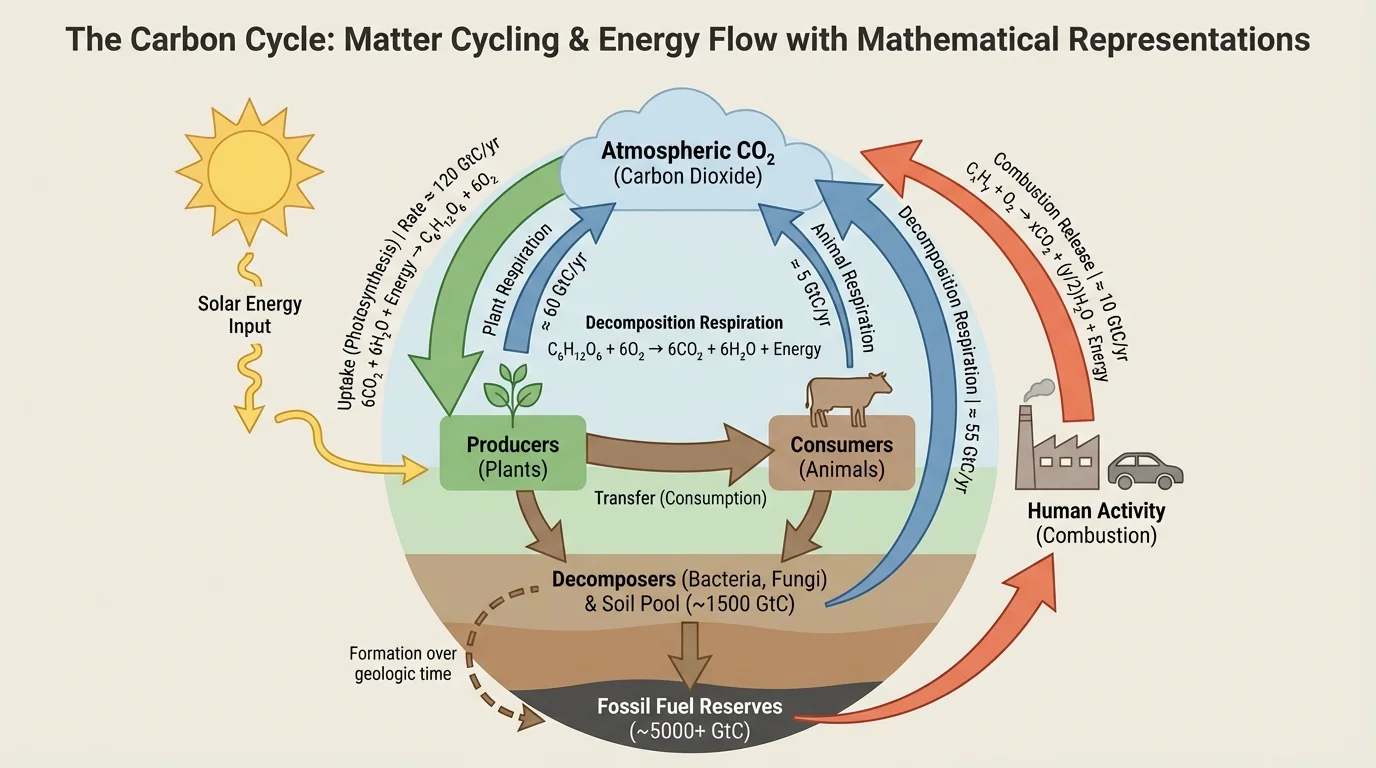
[Figure 3] Carbon moves repeatedly between the atmosphere, living organisms, soil, and water. Producers take in \(\textrm{CO}_2\) during photosynthesis. Consumers obtain carbon by eating producers or other consumers. Decomposers break down dead organisms and wastes, returning carbon compounds to soil and releasing carbon back to the atmosphere through respiration.
Combustion can also return carbon to the atmosphere. When wood burns, carbon stored in plant tissues reacts with oxygen, and much of it is released as \(\textrm{CO}_2\). This links ecosystems with human activities such as deforestation and fossil fuel use.
Here is a proportional example. Suppose a tree contains \(1{,}000\textrm{ kg}\) of carbon-containing biomass. If insects consume \(12\%\) of that biomass in one season, then the amount consumed is:
\[1{,}000 \times 0.12 = 120\textrm{ kg}\]
If birds then consume insects representing \(20\%\) of that insect biomass, the transfer upward is:
\[120 \times 0.20 = 24\textrm{ kg}\]
This does not mean the rest of the carbon disappears. It remains in insect bodies, waste, dead matter, soil organic material, or returns to the atmosphere through respiration and decomposition. Carbon is cycling among forms and locations.
Carbon atoms in your body may once have been part of ancient plants, ocean plankton, or the air exhaled by another organism. The carbon cycle connects every living thing across time.
Claims about carbon movement are strongest when they include numbers. Saying "some carbon moves from plants to animals" is true but vague. Saying "\(12\%\) of the plant biomass was consumed, and \(20\%\) of that entered the next trophic level" is a claim supported by a mathematical representation. The continuous looping pattern remains visible in [Figure 3].
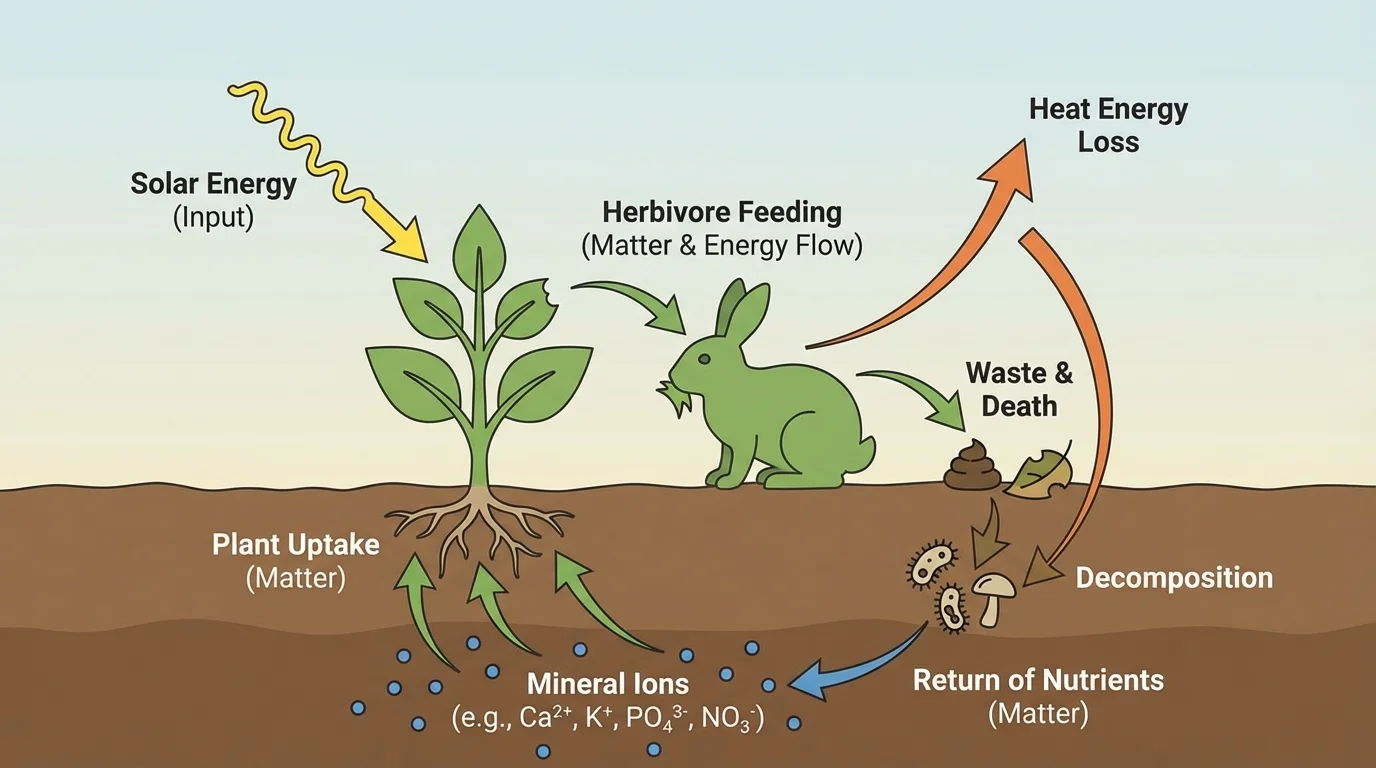
[Figure 4] Water and nutrients also move through ecosystems, but unlike energy, they are reused. Nutrients circulate through soils, organisms, wastes, and decomposed material in a simplified land ecosystem.
Plants absorb water and dissolved minerals through roots. Animals obtain water by drinking and by eating food, and they obtain nutrients such as nitrogen and phosphorus by consuming other organisms. When organisms excrete waste or die, decomposers return much of that matter to the soil or water, where it can be used again.
Suppose soil in a garden contains \(40\textrm{ kg}\) of available nitrogen compounds. If plants absorb \(30\%\) of that amount during a growing season, then the absorbed amount is:
\[40 \times 0.30 = 12\textrm{ kg}\]
If herbivores eat plant material containing \(25\%\) of that absorbed nitrogen, they take in:
\[12 \times 0.25 = 3\textrm{ kg}\]
The remaining nitrogen is still in plants, soil, wastes, or decomposed material. Again, the matter is redistributed rather than destroyed.
| Process | What moves | Direction pattern | Simple proportional example |
|---|---|---|---|
| Photosynthesis | Carbon from air into biomass | Abiotic to biotic | \(200\textrm{ kg}\) plant gain from available carbon |
| Feeding | Matter and energy in food | One trophic level to another | \(10\%\) energy transfer |
| Respiration | Carbon back to atmosphere | Biotic to abiotic | Part of consumed biomass released as \(\textrm{CO}_2\) |
The nutrient cycle in [Figure 4] helps explain why healthy soils are so important. If decomposition slows or nutrients are removed faster than they are returned, plant growth can decrease, affecting the entire food web.
Decomposers such as fungi and bacteria are often overlooked because they are less visible than trees or wolves, but they are essential to ecosystem stability. Without decomposers, dead material and wastes would accumulate, and nutrients would remain locked in forms that other organisms could not easily reuse.
Imagine fallen leaves with a mass of \(500\textrm{ kg}\). If decomposers break down \(60\%\) of that leaf litter over time, then:
\[500 \times 0.60 = 300\textrm{ kg}\]
of matter is processed and redistributed into the soil, atmosphere, and decomposer biomass. The remaining \(200\textrm{ kg}\) may still be decomposing or stored in the environment. This kind of reasoning supports the claim that decomposition returns matter to the ecosystem rather than destroying it.
Conservation means that in physical and biological systems, matter is not created from nothing or destroyed into nothing during ordinary processes. Instead, atoms are rearranged and transferred.
Decomposers also connect directly to the carbon cycle and nutrient cycle. The same fallen leaf contains carbon, hydrogen, oxygen, nitrogen, and minerals. As it breaks down, each kind of atom can move into different reservoirs. This is why ecosystems must be understood as linked cycles, not isolated pathways.
Farmers apply these ideas when they manage soil nutrients. If a crop removes a large proportion of nitrogen and phosphorus from the field, those nutrients must be replaced through compost, fertilizer, or crop rotation. Otherwise, the next generation of plants may have less matter available for growth, and total biomass production can drop.
Fisheries management also depends on energy flow. Because only a fraction of energy is available at each higher trophic level, harvesting top predators can affect food webs strongly. Producing food from lower trophic levels is often more energy-efficient than relying only on large predators.
Worked example: supporting a claim about a marine food chain
A coastal ecosystem stores \(20{,}000\) units of energy in phytoplankton. If \(8\%\) becomes available to zooplankton and \(12\%\) of that becomes available to small fish, how much energy reaches the small fish?
Step 1: Find the energy transferred to zooplankton.
\(20{,}000 \times 0.08 = 1{,}600\)
Step 2: Find the energy transferred to small fish.
\(1{,}600 \times 0.12 = 192\)
The small fish receive \(192\) units of energy. This supports the claim that much less energy reaches higher trophic levels.
Reforestation provides another example. Planting trees increases the number of producers that can remove \(\textrm{CO}_2\) from the atmosphere and store carbon in biomass. If a reforested area stores \(15\%\) more plant biomass than it did before, that change can be used as evidence for increased carbon uptake, provided the measurement is reliable.
When you evaluate a statement about ecosystems, ask two questions. First, does the claim distinguish between matter cycling and energy flow? Second, is there a mathematical representation that supports the claim? A strong claim might say, "Only \(10\%\) of the energy in producer biomass is transferred to herbivores," or "\(30\%\) of available soil nitrogen was absorbed by plants." Those claims can be checked with data.
A weaker claim often mixes ideas incorrectly, such as saying energy is recycled in the same way matter is recycled. Energy is transferred and transformed, but much of it becomes heat and is not cycled through the ecosystem in the same looping way. Matter, by contrast, can move from air to plant to animal to soil and back again.
"In ecosystems, atoms travel in circles, but usable energy moves in a path."
The most convincing ecological explanations combine biology with clear quantitative reasoning. You do not need advanced equations to make strong scientific arguments. Percentages, ratios, and simple calculations are enough to show that matter is conserved as it cycles and that energy decreases in availability as it flows through living systems.
