The ground beneath your feet, the air you breathe, and the organisms around you are not separate parts of nature. They are parts of one interacting planet. Forests influence rainfall. Tiny ocean organisms help regulate climate. Microbes in soil can speed up the breakdown of rock. Over millions of years, life has transformed Earth so deeply that many of the planet's most familiar features exist partly because living things helped create them. At the same time, Earth's shifting climate, moving plates, changing oceans, and circulating atmosphere have continuously shaped what kinds of life can survive. Earth and life do not just coexist; they co-evolve.
This idea is central to understanding Earth science. The biosphere includes all living organisms and the regions where life exists. But life always depends on and affects the atmosphere, the hydrosphere, and the geosphere. These interactions are often sensitive. A small change in one system can trigger larger changes in another. Sometimes the result is stabilizing. Sometimes it pushes the planet in a new direction, as [Figure 1] shows.
Earth works as a connected set of systems through exchanges of matter and energy among air, water, rocks, and living things. Water moves through evaporation, condensation, precipitation, runoff, and groundwater flow. Carbon moves among the air, oceans, soils, rocks, and organisms. Nutrients such as nitrogen and phosphorus cycle through ecosystems and Earth materials. None of these movements happens in isolation.
A forest, for example, is not just a collection of trees. Tree roots interact with rock and soil. Leaves exchange gases with the atmosphere. Plants absorb water from the ground and release it through transpiration. Decomposers return nutrients to soil. The forest affects stream flow, local temperature, erosion, and even cloud formation. In that sense, a forest is part of several Earth systems at once.
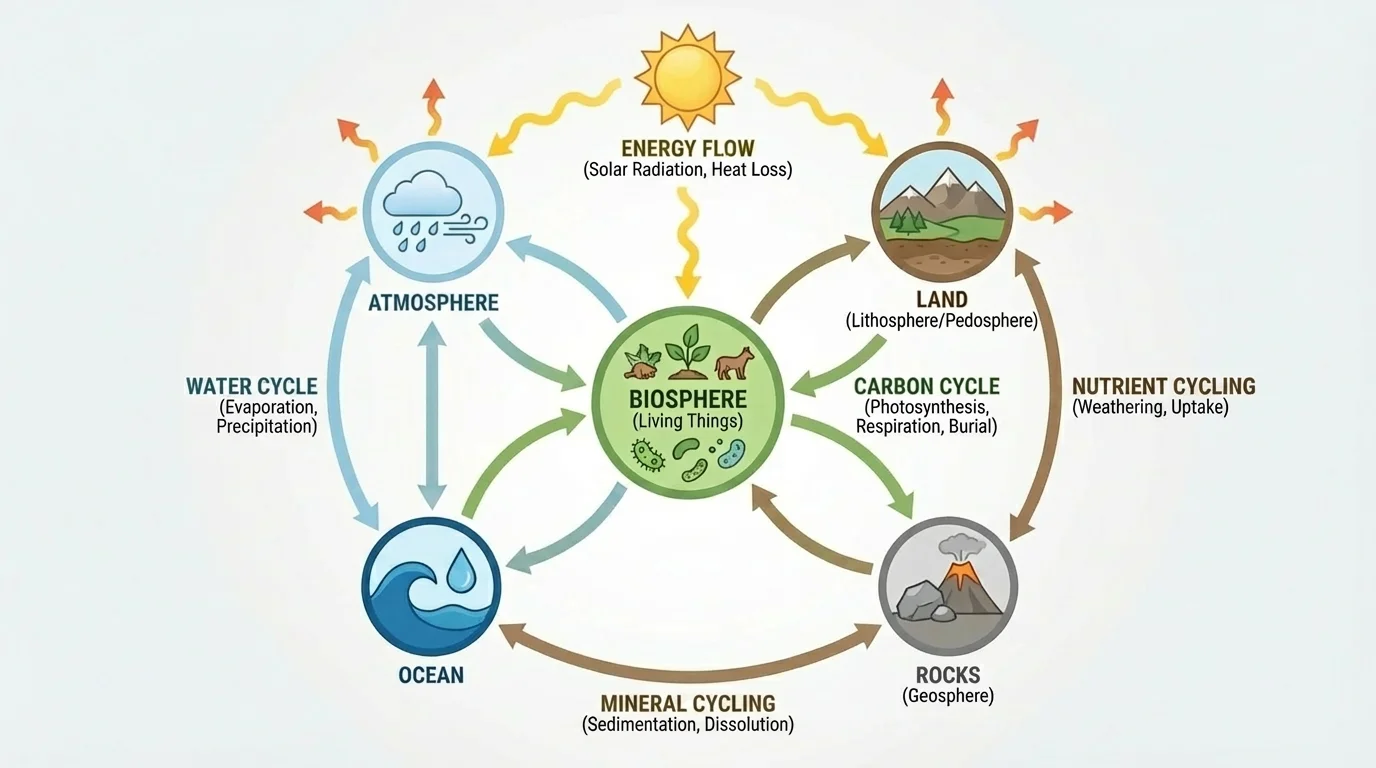
These interactions are often described using the idea of a feedback loop. In a feedback loop, a change in one part of a system causes effects that either reduce the original change or increase it. This matters because Earth is not static. It is always responding to disturbances such as volcanic eruptions, droughts, glaciation, species evolution, and human activity.
Earth system feedbacks are chains of cause and effect in which a change in one part of Earth influences other parts, and those responses then affect the original change. Negative feedback reduces or stabilizes change, while positive feedback amplifies change.
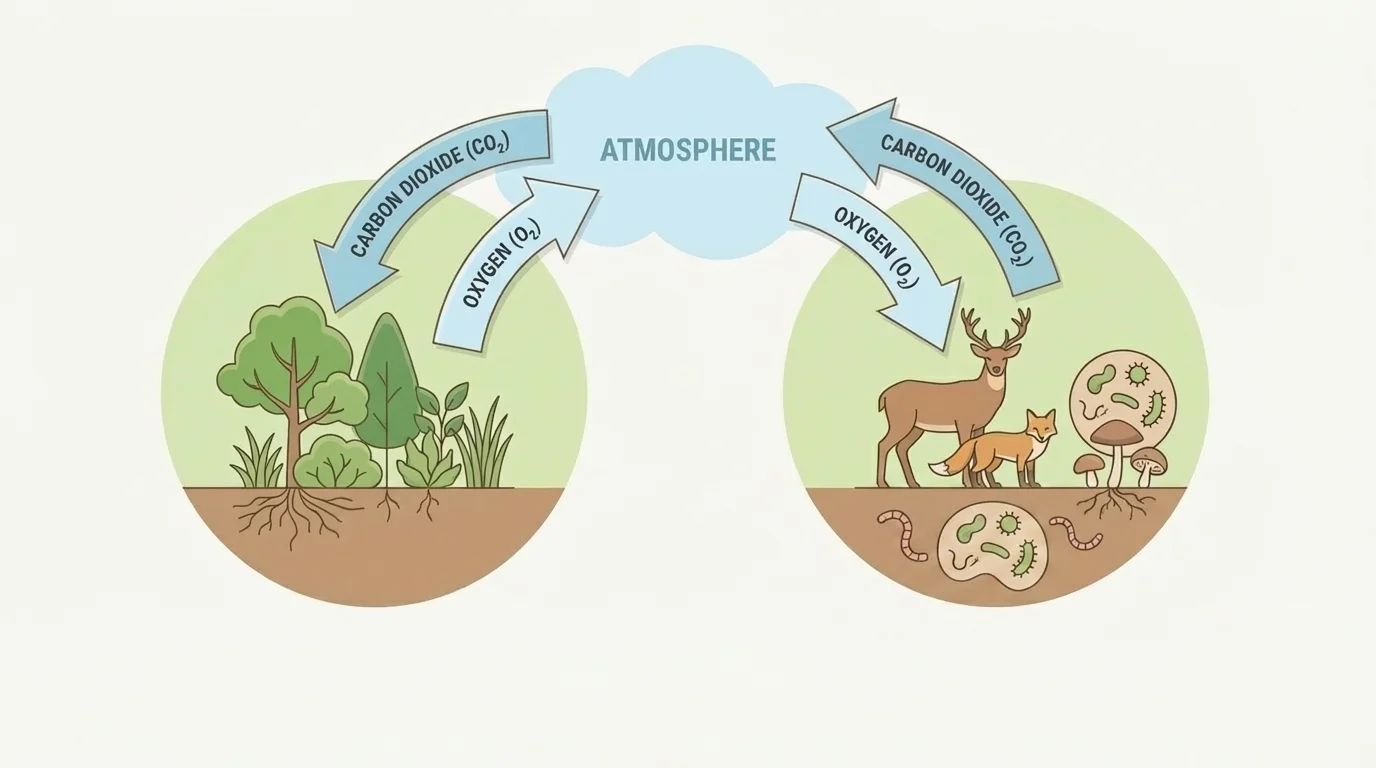
One reason Earth has remained habitable for billions of years is that many interacting processes help regulate temperature, atmospheric composition, and nutrient availability. But regulation does not mean perfect balance. Earth has also experienced dramatic shifts, including ice ages, mass extinctions, and major atmospheric changes. Life has been both a passenger and an engineer in these transitions, as [Figure 2] helps illustrate.
The modern atmosphere is not simply the product of volcanoes and chemistry. It has been profoundly altered by life through the exchange of gases between organisms and the air. Early Earth had little free oxygen. The rise of photosynthetic organisms, especially ancient cyanobacteria, changed that. Through photosynthesis, these organisms used sunlight to convert carbon dioxide and water into sugars and oxygen:
\[6\textrm{CO}_2 + 6\textrm{H}_2\textrm{O} \rightarrow \textrm{C}_6\textrm{H}_{12}\textrm{O}_6 + 6\textrm{O}_2\]
In words, photosynthesis removes carbon dioxide and water from the environment and converts them into stored chemical energy and oxygen. That oxygen gradually accumulated in the atmosphere and oceans. This major transition, often called the Great Oxygenation Event, changed Earth's chemistry and made complex aerobic life possible.
Respiration and decomposition work in the opposite direction. Organisms use oxygen to break down organic molecules and release energy, producing carbon dioxide and water. The balance between photosynthesis and respiration helps regulate atmospheric gases. On short time scales this balance can shift seasonally. On longer time scales, burial of organic carbon in sediments can remove carbon from the active system for millions of years.
This is one reason the carbon cycle is so important. Carbon dioxide is a greenhouse gas, meaning it absorbs and re-emits infrared radiation.
When the concentration of atmospheric \(\textrm{CO}_2\) rises, more heat is retained in the climate system. Living things influence this by taking up carbon, releasing it, or changing how much is stored in soils, forests, wetlands, and oceans. As we saw in [Figure 2], the biosphere is not separate from atmospheric chemistry; it is one of its main regulators.
Numeric example: net carbon removal by a forest
Suppose a forest removes \(2.5\) units of carbon from the atmosphere each year through growth, but wildfire and decomposition return \(1.8\) units per year.
Step 1: Identify the net change.
Net removal equals carbon taken in minus carbon released: \(2.5 - 1.8 = 0.7\).
Step 2: Interpret the result.
The forest is a net carbon sink of \(0.7\) units per year.
This simple calculation shows how ecosystems can either lower or raise atmospheric \(\textrm{CO}_2\), depending on the balance of processes.
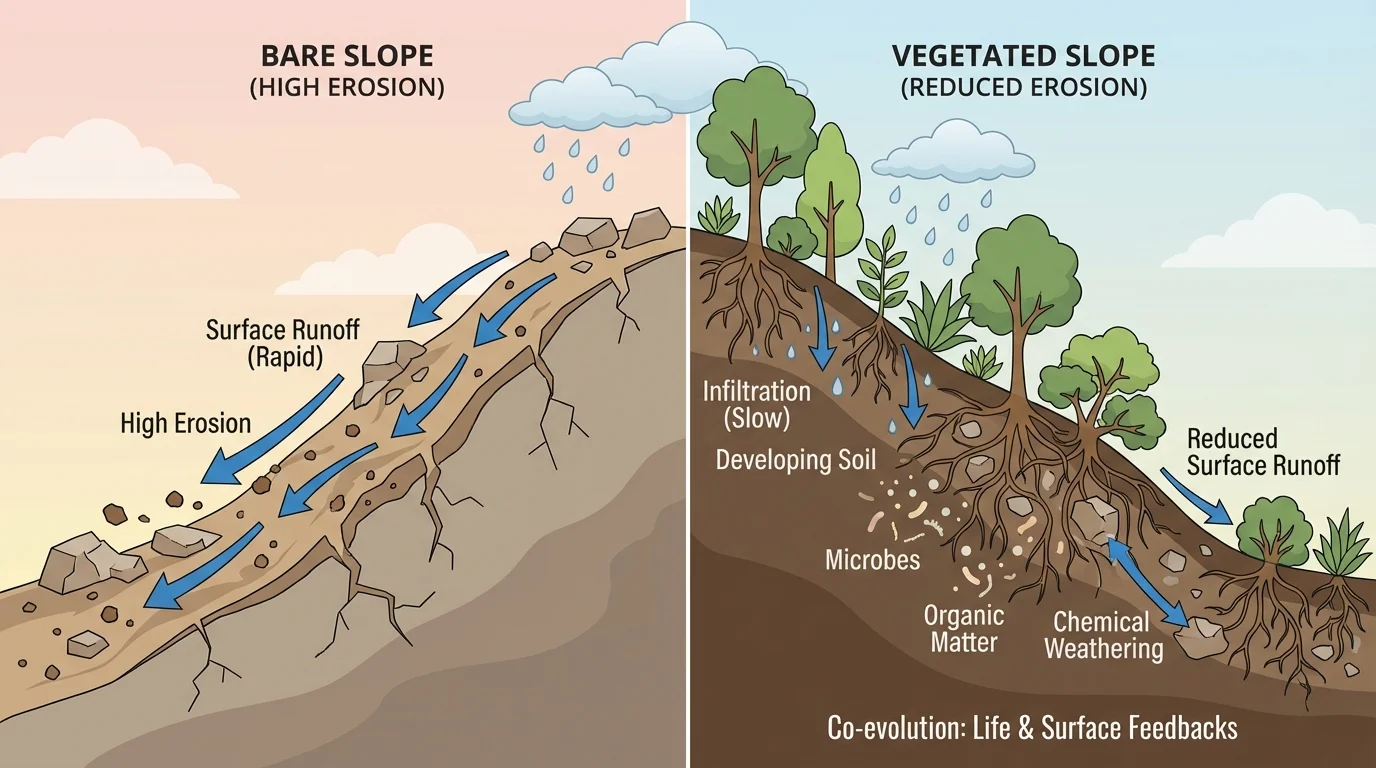
Life also affects the atmosphere indirectly. Forests release water vapor that can influence cloud formation and regional precipitation. Wetlands release methane, \(\textrm{CH}_4\), a powerful greenhouse gas. Marine plankton release compounds that can help seed cloud droplets. Even the smell of a pine forest is part of a chemical conversation between life and the atmosphere. Similar biosphere effects on land and water are shown in [Figure 3].
Living things do not just change the air. They also reshape land and influence the movement of water. Plant roots can wedge into cracks in rock, helping break it apart. Lichens and microbes release acids that speed up chemical weathering. Burrowing organisms mix sediments. Over time, these actions contribute to soil formation.
Soil is one of the most important products of biosphere-geosphere interaction. It contains mineral particles from weathered rock, organic matter from dead organisms, water, air, and huge communities of microbes. Without life, Earth would still have broken rock and sediment, but living organisms greatly increase the complexity and fertility of soils.
Chemical weathering can also influence climate. When certain rocks weather, carbon dioxide is removed from the atmosphere and eventually stored in dissolved ions or carbonate minerals. Plants can speed this process by increasing root activity, holding moisture in soil, and producing organic acids. In that way, life can help regulate long-term climate through rock chemistry.
Vegetation also affects erosion and runoff. A hillside covered in grasses, shrubs, or trees usually loses less soil than bare ground because roots hold sediment in place and leaves reduce the force of raindrops. Water is more likely to soak into soil when plant cover is present, reducing flash flooding. On bare land, rainfall often runs off quickly, carrying sediment into streams and changing river shape.
River systems respond strongly to the presence or absence of life. Wetlands slow water flow, trap sediment, and support rich food webs. Beaver dams create ponds and alter stream channels. Mangrove forests protect coastlines by trapping sediment and reducing wave energy. Coral reefs reduce coastal erosion by acting as physical barriers. Organisms are not just living on landscapes; they are active agents in building them.
Some of the white cliffs and limestone layers found around the world formed largely from the remains of marine organisms. Tiny shells and skeletons can accumulate over immense spans of time and become major rock formations.
A simple relation often used to describe runoff is \(P = R + I + E\), where \(P\) is precipitation, \(R\) is runoff, \(I\) is infiltration into the ground, and \(E\) is evaporation and transpiration combined over a short time period.
For example, if a storm drops \(10\) centimeters of water on an area and \(3\) centimeters run off while \(2\) centimeters return to the atmosphere, then infiltration is \(I = 10 - 3 - 2 = 5\) centimeters. Areas with dense vegetation often have larger \(I\) values than paved or bare areas.
The oceans hold vast amounts of water, heat, and carbon, so interactions between marine life and ocean systems strongly affect the whole planet. Microscopic phytoplankton perform a large share of global photosynthesis. They remove \(\textrm{CO}_2\) from surface waters, which helps draw more \(\textrm{CO}_2\) out of the atmosphere. Some of this carbon moves into deep water or sediments when organisms die or are eaten.
Marine organisms also influence ocean chemistry. Shell-forming organisms such as corals, foraminifera, and mollusks build structures from calcium carbonate. Over long periods, their remains can become sediments and rock. This means life participates in moving carbon from the ocean-atmosphere system into the geosphere.
Coral reefs are a striking example of co-evolution between life and Earth's surface. Reef-building corals create complex limestone structures that alter coastlines, influence wave energy, and provide habitats for thousands of species. But reef growth depends on temperature, water chemistry, light, and nutrient levels. When ocean temperature rises too much or when seawater becomes more acidic, reefs become stressed or die back.
Ocean acidification happens because seawater absorbs some atmospheric \(\textrm{CO}_2\). The dissolved gas forms carbonic acid, which shifts ocean chemistry and can make it harder for some organisms to build shells and skeletons. If shell-forming organisms decline, that can affect food webs, sediment production, and carbon storage. A chemical change in seawater can therefore reshape biological communities and physical coastal systems.
The ocean as a climate partner
The ocean does not simply respond to climate; it helps control climate. It stores heat, transports energy by currents, absorbs carbon dioxide, and supports organisms that influence both atmospheric gases and marine sediments. Changes in ocean circulation or biology can therefore affect weather patterns, long-term climate, and the shape of coastlines.
The importance of marine life helps explain why disturbances in one system can spread widely. A shift in ocean temperature can change plankton populations. That can alter fish populations, carbon uptake, and food security for human communities. Earth system interactions are scientifically fascinating, but they are also deeply practical.
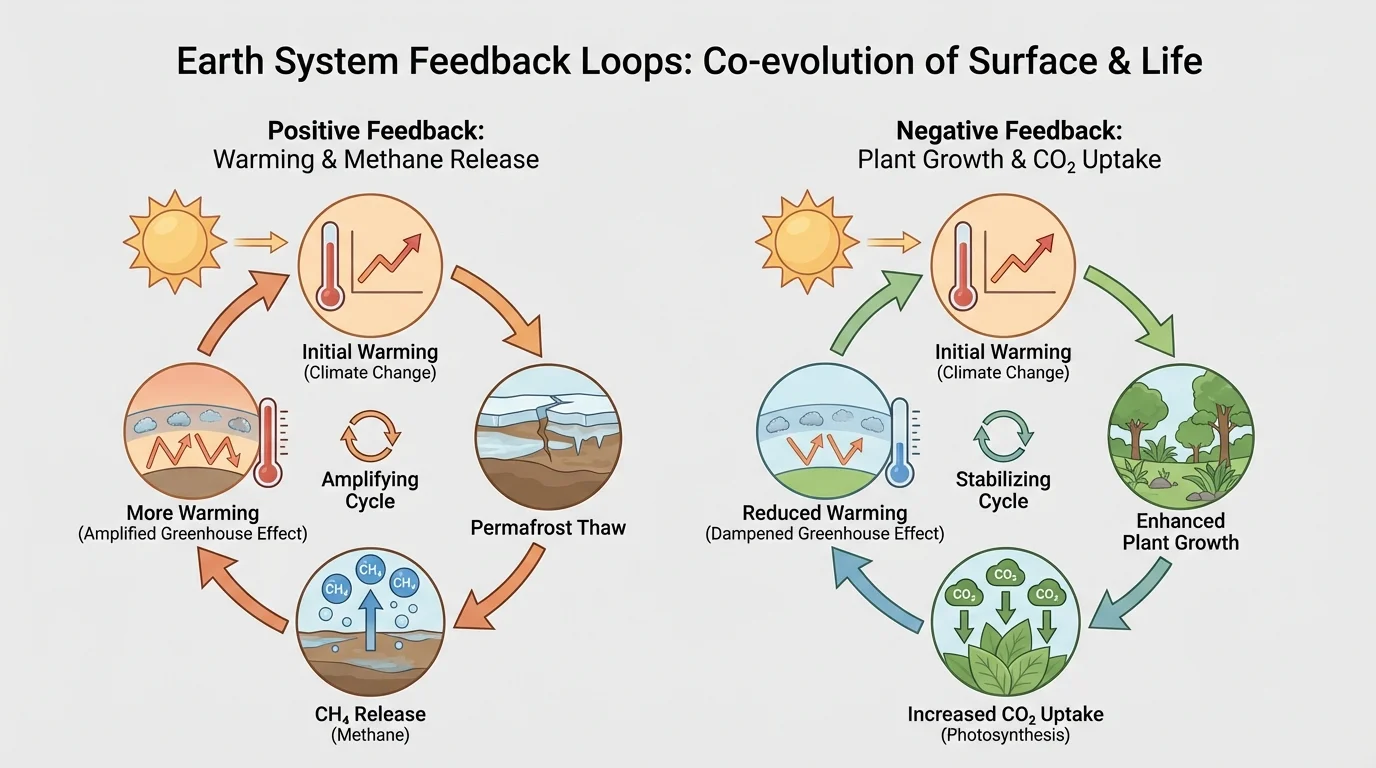
As [Figure 4] illustrates, feedbacks help explain why some environmental changes remain limited while others accelerate. A negative feedback counteracts a change. A positive feedback increases it. The words "positive" and "negative" here do not mean good or bad; they describe the direction of the response.
An example of negative feedback involves plant growth. If warmer conditions and higher \(\textrm{CO}_2\) levels cause some plants to grow faster, those plants may remove more \(\textrm{CO}_2\) from the atmosphere, reducing part of the original warming influence. This does not always fully cancel the warming, but it can resist it.
An example of positive feedback occurs in permafrost regions. As temperatures rise, frozen ground thaws. Organic matter in the thawed soil decomposes and releases \(\textrm{CO}_2\) and methane. Those gases strengthen the greenhouse effect, which causes more warming and more thawing.
Another positive feedback involves ice and albedo. Ice and snow reflect a large fraction of sunlight. When they melt, darker land or ocean surfaces absorb more energy, causing additional warming and further melting. Biological changes can connect to this too. If warming shifts tundra ecosystems toward shrub growth, the land surface may absorb more solar energy, affecting regional climate.
Feedbacks can be delicate because they depend on thresholds. A wetland may absorb floodwaters up to a point, but if drainage or development reduces its area too much, flooding can increase rapidly. A forest may recover from occasional fire, but repeated drought and heat can push it into long-term decline. Earth system responses are not always smooth or predictable.
The crucial idea is that living systems can either buffer environmental change or intensify it. Which outcome occurs depends on species, climate, chemistry, and time scale.
Earth history provides the clearest evidence that life and the planet co-evolve. The Great Oxygenation Event changed atmospheric chemistry and likely contributed to the decline of many anaerobic organisms while opening opportunities for new forms of life. Much later, the spread of land plants transformed continents. Roots increased weathering, soils became more developed, and large amounts of carbon were buried in sediments. This likely contributed to long-term climate cooling.
The evolution of forests changed rivers too. Before deep-rooted plants became common, many river systems behaved differently because banks were less stabilized by vegetation. As plant cover expanded, channels, floodplains, and sediment movement changed. Life altered the architecture of landscapes.
Mass extinctions also reveal biosphere-Earth system connections. A large volcanic event or asteroid impact can change climate, ocean chemistry, and sunlight levels. Those physical changes alter ecosystems. Then the biological collapse feeds back into nutrient cycling, carbon storage, and sediment processes. Recovery after extinctions often produces new Earth-life relationships rather than a simple return to earlier conditions.
"The present is the key to the past"
— A guiding principle of geology
That principle matters here because modern interactions help us interpret ancient rocks, fossils, and atmospheric clues. Limestone beds, coal deposits, fossil soils, reef structures, and isotopic evidence all record moments when life and Earth systems reshaped one another. As seen earlier in [Figure 1], no Earth system acts alone, and the same was true hundreds of millions of years ago.
Humans are part of the biosphere, but human societies now alter Earth systems at a rate that is geologically unusual. Burning fossil fuels moves carbon from the geosphere to the atmosphere very quickly. Deforestation reduces carbon storage, changes albedo, and alters local water cycles. Urbanization changes runoff, heat balance, and habitat structure. Agriculture modifies soils, nutrient cycles, and biodiversity.
These actions affect feedbacks. For instance, removing forests can reduce evapotranspiration, lower regional rainfall, and make fires more likely. Fires then release more carbon and further reduce forest cover. In some areas, this creates a reinforcing loop. On the other hand, restoring wetlands, protecting forests, and rebuilding soils can increase carbon storage, reduce flooding, and improve ecosystem resilience.
Real-world case study: mangroves and coasts
Mangrove forests grow along tropical and subtropical shorelines and illustrate how the biosphere and Earth's surface shape each other.
Step 1: Physical setting shapes life.
Tides, salinity, sediment supply, and wave energy determine where mangroves can grow.
Step 2: Life reshapes the physical setting.
Mangrove roots slow water, trap sediment, build land, and reduce coastal erosion during storms.
Step 3: Human disturbance changes the feedback.
If mangroves are cleared, coastlines can erode faster, storm damage can increase, and carbon stored in soils may be released.
This is a modern example of co-evolution: environmental conditions shape the ecosystem, and the ecosystem reshapes the land-water boundary.
Scientists use satellites, ice cores, sediment records, atmospheric measurements, and ecological studies to track these changes. Understanding feedbacks is essential for predicting climate change, water availability, crop production, biodiversity loss, and natural hazards.
The idea that Earth's surface and life co-evolve is not just a theory about the distant past. It affects issues people face now: wildfire risk, water shortages, coastal flooding, fisheries, food systems, and disease patterns. If a region loses vegetation, its soil, streams, and local climate may change. If ocean ecosystems shift, food chains and carbon storage can shift as well.
It also changes how we think about environmental solutions. Protecting biodiversity is not only about saving species. It can also help stabilize soils, regulate water, store carbon, and reduce hazard risk. In many cases, healthy ecosystems support healthy Earth system function.
When you view Earth through this systems lens, familiar things look different. A forest becomes a climate regulator. A reef becomes a geological structure built by living organisms. Soil becomes a long-term partnership between rock, water, air, and life. Co-evolution means that Earth's surface is a record of life's activity, and life is a record of Earth's changing conditions.
Earlier Earth science topics such as the water cycle, rock cycle, climate system, and plate tectonics are all part of this lesson. The new idea is that life is not merely affected by those processes; it also modifies them and can redirect their long-term outcomes.
This is why Earth science is so powerful. It explains not only what the planet is made of, but also how living and nonliving processes combine to create the world we know. The biosphere does not sit on top of Earth like a thin coating. It participates in building the atmosphere, shaping landscapes, altering oceans, and influencing climate across time scales from a single storm to hundreds of millions of years.
