A pilot, an engineer, and a doctor may all use the same algebra skill in completely different situations: they often start with a known formula and then rewrite it to solve for the value they actually need. A formula is not locked into one form. If a relationship is true, then algebra lets us turn that relationship around and highlight the quantity of interest.
Many formulas are introduced in one standard form, but real problems do not always ask for the variable that is already isolated. For example, a physics formula might be given as \(V = IR\), where \(V\) is voltage, \(I\) is current, and \(R\) is resistance. If you know voltage and current, the quantity you want is resistance, not voltage. So instead of plugging values into the original form and getting stuck, you rearrange the formula to isolate \(R\).
In algebra, this process is called solving for a variable. In science and mathematics, people often say rearranging a formula or highlighting a quantity of interest. The idea is exactly the same as solving an equation: use operations that keep the equation true while moving toward the variable you want alone on one side.
When a formula describes a relationship among quantities, every variable matters. The formula is a statement about how those quantities are connected. Rearranging it does not change the relationship. It only changes the form so that one chosen variable becomes easier to find.
When solving equations in earlier algebra, you used inverse operations such as addition and subtraction or multiplication and division to undo what was happening to a variable. Rearranging formulas uses that same logic, except now the equation may contain several variables instead of just one unknown number.
That is why formula rearrangement belongs naturally in algebra: you are creating an equivalent equation that describes the same relationship in a new and more useful way.
An equation stays true when the same operation is applied to both sides, as [Figure 1] illustrates. This is the balancing principle behind all equation solving. If you add, subtract, multiply, or divide both sides by the same nonzero quantity, the equality is preserved.
Suppose a variable is being multiplied by something. To isolate it, divide both sides by that thing. If something is being added to the variable expression, subtract it from both sides. If the variable is squared, use a square root to undo the squaring, being careful about restrictions and context.
The order matters. You undo operations in the reverse order from how they are applied. If a variable is first multiplied and then added to, you usually subtract first and divide second. Thinking in reverse is one of the most powerful habits in algebra.
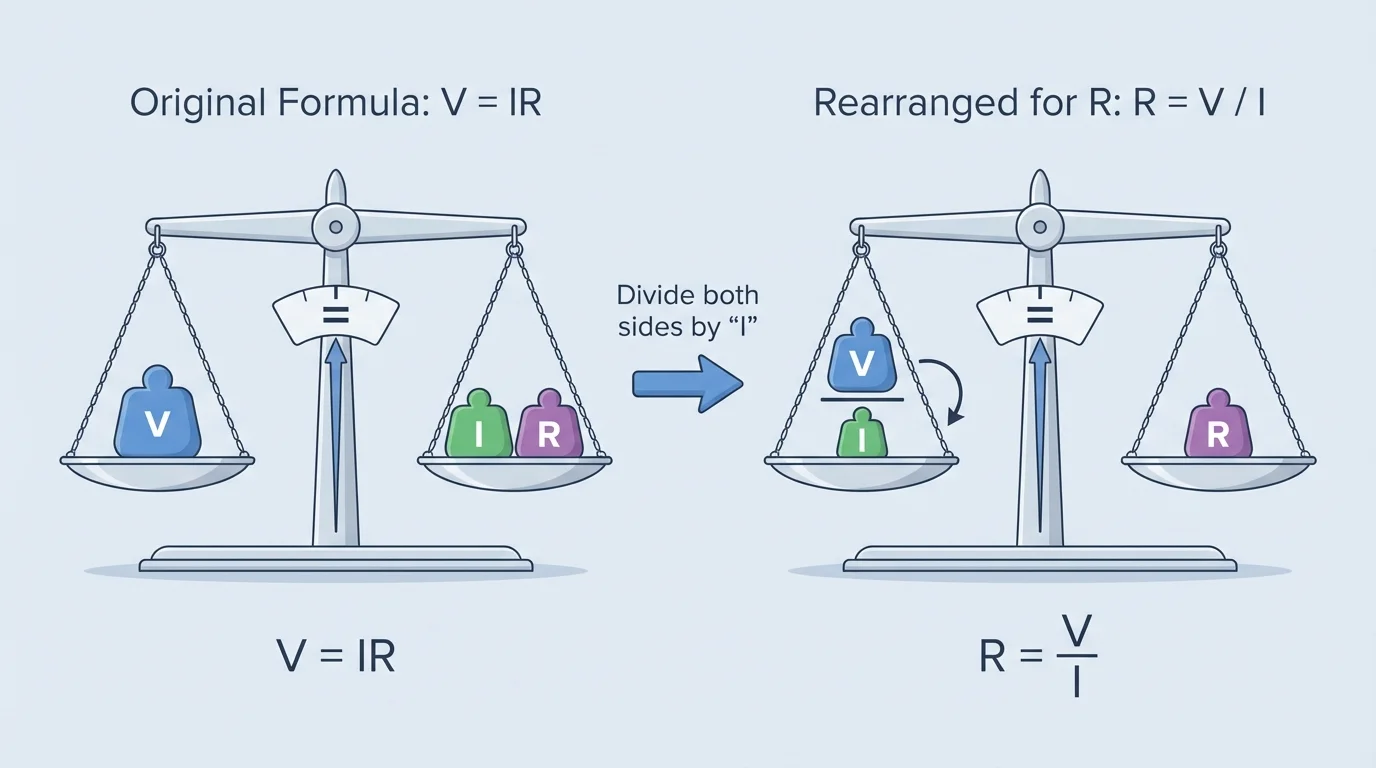
This balancing idea also explains why some common mistakes are wrong. You cannot divide only one term on one side if the entire side is a sum, unless each term is divided correctly. Algebraic steps must apply to whole expressions, not just the part you happen to want to change.
Quantity of interest is the variable you want to isolate or solve for in a formula.
Inverse operations are operations that undo each other, such as addition and subtraction or multiplication and division.
Equivalent equations are equations that have the same meaning or solution even though they look different.
As you work, ask yourself a simple question: "What is being done to the variable I want?" Then undo those operations step by step.
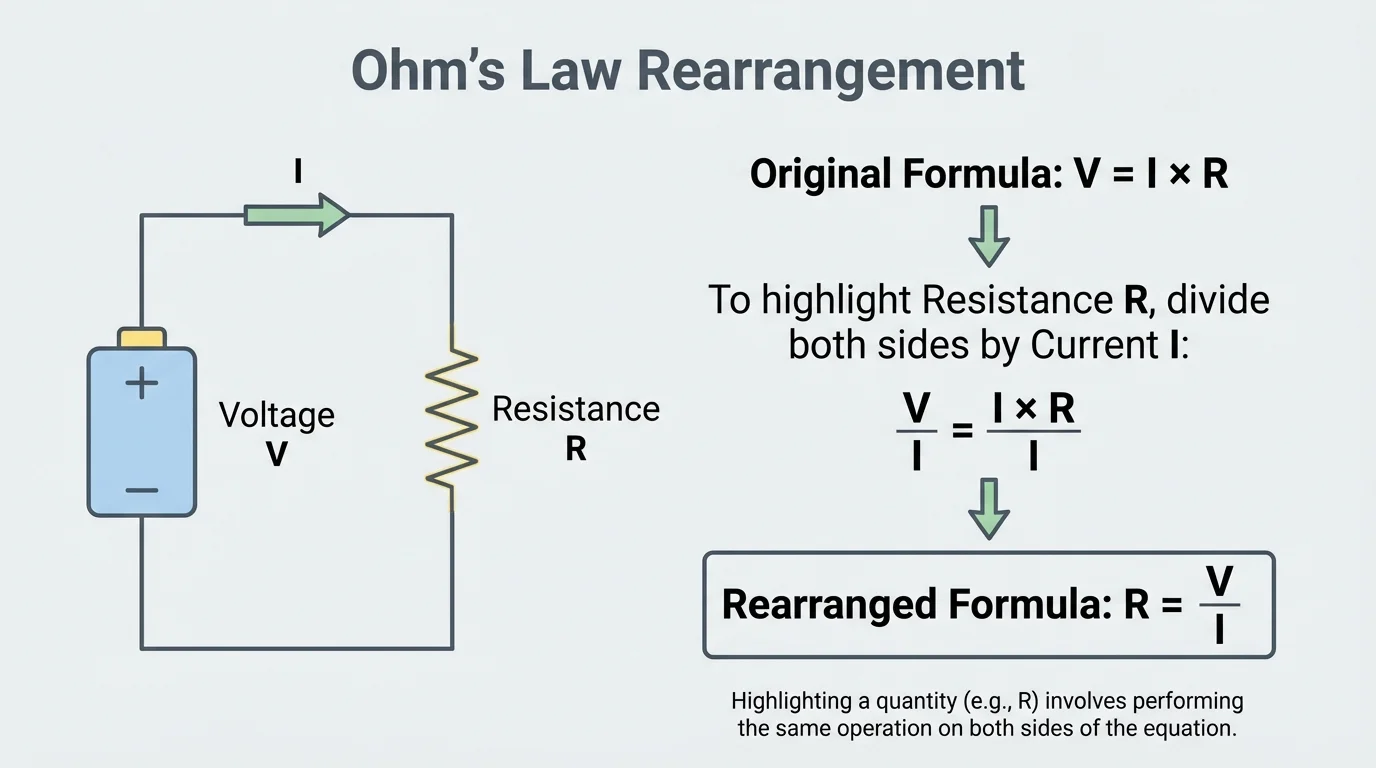
[Figure 2] One of the most famous formulas in electricity is Ohm's law, \(V = IR\). In a circuit, voltage, current, and resistance are linked directly. This is a perfect example of formula rearrangement because different problems may ask for different quantities.
If we want to highlight resistance \(R\), we start with the given formula:
\(V = IR\)
Since \(R\) is multiplied by \(I\), divide both sides by \(I\), provided \(I \neq 0\):
\[\frac{V}{I} = R\]
It is usually written with the variable first:
\[R = \frac{V}{I}\]
If instead you wanted current \(I\), you would divide both sides of \(V = IR\) by \(R\):
\[I = \frac{V}{R}\]
Notice that all three forms come from the same relationship. The physics has not changed. Only the algebraic form has changed.
Solved example 1: Rearranging Ohm's law to find resistance
A device has voltage \(V = 12\) and current \(I = 3\). Find \(R\).
Step 1: Start with the original formula.
\(V = IR\)
Step 2: Divide both sides by \(I\) to isolate \(R\).
\(\dfrac{V}{I} = R\)
Step 3: Substitute the known values.
\(R = \dfrac{12}{3}\)
Step 4: Simplify.
\(R = 4\)
The resistance is \(4\).
The same circuit idea helps you interpret the formula physically: if the voltage is fixed and the current is known, the resistance is the ratio of voltage to current.
Although formulas can look very different, the strategy is remarkably consistent.
First, identify the variable you want to isolate. Second, look at all the operations attached to it. Third, undo those operations one at a time using inverse operations. Finally, simplify the result and write the target variable alone on one side.
It often helps to work from the outside in. For example, in \(P = 2l + 2w\), the term \(2w\) is part of a sum. So subtract the other term first, then divide by \(2\). In contrast, in \(A = lw\), the variable \(w\) is simply multiplied by \(l\), so a single division isolates it.
Equivalent forms of a formula
A formula can often be written in several correct ways depending on which variable is isolated. For instance, \(d = rt\), \(r = \dfrac{d}{t}\), and \(t = \dfrac{d}{r}\) all describe the same relationship between distance, rate, and time. Choosing the most useful form depends on what quantity is unknown.
This flexibility is one reason algebra is so useful in science, finance, and engineering. You are not memorizing disconnected formulas; you are learning to transform relationships to fit a problem.
The examples below show how the same reasoning works across different kinds of formulas.
Solved example 2: Solve \(A = lw\) for \(w\)
A rectangle has area \(A\), length \(l\), and width \(w\). Rearrange the formula to highlight \(w\).
Step 1: Write the formula.
\(A = lw\)
Step 2: Identify what is happening to \(w\).
\(w\) is multiplied by \(l\).
Step 3: Divide both sides by \(l\), assuming \(l \neq 0\).
\(\dfrac{A}{l} = w\)
Step 4: Rewrite with the variable first.
\[w = \frac{A}{l}\]
This says width equals area divided by length.
That result is sensible: if you know the area and one side length of a rectangle, the other side must be the quotient.
Solved example 3: Solve \(P = 2l + 2w\) for \(w\)
The perimeter \(P\) of a rectangle is given by \(P = 2l + 2w\). Rearrange to find \(w\).
Step 1: Start with the formula.
\(P = 2l + 2w\)
Step 2: Subtract \(2l\) from both sides.
\(P - 2l = 2w\)
Step 3: Divide both sides by \(2\).
\(\dfrac{P - 2l}{2} = w\)
Step 4: Write the final form.
\[w = \frac{P - 2l}{2}\]
Parentheses matter because the entire expression \(P - 2l\) is divided by \(2\).
This example is more complex than \(A = lw\) because the variable is inside a larger expression. The balancing principle from [Figure 1] is still doing all the work.
Solved example 4: Solve \(d = rt\) for \(t\)
A car travels distance \(d\) at rate \(r\) for time \(t\). Rearrange for \(t\).
Step 1: Start with the formula.
\(d = rt\)
Step 2: Divide both sides by \(r\), assuming \(r \neq 0\).
\(\dfrac{d}{r} = t\)
Step 3: Write the result clearly.
\[t = \frac{d}{r}\]
If a car travels \(150\) miles at \(50\) miles per hour, then \(t = \dfrac{150}{50} = 3\). The trip takes \(3\) hours.
This form appears constantly in travel, sports timing, and motion problems. It is often more practical than the original formula because time is frequently the unknown.
Solved example 5: Solve \(A = \dfrac{1}{2}bh\) for \(h\)
The area of a triangle is \(A = \dfrac{1}{2}bh\). Rearrange to solve for height \(h\).
Step 1: Write the formula.
\(A = \dfrac{1}{2}bh\)
Step 2: Undo the factor of \(\dfrac{1}{2}\) by multiplying both sides by \(2\).
\(2A = bh\)
Step 3: Divide both sides by \(b\), assuming \(b \neq 0\).
\(\dfrac{2A}{b} = h\)
Step 4: State the rearranged formula.
\[h = \frac{2A}{b}\]
This is a great example of doing the inverse operations in the correct order.
Some formulas feel harder because the variable is inside a fraction, under a root, or raised to a power. But the same logic still applies, as [Figure 3] shows: identify the outermost operation affecting the target variable and reverse the operations step by step.
Consider a formula with a fraction: \(m = \dfrac{y}{x}\). If you want \(y\), multiply both sides by \(x\): \(mx = y\), or \(y = mx\). If you want \(x\), start with \(m = \dfrac{y}{x}\), multiply by \(x\) to get \(mx = y\), then divide by \(m\): \(x = \dfrac{y}{m}\), assuming \(m \neq 0\).
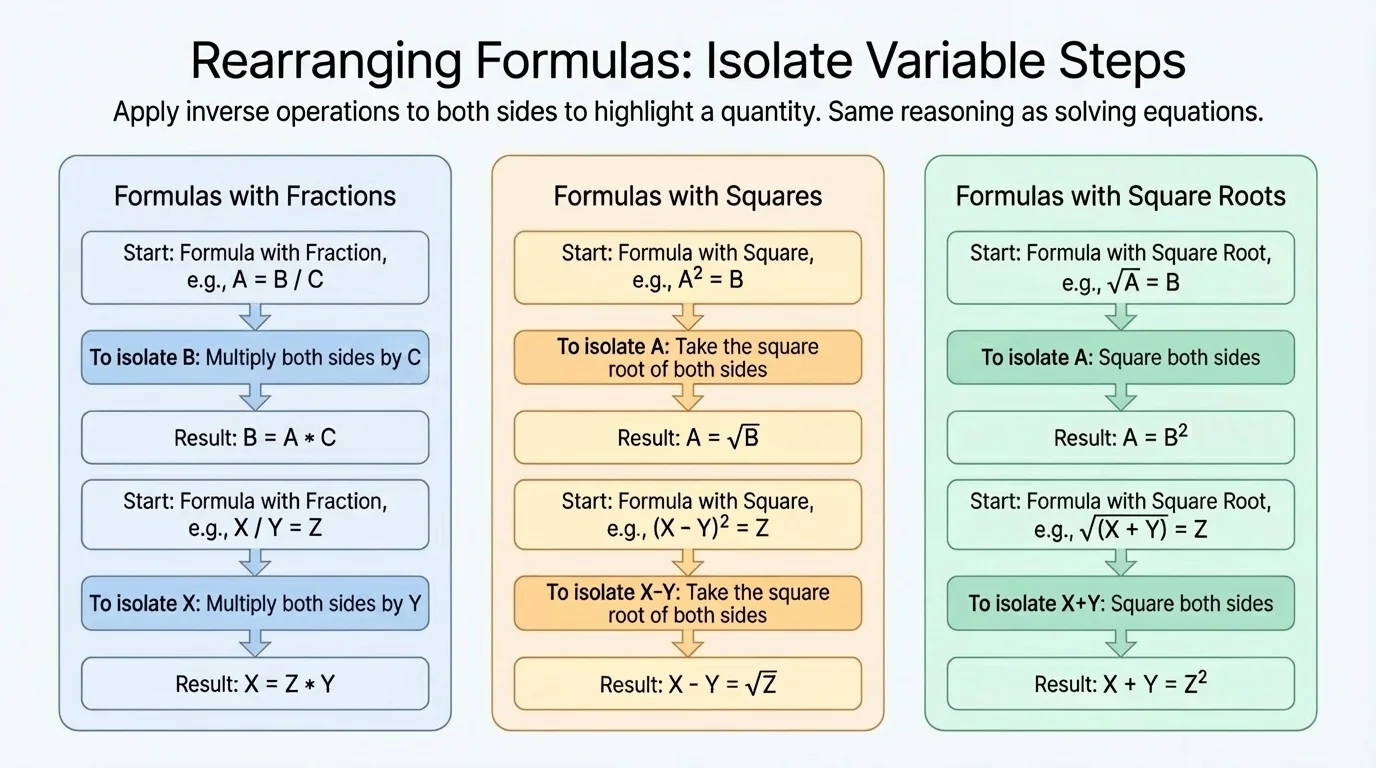
Now consider a power. If \(A = s^2\) and you want \(s\), then take the square root of both sides:
\[s = \sqrt{A}\]
In geometry, if \(s\) represents a side length, we usually use the principal square root because lengths are nonnegative.
For a square root formula, reverse the process. If \(v = \sqrt{u}\), then square both sides to solve for \(u\):
\(u = v^2\)
Equations involving roots and powers often require attention to meaning. A mathematical rearrangement may allow more than one algebraic possibility, but the context can restrict which values make sense.
Engineers and scientists routinely rearrange formulas before substituting numbers. This reduces repeated work and often makes units easier to track because the desired quantity is isolated before calculation begins.
The process map in [Figure 3] is especially helpful when several operations are stacked, such as dividing, then squaring, or adding, then taking a root.
One common mistake is forgetting that an operation applies to an entire expression. For example, from \(P - 2l = 2w\), some students incorrectly write \(w = P - l\). The correct step is to divide the entire left side by \(2\), giving \(w = \dfrac{P - 2l}{2}\).
Another mistake is dividing by a quantity that could be zero without acknowledging it. In formulas such as \(V = IR\), dividing by \(I\) assumes \(I \neq 0\). In most school problems this is acceptable, but mathematically it is important to notice.
A third mistake is changing only one side of the equation. The balancing principle must hold at every step. If you subtract \(2l\) from the left side, you must subtract \(2l\) from the right side as well.
Parentheses are also essential. Compare \(\dfrac{P - 2l}{2}\) with \(P - \dfrac{2l}{2}\). These are not the same expression. Careful notation prevents algebra errors.
Formula rearrangement is not just a classroom exercise. It appears whenever someone knows some quantities in a relationship and needs to find another.
In physics, Ohm's law is used to determine current, voltage, or resistance depending on what is measured in a circuit. An electrician may know the voltage source and the resistance of a component, then rearrange to calculate current.
In geometry and design, area and perimeter formulas are often rearranged to find missing dimensions. If a room's area is fixed and the width is known, a builder can solve for the length. If fencing gives a fixed perimeter, a planner can express one dimension in terms of another.
In motion problems, forms of \(d = rt\) help estimate travel time, average speed, or distance. Navigation systems and logistics software constantly use relationships like these.
In medicine, formulas involving concentration, dosage, body mass, or flow rate are often rearranged so the needed quantity can be calculated directly and safely. A mistake in algebra there is not just inconvenient; it can be serious.
In finance, formulas for simple interest, growth, or payment amounts can be rewritten to solve for time, rate, or principal. The algebraic skill is the same even when the context changes.
| Context | Original Formula | Possible Quantity of Interest | Rearranged Form |
|---|---|---|---|
| Electric circuits | \(V = IR\) | Resistance \(R\) | \(R = \dfrac{V}{I}\) |
| Travel | \(d = rt\) | Time \(t\) | \(t = \dfrac{d}{r}\) |
| Rectangle area | \(A = lw\) | Width \(w\) | \(w = \dfrac{A}{l}\) |
| Triangle area | \(A = \dfrac{1}{2}bh\) | Height \(h\) | \(h = \dfrac{2A}{b}\) |
Table 1. Examples of how a single formula can be rearranged to solve for a different quantity.
A good habit is to verify your new formula. One way is to substitute your rearranged expression back into the original relationship. Another way is to test with actual numbers.
Suppose you found \(w = \dfrac{P - 2l}{2}\) from \(P = 2l + 2w\). Choose \(l = 5\) and \(w = 3\). Then the original formula gives \(P = 2(5) + 2(3) = 10 + 6 = 16\). Now use the rearranged formula: \(w = \dfrac{16 - 2(5)}{2} = \dfrac{16 - 10}{2} = \dfrac{6}{2} = 3\). It matches, which supports that the rearrangement is correct.
You can also check whether the units make sense. In \(R = \dfrac{V}{I}\), resistance has units of voltage divided by current. In \(t = \dfrac{d}{r}\), time has units of distance divided by rate. Unit reasoning is often a powerful way to catch mistakes.
By this point, the pattern should feel familiar: identify the target variable, keep the equation balanced, undo operations in reverse order, and check the result. That same reasoning works whether the formula comes from algebra, geometry, science, or real life.
