A single word can change the meaning of an entire sentence. Think about the word "charge." In one text, it might mean to power a phone battery. In another, it could mean an accusation in court, a rush forward in battle, or the price for a service. Strong readers do not guess and hope. They know how to check. That is why reference materials matter: they help you move from vague understanding to exact understanding.
When you read a novel, a science article, a historical speech, or a news report, you will meet words that are unfamiliar, technical, or tricky because they have more than one meaning. To understand the text accurately, you need more than one strategy. Context clues help, but context is not always enough. Reference materials such as dictionaries, glossaries, and thesauri help you confirm what a word means, how it sounds, how it functions in a sentence, and where it came from.
Reference skills are not just "school skills." They are life skills. In everyday life, people use reference tools to understand legal terms in a contract, medical terms on a health website, technical words in instructions, and unfamiliar language in current events. Misunderstanding a word can lead to confusion, weak writing, or even serious mistakes.
For students in grades 9 and 10, these skills become especially important because texts become more demanding. Authors expect readers to handle academic vocabulary, figurative language, and specialized terminology. A reader who knows how to consult the right source can keep learning without getting stuck.
Reference materials are sources designed to provide specific information quickly and accurately. A dictionary explains words, pronunciation, parts of speech, and often word origins. A glossary defines terms used in a particular subject or text. A thesaurus lists synonyms and related words to help refine meaning and word choice.
Different tools answer different questions. If you want to know what a word means in general English, a dictionary is often the best place to start. If you are reading biology and come across a technical term such as "mitosis," a textbook glossary may be more useful than a general dictionary because it gives the meaning specific to that subject.
Reference materials can be general or specialized, and they can be print or digital. A general dictionary covers words used across many situations. A specialized source focuses on a field, topic, or text. For example, a medical dictionary defines words used in health care, while the glossary at the back of a literature textbook explains literary terms such as "motif" or "irony."
Print materials are physical books. Digital materials include dictionary websites, e-books with built-in definitions, academic databases, pronunciation tools, and apps. Digital tools are often faster, but speed does not automatically mean quality. A reliable digital source should be edited by language experts or trusted institutions.
| Reference Tool | Main Purpose | Best Use |
|---|---|---|
| Dictionary | Meaning, pronunciation, part of speech, etymology | General word clarification |
| Glossary | Subject-specific definitions | Understanding technical terms in a text or course |
| Thesaurus | Synonyms and related words | Refining word choice and connotation |
| Encyclopedia or subject reference | Broader background information | Understanding concepts beyond a short definition |
Table 1. Comparison of common reference tools and the purposes they serve.
A dictionary entry is more than a definition. It is a compact package of information, as [Figure 1] shows, and each part helps you make a better decision about a word. Learning to read entries carefully saves you from choosing the first meaning you see and assuming it must be right.
A typical entry may include the word in bold, a pronunciation guide, the part of speech, numbered definitions, usage labels, sample sentences, and sometimes an etymology note. Some entries also list inflected forms, such as plural nouns or past-tense verbs. If a word can be both a noun and a verb, the entry usually separates those uses.
Take the word "conduct." Its part of speech affects its meaning. As a noun, it can mean behavior. As a verb, it can mean to lead, manage, or carry electricity. If you read the sentence "Copper can conduct electricity," the verb meaning fits. If you read "His conduct during the debate was respectful," the noun meaning fits. The dictionary helps, but the sentence decides.
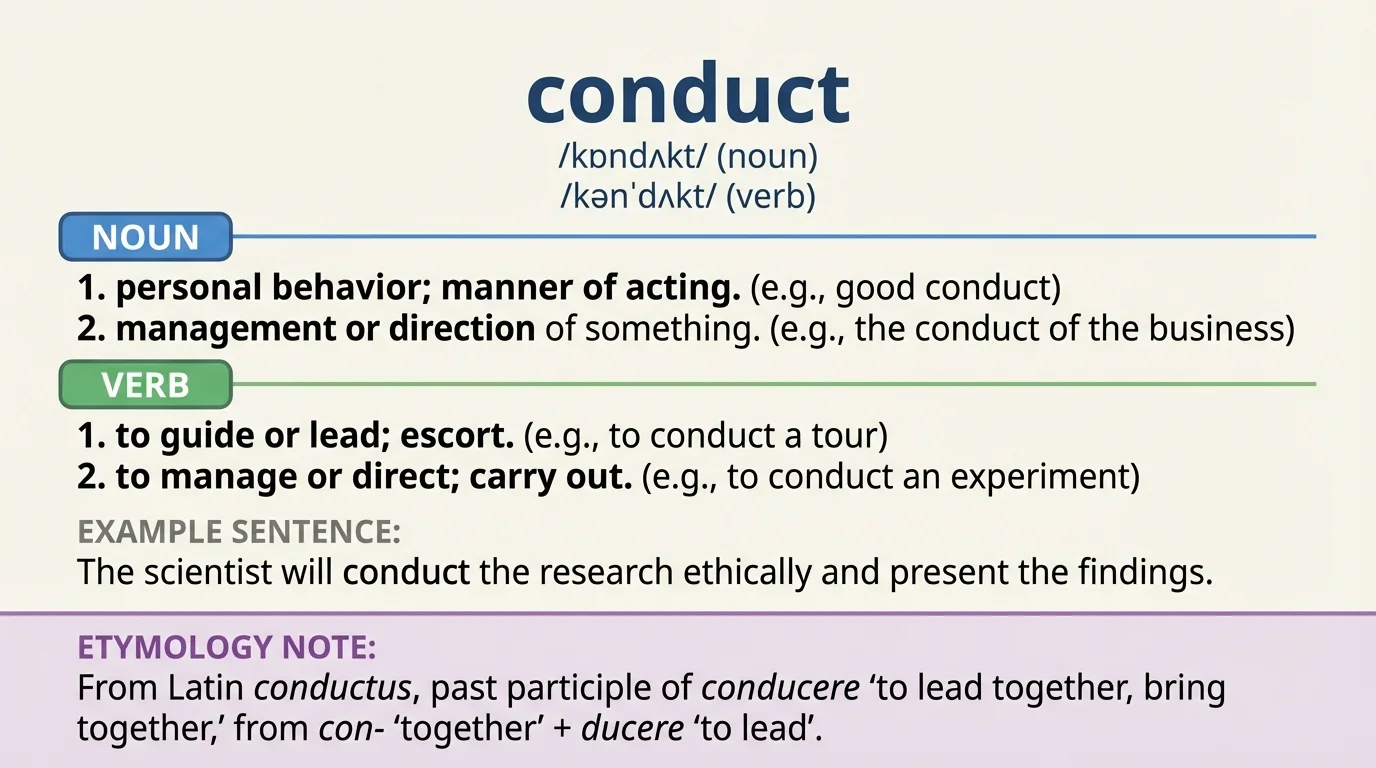
Many dictionaries also include labels such as formal, informal, archaic, or technical. These labels matter. A meaning marked informal may not belong in a formal essay. A meaning marked technical may apply only in a specific field. Good readers notice these details instead of treating all meanings as equal.
Another useful feature is the pronunciation guide. Dictionaries may show pronunciation using a standard respelling system or the phonetic notation system known as the International Phonetic Alphabet (IPA).
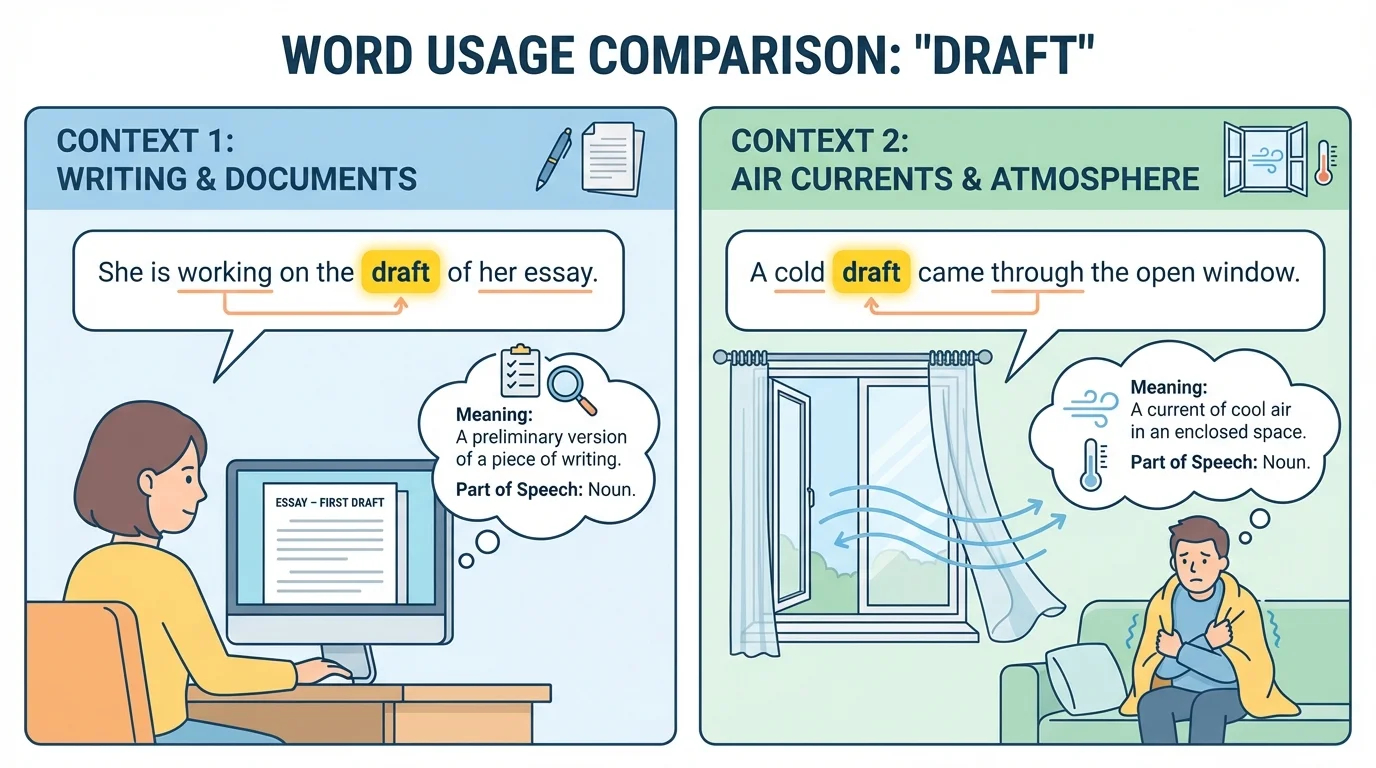
Reference materials work best when used with context. Readers do not just look up a word and stop; they compare the listed meanings with the sentence around the word. This process is especially important for multiple-meaning words, as [Figure 2] illustrates.
Suppose you read the sentence, "She submitted the first draft of her essay." A dictionary might list several meanings of "draft": a preliminary version of writing, a current of cool air, military conscription, or the act of pulling something. The context word "essay" tells you that the correct meaning is the preliminary version.
Now consider the sentence, "A cold draft slipped under the door." The same dictionary entry applies, but this time the context points to a current of air. Without context, you might choose the wrong meaning. Without the dictionary, you might miss some possibilities. Together, context and reference tools create precision.
This is especially useful in argumentative and informational texts, where authors often use words in exact ways. In science, "theory" does not mean a random guess. In history, "revolution" may refer to political change rather than a circular motion. In literature, figurative language may temporarily shift a word's ordinary meaning. Context tells you what the author is doing, and the reference source confirms the meaning.
Context narrows choices. When a word has several definitions, start by reading the whole sentence and, if needed, the sentences before and after it. Identify what kind of idea the passage discusses, then compare that idea with the meanings in the reference source. The correct meaning should fit both grammar and sense.
Later, when you meet another multiple-meaning word, the same principle still applies. The word does not carry one fixed meaning everywhere. It carries a range of possible meanings, and the sentence selects the one that belongs there. That is the same pattern we saw with "conduct" in [Figure 1] and "draft" in [Figure 2].
A specialized reference material is often the best choice when a word has a technical meaning in a specific field. For example, the word "cell" in everyday conversation may mean a small room or a phone unit, but in biology it means the basic structural and functional unit of life. A biology glossary gives the meaning that fits the course.
Glossaries are especially helpful because they are built for a particular audience and text. A history textbook glossary may define "imperialism" in a way connected to the events students are studying. A literature glossary may explain "foil" as a character who highlights another character's qualities. These subject-based meanings can be more focused than a general dictionary definition.
When reading academic material, check whether the book, article, or website provides its own glossary. Authors sometimes use terms in very specific ways, and the glossary tells you how those terms operate in that text. This is one reason glossaries are so useful in science, technology, and social studies.
Many textbooks place the most important technical terms in bold because those are the words students are most likely to need again. That design choice is a clue: the author is signaling which words are central to the subject.
Even digital reading platforms often include built-in glossaries. When you tap or hover over a term, a short definition appears. These tools are convenient, but you should still ask whether the definition is detailed enough for your purpose. Sometimes a quick glossary note helps you continue reading, but a fuller dictionary or subject reference is needed for deeper understanding.
A thesaurus is useful when you already know the basic meaning of a word but want to understand shades of meaning or choose a more precise alternative. It groups words that are similar, but not identical. That difference matters.
For example, "happy," "content," "pleased," and "ecstatic" are related, but they do not all mean the same thing. "Ecstatic" is much stronger than "pleased." If you replace words carelessly, you can change the tone of a sentence. That is why writers often use a dictionary and thesaurus together: the thesaurus suggests options, and the dictionary confirms the exact meaning and connotation of those options.
Suppose a student writes, "The speech was good." A thesaurus may suggest "effective," "persuasive," "powerful," or "moving." Each choice highlights a different quality. "Persuasive" fits if the speech convinced people. "Moving" fits if it stirred emotion. Strong word choice depends on exact meaning, not just variety.
| Word | Near-Synonym | Difference in Meaning |
|---|---|---|
| angry | irritated | Weaker, often shorter-lasting feeling |
| angry | furious | Much stronger emotion |
| thin | slender | Often positive or neutral tone |
| thin | scrawny | Negative tone |
Table 2. Examples of near-synonyms that differ in intensity or connotation.
That is why a thesaurus should never replace careful reading. It is a tool for nuance. If you use it without checking the dictionary, you may choose a word that is close but wrong.
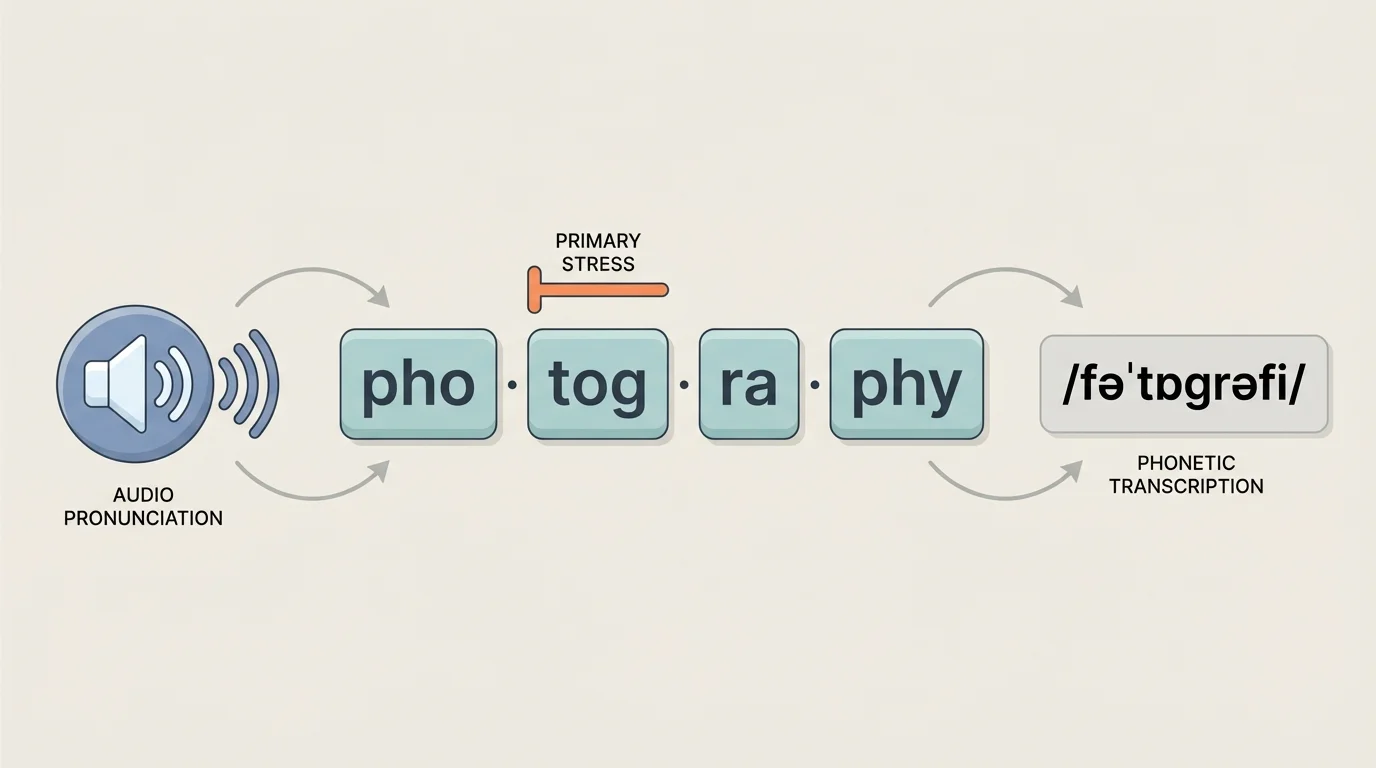
Pronouncing a word correctly matters because pronunciation supports speaking, listening, and confidence. Digital tools make this easier than ever. A pronunciation guide breaks a word into sounds and stresses, as [Figure 3] shows, helping readers hear the pattern instead of guessing.
In many dictionaries, stress marks show which syllable receives emphasis. For example, a word may look similar to another word but have a different stress pattern. If you place the stress on the wrong syllable, listeners may misunderstand you or immediately hear that the word is unfamiliar to you.
Digital dictionaries often include audio clips, sometimes in more than one variety of English. This feature is useful because English pronunciation can vary by region while still being correct. A student reading aloud in class, giving a presentation, or discussing a text benefits from checking both meaning and pronunciation.
Pronunciation tools are especially helpful for words from specialized subjects or from other languages. In literature, you may meet names that are not spelled the way they sound in English. In science, you may meet long technical terms. Checking audio prevents repeated mistakes and builds confidence over time.
Even when an audio feature is available, the printed pronunciation still matters. It helps you notice patterns in syllables, vowels, and stress. Once you become familiar with those patterns, you can decode unfamiliar words more independently, just as you do with the sound structure displayed in [Figure 3].
Grammar helps you select the right meaning of a word. A word's part of speech may be interesting to identify, but before you explore its history, you need to know how the word functions in the sentence. Is it acting as a noun, verb, adjective, or adverb? Dictionaries label this clearly, and grammar confirms it.
Consider the word "present." In "She will present her findings," it is a verb. In "Everyone received a present," it is a noun. In "All members were present," it is an adjective. The spelling is the same, but the role changes. That role helps determine the correct meaning and often the correct pronunciation as well.
Look at the words around the unknown word. Articles like "a" or "the" often signal a noun. Words such as "to" may introduce a verb. Describing words before nouns often function as adjectives. These grammar clues work with the dictionary entry to narrow your choices.
Example: Using grammar to choose a meaning
Read the sentence: "The committee will record the results."
Step 1: Notice the position of the word.
The word comes after "will," which usually signals a verb.
Step 2: Check the dictionary entry.
The dictionary lists record as both a noun and a verb.
Step 3: Match grammar to meaning.
Because the sentence needs a verb, the correct meaning is "to write down or store information."
The grammar of the sentence helps eliminate the noun meaning.
This is one reason close reading matters. A reader who notices sentence structure can use reference materials more effectively than a reader who looks up a word without paying attention to how it behaves in the sentence.
Etymology is the study of a word's origin and how its form and meaning developed over time. Not every reading situation requires etymology, but it can deepen understanding and help you remember unfamiliar words.
For example, if you learn that "biology" comes from Greek roots meaning "life" and "study," the word becomes easier to understand and connect to related terms such as "biography" or "biome." Etymology can also explain why English contains so many words that look or sound unusual: English has borrowed from many languages over centuries.
Word history can also reveal meaning shifts. A word may once have meant something narrower or broader than it does today. Knowing this can help you understand older texts, formal language, or academic vocabulary. It also reminds you that language changes over time, even while dictionaries work to describe current usage accurately.
Prefixes, suffixes, and roots are still valuable clues. Even before opening a reference source, you can often make a smart prediction about a word by noticing parts such as pre-, sub-, -ology, or -tion. Then you can verify that prediction with a dictionary or glossary.
Some digital dictionaries let you expand etymology sections to trace a word across languages and centuries. That information is not just a historical extra. It can help you see relationships among words and understand why certain spellings or meanings make sense.
Not all sources are equally reliable. A trusted dictionary, whether print or digital, is edited carefully and updated regularly. An unverified website may give incomplete definitions, awkward examples, or incorrect pronunciation. Good readers ask where the information comes from.
Print dictionaries are often highly reliable and useful for focused study. They also force you to slow down and notice nearby words, guide words, and alphabetical order. Digital tools are fast, searchable, and often include audio, usage notes, and cross-references. Each format has strengths.
When using digital tools, be careful with automatic definitions built into search engines or social media platforms. They may be convenient, but they are not always complete. If a word is central to understanding a text, confirm it with a trusted source rather than relying on the quickest answer.
A strong habit is to compare sources when a word seems especially important or confusing. If a dictionary meaning feels vague, check a glossary or a second reputable dictionary. If a thesaurus suggests a synonym, confirm its meaning before using it. Precision comes from verification.
When you meet an unfamiliar word, do not jump straight to the first definition you see. Follow a sequence of decisions so that meaning, grammar, and context all work together.
[Figure 4] First, read the sentence and the surrounding lines. Second, identify how the word functions grammatically. Third, decide whether the word seems general or subject-specific. Fourth, consult the best reference source: dictionary for general meaning, glossary for technical meaning, thesaurus for nuance, or etymology note for deeper understanding. Fifth, test the meaning back in the original sentence. If it fits smoothly, you probably have the right interpretation.
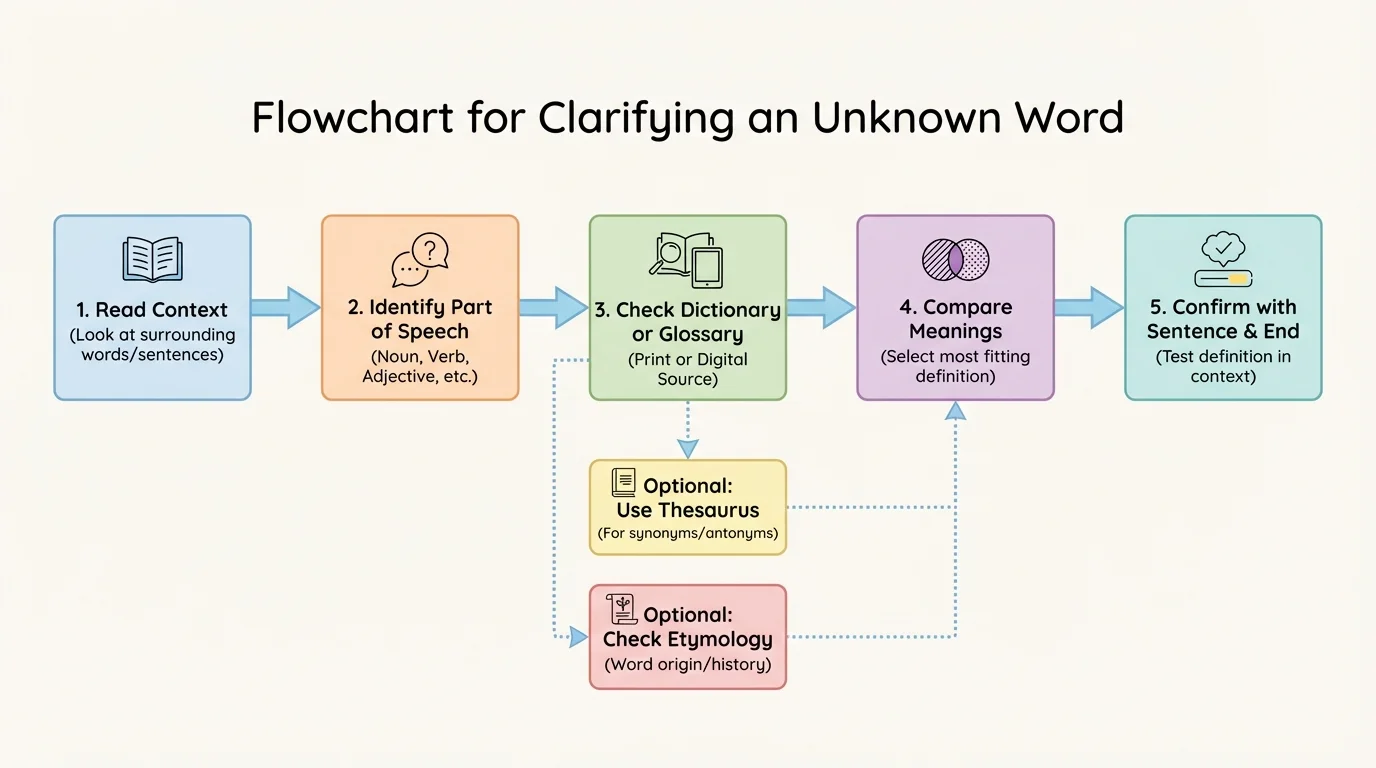
This strategy prevents a common mistake: choosing a definition that is technically listed but does not fit the passage. The goal is not just to find a meaning. The goal is to find the precise meaning intended by the author.
Case study: Clarifying the word "charge"
Sentence: "The scientist measured the charge on the particle."
Step 1: Read the context.
The sentence is about science and particles, so the topic is specialized.
Step 2: Identify the grammar.
The phrase "the charge" shows the word is a noun.
Step 3: Choose the right source.
A science glossary or scientific dictionary is more useful than a general quick definition.
Step 4: Verify the meaning.
Here, "charge" means an electrical property of matter, not a price, an accusation, or an attack.
The source must match the context of the reading.
As your reading becomes more advanced, this process becomes almost automatic. Skilled readers constantly move between context, grammar, and reference materials. They are not simply decoding words; they are making informed decisions about meaning.
"The difference between the almost right word and the right word is really a large matter."
— Mark Twain
That idea applies directly to reference skills. The right word meaning, the right pronunciation, and the right shade of meaning all matter. Whether you are reading literature, analyzing an argument, or studying a technical text, the ability to consult reference materials carefully turns confusion into understanding.
