People try to convince you of things every day. A commercial says one snack is the "best." A classmate argues that recess should be longer. A video claims a new game is worth buying. A news article explains why a town should build a new park. All of these are arguments—not necessarily angry fights, but messages meant to persuade. If you can trace and evaluate an argument, you become a smarter reader, a better listener, and a stronger speaker.
Tracing an argument means following the path of the writer's or speaker's thinking. Evaluating an argument means judging how strong that thinking is. Some claims are carefully supported with facts, examples, and clear reasoning. Other claims sound confident but do not actually prove anything. Learning the difference helps you avoid being misled.
Arguments appear in books, articles, speeches, podcasts, classroom presentations, debates, reviews, and even everyday conversations. When someone wants you to agree with an idea, that person usually makes a claim and tries to support it. Being able to examine that support is an important reading and listening skill.
This skill matters in school because students often read articles and listen to presentations that include opinions about real topics. It also matters outside school. If a website says, "This app improves grades," you should ask, "How do they know?" If a speaker says, "Our community needs more trees," you should ask, "What reasons and evidence support that idea?"
When you read informational text, you already look for the main idea and supporting details. Evaluating arguments builds on that skill. The difference is that an argument tries to convince, not just inform.
An argument can be strong or weak. A strong one gives reasons that make sense and evidence that fits the claim. A weak one may use opinions, exaggeration, or details that do not really prove anything. Your job is not just to notice what the author says. Your job is to decide whether the author has earned your trust.
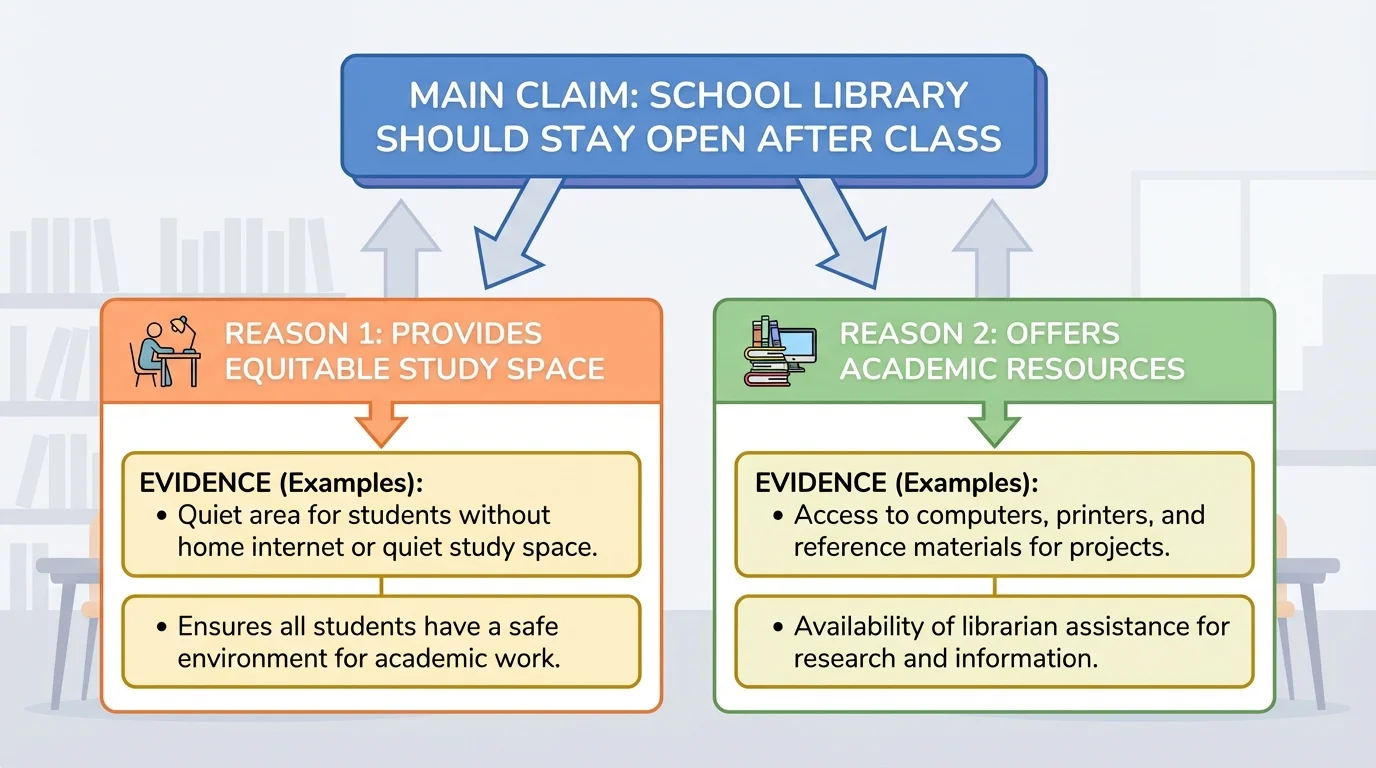
An argument has several important parts. The first is the claim, which is the main point the author or speaker wants the audience to accept. A claim might be, "School libraries should stay open after class," or "Pets help children feel less stressed." Around that claim, the writer builds support, as [Figure 1] illustrates through a simple argument structure.
Next come the reasons. Reasons explain why the claim should be believed. For the claim about libraries, one reason might be that students need a quiet place to work. Another reason might be that not all students have internet access at home. Reasons are broader than individual facts. They are the logical supports that hold up the claim.
Then comes evidence. Evidence includes facts, examples, quotations, statistics, observations, or information from reliable sources. Evidence helps prove that a reason is true. If the reason is that students need a quiet place to work, evidence might include a survey showing that many students share crowded homes or an example of students finishing homework in the library after school.
It is also important to tell the difference between a topic, an opinion, and an argument. A topic is just the subject, such as school lunches. An opinion is what someone thinks, such as "school lunches are too expensive." An argument goes further by giving reasons and evidence, such as "school lunches are too expensive because prices rose this year, and cafeteria records show fewer students are buying meals."
Claim is the main point an author or speaker wants the audience to believe.
Reason is an explanation that tells why the claim makes sense.
Evidence is the factual support, examples, quotations, or data used to prove a reason or claim.
When you understand these parts, you can take apart almost any argument. You can ask: What is the claim? What reasons support it? What evidence supports those reasons? This same structure appears in both reading and listening tasks, from written articles to oral presentations.
To trace an argument, begin by finding the main claim. It is often stated near the beginning or end, but not always. Sometimes a writer repeats the claim in different words. Look for sentences that sound like a position the author wants you to accept.
After you find the claim, identify each reason. A writer may signal reasons with words such as because, since, for example, one reason, or another reason. In a speech, a speaker might say, "First," "Also," or "Most importantly." These signal words help you follow the order of ideas.
Then connect each reason to its evidence. Good readers and listeners do not just collect details. They ask, "Which reason does this detail support?" If you cannot connect a detail to any reason, it may not be helping the argument very much.
Tracing the line of thinking means following the argument step by step: main claim, then reason, then evidence. If a text jumps around, repeats ideas, or gives unrelated details, the argument becomes harder to follow and often weaker.
For example, suppose an article claims that students should have a later school start time. One reason might be that older children need enough sleep for healthy learning. Evidence might include information from sleep experts or a study showing that tired students have more trouble focusing. Another reason might be that later start times can improve attendance. Evidence for that reason could be attendance records from schools that changed their schedules.
As you trace, notice whether the ideas connect clearly. The structure in [Figure 1] reminds us that evidence should not float by itself. It should attach to a reason, and the reasons should support the main claim.
Not every claim deserves belief. A supported claim is backed by reasons and evidence that fit the point being made. An unsupported claim is simply stated without enough proof.
Consider these two statements about school lunches. [Figure 2] First: "School lunches should include more fresh fruit because healthy foods help students stay focused, and nutrition reports show that many children do not eat enough fruit each day." This is more than an opinion. It gives a reason and evidence.
Now consider: "School lunches should include more fresh fruit because everyone knows fruit is better." This statement gives almost no usable support. "Everyone knows" is not evidence. It does not name a source, provide facts, or explain clearly why the change is needed.
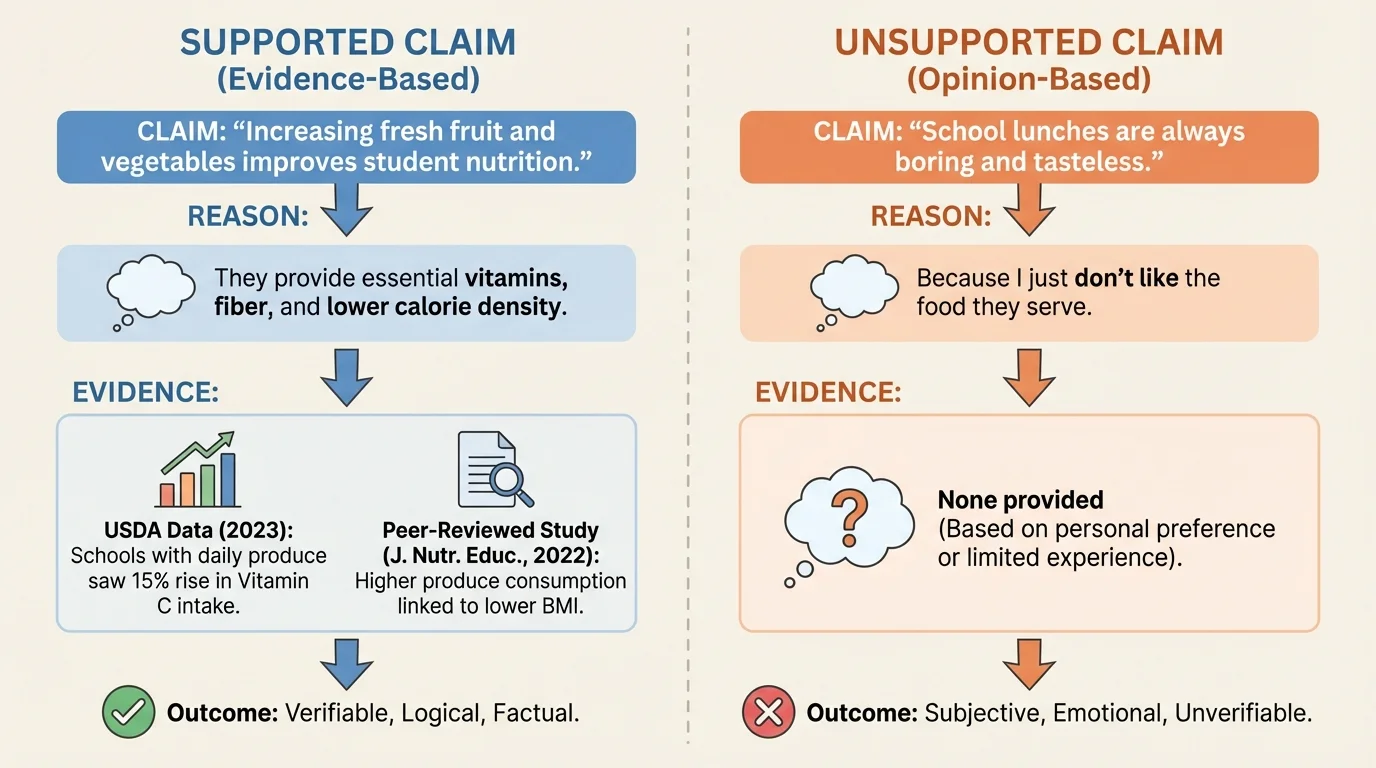
Supported claims often use evidence such as facts, measurements, surveys, observations, examples from real situations, or quotations from experts. Unsupported claims often rely on phrases like "obviously," "everybody knows," "it is just better," or "I feel like it." Feelings can matter, but feelings alone do not prove a point.
Sometimes a claim has some support, but not enough. For instance, if a writer says, "Our town needs a skate park because my cousin would use it," that is an example, but one example may not be enough to support a big community decision. Strong arguments usually need more than one small piece of evidence.
Case study: Is the claim supported?
Claim: "The school should create a gardening club."
Step 1: Find the reason.
The writer says a gardening club would help students learn science in a hands-on way.
Step 2: Find the evidence.
The writer gives examples from two nearby schools where students grew plants and recorded changes in soil, sunlight, and water.
Step 3: Judge the support.
This claim is supported because the examples connect directly to the reason that gardening builds science learning.
When you evaluate support, ask yourself whether the evidence truly proves the claim or only sounds impressive. A supported claim should stand on clear, relevant proof, not just strong wording.
Evidence is not all equal. Some evidence is stronger because it is more credible, more relevant, and more complete. Credible evidence comes from a trustworthy source. A scientist, a school report, or a carefully conducted survey may be credible. A random comment online may not be.
Relevant evidence matches the claim. If someone argues that recess improves learning, a fact about the color of playground equipment is probably not relevant. It may be true, but it does not help prove the point. Relevant evidence must connect directly to the reason being discussed.
Good evidence should also be sufficient, which means there is enough of it. One example can help, but one example alone may not prove a broad claim. If a speaker says, "Reading before bed helps children sleep better," one personal story is weaker than a study of many children plus expert advice from doctors.
| Question to Ask | What It Helps You Check |
|---|---|
| Is the source trustworthy? | Credibility |
| Does this detail connect to the claim? | Relevance |
| Is there enough proof? | Sufficiency |
| Does the evidence match the reason? | Logical connection |
Table 1. Questions readers and listeners can use to evaluate the strength of evidence.
Suppose an article claims that planting trees near streets makes neighborhoods better. Strong evidence might include temperature measurements, reports about cleaner air, and examples showing that shaded sidewalks are used more often. Weak evidence would be something like, "Trees are nice to look at." That may be true, but it is not enough to prove the larger claim by itself.
A statement can be true and still be poor evidence if it does not fit the claim. That is why good evaluators ask not only "Is this true?" but also "Does this actually help prove the point?"
As you evaluate, look for the match between claim, reason, and evidence. If the match is weak, the argument is weak. If the pieces fit together clearly, the argument becomes much stronger.
Some arguments sound convincing at first because they use strong emotions or dramatic language. However, strong emotion is not the same as strong reasoning. If a writer says, "Only a terrible person would disagree," that statement pressures the audience instead of proving the claim.
Another problem is bias, which means showing unfair preference or one-sided thinking. A biased source may include only information that supports its view and leave out facts that might challenge it. Bias does not always mean the source is completely wrong, but it means you should read carefully.
Exaggeration is also common. Words like always, never, everyone, and best ever can be warning signs. These words are sometimes true, but often they make a claim seem stronger than the evidence really shows.
"Strong claims need strong proof."
— Guiding principle for reading and listening critically
You should also notice when a speaker changes the subject instead of answering a question. If the claim is about whether students need more study time, and the speaker starts talking about school colors or sports mascots, that information may be distracting rather than useful.
Weak reasoning can also happen when someone gives a conclusion without enough steps in between. For example: "Our class likes drawing, so the school should cancel math." The jump from one idea to the next is too large. A good argument needs clear links between its parts.
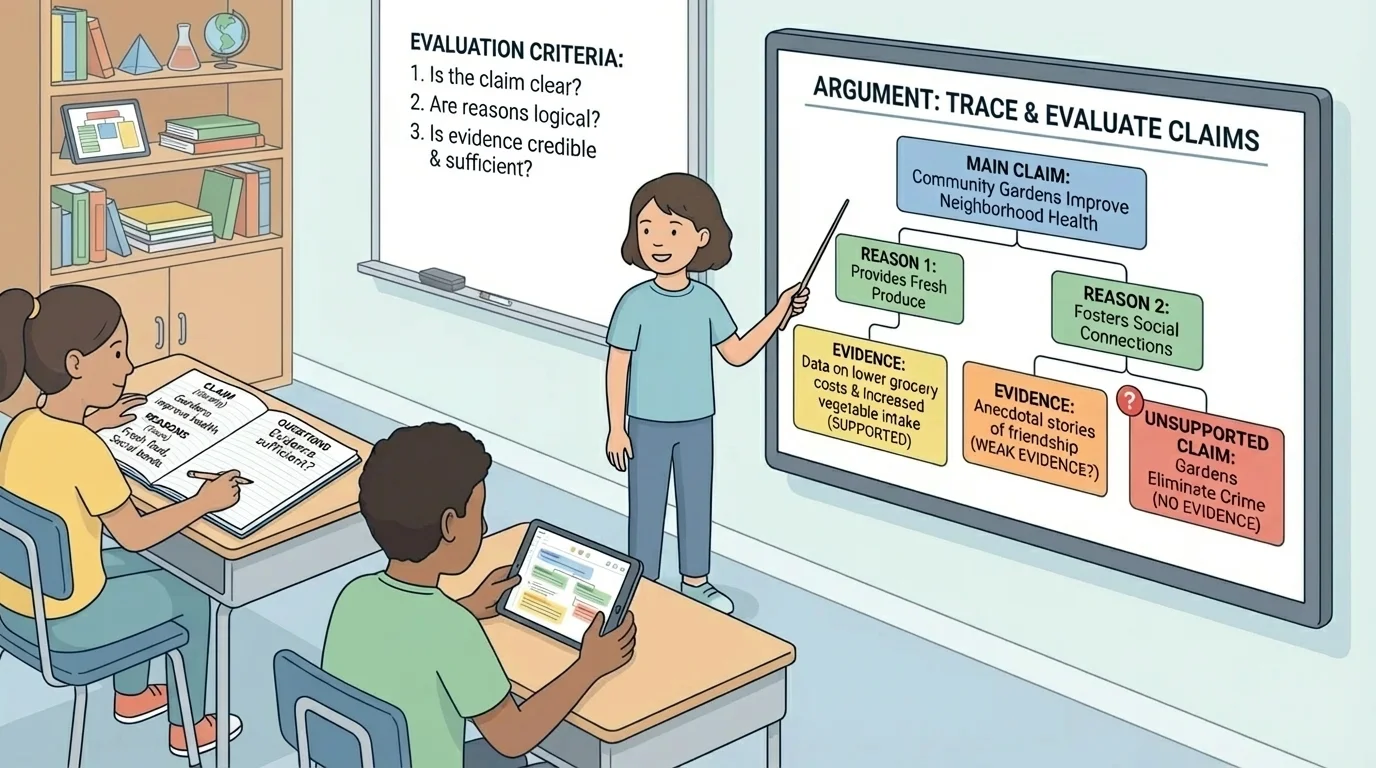
Tracing and evaluating arguments is not only for reading. It matters in listening too. During a speech, debate, announcement, or class presentation, you must pay attention to the speaker's audience, purpose, claim, reasons, and evidence. The scene in [Figure 3] shows how listeners can track these parts while someone presents.
When listening, it helps to take notes in a simple pattern: write the claim first, list each reason under it, and add the evidence beside each reason. This keeps the speaker's ideas organized in your mind. It also prepares you to ask thoughtful questions or respond respectfully.
Good listeners do more than hear words. They notice tone, clarity, and whether the speaker explains ideas in an organized way. If a speaker gives facts but never shows how those facts connect to the claim, listeners may feel confused. If a speaker uses clear transitions such as "my first reason" and "for example," the argument becomes easier to trace.
Listening carefully also helps during collaboration. In group discussions, students often share claims and support them orally. Respectful listeners ask questions like, "What evidence supports that?" or "How does that example connect to your point?" These questions improve both speaking and thinking.
Evaluating oral arguments requires both attention and judgment. A listener must identify the speaker's ideas, decide whether the support is strong, and respond in a way that is focused, respectful, and based on evidence rather than interruption or personal attack.
Later, when you give your own presentation, the same rule applies: make your claim clear, support it with reasons and evidence, and organize your ideas so your audience can follow them. What makes an argument easier to evaluate often also makes it easier to present well.
For example, a student presentation about adding more bike racks at school would be stronger if the speaker explains the claim, gives reasons such as safety and convenience, and then provides evidence like the number of bikes currently left in unsafe places. As with the note-taking pattern in [Figure 3], the audience can then trace each point clearly.
Now consider a short argument: "Our school should start a recycling program. First, recycling reduces the amount of trash sent to landfills. Second, students can learn responsibility by sorting materials. In a nearby school, recycling bins lowered cafeteria waste, and the science club tracked how much paper was reused each month."
The main claim is that the school should start a recycling program. One reason is that recycling reduces trash. Another reason is that it teaches responsibility. The evidence includes the example of a nearby school lowering cafeteria waste and tracking reused paper.
Is the claim supported? Yes, it has reasons and evidence. Is it strongly supported? It is fairly strong, but it could be even stronger with more details, such as exact numbers, expert information about waste reduction, or evidence from several schools instead of one. This shows that evaluation is not just "supported" or "unsupported." Sometimes support exists, but the strength can still vary.
Modeled evaluation
Argument: "Students should have a short movement break during long classes because brief activity helps attention, and teachers in three classes reported better focus after trying it."
Step 1: Identify the claim.
The claim is that students should have a short movement break during long classes.
Step 2: Identify the reason.
The reason is that brief activity helps attention.
Step 3: Identify the evidence.
The evidence is that teachers in three classes reported better focus after trying movement breaks.
Step 4: Evaluate the support.
The claim is supported because the evidence connects to the reason. However, the support would be stronger with student data, more classes, or a study from a reliable source.
Skilled readers and listeners stay alert for both structure and quality. They trace the path of the argument, check whether support exists, and judge whether that support is enough. This helps them become fair-minded thinkers who can learn from strong arguments and question weak ones.
