Why does a metal spoon feel so different from a wooden spoon, even when both do the same job? Scientists and engineers answer questions like this by studying properties of materials. A property is a feature that can be observed or measured. By paying close attention to what materials look like, feel like, and do in tests, we can identify them and choose the best one for a job.
Every object around you is made of one or more materials. Your desk may contain metal screws, a plastic tray, and a wooden top. A raincoat might look like cloth, but its material behaves differently because it repels water. When scientists want to identify an unknown material, they do not just guess. They collect evidence from observations and measurements.
An observation is information gathered with the senses or simple tools. You might notice that a material is shiny, rough, bendable, or transparent. A measurement is information gathered with a number and a unit, such as length in centimeters, temperature in degrees, or time in seconds. Both observations and measurements help us identify materials.
Material is the substance something is made from, such as wood, plastic, glass, rubber, or metal.
Property is a characteristic of a material that can be observed or measured.
Matter is anything that has mass and takes up space. Matter is made of tiny particles too small to be seen with our eyes.
Although we cannot see the tiny particles that make up matter, we can learn about materials by studying their visible and testable properties. The particles in different materials are arranged and move differently, and that helps explain why some materials are hard, some are flexible, and some absorb water.
A material is not the same as an object. A glass bottle and a glass window are different objects, but they may be made from the same material: glass. A rubber ball and a rubber band are different objects, but they share the material rubber. Scientists separate the idea of what something is used for from what it is made of.
Materials can sometimes be identified quickly. If you hold a clear, hard, smooth cup, you may think it is glass. But careful science goes farther than a quick guess. Some plastics can also be clear and smooth. That is why scientists compare several properties before deciding what a material is.
One material can be described by many properties, as [Figure 1] shows. The more evidence we gather, the more confidently we can identify the material. Some properties are easy to notice right away, while others need a simple test.
A material's texture tells how its surface feels. It may be rough, smooth, bumpy, or fuzzy. Hardness tells whether a material resists scratching, denting, or bending. A ceramic tile is hard. A sponge is soft. Flexibility tells whether a material bends easily without breaking. Rubber is usually more flexible than glass.
Magnetism is another useful property. Some metals, such as iron-containing steel, are attracted to magnets, while many other materials are not. Transparency describes how much light passes through a material. Clear glass is transparent. Wax paper may be translucent, which means some light passes through but images are blurry. Wood is opaque, which means light does not pass through.
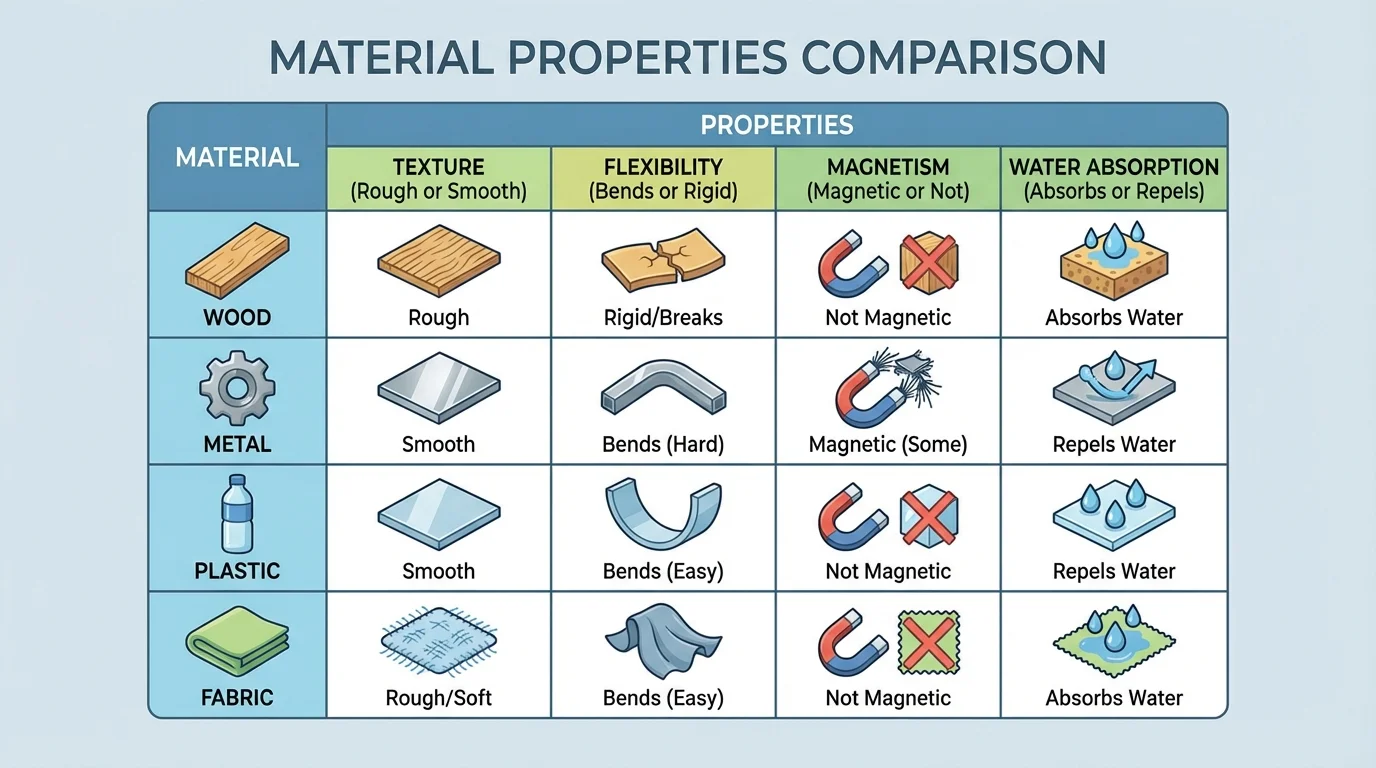
Absorbency describes how well a material soaks up water. A paper towel has high absorbency. Plastic wrap has very low absorbency. Solubility describes whether a substance dissolves in a liquid such as water. Salt is soluble in water, but sand is not. Solubility is especially helpful when identifying powders or small solid substances.
Conductivity means how well a material allows heat or electricity to move through it. Many metals are good conductors of heat, which is why metal pots heat up quickly on a stove. Wood and many plastics are poorer conductors, so they are often used for handles. For this level of material identification, it is enough to know that some materials transfer heat or electricity more easily than others.
State of matter can also help identify a material. A material may be a solid, liquid, or gas. Most identification lessons in elementary school focus on solids, because their properties are easier to compare directly. Solids keep their shape, while liquids flow and take the shape of their container.
Glass is made mostly from sand that has been heated to a very high temperature. Even though sand grains and a glass window look very different, scientists can still connect them by studying their materials and properties.
Color and luster can help too. Luster means how a surface reflects light. A shiny aluminum can and a dull piece of cardboard are easy to tell apart partly because of luster. Still, color alone can be misleading. Plastic can be painted silver to look like metal, so it is smarter to use several properties together, just as we saw earlier in [Figure 1].
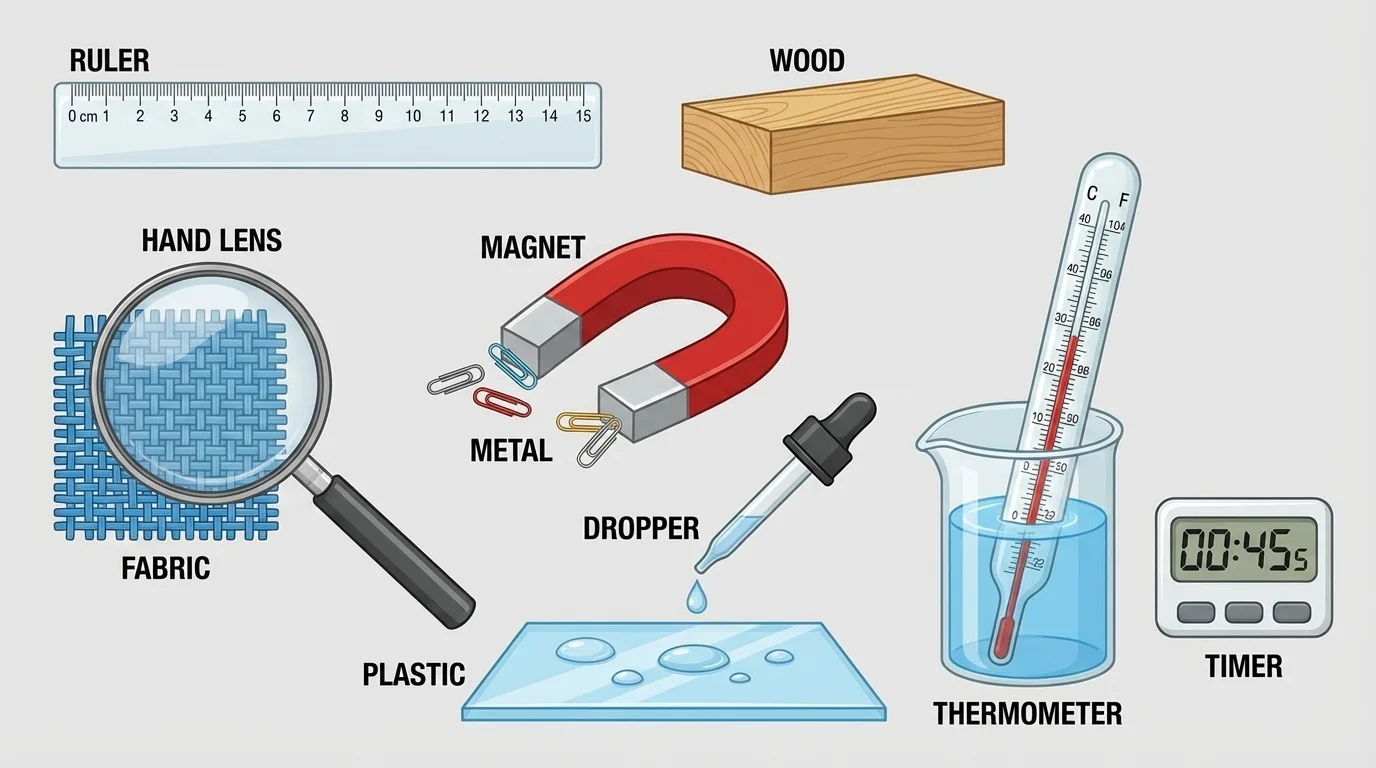
Scientists choose tools based on the property they want to test, as [Figure 2] illustrates. A ruler can measure length or thickness. A hand lens helps us observe tiny details, such as fibers in fabric or grain patterns in wood. A magnet helps test magnetic attraction.
A dropper can place the same number of water drops on different materials to test absorbency. A timer can measure how long something takes, such as how quickly water soaks in. A thermometer can measure temperature during safe teacher-led demonstrations, such as comparing how warm different materials become in sunlight. Careful measurement gives more exact information than guessing.
Sometimes we also use our senses in safe ways. We can observe whether a material feels smooth or rough, stiff or bendable. We should never taste unknown substances, and we should not smell them closely unless an adult says it is safe. In science, safety always comes first.
Recording observations in a chart helps organize evidence. For example, a class could compare four materials and mark whether each one is magnetic, flexible, transparent, or absorbent. A table makes it easier to look for patterns.
| Material | Smooth or Rough | Flexible | Magnetic | Absorbent |
|---|---|---|---|---|
| Metal spoon | Smooth | No | Sometimes | No |
| Rubber band | Smooth | Yes | No | No |
| Paper towel | Soft | Yes | No | Yes |
| Wood block | Usually rough or grainy | No | No | Somewhat |
Table 1. A sample comparison of observable properties for common materials.
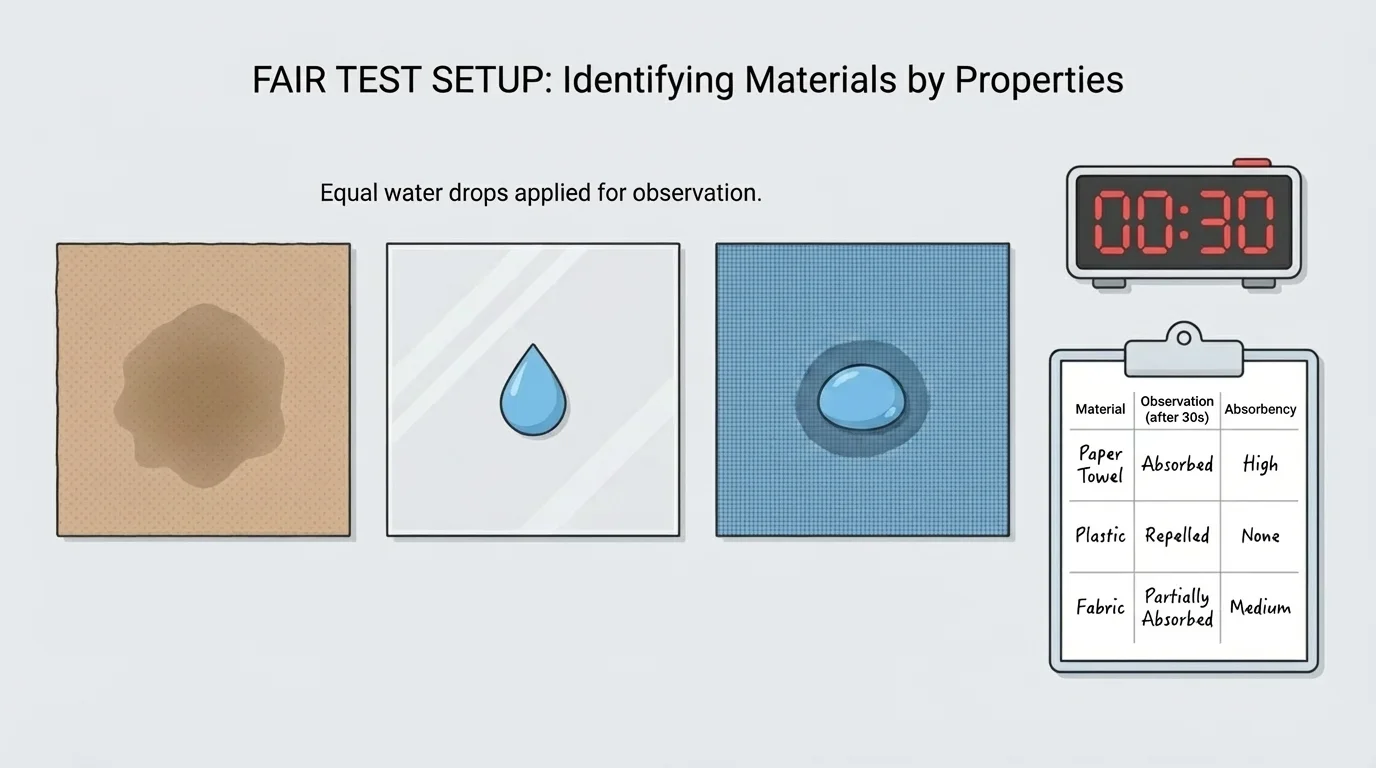
Fair tests compare materials under the same conditions, as [Figure 3] shows. If one material gets more water, more time, or a different-sized sample, the results may not be trustworthy. In a fair test, you change only one factor at a time.
Suppose you want to compare absorbency. You might place one drop of water on each sample, wait the same amount of time, and observe what happens. If sample A absorbs the water quickly and sample B still has water sitting on top after the same amount of time, then sample A is more absorbent under those conditions. The exact numbers are not as important as making the test fair.
Repeating tests is also important. If you test once, you might make a mistake or notice something unusual. If you test several times and get similar results, you can feel more confident. Scientists often repeat observations because science depends on evidence, not on one quick look.
Example: Identifying an unknown strip of material
A student has an unknown strip. It is smooth, bends easily, is not attracted to a magnet, and does not absorb a drop of water.
Step 1: List the observed properties.
The strip is smooth, flexible, nonmagnetic, and not absorbent.
Step 2: Compare those properties to known materials.
Paper is usually absorbent, so it is probably not paper. Metal is often not very flexible, so it is probably not a metal strip. Fabric often absorbs water, so it is probably not fabric.
Step 3: Make the best identification using evidence.
A flexible plastic strip fits all the evidence better than the other choices.
This is not a random guess. It is a conclusion based on properties.
Scientists also write down exactly what they did. If another student follows the same steps and gets the same result, that strengthens the evidence. This is one reason science is powerful: people can verify one another's work.
One property alone is often not enough to identify an unknown material, and [Figure 4] illustrates how scientists use a sequence of questions. Instead of asking only "Is it hard?" a scientist asks many questions: Is it transparent? Is it flexible? Is it magnetic? Does it absorb water? Looking at a set of properties gives a clearer answer.
Wood is usually hard, somewhat absorbent, not transparent, and not magnetic. It often shows grain lines. Metal is usually hard, shiny, not absorbent, and many types conduct heat well. Some metals are magnetic, but not all of them. Plastic can vary a lot. Some plastics are hard and clear, while others are soft and bendable. That is why plastic sometimes takes extra testing to identify.
Glass is usually hard, smooth, transparent, and not flexible. It does not absorb water. Rubber is often flexible, nonabsorbent, and not transparent. Fabric is usually flexible and often absorbent, but some special fabrics are designed to repel water. Ceramic materials, such as tiles and mugs, are usually hard and brittle, which means they break instead of bend.
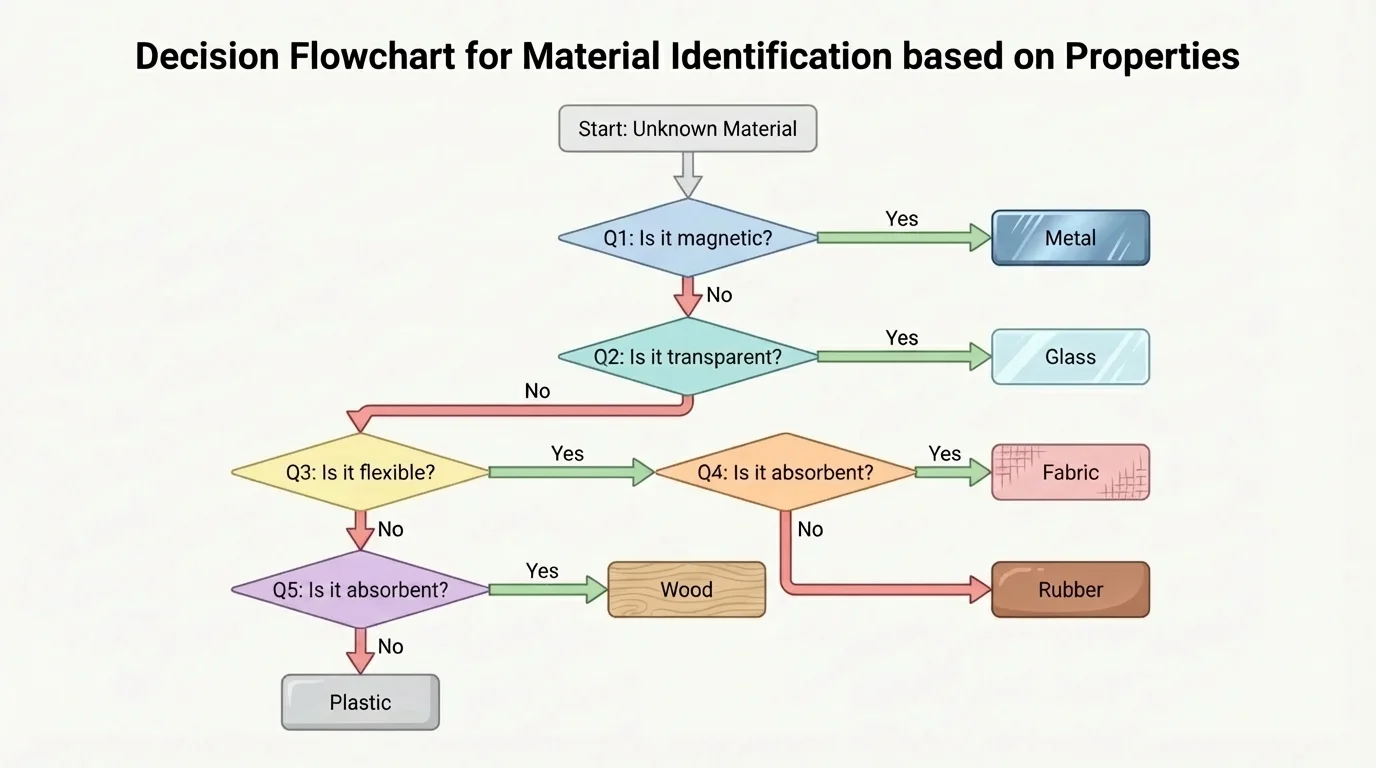
Because materials can share some properties, scientists combine evidence. A clear material might be glass or plastic. If it bends a little without breaking, that points more toward plastic. If it is very hard and breaks rather than bends, that points more toward glass. This kind of careful comparison is exactly what the process in [Figure 4] helps organize.
Why different materials have different properties
All matter is made of tiny particles too small to see, but those particles are arranged differently in different materials. That helps explain why a metal nail is hard, a rubber band stretches, and a paper towel absorbs water. Even though we cannot see the particles directly, we can infer what materials are like by observing their properties.
Sometimes changing the shape of an object does not change the material. A metal wire and a metal spoon can look very different but still share important properties, such as hardness and heat conductivity. Material identification focuses on the substance, not just the object's shape or use.
Not every object is made of just one material. A shoe may contain fabric, rubber, foam, plastic, and metal eyelets. A juice box may include paper, plastic, and a thin layer of metal. When an object has several materials, scientists may need to examine each part separately.
Coatings can also hide properties. A wooden toy covered in shiny paint may look smooth and bright, but underneath it is still wood. A metal pan may have a plastic handle so that it feels cooler and is safer to hold. Scientists must decide whether they are testing the outside surface or the whole object.
Mixtures can make identification harder because the material is not pure. Soil, for example, may contain tiny rocks, bits of dead plants, water, and air. When materials are mixed, the properties of the mixture may not match any one ingredient exactly.
Earlier science learning about solids, liquids, and gases helps here. Materials can often be identified best when you notice both their state of matter and their other properties, such as flexibility, transparency, or absorbency.
Engineers choose materials by matching properties to a job. A bicycle helmet needs materials that are light but protective. A window needs a material that is transparent and hard. A rain boot needs a material that does not absorb water. A kitchen potholder needs a material that does not transfer heat quickly to your hand.
Recycling centers also depend on material identification. Workers and machines sort paper, glass, plastic, and metals so that each material can be processed correctly. If the wrong materials get mixed together, recycling becomes harder and less effective.
Doctors, builders, clothing designers, and sports equipment designers all rely on material properties. A bandage should be soft and flexible. A bridge material should be strong and long-lasting. A soccer ball should be tough and somewhat waterproof. Science helps people choose wisely instead of guessing.
Real-world application: Choosing a material for a water bottle
A reusable water bottle should not absorb water, should be hard to break, and should be safe for everyday use.
Step 1: Rule out absorbent materials.
Paper and most fabrics are poor choices because they absorb water.
Step 2: Compare hard, waterproof materials.
Glass is waterproof, but it can break if dropped. Some plastics are waterproof and lighter. Metal is also waterproof and durable.
Step 3: Match the final choice to the need.
If lightweight is important, plastic may work well. If long-lasting strength is most important, metal may be a better choice.
The best material depends on which properties matter most for the job.
This is one of the most important ideas in physical science: materials are not inherently good or bad by themselves. A material is useful when its properties fit the purpose.
Some properties can be tested easily in an elementary classroom, while others require special equipment. Students can safely test texture, flexibility, magnetism, transparency, and absorbency with teacher guidance. More advanced tests, such as whether a material burns, melts at high temperatures, or conducts electricity in a circuit, require extra safety steps and adult supervision.
It is also important to know what this topic does not require. You do not need density to identify materials in this lesson, and you do not need to distinguish between mass and weight. Many useful identifications can be made from other observable and measurable properties.
Strong science depends on evidence, fair testing, clear recording, and careful thinking. When you observe closely and measure carefully, ordinary objects become clues. A spoon, a tile, a glove, or a bottle can all tell a story about the material they are made from.
