Have you ever looked up at the night sky and wondered, "If the Sun is a star, why does it look so much brighter than all the others?" That question leads to an important idea in astronomy. The answer is not that stars are unimportant or tiny dots with no real power. The reason is much simpler: the Sun is far, far closer to Earth than any other star.
Every day, the Sun lights up the sky, warms Earth, and makes daytime possible. At night, stars appear as small shining points. Some are easy to see, while others are faint. This difference can make it seem as if the Sun is completely different from stars, but scientists know that the Sun is a star.
So why does one star fill our sky with light while the others look like tiny specks? To answer that, we need to think about how light travels and how distance changes what we see. The farther away a light source is, the dimmer it usually appears to an observer.
Apparent brightness is how bright an object looks from Earth. It is about what our eyes detect, not just about the object itself.
Relative distance means how far one object is compared with another object. For example, the Sun is much closer to Earth than other stars are.
When we talk about the Sun and stars in this lesson, we are focusing on what we can support using distance. We are not trying to explain brightness by talking about a star's age, life stage, or other features. Our goal is to build a strong argument from a simple idea: closer stars look brighter to us.
Think about a lamp in your room. If you stand close to it, the light seems strong. If you walk to the other side of the room, the same lamp looks less intense. The lamp did not suddenly change. Your distance from it changed.
That same idea helps explain objects in space. A star can be very far away and still send light toward Earth, but by the time that light reaches us, the star may look faint. A closer star can appear much brighter because its light has less distance to travel before it reaches our eyes.
The Sun is special to us because it is the star closest to Earth. That closeness gives it a very high apparent brightness in our sky.
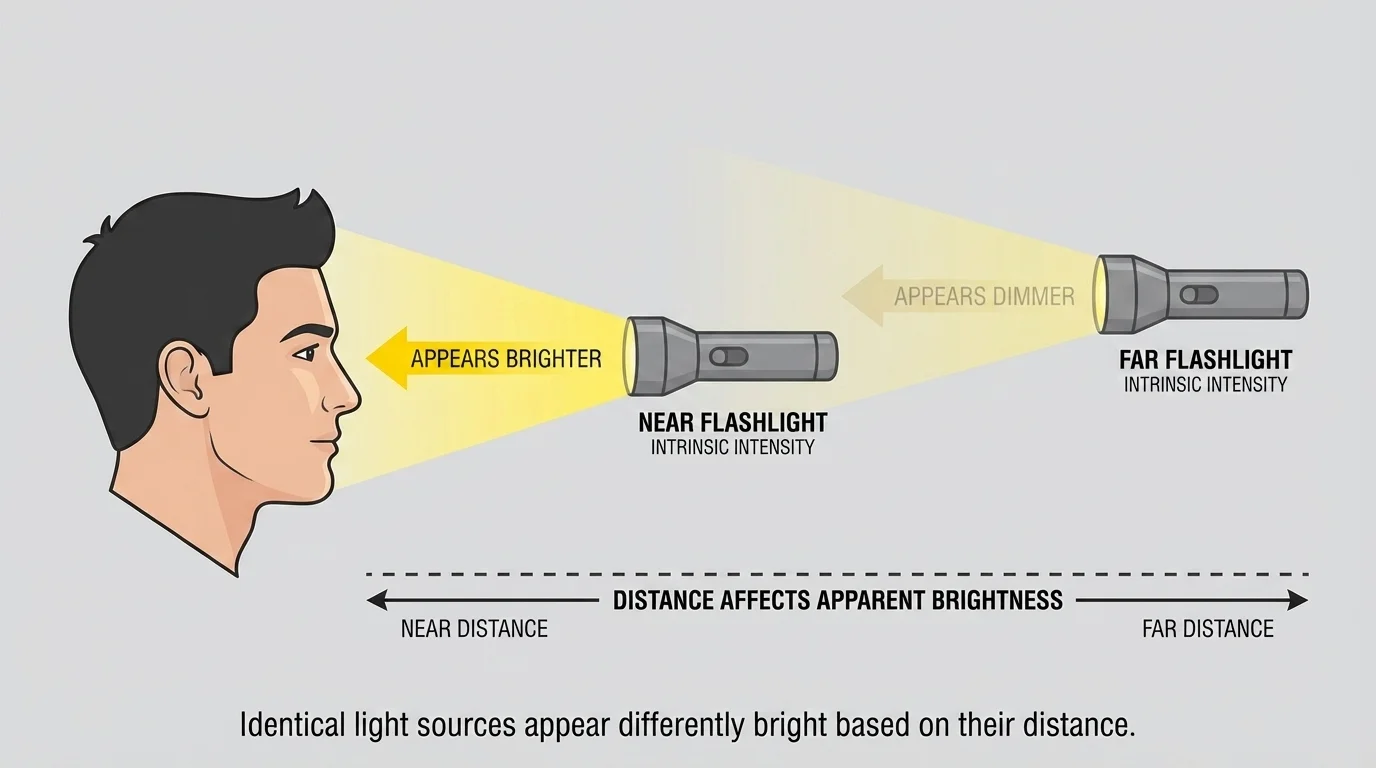
A simple everyday example helps us make sense of space. As [Figure 1] shows, if two identical flashlights shine toward you, the one that is closer looks brighter. If one flashlight is moved much farther away, it looks dimmer even though it is still the same flashlight.
This happens with streetlights too. A streetlight near you can seem bright enough to light the sidewalk clearly. Another streetlight farther down the road may look dim, even if both are built the same way. Your eyes are noticing a difference in distance.
Stars work in a similar way. If two stars send light into space, the one closer to Earth can appear brighter than the one farther away. This does not mean the farther star is unimportant. It means distance affects how bright the star looks from where we are.
Scientists often support ideas with patterns in observations. One clear pattern is this: lights nearby appear brighter, and lights far away appear dimmer. This pattern works in a bedroom, on a road, on a sports field, and in the night sky.
The nearest star to Earth is the Sun. After the Sun, the next nearest star is still so far away that its light takes years to reach us.
This is why we must be careful when we look at the sky. Our eyes tell us how bright something appears, but appearance is strongly affected by how far away it is.
The key argument is simple and powerful: the Sun appears much brighter than the stars we see at night because it is much closer to Earth. The Sun is part of our solar system, while the other stars are far beyond it.
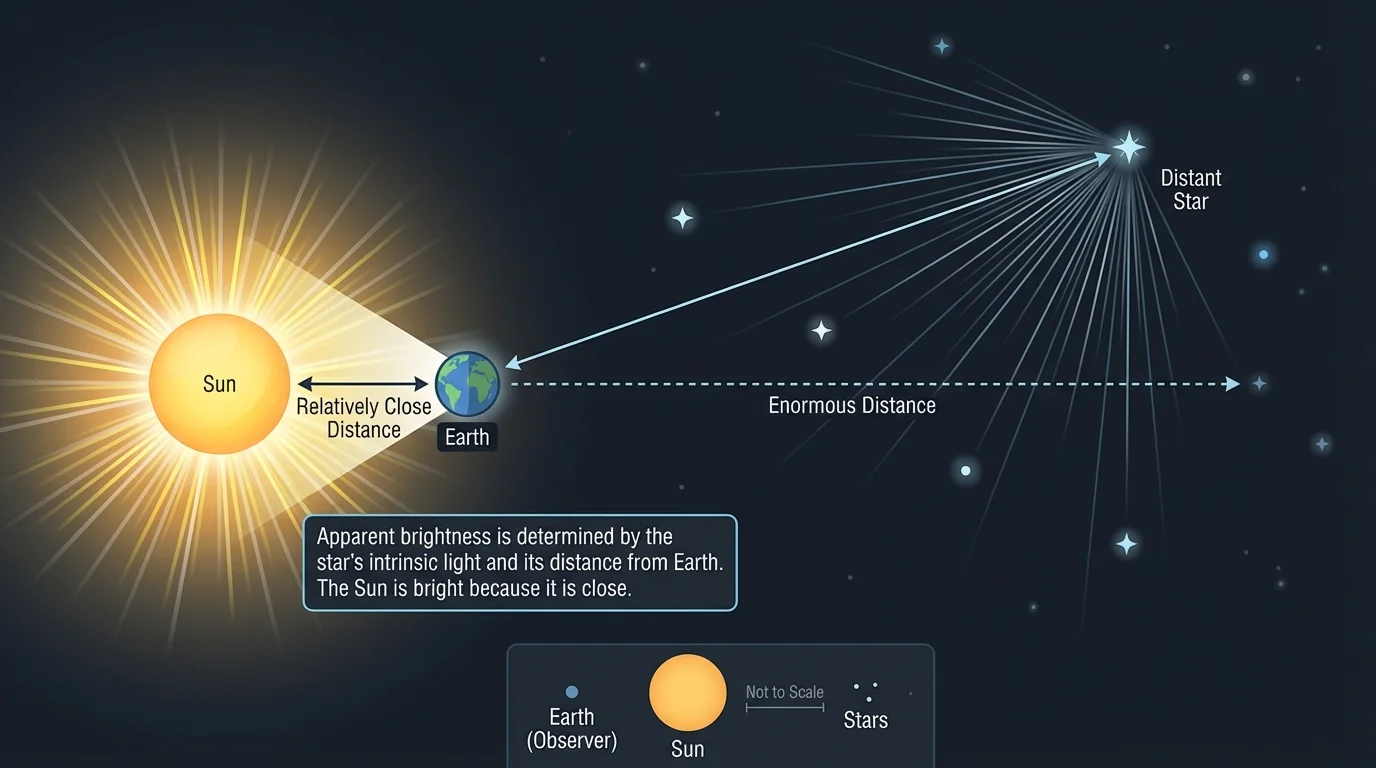
[Figure 2] Earth is about the average Earth–Sun distance from the Sun. Scientists call this distance about one astronomical unit, or astronomical unit. We can write that as about one unit for comparison. The nearest stars beyond the Sun are many thousands of times farther away than that.
This difference in distance is enormous. If one object is nearby and another is incredibly far away, the nearby one will usually look much brighter. That is why the Sun dominates our daytime sky.
At night, when the Sun is below the horizon for our location, we can see distant stars. They are still there in the daytime too, but the Sun's bright light fills the sky and makes the dimmer-looking stars hard to see.
The main idea is that apparent brightness depends strongly on how far away the light source is from the observer. Because Earth is much closer to the Sun than to any other star, the Sun appears brightest in our sky.
This does not mean every visible star is exactly the same. What matters for our argument is that relative distance alone gives a strong explanation for why the Sun looks so much brighter to people on Earth.
Space contains objects at very different distances from Earth. Looking at those distances helps us understand what we see. The Moon looks bright in our sky, the Sun looks much brighter, and stars usually look much fainter. One major reason is how far away each object is.
The table below compares these objects in a simple way.
| Object | Relative distance from Earth | How it usually appears in the sky |
|---|---|---|
| Moon | Very close compared with the Sun and stars | Large and bright |
| Sun | Farther than the Moon, but extremely close compared with other stars | Extremely bright |
| Other stars | Very, very far away | Small points of light, often faint |
Table 1. A simple comparison of how relative distance relates to how bright objects appear from Earth.
We can even use a tiny number example to think about this pattern. Suppose one light is at a distance of \(1\) unit and another identical light is at \(10\) units. The one at \(1\) unit will appear much brighter. If a third identical light is at \(100\) units, it will look dimmer still. The exact numbers are not the main point here. The important idea is that as distance increases, apparent brightness decreases.
As we saw with the Sun in [Figure 2], stars beyond our solar system are so distant that even though they are real suns in space, they usually look like tiny dots from Earth.
Scientists support explanations with evidence. One kind of evidence is direct observation. We observe that the Sun is the brightest object in our daytime sky. We also observe that stars look faint and distant in the night sky. These observations fit the explanation based on distance.
Another piece of evidence comes from using tools. Telescopes reveal many more stars than our eyes can see alone. This tells us that the night sky contains many stars that appear too dim for easy viewing. Their faint appearance matches the idea that they are very far away.
We also know that the Sun has a much stronger effect on Earth than the stars we see at night. It lights our days and helps warm the planet. That makes sense because the Sun is nearby compared with all other stars.
Light travels from a source to an observer. When the source is farther away, the same light source usually looks dimmer. This basic idea about light helps explain what we see in the sky.
If someone said, "The Sun is brighter than stars because it is not a star," that claim would not match scientific evidence. A better-supported claim is that the Sun is a star, and it appears much brighter mainly because it is much closer to Earth than the others.
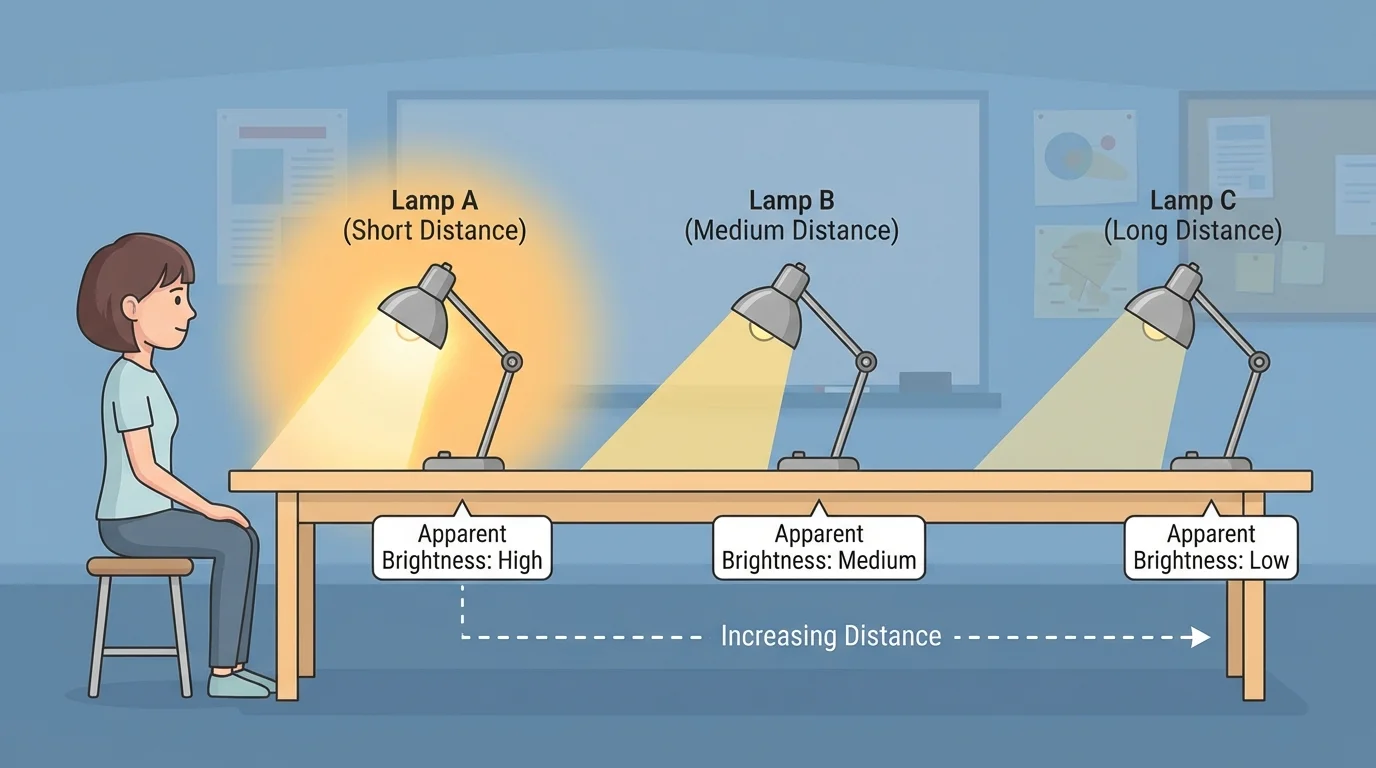
A model can help make this idea easier to picture. In [Figure 3], one observer faces three identical lamps placed at different distances. The closest lamp looks brightest, the middle lamp looks less bright, and the farthest lamp looks dimmest.
This model is useful because it keeps one thing the same and changes one thing: distance. When the lamps are identical, any difference in how bright they look can be explained by how far away they are from the observer.
Scientists often use models like this to test ideas. A model does not have to be huge or complicated. It just has to help us notice an important pattern clearly.
Using a model to support the argument
Step 1: Set up three identical lights.
Place one at \(1\) meter, one at \(3\) meters, and one at \(6\) meters from an observer.
Step 2: Observe how the lights look.
The light at \(1\) meter appears brightest. The light at \(3\) meters appears dimmer. The light at \(6\) meters appears dimmest.
Step 3: Build the argument.
Because the lights are the same, the best explanation for the difference in apparent brightness is distance.
This is similar to the Sun and stars: the Sun appears brightest because it is much closer to Earth.
That same reasoning connects back to the flashlight comparison in [Figure 1]. Whether we use flashlights, lamps, or stars, the pattern stays the same: closer light sources look brighter to the observer.
Understanding apparent brightness helps us understand Earth's place in the universe. The Sun may seem unique because of how bright it appears, but it is one star among many. What makes it stand out so strongly to us is its closeness.
This idea matters in astronomy because scientists cannot travel to most stars. They must learn from the light that reaches Earth. Looking carefully at how bright objects appear is one way to ask useful questions about space.
It also reminds us that our eyes do not tell the whole story by themselves. Things that look tiny or faint may actually be extremely far away, not unimportant. The stars in the night sky are excellent examples of that.
"The nearer light looks brighter to the observer."
— A key idea for understanding the Sun and stars
When you look up during the day and then again at night, you are seeing distance at work. The Sun's apparent brightness is strong because it is our nearest star. The stars of the night are much farther away, so they appear as dimmer points of light even though they are stars too.
