Every day, a single person may flip on lights, charge a phone, drink clean water, eat food shipped from far away, and throw away packaging at the end of the day. Now multiply that by millions, then by billions. The surprising part is that environmental impact is not only about how many people live on Earth. It is also about how much each person uses. A smaller population with very high resource use can sometimes have a larger effect than a larger population with lower resource use.
To understand human impact on the planet, scientists look at both population size and resource consumption. Population size tells us how many people need food, water, land, and energy. Resource consumption tells us how much each person uses. Together, these help explain why forests are cut, rivers are diverted, minerals are mined, and gases build up in the air.
When scientists study these changes, they do not stop at opinions. They build arguments supported by data. An argument in science is not a fight. It is a clear claim backed by evidence and reasoning. For this topic, a strong claim might be: As human population and per-capita resource use increase, the impacts on Earth's systems usually increase as well.
Population growth is an increase in the number of people living in an area or on Earth. Per-capita consumption means the average amount of resources each person uses. Earth's systems are the major interacting parts of the planet: the atmosphere, hydrosphere, geosphere, and biosphere.
These ideas matter in real life. Cities need more drinking water as they grow. Farms may use more land and fertilizer to feed more people. Factories and vehicles may burn more fossil fuels when demand for goods rises. At the same time, changes in technology or habits can reduce impact. For example, if homes use less electricity per person, total energy use may grow more slowly even when population grows. [Figure 1]
Earth is not made of separate parts that work alone. It is a connected system. The atmosphere is the layer of gases around Earth. The hydrosphere includes all water, such as oceans, rivers, lakes, groundwater, ice, and water vapor. The geosphere includes rocks, soil, landforms, and Earth's solid surface. The biosphere includes all living things.
When humans change one system, the effects often spread into the others. Cutting a forest changes the biosphere because plants and animals lose habitat. It also changes the geosphere because roots no longer hold soil in place. Rain can then wash more soil into streams, affecting the hydrosphere. If the forest is burned or replaced by activities that release more \(\textrm{CO}_2\), the atmosphere changes too.
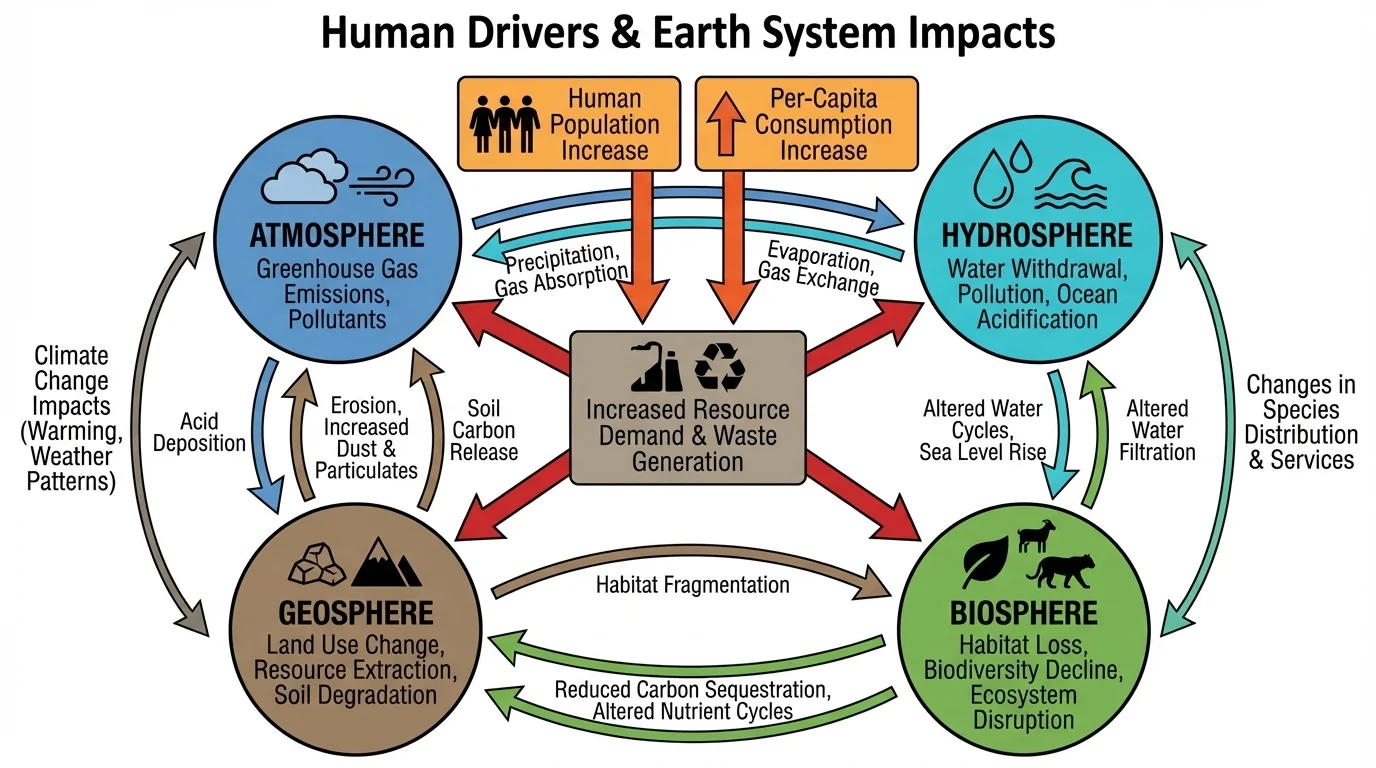
This is why scientists think in terms of systems. A change in one place can start a chain reaction. For example, pumping large amounts of groundwater for farming can lower the water table, reduce stream flow, stress wetlands, and affect plants and animals that depend on that water.
Living things depend on nonliving parts of the environment. Plants need sunlight, water, air, and soil nutrients. Animals depend on plants, other animals, water, shelter, and stable conditions. Changes to Earth's systems can therefore change ecosystems.
Understanding these links helps us build better arguments. Instead of saying, "People hurt nature," scientists ask, Which system changed? What caused the change? What evidence supports that idea? What effects followed? [Figure 2]
One useful way to think about human impact is to connect the number of people to the amount each person uses. In a simple form, total resource use can be estimated by multiplying population by per-capita consumption:
\[\textrm{Total resource use} = \textrm{population} \times \textrm{per-capita use}\]
For example, if a town of \(10{,}000\) people uses \(200\) liters of water per person each day, then total daily use is \(10{,}000 \times 200 = 2{,}000{,}000\) liters. If the population grows to \(12{,}000\) and per-person use stays the same, total use becomes \(12{,}000 \times 200 = 2{,}400{,}000\) liters. If population stays at \(10{,}000\) but per-person use rises to \(250\) liters, total use becomes \(10{,}000 \times 250 = 2{,}500{,}000\) liters. In both cases, impact grows.
This does not mean every person has the same effect on Earth. Per-capita consumption can be very different from one place to another. In some regions, people use much more electricity, meat, fuel, metal, paper, and plastic per person than in others. So when scientists compare impacts, they look at both population and lifestyle.
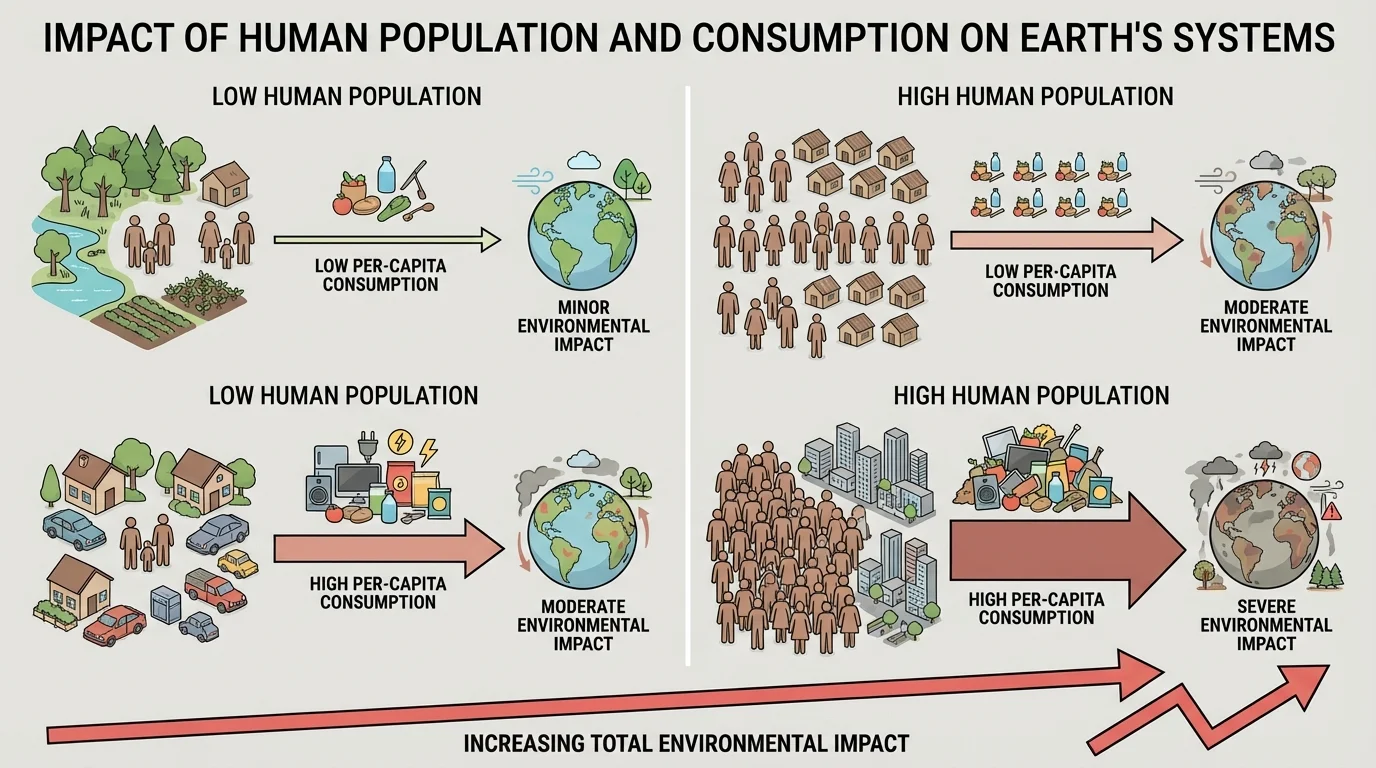
A community with efficient buildings, public transportation, and careful water use may place less stress on Earth's systems than a community of the same size that wastes energy and water. That is why the phrase per person is so important.
Some environmental problems grow because more people need resources, while others grow even faster because average use per person rises. A change in technology, income, or daily habits can change impact even if population stays the same.
When building an argument, students should avoid overly simple statements like "population alone causes environmental problems." A stronger scientific statement is that both increasing population and increasing resource use per person can increase total demand on Earth's systems.
Human activities affect Earth in many connected ways. Farming changes land cover. Mining removes materials from the geosphere. Building roads and cities covers soil with concrete and asphalt. Burning coal, oil, and natural gas adds gases to the atmosphere. Throwing away plastics and chemicals adds pollution to land and water.
These activities can cause direct and indirect effects. A direct effect is something immediate, like trees being removed for a new neighborhood. An indirect effect happens later or farther away, like increased flooding because there are fewer roots and less soil to absorb water. Both kinds of effects matter when using evidence.
Scientists often measure changes with data such as air temperature, \(\textrm{CO}_2\) concentration, water quality, species counts, forest cover, or soil loss. The more specific the evidence, the stronger the argument.
Human impact is not the same as human presence. People always interact with the environment, but the size of the impact depends on how much land, energy, water, and material are used, how waste is managed, and whether resources are replaced or conserved. Two communities with the same population can have very different effects on Earth's systems.
This is why engineers and scientists study better designs, such as drip irrigation, fuel-efficient transportation, recycling systems, and renewable energy. These do not remove all impact, but they can reduce it.
The atmosphere is strongly affected by energy use. When fossil fuels such as coal, oil, and natural gas are burned, they release carbon dioxide, written as \(\textrm{CO}_2\). Carbon dioxide is a greenhouse gas, which means it helps trap heat in Earth's atmosphere. Methane, written as \(\textrm{CH}_4\), is another greenhouse gas.
If more people use more electricity, vehicles, manufactured products, and air travel, fossil fuel use often increases unless cleaner energy sources replace it. This can raise the amount of greenhouse gases in the atmosphere. Scientists have measured atmospheric \(\textrm{CO}_2\) and found that it has increased greatly since the Industrial Revolution. Temperature records also show long-term warming.
A supported argument might say: Increasing human population and per-capita energy use contribute to climate change because more fossil fuels are burned, which raises atmospheric greenhouse gas levels and changes Earth's energy balance. The evidence for that claim includes measured \(\textrm{CO}_2\) concentrations, temperature data, and records of fossil fuel use.
Changes in the atmosphere can influence other systems. Warmer temperatures can melt ice, raise sea level, shift rainfall patterns, and increase stress on some organisms. Crops may struggle in heat waves, coral reefs may bleach in warmer water, and some species may move toward cooler regions if possible. [Figure 3]
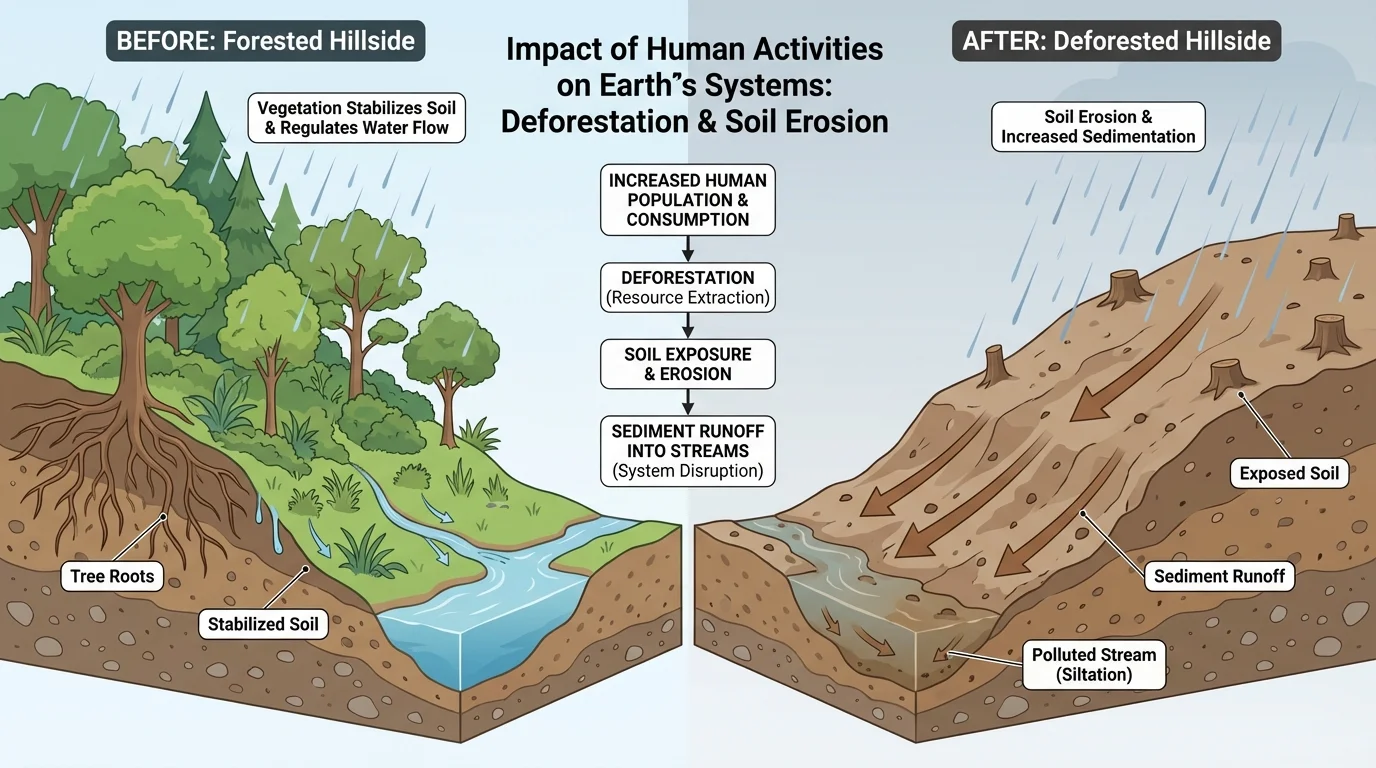
Changes to land and water are often easier to see directly. When forests are removed, the geosphere becomes more exposed. Tree roots normally hold soil in place. Without them, rain can wash soil away more easily. This process is called erosion.
Eroded soil can end up in rivers and lakes. This can make water cloudy, reduce light for aquatic plants, and carry fertilizers into waterways. When extra nutrients enter lakes or coastal waters, algae may grow quickly. After the algae die, decomposers use oxygen while breaking them down. Low oxygen can kill fish and other organisms. This process is called eutrophication.
Water use also matters. As population grows, communities often withdraw more freshwater for drinking, farming, and industry. If water is taken from rivers or aquifers faster than it is naturally replaced, water levels can fall. Wetlands may shrink, stream habitats may disappear, and conflicts over water may increase.
| Human activity | Earth system most directly affected | Possible wider effects |
|---|---|---|
| Burning fossil fuels | Atmosphere | Warming, changing climate, ocean changes |
| Deforestation | Biosphere and geosphere | Habitat loss, erosion, increased runoff |
| Heavy water withdrawal | Hydrosphere | Lower river flow, wetland loss, species stress |
| Mining | Geosphere | Habitat damage, water pollution, waste rock |
| Urban growth | Geosphere and biosphere | Less permeable ground, flooding, fragmentation |
Table 1. Examples of how human activities affect one Earth system directly and others indirectly.
The same land-use change can affect different places in different ways. A dam may provide electricity and water storage for people, but it can also block fish migration and trap sediment that would normally move downstream. Scientific arguments should include these trade-offs rather than pretending one action has only one result.
Environmental change does not affect all organisms in exactly the same way. Some species are very sensitive to change. Others can tolerate it better. A frog that depends on clean freshwater may decline if a wetland is polluted or drained. A species that thrives in disturbed land, such as some weeds or pests, may spread.
This is why the biosphere can be changed in uneven ways. Human actions may reduce biodiversity, which is the variety of living things in an area or on Earth. But a few adaptable species may become more common at the same time. Seeing more pigeons, rats, or invasive plants in a city does not mean the ecosystem is healthy overall.
Habitat fragmentation is another major effect. This happens when large natural areas are broken into smaller pieces by roads, neighborhoods, farms, or other development. Smaller habitat patches may not provide enough space, food, or mates for some species. As a result, populations can shrink even if a few patches remain.
Case study: one change, many outcomes
A coastal marsh is partly drained to build homes and roads for a growing town.
Step 1: Identify the direct changes
Wetland area decreases, more pavement is added, and more freshwater is used by people.
Step 2: Trace effects through Earth's systems
The biosphere loses habitat for birds, fish, and insects. The geosphere is covered by roads and buildings. The hydrosphere changes because less water can soak into the ground and runoff increases. The atmosphere may be affected if construction and traffic increase emissions.
Step 3: Evaluate which organisms are affected differently
Wetland specialists may decline, while some city-adapted species may increase.
This kind of analysis helps turn observations into a scientific argument.
When we connect evidence to living things, we can explain why one environmental change may damage some species, leave others mostly unchanged, and even benefit a few. That makes the argument more accurate. [Figure 4]
Scientists often organize arguments using the pattern claim, evidence, reasoning. A claim answers a question. Evidence is the data or observations that support the claim. Reasoning explains why the evidence supports the claim using scientific ideas.
Suppose a city grows quickly over \(20\) years. During that time, water use rises, a nearby river's dry-season flow drops, and fish populations decline. A strong argument does not just list these facts. It links them: more people and higher per-person water use increase withdrawals, which leaves less water in the river during dry months, reducing habitat for fish.
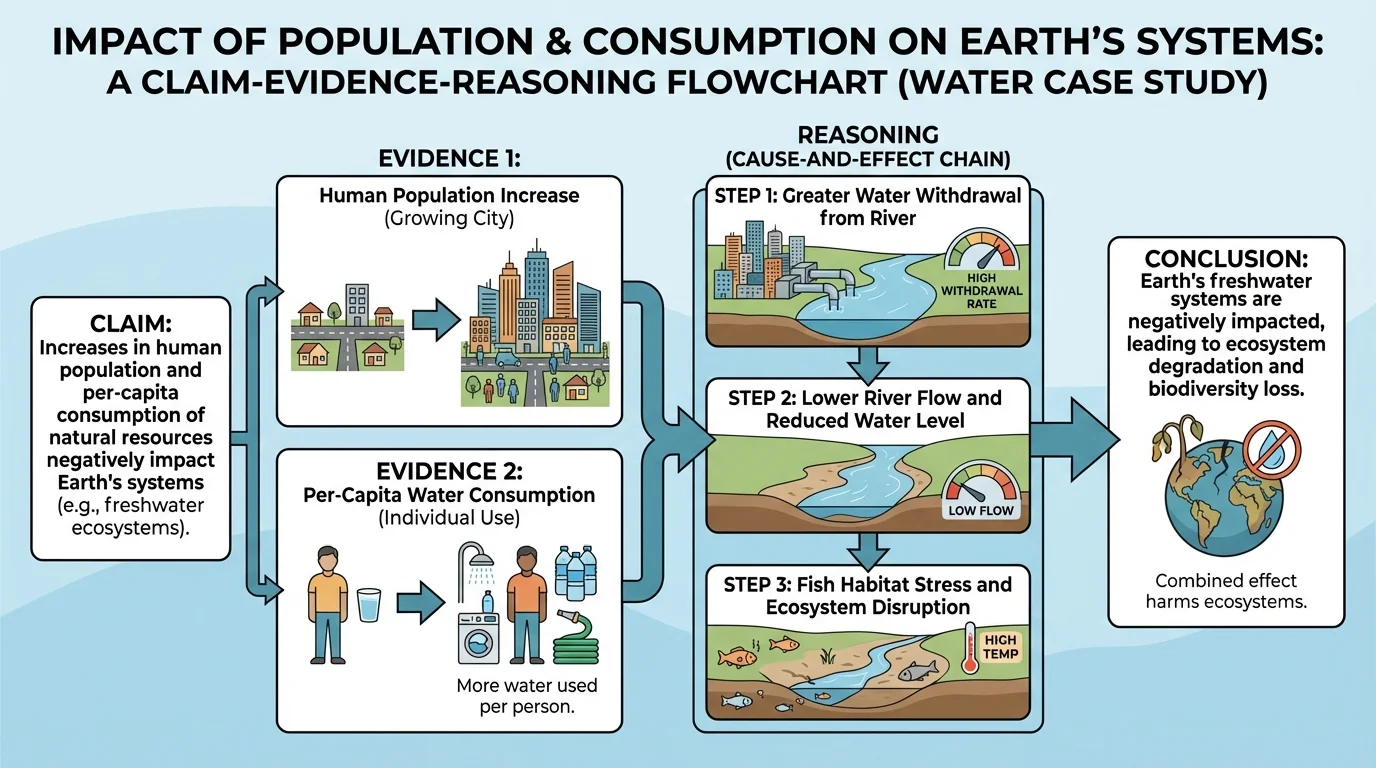
Here is a model scientific argument: Increases in human population and per-capita water use can harm river ecosystems. Evidence: the city population grew, average daily water use per person increased, total water withdrawal rose, and dry-season river flow decreased. Reasoning: because rivers and connected groundwater systems have limited water, increased human withdrawal leaves less water available for aquatic habitats.
Notice what makes this strong. It uses measurable evidence. It explains cause and effect. It connects human actions to specific changes in Earth's systems. It does not rely only on personal opinion.
Using numbers in an argument
A town's population grows from \(8{,}000\) to \(11{,}000\) people. Average electricity use per person changes from \(12\) kilowatt-hours per day to \(14\) kilowatt-hours per day.
Step 1: Find the original total use
Original total use is \(8{,}000 \times 12 = 96{,}000\) kilowatt-hours per day.
Step 2: Find the new total use
New total use is \(11{,}000 \times 14 = 154{,}000\) kilowatt-hours per day.
Step 3: Compare the change
The increase is \(154{,}000 - 96{,}000 = 58{,}000\) kilowatt-hours per day.
This evidence supports the claim that both population growth and higher per-capita consumption increase total demand on energy systems.
Later, when discussing land or water impacts, we can return to the logic shown in [Figure 4]: claim, evidence, and reasoning work together. Without reasoning, evidence is just a list. Without evidence, a claim is just an opinion.
If both population and per-capita consumption matter, then solutions can focus on both. Communities can plan for growth by protecting water sources, preserving habitats, and designing efficient transportation. People can reduce per-person use by conserving energy and water, reusing materials, and wasting less food.
Technology can also help. Solar and wind power can reduce greenhouse gas emissions compared with fossil fuels. Efficient irrigation can help farmers use less water. Better insulation and appliances can lower energy use in homes. Recycling metals and paper can reduce mining and deforestation pressure.
However, most solutions involve trade-offs. Solar farms need land. Wind turbines can affect birds and bats if poorly placed. Hydroelectric dams provide electricity but may disrupt river ecosystems. A strong argument recognizes these trade-offs and compares evidence carefully instead of assuming every solution is perfect.
Lower impact does not always mean no impact. Sustainable choices aim to meet human needs while reducing damage to Earth's systems and protecting resources for the future. The goal is often to balance environmental health, human well-being, and economic needs.
Population trends are also complex. In some places, growth is fast; in others, it is slow. Education, healthcare, and access to resources can influence population patterns over time. Scientists and decision-makers study these patterns because planning ahead can reduce stress on Earth's systems.
When you construct an argument about population and resource use, think like a scientist. Ask what changed, which Earth systems were affected, and what evidence supports the connection. A forest cut down for housing, a river with lower flow, rising atmospheric \(\textrm{CO}_2\), or a shrinking wetland can all be part of the evidence.
The big idea is not simply that "more people are bad." The stronger and more accurate idea is that increasing human population and increasing per-capita consumption often increase total demand on Earth's systems. Those demands can alter the atmosphere, hydrosphere, geosphere, and biosphere. The effects can damage ecosystems, but they can also be reduced through better choices, smarter engineering, and careful planning.
As we saw earlier in [Figure 1], Earth's systems are connected. That means solutions can create positive chain reactions too. Protecting forests can store carbon, reduce erosion, improve water quality, and preserve habitat all at once.
