A fallen leaf might seem unimportant, but in an ecosystem it can become part of a major pathway for matter transfer. That leaf can be eaten by an insect, broken down by fungi, mixed into soil, taken up by a plant root, and eventually become part of a bird, a fox, or even the air as \(CO_2\). In ecosystems, matter is continually reused. Food webs help us see those hidden connections.
An ecosystem is a community of living things interacting with each other and with nonliving parts of their environment, such as air, water, sunlight, and soil. A food web shows many connected feeding relationships in an ecosystem, as [Figure 1] illustrates. Unlike a simple path, a food web shows that most organisms have more than one food source and more than one predator.
A food chain is a single pathway, such as \(\textrm{grass} \to \textrm{grasshopper} \to \textrm{frog} \to \textrm{snake}\). That can be useful, but real ecosystems are more complex. A frog may eat several kinds of insects, and a snake may eat frogs, mice, or small birds. When many food chains overlap, they form a food web.
Food webs are important because they help us trace two big ideas at the same time: energy transfer and matter cycling. Energy enters most ecosystems from sunlight. Matter, however, is not used once and gone forever. The atoms in water, air, soil, and living things move again and again between organisms and the environment.
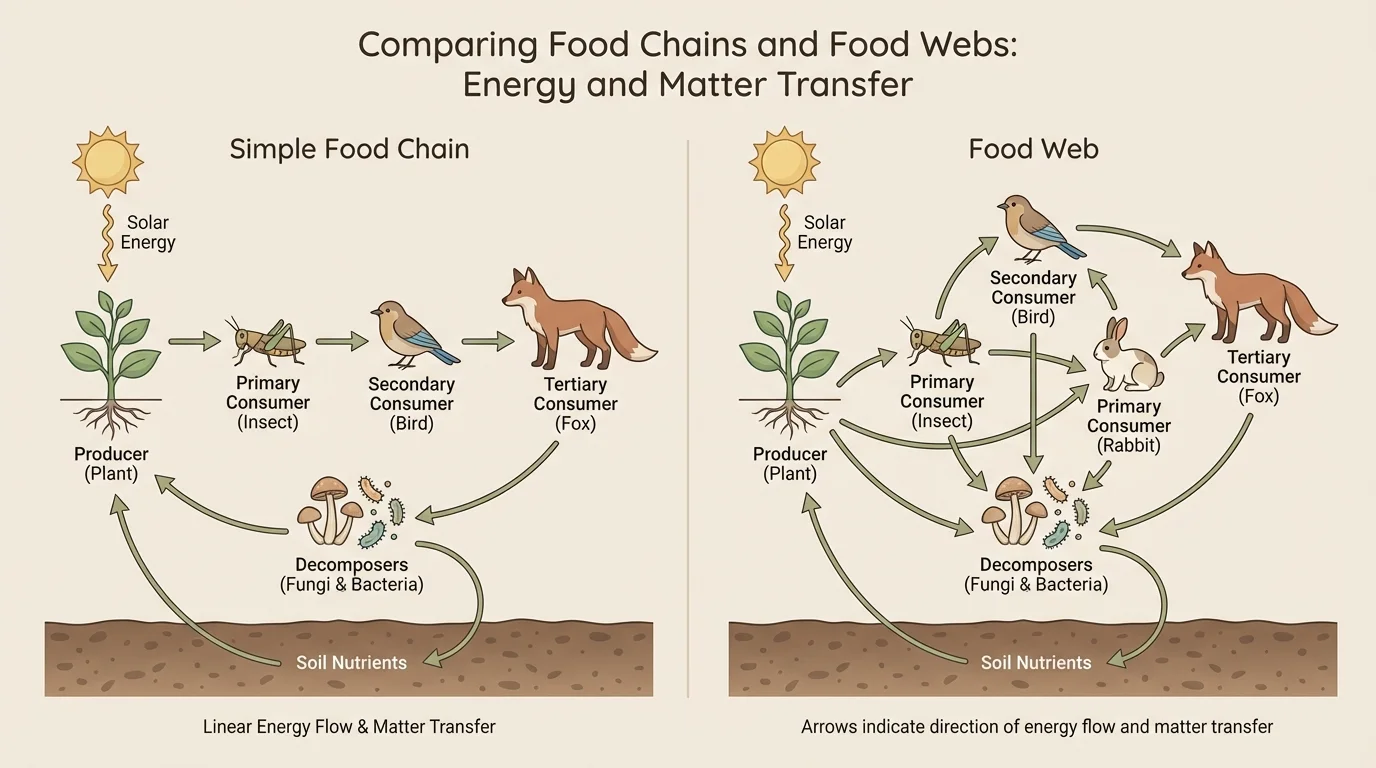
A producer makes its own food, usually by photosynthesis.
A consumer gets energy and matter by eating other organisms.
A decomposer breaks down dead organisms and wastes, returning nutrients to the environment.
These three groups are the main players in every food web. They do different jobs, but each one is necessary. Without producers, little energy would enter the web. Without consumers, feeding relationships would be much simpler. Without decomposers, dead matter would pile up and nutrients would not be returned efficiently to the environment.
In a food web, producers, consumers, and decomposers all interact. Producers include green plants, algae, and some bacteria. They use sunlight, water \(H_2O\), and carbon dioxide \(CO_2\) to make sugars such as \(C_6H_{12}O_6\) through photosynthesis.
Consumers cannot make their own food in this way. Herbivores eat producers, carnivores eat other animals, and omnivores eat both plants and animals. A rabbit is an herbivore. A hawk is a carnivore. A raccoon is an omnivore.
Decomposers such as fungi and bacteria feed on dead plants, dead animals, and wastes. They break large materials into smaller substances. These substances include nutrients that move back into soil or water, where producers can use them again. Some animals, like earthworms and vultures, help break down dead matter too, although they are more accurately called detritivores or scavengers rather than true decomposers.
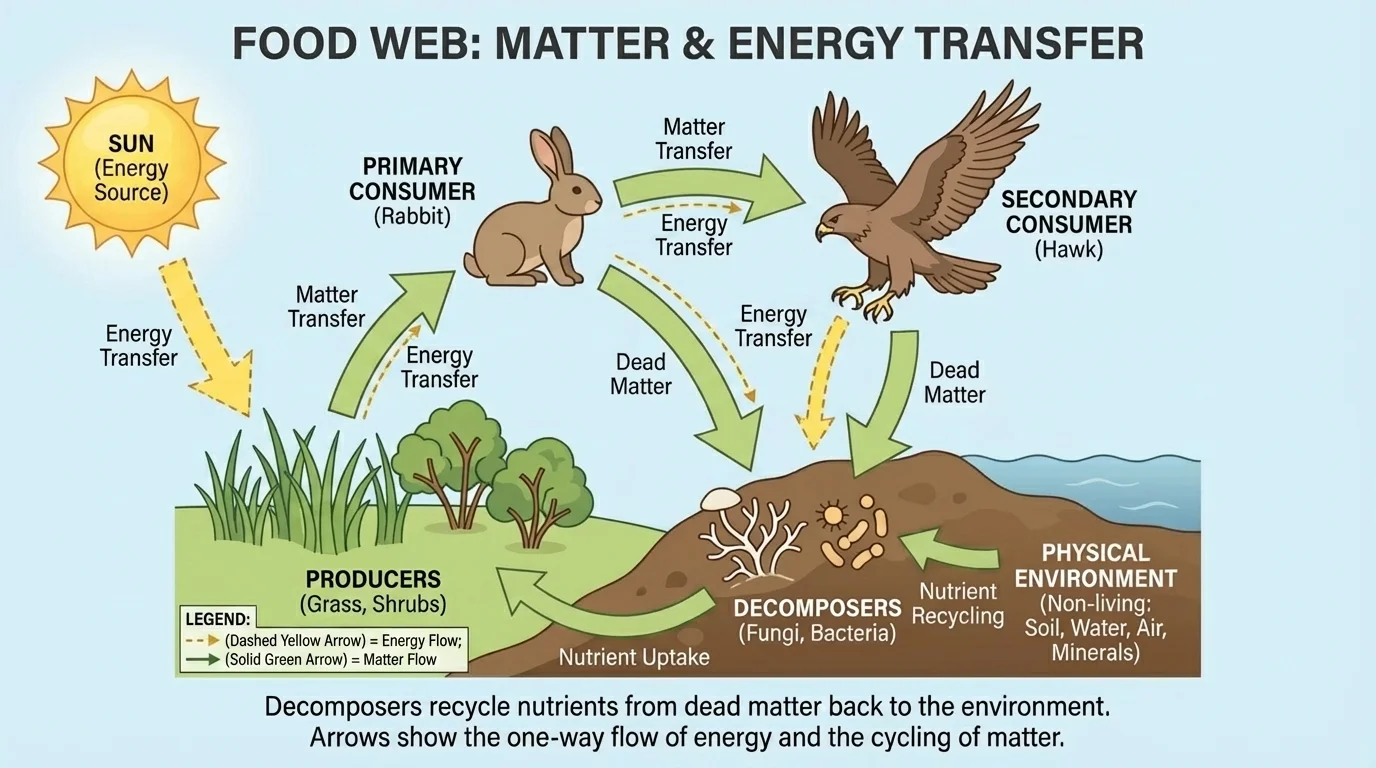
Think of an ecosystem like a giant recycling system with a one-way energy supply. New energy keeps entering, mostly from sunlight, but the matter inside the system keeps getting rearranged into new forms. That is why the same carbon atom might be part of a tree leaf one year and part of a fox's muscle later.
Energy transfer means energy moving from one organism to another when one organism is eaten. For example, sunlight is captured by grass. A grasshopper eats the grass. A bird eats the grasshopper. At each step, energy is transferred.
But energy does not cycle the same way matter does. Much of it is used by organisms for life processes such as movement, growth, repair, and keeping cells functioning. A large amount is also released as heat into the environment. This means that less usable energy is available at higher levels of the food web.
That is one reason ecosystems usually have many producers, fewer herbivores, and even fewer large predators. It takes a lot of grass to support a few rabbits, and a lot of rabbits to support a fox. Students sometimes think predators are the most important part of a food web because they are dramatic, but the web depends first on producers bringing in energy.
Energy moves, matter cycles
Energy usually enters from sunlight and then passes through producers to consumers and decomposers. Matter, by contrast, is reused. The atoms in living things move into air, soil, and water, then back into living things again. This difference is one of the most important ideas in ecology.
You can connect this idea to everyday life. Food gives your body energy, but your body also releases heat. At the same time, the atoms in your food become part of your muscles, skin, and bones, or leave your body as waste. Ecosystems work in a similar way on a larger scale.
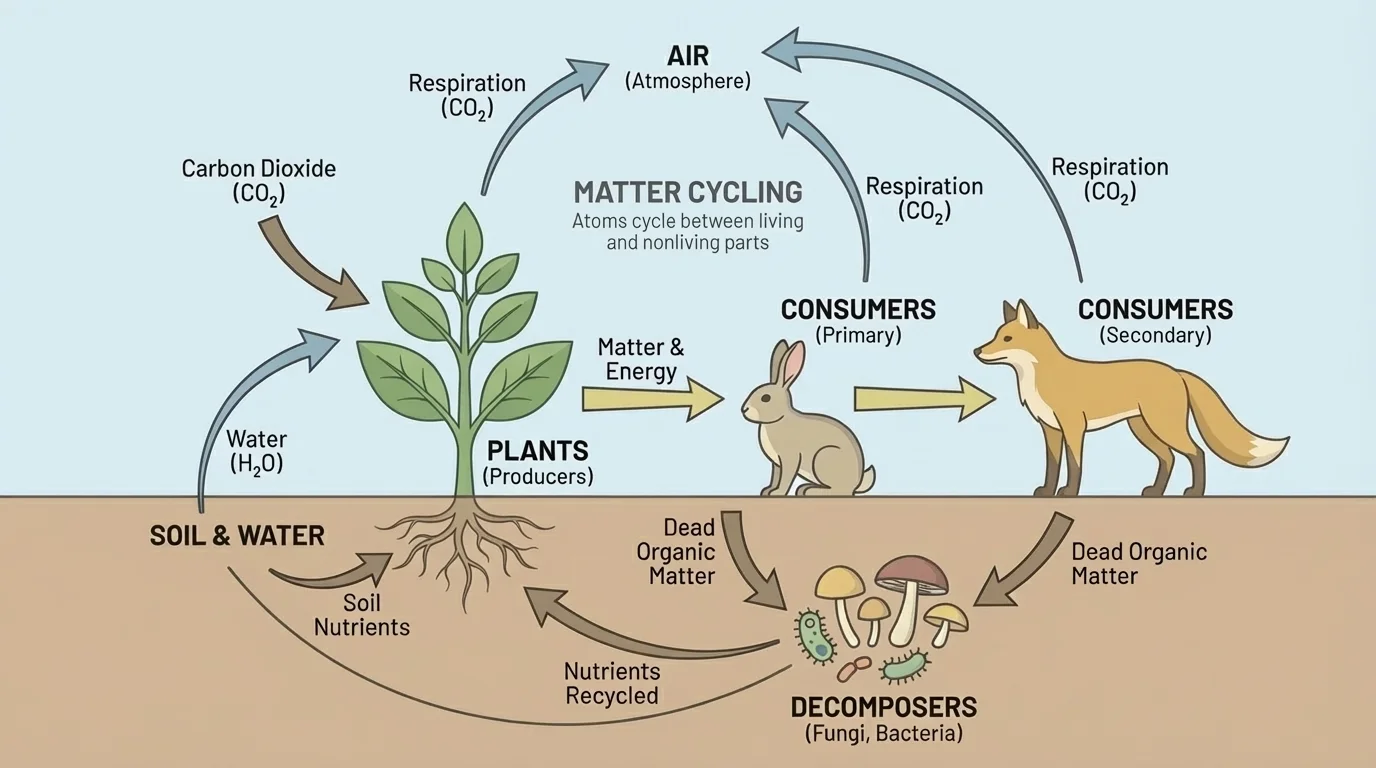
Matter cycling occurs through ecosystems between living organisms and the physical environment. The atoms that make up organisms do not disappear when organisms die. Instead, those atoms are transferred, rearranged, and used again.
For example, a plant takes in carbon dioxide \(CO_2\) from the air and water \(H_2O\) from the soil. Using sunlight, it makes sugars and other molecules. When a deer eats the plant, some of those atoms become part of the deer's body. When the deer breathes, it releases some carbon back into the air as \(CO_2\). When it produces waste or eventually dies, more matter returns to the environment.
Oxygen also moves through ecosystems. During photosynthesis, producers release oxygen \(O_2\). Animals and many other organisms use oxygen in cellular respiration and release carbon dioxide. Water moves through drinking, absorption, perspiration, waste, evaporation, and precipitation. Nutrients such as nitrogen, phosphorus, calcium, and potassium move through soil, water, organisms, wastes, and decomposing remains.
If you burn a log in a campfire, much of its matter does not vanish. Some becomes ash, some becomes gases in the air, and some heat energy is released. In ecosystems, decomposition is slower and more controlled, but the same idea remains true: atoms are conserved and move into new places.
Atoms are tiny particles that make up all matter. A living thing is built from atoms, and so are air, soil, and water. This is why the atoms in organisms can move back and forth between living and nonliving parts of an ecosystem.
This cycling explains why healthy soil and clean water matter so much. They are not separate from life; they are storage places and pathways for the same matter that organisms need in order to grow and survive.
When people hear the word "decomposer," they often think only of rot. But decomposition is one of the most valuable jobs in an ecosystem. Without it, nutrients would remain locked inside dead organisms and wastes.
Fungi can send thread-like structures into dead wood or fallen leaves. Bacteria can chemically break down tissues into simpler substances. As this happens, nutrients are released into the surrounding environment. In forests, nutrients return mainly to the soil. In lakes, ponds, rivers, and oceans, nutrients return mainly to the water or bottom sediments.
Nutrient recycling is the process by which decomposers return usable nutrients to the environment. Plant roots then absorb many of those nutrients from soil. Algae and aquatic plants absorb dissolved nutrients from water. New growth becomes possible because decomposers have finished the recycling step.
A single handful of healthy soil contains enormous numbers of decomposers, including bacteria and fungi too small to see without a microscope. Much of the recycling in ecosystems happens out of sight.
This is why composting works. Food scraps, dead leaves, and yard waste are broken down by decomposers. Over time, they become nutrient-rich compost that can be mixed into soil for gardens. Composting is a real-world example of nutrient cycling that people can observe directly.
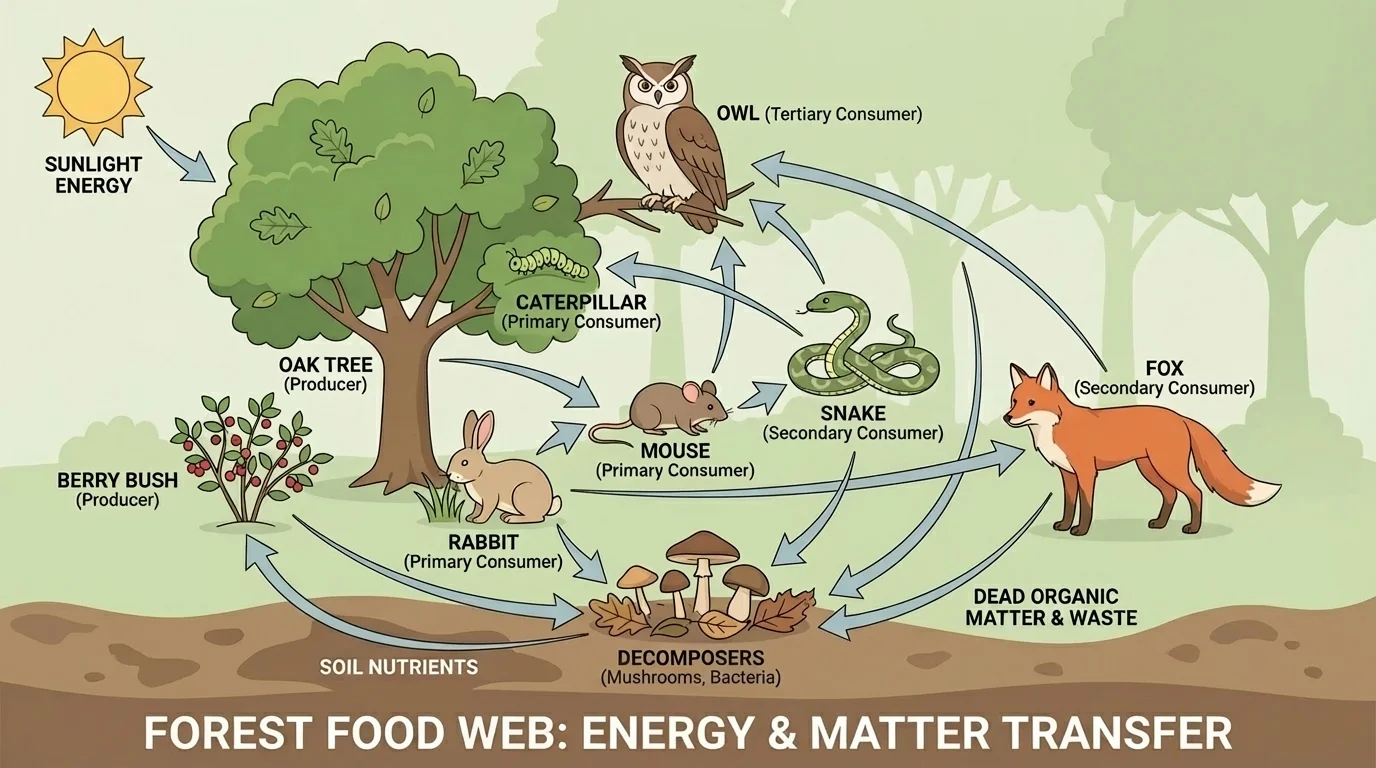
In a forest ecosystem, many feeding links overlap. Oak trees, grasses, berry bushes, and mosses are producers. Caterpillars, deer, rabbits, and mice are consumers that feed on plants or plant parts. Owls, foxes, snakes, and hawks feed on smaller consumers.
A caterpillar may eat leaves from an oak tree. A bird may eat the caterpillar. A hawk may eat the bird. Meanwhile, a mouse may eat seeds, and a snake may eat the mouse. A fox may eat rabbits, mice, insects, and even berries at times. One organism can belong to several food chains at once, which is exactly why a web is a better model than a single chain.
Leaves, twigs, dead insects, droppings, and animal bodies fall to the forest floor. There, fungi, bacteria, beetles, and worms break them down. Nutrients return to the soil and are absorbed again by roots. The forest floor is not a "trash pile"; it is a recycling center for matter.
Case study: tracing one carbon atom in a forest
Step 1: A producer takes in carbon from the air.
An oak leaf absorbs \(CO_2\) and uses it in photosynthesis.
Step 2: A consumer eats the producer.
A caterpillar eats part of the leaf, so some of that carbon becomes part of the caterpillar's body.
Step 3: Another consumer eats the first consumer.
A bird eats the caterpillar, and the carbon moves into the bird.
Step 4: Matter returns to the environment.
The bird releases some carbon by respiration as \(CO_2\), and when wastes or dead matter decompose, more carbon returns to soil and air.
This one atom can keep moving through the ecosystem many times.
The same forest web helps explain why removing one species can affect many others. If a disease kills many oak trees, caterpillars may lose food, birds may find fewer caterpillars, and hawks may eventually find fewer birds. Matter and energy still move, but the pathways change.
Aquatic ecosystems also connect living things with water and dissolved nutrients. In a pond, producers may include algae, duckweed, and other water plants. Primary consumers may include snails, tadpoles, zooplankton, and insect larvae. Larger consumers may include fish, frogs, turtles, and herons.
Suppose algae grow near the pond surface. Tiny zooplankton eat the algae. Small fish eat the zooplankton. A larger fish eats the small fish. A heron may eat the larger fish. At the same time, snails may scrape algae from rocks, and frogs may eat insects that began life in the water.
When organisms die or release wastes, decomposers in the mud and water break that material down. Nutrients dissolve into the water or settle into sediments. Aquatic plants and algae use those nutrients again, so the pond continues cycling matter just as a forest cycles matter through its soil.
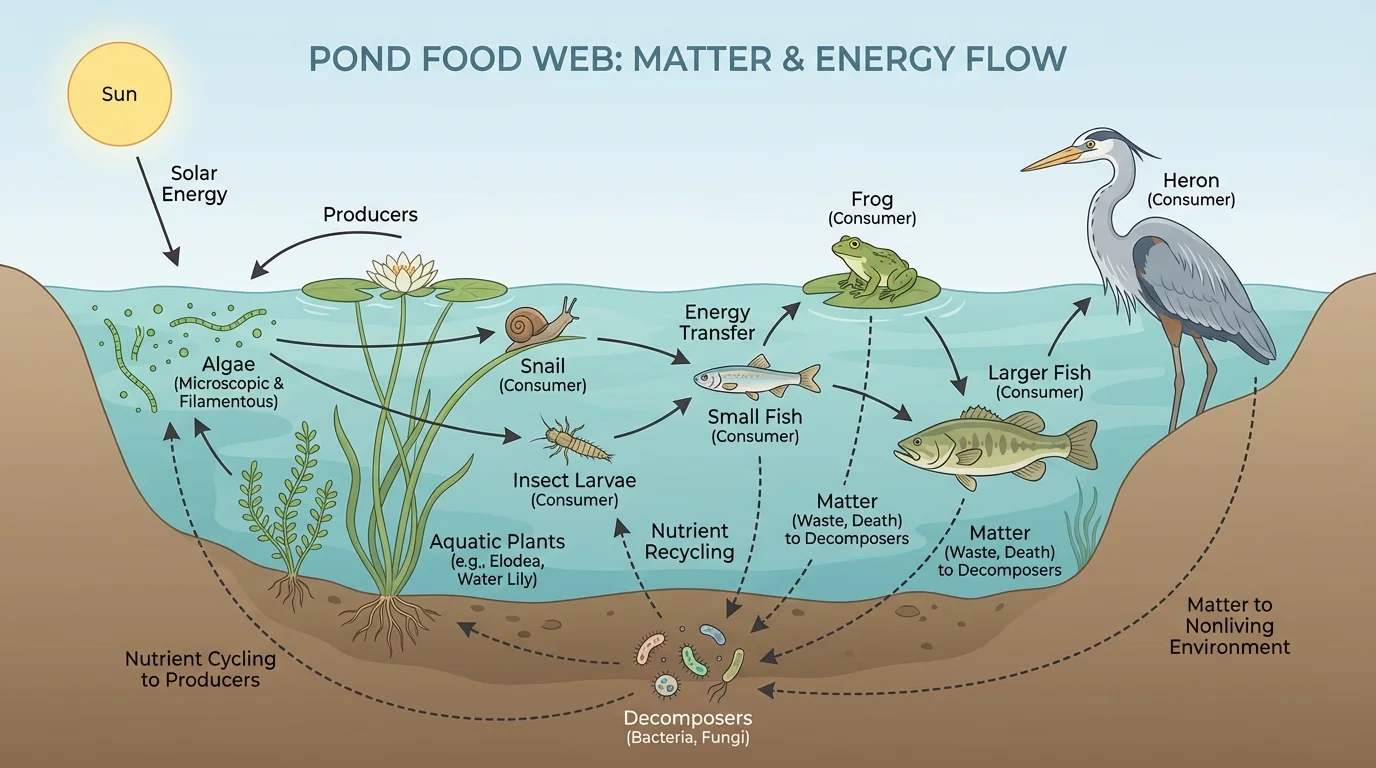
One important difference is where the recycled nutrients collect. In terrestrial ecosystems, many nutrients build up in soil. In aquatic ecosystems, many nutrients are dissolved in water or stored in bottom sediments. Even so, the same basic pattern remains: producers use available matter, consumers eat producers or other consumers, and decomposers return materials to the environment.
Real-world application: algal blooms
Step 1: Extra nutrients enter water.
Fertilizer washed from farms or lawns may add large amounts of nitrogen and phosphorus to a pond or lake.
Step 2: Producers grow rapidly.
Algae can multiply very quickly when nutrient levels rise.
Step 3: The food web is disrupted.
When many algae die, decomposers break them down and use large amounts of oxygen, which can make it hard for fish and other organisms to survive.
This shows that changes in nutrient cycling can strongly affect an entire ecosystem.
As in the forest example in [Figure 4], one species in a pond usually connects to many others. Food webs are networks, not straight lines.
Food webs are dynamic, meaning they can change over time. Seasons, drought, fire, disease, pollution, habitat destruction, and invasive species can all change the numbers of organisms in a web.
If insects decline in a forest, birds that eat insects may decline too. If wolves return to an area, deer numbers may drop, which can allow more young trees and shrubs to grow. If too many nutrients enter a pond, algae may increase so much that other parts of the web are harmed. A change in one population often spreads through the system.
This happens because organisms depend on both living and nonliving factors. A producer depends on sunlight, water, carbon dioxide, and nutrients. A consumer depends on food and habitat. A decomposer depends on dead material, moisture, and suitable conditions. Ecosystems stay healthier when these relationships remain balanced.
Interdependence in ecosystems
No organism lives completely alone. Every species depends on other organisms and on the physical environment. Food webs help us see that a change in one part of the system can affect many other parts, sometimes in ways that are not obvious at first.
The cycling of atoms also means that pollution can move through ecosystems. If harmful substances enter soil or water, they may be taken up by producers, passed to consumers, and returned again during decomposition. Understanding food webs helps scientists track both useful materials and dangerous ones.
Farmers use knowledge of food webs when protecting crops. They may encourage predators that eat crop pests instead of using only chemicals. Gardeners use compost to return nutrients to the soil. Fisheries scientists study aquatic food webs to prevent overfishing and protect breeding habitats.
Conservationists also rely on food webs. If a wetland is drained, the problem is not just the loss of one place. Producers, fish, amphibians, birds, insects, decomposers, water chemistry, and nutrient cycling can all be affected. Protecting an ecosystem means protecting the relationships within it.
Even your lunch connects to these ideas. The atoms in a sandwich may have once been in soil, rain, plant tissues, animal tissues, or the atmosphere. The energy in that food ultimately came from sunlight captured by producers. Matter is recycled; energy is transferred.
"In nature, nothing exists alone."
— Rachel Carson
That idea fits food webs perfectly. Every organism is part of a larger system of feeding, growth, decay, and recycling. Once you start seeing those links, a forest, pond, field, or schoolyard no longer looks like a collection of separate living things. It looks like a network built from energy flow and the endless cycling of matter.
