Flip a light switch, charge a phone, ride a bus, or wear a metal zipper, and you are connected to a huge global system of energy production and resource extraction. Electricity seems instant and invisible, but behind it may be a coal mine, a natural gas field, a uranium fuel rod, a dam, a wind farm, or a solar array built from mined silicon, copper, lithium, and rare earth elements. The central idea of this topic is simple but powerful: every way humans obtain energy and materials creates benefits, but every one also carries costs and risks.
Earth's systems and human systems are tightly connected. When people remove fuels, metals, water, or minerals from the Earth, they change land, water, air, ecosystems, economies, and even international politics. At the same time, these activities can improve lives by providing electricity, transportation, heat, fertilizer, jobs, and manufactured goods. The hard question is rarely, "Is this energy source good or bad?" A better question is, "Compared with what, for whom, over what time scale, and under what rules?"
Energy production is the process of converting energy stored in resources such as fuels, sunlight, wind, moving water, or atomic nuclei into useful forms like electricity, heat, or motion.
Resource extraction is the removal of natural materials from Earth systems, including mining, drilling, logging, quarrying, fishing, and pumping groundwater.
Tradeoff means gaining one benefit while accepting one or more costs, risks, or limits.
To understand energy choices, it helps to look at four major categories of impacts: economic, social, environmental, and geopolitical. These categories overlap. For example, a cheaper fuel may lower electricity prices, but if it creates air pollution, the health costs can shift from power companies to families and hospitals. A country that controls a key mineral supply may gain political influence, while importing countries become more vulnerable to disruption.
[Figure 1] shows that modern societies rely on several main energy pathways, each of which begins with a chain of decisions and physical processes. Fossil fuels such as coal, oil, and natural gas are extracted from underground and then burned to release chemical energy. Nuclear fission uses uranium fuel in reactors to release energy from atomic nuclei. Renewable systems include solar panels that convert sunlight directly into electricity, wind turbines that convert moving air into electrical power, and hydroelectric dams that use falling water.
Resource extraction is broader than energy alone. Copper is mined for wires, lithium and cobalt for batteries, iron ore for steel, sand for concrete and glass, and phosphorus for fertilizer. A solar panel does not release smoke while generating electricity, but it still depends on mined materials and factory production. A wind turbine does not burn fuel, yet it requires steel, concrete, fiberglass, and transmission lines. Even "clean" technologies depend on Earth materials.
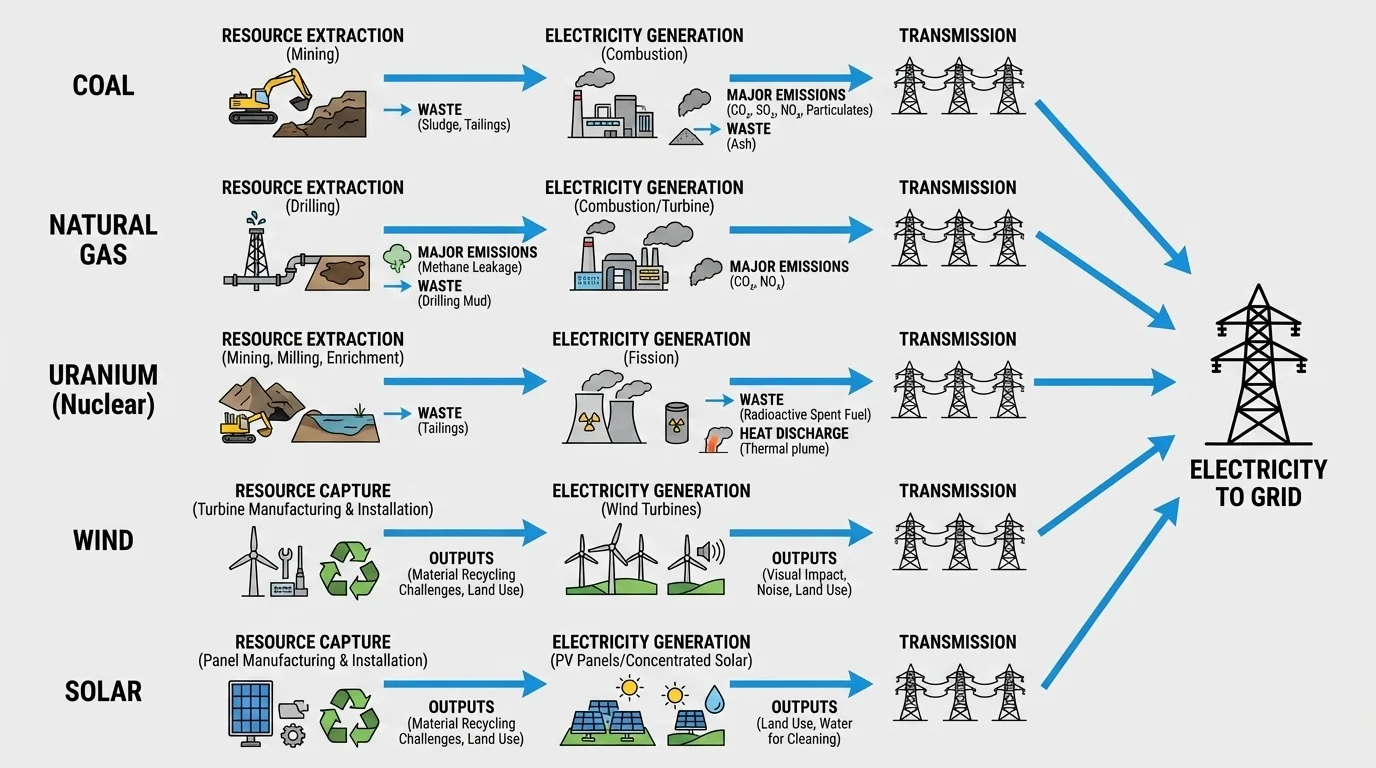
Different systems also produce energy in different ways. Burning fuels in a power plant often heats water into steam, which spins a turbine. In simple terms, chemical or nuclear energy becomes thermal energy, then mechanical energy, then electrical energy. For electrical power, the relationship is often described by the formula \[P = \frac{E}{t}\] where power is the rate of energy transfer. If a plant transfers energy of \(3.6 \times 10^9\) joules in \(1\) hour, and \(1\) hour is \(3,600\) seconds, then \(P = \dfrac{3.6 \times 10^9}{3,600} = 1.0 \times 10^6\) watts, or \(1\) megawatt. This helps show why very large facilities are needed to power cities.
Another key difference is whether energy can be stored easily. Coal, oil, natural gas, and uranium are concentrated resources that can be stored and transported. Sunlight and wind are flows rather than fuel stocks; they must be used when available or paired with storage and grid management. That is why energy systems are not just about generation. They also include storage, transmission, distribution, and demand patterns.
A single smartphone may contain materials linked to mining on multiple continents, including copper, gold, lithium, cobalt, nickel, and rare earth elements. Everyday technology depends on global extraction networks even when we do not see them.
Energy and extraction systems are therefore best understood as networks, not isolated machines. When one part changes, others change too. A rise in electric vehicles can reduce gasoline demand, but it can also increase demand for battery minerals and electricity generation. Solving one problem may shift pressure somewhere else unless the whole system is considered.
Energy production can create enormous economic benefits. Reliable electricity supports hospitals, schools, internet systems, refrigeration, manufacturing, and transportation. Extraction industries can provide jobs, tax revenue, export income, and infrastructure such as roads and ports. Regions with abundant resources often develop industries around them because local materials lower transport costs.
But the economic picture is more complicated than the market price of fuel or electricity. Building a power plant, mine, pipeline, refinery, dam, wind farm, or transmission line requires large infrastructure investment. Operating costs, maintenance, fuel supply, insurance, and decommissioning also matter. A coal plant may have moderate fuel costs but expensive pollution controls. A solar farm may have high upfront construction costs but low fuel costs afterward because sunlight is free.
Economists also pay attention to externalities, which are costs or benefits not fully included in the market price. For example, if burning coal produces fine-particle air pollution, a power company may not directly pay all the medical costs caused by asthma, heart disease, or missed workdays. In that case, the electricity appears cheaper than its full social cost. This is one reason energy debates often involve disagreement about what counts as "cheap."
Why market price is not the whole story
A low electricity price can hide damage to air, water, climate, or public health. A high upfront cost can hide long-term savings if a technology uses no fuel and little maintenance. To compare energy sources fairly, decision-makers often look at total life-cycle costs, including construction, fuel, operation, waste handling, cleanup, and health impacts.
Energy systems are often compared using the concept of energy return on investment. This means how much useful energy a system provides compared with the energy required to build, operate, and fuel it. A source that produces far more energy than it consumes is easier to scale for society. Historically, many conventional fossil fuel deposits had high energy returns, but as easy-to-reach deposits decline, extraction can become more expensive and energy-intensive.
Government policies also affect economics. Subsidies, tax credits, research funding, and public land leases can make one energy source more competitive than another. Regulations can raise costs in the short term by requiring cleaner equipment, safer mines, or stronger waste controls, but they may reduce larger long-term costs from disasters or disease.
Energy access is one of the most important social benefits of resource use. Electricity improves lighting, communication, medical care, food storage, and educational opportunities. Clean cooking fuels can reduce indoor smoke exposure. In many places, energy development brings roads, salaries, and public services to areas that previously had little infrastructure.
However, social costs can be severe. Coal miners have historically faced accidents, black lung disease, and long-term health risks. Oil and gas drilling can expose workers and nearby communities to explosions, chemical leaks, and water contamination. Large dams may provide electricity and flood control, but they can also displace entire communities, including Indigenous groups with deep cultural ties to their land. When benefits flow to cities while harms fall on rural communities, conflict often follows.
These unequal patterns are studied through the idea of environmental justice, which asks whether environmental harms and benefits are distributed fairly. Poorer neighborhoods and marginalized communities have often been located closer to refineries, highways, landfills, or power plants. This means social questions are not separate from environmental ones. Who gets the power, who gets the jobs, and who bears the risk are all part of the same system.
Case study: A hydroelectric dam
A large dam can seem like a straightforward source of low-carbon electricity, but its social impacts are mixed.
Step 1: Identify benefits
The dam may provide electricity, irrigation water, flood control, recreation, and jobs during construction and operation.
Step 2: Identify costs
The reservoir may flood farms, forests, and villages. Fish migration can be disrupted, and families may be forced to relocate.
Step 3: Compare who gains and who loses
Urban industries may receive most of the electricity, while local residents lose land and cultural sites. A fair analysis asks whether compensation, consent, and long-term support are adequate.
The same project can be beneficial at a national scale and harmful at a local scale.
Public trust matters as much as engineering. If companies hide spills, ignore local voices, or break promises about cleanup, resistance grows. Social acceptance can determine whether a project moves forward, no matter how profitable it looks on paper.
[Figure 2] Environmental impacts happen at every stage of an energy system: extraction, transport, processing, use, and waste disposal. Mining can remove vegetation, alter drainage, and produce toxic waste rock. Drilling can fragment habitats and risk oil spills or methane leaks.
Burning fossil fuels releases pollutants such as sulfur dioxide, nitrogen oxides, and particulate matter, as well as greenhouse gases including carbon dioxide \(\textrm{CO}_2\) and, in some cases, methane \(\textrm{CH}_4\). These gases affect Earth's atmosphere and climate. The basic idea of climate forcing is that more greenhouse gases trap more outgoing heat. While the full climate system is complex, the relationship is clear enough that rising concentrations of greenhouse gases increase the risk of long-term warming, sea-level rise, changing precipitation, and more extreme heat events.
Coal is especially important in this discussion because it produces large amounts of carbon dioxide per unit of electricity compared with many other sources. If one fuel emits \(900\) grams of \(\textrm{CO}_2\) per kilowatt-hour and another emits \(450\) grams per kilowatt-hour, then for \(1,000\) kilowatt-hours the first emits \(900,000\) grams and the second emits \(450,000\) grams. Since \(1,000\) grams equals \(1\) kilogram, these become \(900\) kilograms and \(450\) kilograms. That difference matters when scaled to millions of homes.
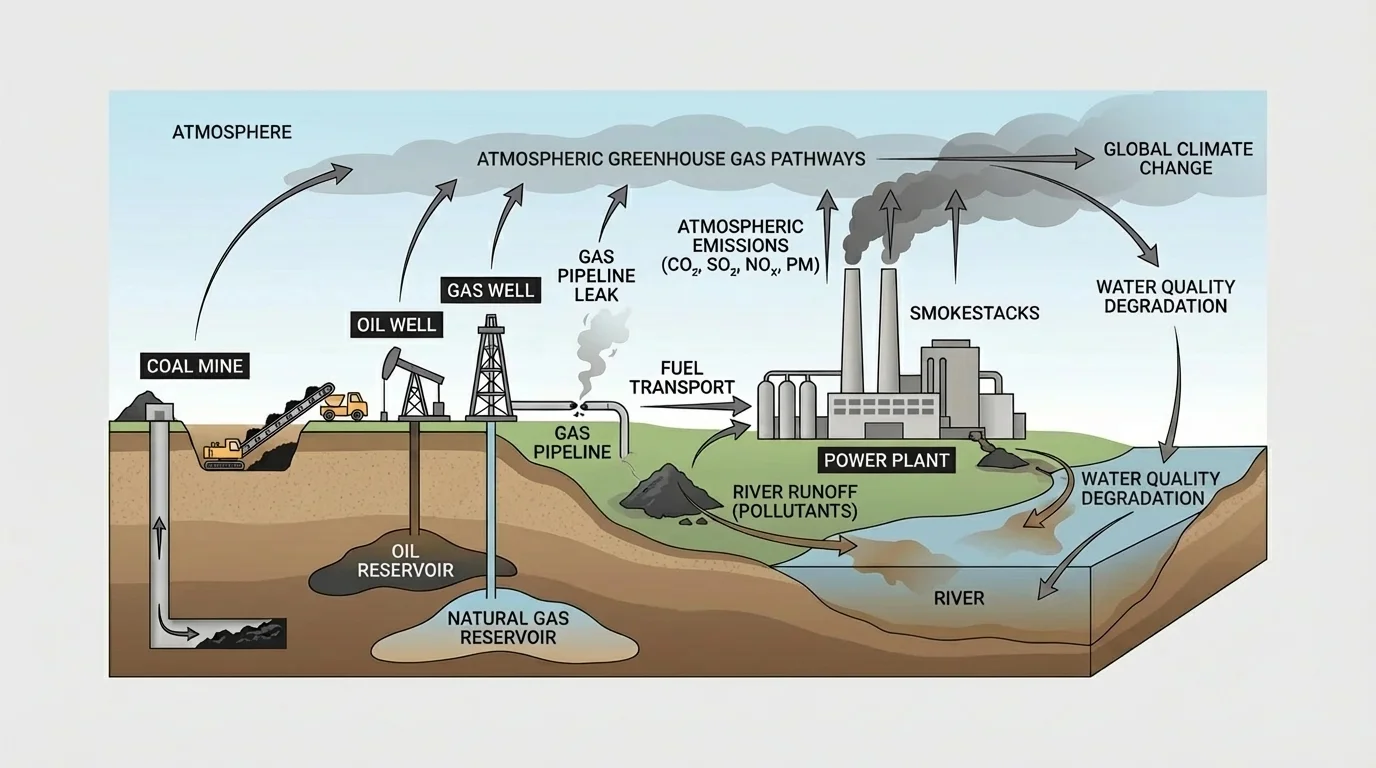
Not all environmental risks come from fossil fuels. Nuclear power produces very low direct \(\textrm{CO}_2\) emissions during operation, but it creates radioactive waste that must be isolated carefully for long periods. Hydroelectric dams can alter river ecosystems, trap sediment, and change water temperature. Wind farms can affect birds and bats if poorly placed. Solar farms require land and materials, though rooftop solar reduces land-use pressure. Biomass can be renewable if forests and soils are managed well, but it can also cause deforestation and air pollution if overused.
Water is another major issue. Thermal power plants often use large amounts of water for cooling. Mining and processing metals can contaminate rivers with acids or heavy metals such as lead, arsenic, or mercury. In dry regions, competition for water between energy production, farming, and households can become intense.
Earth's systems interact continuously. Changes in the geosphere, hydrosphere, atmosphere, and biosphere do not stay isolated. A mine changes land, but it can also alter stream chemistry, vegetation, animal habitats, and human health.
Life-cycle analysis helps compare technologies more fairly. A battery-powered car has no tailpipe emissions, but the full environmental impact depends on how the electricity is generated, how battery minerals are mined and processed, and how the battery is recycled or disposed of. This is why a simple label such as "clean" or "dirty" often hides important details.
Energy and resource systems do not exist only inside national borders. Geography influences power, dependence, and conflict through the uneven global distribution of fuels and critical minerals. Countries that export oil, gas, uranium, or metals may gain income and international influence. Countries that import them may become vulnerable to price shocks, embargoes, or supply disruptions.
Some risks come from concentration of supply, as [Figure 3] shows. If a large share of the world's cobalt comes from a small number of mines, or if much lithium refining is concentrated in a few countries, then manufacturing batteries and electronics depends on stable trade relationships. The same has long been true for oil and natural gas. Wars, sanctions, strikes, piracy, or accidents in key shipping routes can affect energy prices around the world within days.
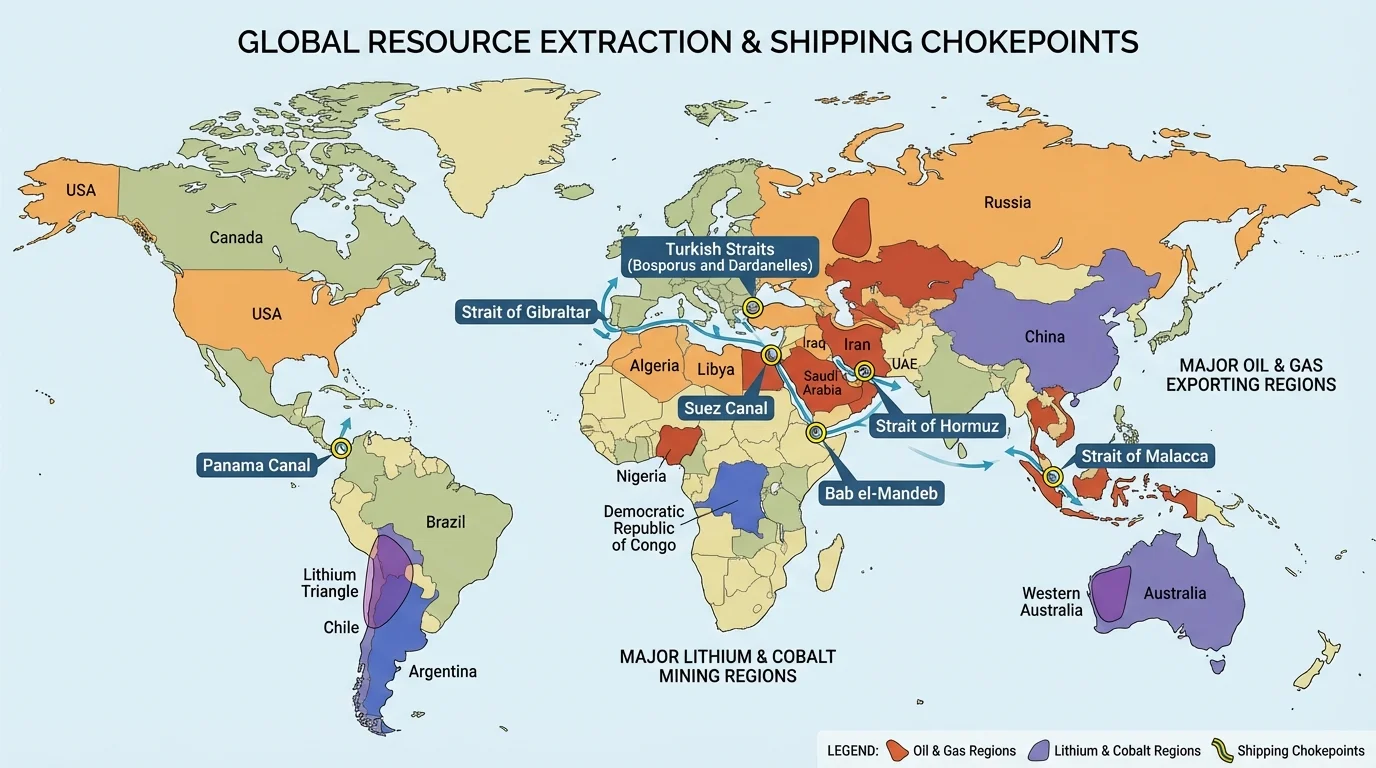
This helps explain why governments care about energy security, the ability to access reliable and affordable energy without severe disruption. A country may try to improve energy security by producing more energy domestically, diversifying imports, expanding storage, building transmission links, or developing alternative technologies. None of these strategies removes risk completely, but they can reduce dependence on any single source.
Geopolitics also shapes the renewable transition. Solar panels, batteries, and electric vehicles reduce dependence on oil in some sectors, but they can increase dependence on minerals such as lithium, nickel, cobalt, copper, and rare earth elements. This does not mean renewables are "just as bad" as fossil fuels; it means the pattern of dependence changes. As we saw earlier in [Figure 1], every energy system has a supply chain, and supply chains can become strategic.
The same ocean route can matter to both fossil fuels and clean-energy materials. Shipping delays in a major canal or strait can affect oil tankers, liquefied natural gas cargoes, and containers filled with batteries or solar components.
Political decisions can therefore change energy systems quickly. Sanctions can limit exports. Trade agreements can expand supply. Conflict can damage pipelines or power plants. International cooperation can stabilize markets, but competition for strategic resources can also intensify.
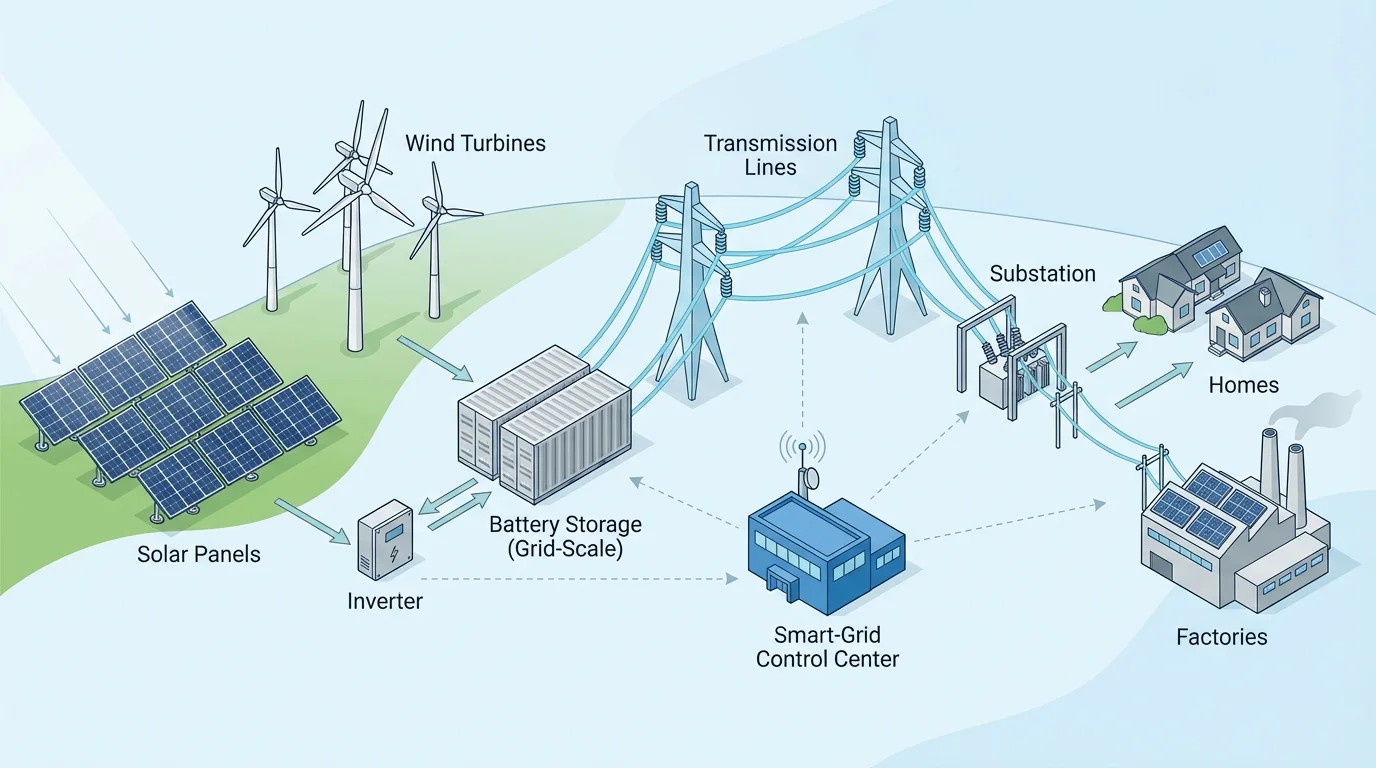
As [Figure 4] shows, technology can reduce some long-standing problems while creating new demands. For fossil fuels, improved methane monitoring can reduce leaks from natural gas systems. Carbon capture technologies aim to trap some \(\textrm{CO}_2\) from power plants or industrial facilities before it reaches the atmosphere. Advanced filters and scrubbers can reduce sulfur dioxide and particulates from smokestacks.
For renewables, better batteries, smarter transmission networks, and more accurate weather forecasting help balance variable energy sources such as solar and wind. If a battery stores electrical energy, the relationship \[E = P \times t\] can estimate capacity. For example, if a battery delivers \(50\) kilowatts for \(4\) hours, then \(E = 50 \times 4 = 200\) kilowatt-hours. That stored energy can help supply electricity after sunset or during a drop in wind speed.
New reactor designs may improve nuclear safety and reduce waste volumes. Direct lithium extraction methods may reduce some water impacts compared with older techniques, though they still require careful evaluation. Recycling technologies for batteries, metals, and electronics can lower demand for newly mined material. More efficient appliances and buildings reduce total energy demand, which may be one of the most effective ways to reduce impacts across the board.
Yet technology is not magic. Carbon capture can be expensive and does not eliminate all emissions. Batteries require mining and processing. Artificial intelligence can improve grid control but also increases electricity demand through data centers. A useful rule is this: technologies usually change tradeoffs; they rarely erase them.
Worked example: estimating avoided emissions
A town replaces a coal-based electricity source with a lower-emission source. Assume annual electricity use of \(20,000\) megawatt-hours. The coal source emits \(900\) kilograms of \(\textrm{CO}_2\) per megawatt-hour, and the replacement emits \(100\) kilograms per megawatt-hour.
Step 1: Find annual emissions from the coal source
\(20,000 \times 900 = 18,000,000\) kilograms of \(\textrm{CO}_2\)
Step 2: Find annual emissions from the replacement source
\(20,000 \times 100 = 2,000,000\) kilograms of \(\textrm{CO}_2\)
Step 3: Subtract to find avoided emissions
\(18,000,000 - 2,000,000 = 16,000,000\) kilograms of \(\textrm{CO}_2\)
The town avoids emitting 16,000,000 kilograms of carbon dioxide each year. This numerical comparison does not include mining, land use, or cost, but it shows why technology choices matter.
Research and innovation can therefore shift the balance of costs and benefits significantly. But whether that shift is fair, affordable, and fast enough depends on policy and public choices as much as on engineering.
Societies do not simply accept the raw impacts of energy systems. They create laws and rules to shape them. Air pollution standards can require cleaner fuels and better filters. Water protections can limit discharge from mines and refineries. Worker safety laws can reduce accidents. Zoning, permitting, and environmental review can influence where projects are built and what protections they must include.
Economic policies matter too. Carbon pricing tries to include climate damage in the cost of emissions. If a fee is set at \(\$40\) per metric ton of \(\textrm{CO}_2\), then a facility emitting \(10,000\) metric tons would owe \(\$400{,}000\). That changes incentives: cleaner technologies become more competitive, and wasteful systems become less attractive. Subsidies and tax credits can accelerate investment in renewables, storage, public transit, or efficiency upgrades.
Social regulations are not only government laws. They also include labor standards, corporate reporting rules, community consultation, and requirements for free, prior, and informed consent in some Indigenous contexts. Companies may be expected to restore land after mining, monitor groundwater, or publish supply-chain information about human rights risks. These rules can raise short-term costs but reduce abuse and long-term damage.
Why regulation can change technology choices
If pollution is free, firms may choose cheaper but dirtier methods. If pollution carries a cost or legal limit, cleaner technologies become more attractive. In this way, regulation does not just punish bad behavior; it can drive innovation by changing what is economically sensible.
International agreements also matter. Climate agreements influence national targets. Nuclear treaties shape safety and inspection systems. Trade rules affect tariffs on solar panels, batteries, oil, and metals. Because Earth's atmosphere and oceans cross borders, environmental problems often require cooperation beyond one country.
When real communities make energy decisions, they usually compare options rather than searching for a perfect source. A remote village may choose rooftop solar plus batteries because extending power lines is too expensive. A country with strong river systems may use hydropower. An industrial region needing constant high-output electricity may combine nuclear, natural gas, hydro, wind, solar, and storage. Geography, climate, wealth, and existing infrastructure all influence what is practical.
The comparison below shows why no major option is free of impact. The important question is how the pattern of impact differs and how technology and rules can improve outcomes.
| Energy source or activity | Main benefits | Main costs or risks | How technology or regulation can help |
|---|---|---|---|
| Coal | Reliable power, existing infrastructure, jobs in some regions | High \(\textrm{CO}_2\) emissions, air pollution, mining damage, health impacts | Scrubbers, stricter pollution rules, mine reclamation, phase-down policies |
| Oil and natural gas | Transportable fuels, flexible power generation, high energy density | Spills, methane leaks, \(\textrm{CO}_2\) emissions, geopolitical dependence | Leak detection, safety standards, efficiency, alternative fuels, carbon policies |
| Nuclear | High power output, low operational \(\textrm{CO}_2\) emissions, reliable generation | Radioactive waste, accident risk, high construction cost | Advanced reactor design, strict safety regulation, long-term waste storage |
| Hydropower | Low operational emissions, renewable electricity, flood control potential | Ecosystem disruption, displacement, sediment changes | Fish passages, careful siting, social compensation, dam management |
| Wind and solar | Low operational emissions, no fuel combustion, rapidly scalable in many places | Variability, land use, material demand, transmission needs | Storage, grid upgrades, recycling, better siting, forecasting |
| Mining for critical minerals | Supports batteries, electronics, and modern infrastructure | Water use, pollution, labor concerns, habitat loss | Recycling, labor standards, cleaner processing, traceable supply chains |
Consider two examples. Germany expanded wind and solar rapidly, reducing some emissions but also facing challenges with grid integration, backup power, and electricity pricing. Norway produces large amounts of hydropower and also exports oil and gas, showing that one country can benefit from low-carbon electricity while still being connected to fossil fuel markets. The Democratic Republic of the Congo supplies much of the world's cobalt, illustrating how clean-energy technologies can depend on mining regions far from the countries where batteries are used.
These examples show that energy systems are not only scientific systems; they are also economic and political systems. Choices that look efficient from one point of view may look unfair or risky from another.
The future of energy is unlikely to depend on a single source. Most countries will use a mix of technologies, resources, and regulations. The best combination will vary by location, but the same principle applies everywhere: benefits must be weighed against costs and risks across multiple dimensions, not just one.
As technology improves, some tradeoffs can become smaller. Batteries can smooth renewable power. Cleaner industrial processes can reduce pollution. Better monitoring can reveal leaks or illegal dumping quickly. Stronger recycling can reduce pressure on mining. Fairer labor and community rules can lower social harm. As shown earlier in [Figure 4], however, modern systems become more interconnected as they become more advanced, so careful planning matters even more.
A scientifically informed citizen should be able to ask strong questions: What are the full life-cycle impacts? Who benefits? Who bears the risks? What alternatives exist? How do new technologies or rules change the answer? Those questions help societies move beyond slogans and toward better decisions about Earth's resources.
